Chicken of the Woods Research
LSL hemolytic lectin identified
Laetiporus sulphureus produces lectins with structural homology to bacterial pore-forming toxins, providing a molecular explanation for the GI distress some people experience.
Tateno et al., J Biol Chem, 2003
35 kDa
lectin monomer molecular weight
1-3 hrs
typical reaction onset time
Conifer hosts
associated with more adverse reactions
Tateno et al., J Biol Chem, 2003
 View as image ↗
Chicken of the woods (Laetiporus sulphureus and related species) is one of the most popular wild-foraged edible mushrooms. It is also one of the most reliably documented to cause adverse reactions in a subset of consumers. Reports range from mild gastrointestinal upset (nausea, vomiting, diarrhea within 1-3 hours) to lip and facial swelling, dizziness, and disorientation. True anaphylaxis from Laetiporus has not been reported in the medical literature, but the mushroom allergy literature documents that fungal food reactions can escalate to anaphylaxis in mold-sensitized individuals.[5] For a broader overview of this species, see what is chicken of the woods? edibility and health research.
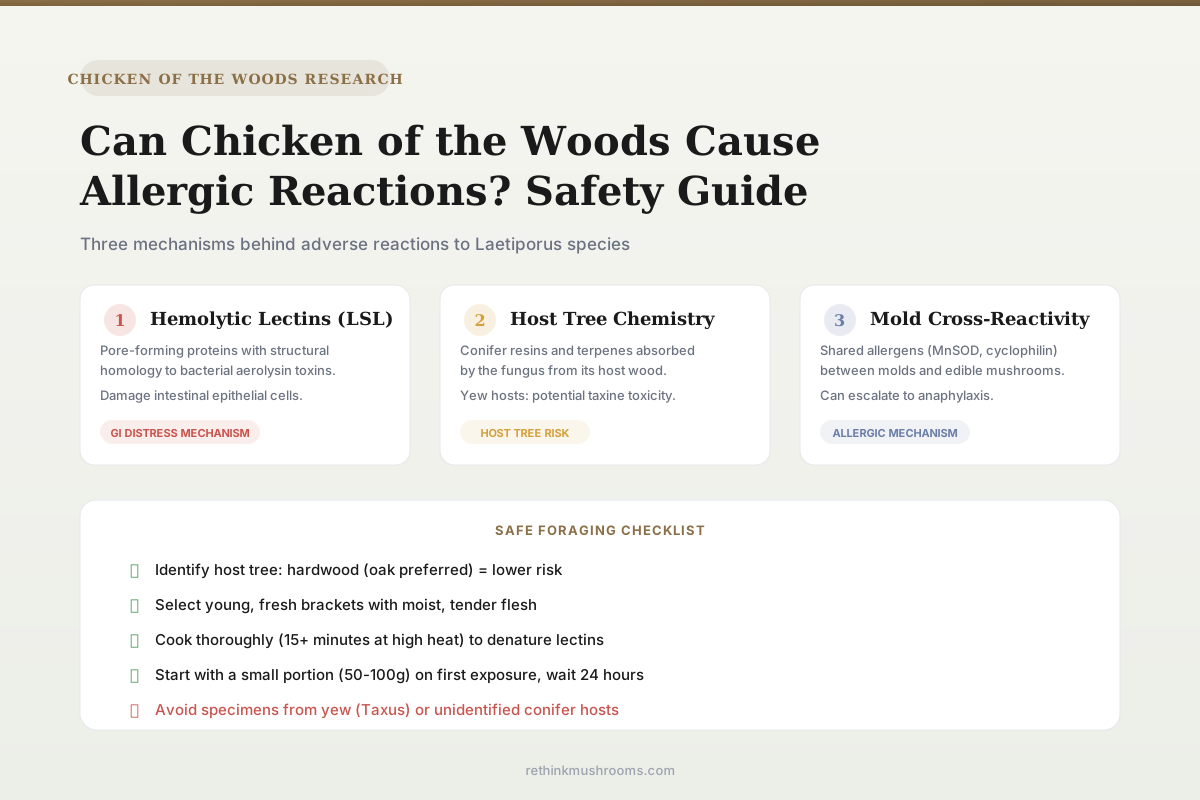
The causes of adverse reactions to chicken of the woods are not fully understood, but three mechanisms have been identified in the research literature: hemolytic lectins with structural similarity to bacterial toxins, host tree chemistry absorbed by the fungus, and allergic cross-reactivity between fungal proteins and airborne mold allergens. This article reviews the evidence for each mechanism and the practical factors that determine whether a given specimen is safe to eat.
Key Takeaways
- Laetiporus sulphureus produces a family of hemolytic lectins (LSL) with 80-90% sequence identity that share structural homology with bacterial pore-forming toxins from the aerolysin family (Tateno et al., 2003; Mancheno et al., 2010)
- The LSL lectin is a hexameric protein with a 35 kDa monomer containing two distinct modules: an N-terminal lectin domain and a C-terminal pore-forming domain that can damage cell membranes (Mancheno et al., 2010)
- People with mold allergies (Alternaria, Cladosporium, Aspergillus) can develop cross-reactive allergic responses to edible mushrooms, including oral allergy syndrome and anaphylaxis, through shared allergens like manganese-dependent superoxide dismutase (Xing et al., 2022)
- A mushroom allergy case series documented reactions including urticaria, angioedema, GI symptoms, and respiratory distress, with onset typically 30 minutes to 2 hours after ingestion (Kayode et al., 2020)
- Laetiporus species growing on coniferous trees (especially hemlock and yew) are associated with higher rates of adverse reactions than those growing on hardwoods like oak (Adamska et al., 2023)
- Laetiporus contains over 80 identified bioactive small molecules with antimicrobial, antioxidant, and anti-inflammatory properties alongside the potentially problematic lectins (Duan et al., 2022)
The Lectin Problem: Pore-Forming Toxins in an Edible Mushroom
Tateno et al. (2003) cloned and characterized a family of novel hemolytic lectins from L. sulphureus, designated LSL (Laetiporus sulphureus lectin). The lectins shared 80-90% sequence identity with each other and showed unexpected homology to bacterial pore-forming toxins, specifically the aerolysin family produced by pathogenic bacteria like Aeromonas hydrophila.[1]
This was a significant finding. Aerolysin-family toxins work by binding to target cell membranes, oligomerizing into ring-shaped structures, and inserting into the lipid bilayer to create pores that kill the cell through osmotic lysis. The structural similarity between LSL and aerolysin suggested that the mushroom lectins could employ the same pore-forming mechanism against human intestinal epithelial cells.
Mancheno et al. (2010) determined the crystal structure of LSLa (one member of the lectin family) and confirmed the structural homology. The protein forms hexamers, with each 35 kDa monomer consisting of two distinct functional modules: an N-terminal lectin domain that binds to lactose and N-acetyllactosamine residues on cell surfaces, and a C-terminal module that structurally resembles the pore-forming domain of aerolysin.[2]
The sugar-binding lectin domain targets the protein to cell surfaces; the pore-forming domain then creates membrane channels. This two-step mechanism (binding then pore insertion) is the same strategy used by bacterial toxins to damage host tissues. In the context of the human GI tract, LSL could bind to epithelial cell surface sugars and create membrane pores, triggering the inflammatory and secretory responses that manifest as nausea, vomiting, and diarrhea.
The critical question is whether cooking destroys LSL activity. Many mushroom lectins are heat-labile and denatured by thorough cooking. Field reports consistently note that well-cooked chicken of the woods causes fewer reactions than undercooked specimens. However, no published study has specifically measured LSL activity retention across different cooking temperatures and durations. The "cook thoroughly" advice is based on general protein denaturation principles and anecdotal evidence rather than controlled LSL thermostability data. For a deeper look at the bioactive chemistry of this species, see chicken of the woods: Laetiporus antimicrobial and antioxidant research.
Host Tree Chemistry: Why Conifer Specimens Are Riskier
Laetiporus is a wood-decomposing fungus that grows on both hardwoods and conifers. The species complex includes L. sulphureus (primarily hardwoods in Europe), L. cincinnatus (at the base of oaks), L. huroniensis (hemlock and other conifers), and L. gilbertsonii (eucalyptus and hardwoods in western North America).
Adamska et al. (2023) reviewed the safety literature and noted that specimens growing on coniferous trees, particularly hemlock (Tsuga) and yew (Taxus), are associated with higher rates of adverse reactions.[7] The hypothesis is that the fungus absorbs chemical compounds from its host tree's wood, and conifers contain resins, terpenes, and (in the case of yew) taxine alkaloids that are absent from hardwoods. A Laetiporus specimen growing on yew could theoretically concentrate taxine, which is cardiotoxic in mammals. This has not been confirmed by chemical analysis of Laetiporus fruiting bodies from yew hosts, but the theoretical risk is taken seriously in mycological field guides.
The practical implication is straightforward: foragers should identify the host tree before harvesting chicken of the woods. Oak-hosted specimens have the best safety record. Hemlock-hosted specimens carry elevated risk. Yew-hosted specimens should be avoided entirely. When the host tree cannot be identified (dead standing trunk, stump without bark), the conservative approach is to pass on the specimen. For identification guidance, see chicken of the woods for beginners: safe identification guide.
Mold Cross-Reactivity: When Airborne Allergies Predict Food Reactions
A separate mechanism for adverse reactions involves allergic cross-reactivity between edible mushrooms and airborne mold allergens. This affects people with pre-existing mold allergies, not the general population.
Dauby et al. (2002) published the first documented case of oral allergy syndrome to raw mushroom in a patient with allergic rhinitis caused by mold sensitization. The patient's IgE antibodies, originally produced against inhaled mold proteins, cross-reacted with structurally similar proteins in the mushroom, triggering oral itching and swelling.[3]
Gabriel et al. (2015) reported a more severe case: anaphylaxis in a 24-year-old woman after eating cooked Agaricus bisporus (button mushroom). She had documented respiratory sensitization to mold allergens. Skin prick testing confirmed IgE cross-reactivity between the mushroom and mold species. This demonstrated that mushroom-mold cross-reactivity can escalate beyond oral symptoms to systemic anaphylaxis.[4]
Xing et al. (2022) reviewed the molecular basis of fungal food cross-reactivity. The key cross-reactive allergens identified include manganese-dependent superoxide dismutase (MnSOD), cyclophilin, thioredoxin, and serine protease. These are conserved proteins found in both airborne molds (Alternaria alternata, Cladosporium herbarum, Aspergillus fumigatus) and edible mushrooms. People sensitized to these proteins through chronic mold inhalation can develop IgE-mediated allergic reactions when they encounter the same protein structures in ingested mushrooms.[6]
This mechanism has not been specifically studied for Laetiporus, but since the cross-reactive allergens (MnSOD, cyclophilin) are conserved across the fungal kingdom, mold-allergic individuals are theoretically at risk of allergic reactions to any edible mushroom species, including chicken of the woods. For an overview of how mushroom supplements can trigger allergic responses, see 7 red flags in mushroom supplements: what to avoid.
Mushroom Allergy Case Series: What Reactions Look Like
Kayode et al. (2020) published a case series documenting mushroom allergic reactions in clinical practice. Reported symptoms included urticaria (hives), angioedema (tissue swelling), gastrointestinal symptoms (nausea, vomiting, cramping), and respiratory distress. Onset was typically 30 minutes to 2 hours after ingestion. Reactions occurred with both raw and cooked mushrooms, though raw mushrooms were more frequently implicated.[5]
The case series included reactions to various commercially available species (primarily Agaricus bisporus). Laetiporus-specific case reports in the allergy literature are absent, likely because wild mushroom consumption is less common than commercial mushroom consumption and because most Laetiporus reactions present to emergency departments as food poisoning rather than to allergists as allergic reactions. The GI-predominant symptom profile of chicken of the woods reactions is more consistent with lectin-mediated epithelial damage than with IgE-mediated allergy, though both mechanisms could coexist in the same individual.
Bioactive Compounds: Risk and Benefit Coexist
Duan et al. (2022) catalogued the bioactive chemistry of Laetiporus species, identifying over 80 small molecule compounds across species. These include polysaccharides with immunomodulatory and antitumor activity, lanostane triterpenoids with anti-inflammatory effects, and organic acids with antimicrobial properties.[8]
This creates a paradox common in mycology: the same organism that produces hemolytic lectins also produces bioactive compounds with documented health benefits. The lectins are concentrated in the fruiting body and may function ecologically as defense proteins against insect predation. The antimicrobial and antioxidant compounds serve different ecological functions. When humans eat chicken of the woods, they consume both the beneficial and the problematic compounds together. For more on the antimicrobial research, see Laetiporus sulphureus: antimicrobial and antioxidant properties.
Adamska et al. (2023) reviewed the food industry potential of L. sulphureus and noted that while safety data supports consumption of properly prepared hardwood-hosted specimens, standardized safety testing (LD50 values, subchronic toxicity studies) has not been completed for Laetiporus extracts or whole mushroom preparations.[7]
Practical Risk Factors: What Determines Safety
Based on the available evidence, the following factors influence the likelihood of an adverse reaction to chicken of the woods:
Host tree species. Oak and other hardwood hosts: lower risk. Hemlock and other conifers: elevated risk. Yew (Taxus): avoid entirely. Unknown host: treat as elevated risk.
Specimen age and condition. Young, fresh brackets with moist, tender flesh: lower risk. Old, dried-out, insect-damaged, or discolored specimens: higher risk. Older specimens have higher concentrations of secondary metabolites and may harbor bacterial contamination.
Cooking thoroughness. Thorough cooking (15+ minutes at high heat) likely denatures at least some LSL lectins, reducing GI irritation potential. Raw or undercooked chicken of the woods poses higher risk. No quantitative data exists on the specific temperature/time needed to inactivate LSL.
Individual sensitivity. People with documented mold allergies (Alternaria, Aspergillus, Cladosporium) may have cross-reactive IgE antibodies that trigger allergic reactions to any edible mushroom. Previous tolerance of chicken of the woods does not guarantee future tolerance; sensitization can develop over time.
First-time consumption. Standard mycological advice is to eat a small portion on first exposure and wait 24 hours before consuming a full meal. This limits the dose if an adverse reaction occurs and helps identify individual sensitivity before a large exposure.
The Bottom Line
Adverse reactions to chicken of the woods are caused by at least three mechanisms: hemolytic lectins with structural homology to bacterial pore-forming toxins, host tree chemistry absorbed by the fungus (particularly from conifers and yew), and IgE-mediated cross-reactivity between mushroom proteins and airborne mold allergens. Most reactions are gastrointestinal (nausea, vomiting) appearing 1-3 hours after consumption. Thorough cooking, selecting hardwood-hosted specimens, and starting with small portions on first exposure reduce but do not eliminate risk. People with mold allergies face additional risk from immunological cross-reactivity.
Frequently Asked Questions
Sources & References
- 1RTHM-00063·Tateno, Hiroaki et al. (2003). “Molecular cloning, expression, and characterization of novel hemolytic lectins from the mushroom Laetiporus sulphureus, which show homology to bacterial toxins..” The Journal of biological chemistry.Study breakdown →PubMed →↩
- 2RTHM-00193·Mancheño, José Miguel et al. (2010). “Laetiporus sulphureus lectin and aerolysin protein family..” Advances in experimental medicine and biology.Study breakdown →PubMed →↩
- 3RTHM-00043·Dauby, Pierr-Alain L et al. (2002). “Cross-reactivity between raw mushroom and molds in a patient with oral allergy syndrome..” Annals of allergy.Study breakdown →PubMed →↩
- 4RTHM-00372·Gabriel, Marta F et al. (2015). “From respiratory sensitization to food allergy: Anaphylactic reaction after ingestion of mushrooms (Agaricus bisporus)..” Medical mycology case reports.Study breakdown →PubMed →↩
- 5RTHM-00626·Kayode, Oyindamola Stephanie et al. (2020). “Mushroom allergy: Case series..” The journal of allergy and clinical immunology. In practice.Study breakdown →PubMed →↩
- 6RTHM-00802·Xing, Haiyan et al. (2022). “Recent Advances in the Allergic Cross-Reactivity between Fungi and Foods..” Journal of immunology research.Study breakdown →PubMed →↩
- 7RTHM-00812·Adamska, Iwona (2023). “The Possibility of Using Sulphur Shelf Fungus (Laetiporus sulphureus) in the Food Industry and in Medicine-A Review..” Foods (Basel.Study breakdown →PubMed →↩
- 8RTHM-00756·Duan, Yingce et al. (2022). “Bioactive components of Laetiporus species and their pharmacological effects..” Applied microbiology and biotechnology.Study breakdown →PubMed →↩