Chicken of the Woods
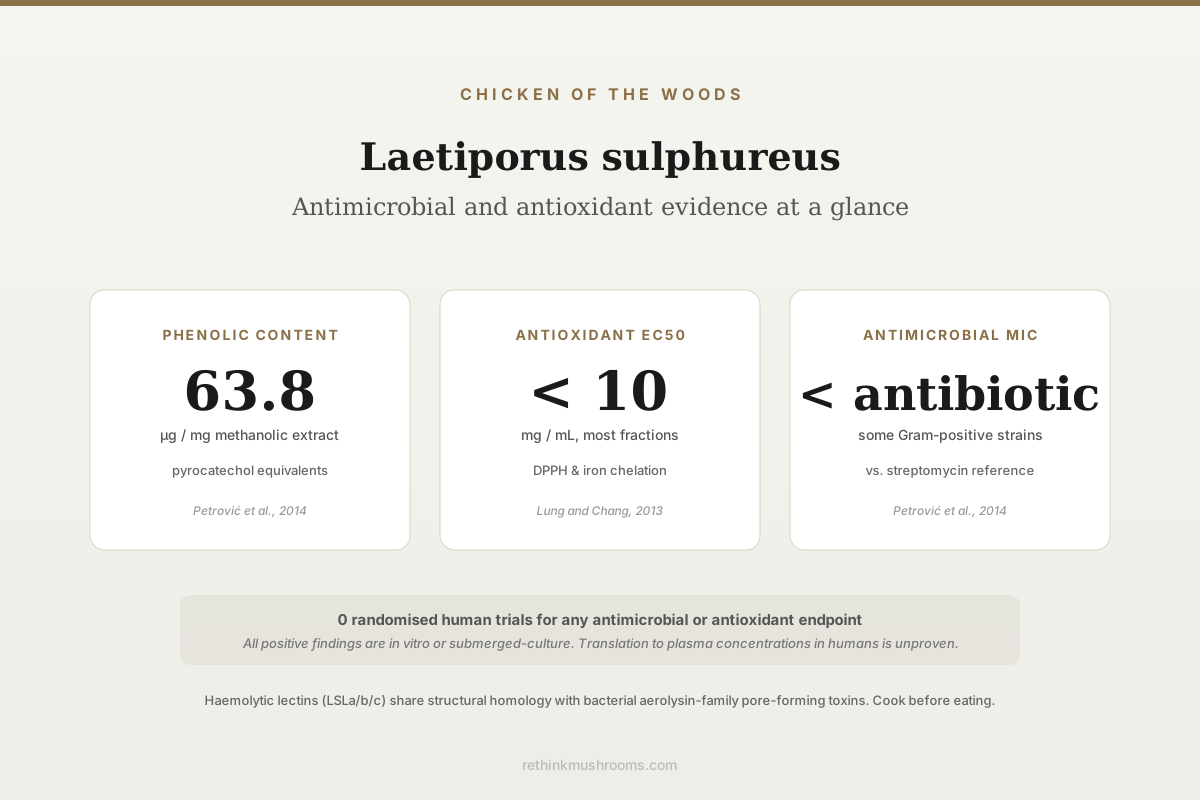
63.8 µg/mg Phenolic Content
Methanolic extract of Laetiporus sulphureus contains phenolic compounds at 63.8 ± 0.25 µg per milligram, pyrocatechol equivalents, with DPPH and ABTS activity that tracks total phenolic content almost linearly. Antimicrobial activity in the same extract reaches Gram-positive MICs below some reference antibiotics.
Petrović et al., Food & Function, 2014
MIC below antibiotics
methanolic and aqueous extracts inhibited several tested bacteria at concentrations below the reference antibiotic in the same assay (Petrović et al., 2014)
EC50 < 10 mg/mL
ethanolic and hot-water extracts from submerged-culture mycelia scavenged DPPH and chelated iron below 10 mg/mL across nearly all fractions tested (Lung and Chang, 2013)
0 human trials
no randomised trial has tested Laetiporus sulphureus for any infection or oxidative stress endpoint in humans
Petrović et al., Food & Function, 2014
 View as image ↗
Chicken of the woods (Laetiporus sulphureus) is one of the easiest wild mushrooms to identify, and the same brown-rot biology that produces its sulphur-yellow shelves also yields a measurable bioactive profile. The chemistry is well-characterised: phenolic compounds in the 60-plus µg/mg range (pyrocatechol equivalent), polysaccharidic fractions with documented free radical scavenging, and a small but distinctive family of haemolytic lectins homologous to bacterial pore-forming toxins.[1][2] The functional evidence that tracks this chemistry covers DPPH radical scavenging, ferrous ion chelation, lipid peroxidation inhibition, and antibacterial activity strong enough to match reference antibiotics against some Gram-positive strains.[3] What the evidence does not include is a single randomised human trial for any infection or oxidative stress endpoint. For safe foraging and kitchen basics, see chicken of the woods for beginners: safe identification guide. For the broader edibility and health picture, see what is chicken of the woods? edibility and health research.
Key Takeaways
- Methanolic extract of L. sulphureus contains 63.8 ± 0.25 µg of phenolic compounds per milligram (pyrocatechol equivalents), with antioxidant activity correlating almost linearly with total phenolic content (Petrović et al., 2014).
- Ethanolic and hot-water extracts from submerged-culture mycelia produce DPPH scavenging and iron chelation EC50 values below 10 mg/mL across nearly every fraction tested, with strong correlation (R² values reported high) between phenol content and activity (Lung and Chang, 2013).
- Methanolic and aqueous extracts inhibit all tested bacteria and fungi, with some minimum inhibitory concentrations stronger than the reference antibiotics streptomycin and ampicillin (Petrović et al., 2014).
- The mushroom's identified phenolics span phenolic acids (vanillic, protocatechuic, caffeic, p-coumaric, cinnamic, p-hydroxybenzoic), flavanols (epicatechin), and flavanones (naringenin) (Jovanović et al., 2023; Petrović et al., 2014).
- Activity is narrower against Gram-negative bacteria than Gram-positive, a pattern consistent with the outer-membrane barrier of Gram-negative organisms (Duan et al., 2022).
- L. sulphureus produces a family of haemolytic lectins (LSLa, LSLb, LSLc) structurally homologous to the bacterial aerolysin-family pore-forming toxins, a finding that complicates any naïve "all extracts are safe" framing (Tateno et al., 2003; Mancheño et al., 2010).
- No published randomised clinical trial has tested L. sulphureus for any antimicrobial or antioxidant endpoint in humans, and no human pharmacokinetic data confirm that culinary intake produces plasma concentrations anywhere near the in vitro active range.
What Phenolic Chemistry Does the Mushroom Actually Contain?
The single most detailed characterisation to date comes from two 2014 papers by Petrović and colleagues in Food & Function. The group ran proximate analysis, phenolic profiling, and antioxidant and antimicrobial assays on matched specimens of wild-harvested Laetiporus sulphureus.[1][2] The fruiting body is dominated by carbohydrates and proteins, with mannitol and trehalose as the principal free sugars. Fatty acid analysis shows predominance of polyunsaturated over saturated and monounsaturated lipids, with α-, γ-, and δ-tocopherol forms all quantifiable. Organic acid profiling identified oxalic and citric acids as the most abundant, with cinnamic and p-hydroxybenzoic acids specifically quantified in the methanolic extract and correlated with antioxidant capacity.
A 2023 Serbian isolate study by Jovanović and colleagues extended the phenolic profile using HPLC. The ethanolic extract contained phenolic acids (vanillic, protocatechuic, caffeic), flavanols (epicatechin), and flavanones (naringenin).[3] This matters because different phenolic classes have different mechanisms. Phenolic acids such as p-coumaric compromise bacterial cell membrane integrity and interact with genomic DNA; flavonoids act more broadly on oxidative stress pathways. A mushroom with representatives from several classes produces a mechanistically diverse extract rather than a single-compound effect.
The comparative 2022 pharmacological review by Duan and colleagues catalogued 80 small molecules reported from Laetiporus species: 15 sterols, 29 triterpenes, 10 sesquiterpenes, 5 polyenes, 10 volatile compounds, and 11 others, alongside polysaccharides and lectins as the principal macromolecules.[4] This chemical diversity is what makes the antimicrobial and antioxidant data spread across so many assay systems.
How Strong Is the Antioxidant Activity In Vitro?
The two workhorse antioxidant assays in the L. sulphureus literature are DPPH radical scavenging and ferrous ion chelation, supplemented by ABTS, reducing power, and lipid peroxidation inhibition. Results are consistent across laboratories.
Lung and Chang's 2013 study in International Journal of Medicinal Mushrooms measured ethanolic and hot-water extracts of submerged-culture mycelia, dried mycelia, and mycelia-free broth.[5] Every fraction except one (the ethanolic extract of dried mycelia broth) produced DPPH scavenging and iron chelation EC50 values below 10 mg/mL. The mycelia-free broth ethanolic extract was particularly rich in ascorbic acid, the dried mycelia ethanolic extract was rich in α-tocopherol and flavonoids, and total phenols concentrated in both the mycelia-free broth and the dried mycelia hot-water extract. Correlation between total phenol content and EC50 was high, consistent with the Petrović data on fruiting bodies.
The 2014 Petrović food-preserving paper reported that the polysaccharidic fraction, not the methanolic fraction, carried the highest antioxidant and antimicrobial activity. That is a reminder that when the literature says "mushroom extract," the extraction solvent is doing a lot of the work.[1]
A 2023 review by Adamska and colleagues in Foods summarised the cumulative in vitro antioxidant data and noted that activity is routinely in the range typically associated with culinary mushrooms regarded as "functional," placing L. sulphureus near Pleurotus and Agaricus species on standard assays.[6]
| Assay | Fraction | Activity | Source |
|---|---|---|---|
| DPPH scavenging | Hot-water extract, submerged mycelia | EC50 < 10 mg/mL | Lung and Chang, 2013 |
| Iron chelation | Ethanolic extract, mycelia-free broth | EC50 < 10 mg/mL | Lung and Chang, 2013 |
| Total phenols | Methanolic extract, fruiting body | 63.8 ± 0.25 µg/mg (pyrocatechol eq.) | Petrović et al., 2014 |
| Polysaccharide antioxidant | Polysaccharidic fraction, fruiting body | Higher than methanolic | Petrović et al., 2014 |
| Cooked-sausage lipid oxidation | Ethanolic extract in food matrix | Retained activity 30 d refrigerated | Cited in Adamska 2023 |
What the assays do not test is whether any of this activity survives digestion, reaches plasma, or translates into a measurable antioxidant effect in a living human. That gap is the single most important caveat on the antioxidant claim.
What Does the Antimicrobial Evidence Actually Show?
The antimicrobial literature on L. sulphureus is strongest against Gram-positive bacteria and narrower against Gram-negatives, a pattern repeatedly reported. The Petrović 2014 extraction-methodology paper is the clearest single reference: methanolic and water extracts inhibited all tested bacteria and fungi, with minimum inhibitory concentrations that in some cases sat below the reference antibiotics (streptomycin for bacteria, bifonazole or ketoconazole for fungi) used in the same assay.[2] The crude extract also showed anticandidal activity against Candida albicans.
The mechanistic picture tracks the phenolic profile. p-Coumaric and related phenolic acids compromise bacterial membrane integrity and interact with genomic DNA; this has been demonstrated with isolated phenolics rather than crude mushroom extract, but the compounds are the same ones quantified in L. sulphureus. Gram-negative resistance is expected because the outer membrane of Gram-negative organisms blocks access to the inner-membrane and cytoplasmic targets that phenolics attack. Duan et al.'s 2022 review catalogued the same asymmetry across the Laetiporus antimicrobial literature.[4]
The Jovanović 2023 Serbian-isolate paper adds antibiofilm data: ethanolic extract tolerated two probiotic bacteria (Lactiplantibacillus plantarum 229v and Bifidobacterium animalis subsp. lactis) and the probiotic yeast Saccharomyces boulardii without impairing their viability or biofilm formation, while inhibiting HCT-116 colorectal and HeLa cervical cancer cell viability in the 1–500 µg/mL range.[3] Selective effect against pathogenic targets while sparing at least some commensal/probiotic strains is the kind of profile that matters if antimicrobial framing is going to mean anything beyond "kills cells in a dish."
One caveat that sits over the entire antimicrobial literature: the in vitro assays use direct application of extract to cultured organisms. This does not model oral exposure, gut-wall absorption, hepatic metabolism, tissue distribution, or in vivo microbiome ecology. Saying L. sulphureus has "antimicrobial activity" is accurate as a description of an assay outcome and uninformative as a clinical claim.
The Lectins Are the Most Interesting Molecule and the Most Often Ignored
The aspect of Laetiporus sulphureus pharmacology least discussed outside the mycology literature is its haemolytic lectins. Tateno and Goldstein's 2003 paper cloned and characterised a family of three lectins (LSLa, LSLb, LSLc) sharing 80–90% sequence identity, each forming tetramers of ~35 kDa subunits.[7] The surprising finding was structural homology to bacterial pore-forming toxins: the mosquitocidal toxin MTX2 from Bacillus sphaericus and α-toxin from Clostridium septicum. Mancheño et al.'s 2010 crystallography paper extended this to include the aerolysin family from Aeromonas hydrophila, ε-toxin from Clostridium perfringens, and parasporin from Bacillus thuringiensis.[8]
Native and recombinant LSL have haemagglutination and haemolytic activity, and the haemolytic activity is inhibited by specific sugars, consistent with pore formation that depends on carbohydrate recognition. The aerolysin-fold homology is not incidental: these are structurally characterised pore-forming proteins. The same biology that makes the lectins useful as experimental tools for glycobiology is the biology behind historical reports of mild gastric upset from raw or undercooked chicken of the woods. Cooking denatures these proteins. This is one of the clearest examples in the edible-mushroom literature where "the active compound" and "the reason the mushroom can cause GI symptoms if mishandled" are the same thing.
For the related safety picture on allergic reactions and adverse effects, see can chicken of the woods cause allergic reactions? safety guide.
What the Lipid and Fatty Acid Profile Contributes
The fatty acid and lipid fraction of Laetiporus sulphureus is often overlooked in "antioxidant" discussion but feeds directly into two of the functional findings. Petrović's 2014 extraction-methodology paper optimised separation of a neutral and polar lipid fraction distinct from a carotenoid and pigment fraction.[2] Fatty acid analysis indicated polyunsaturated predominance followed by saturated and then monounsaturated, a profile more typical of basidiomycetes than of animal tissues. The α-, γ-, and δ-tocopherol vitamers quantified in the same fruiting bodies are fat-soluble antioxidants in their own right, and their presence explains part of the ethanolic-fraction activity in the Lung and Chang 2013 data.
The same lipid fraction contributes to antimicrobial observations. A 2014 Food & Function report and follow-up reviews describe synergy between phenolic compounds and lipid ingredients in inhibiting both bacteria and fungi.[6] That synergy explains why crude extract activity sometimes exceeds what would be predicted from isolated phenolic concentrations alone. It also explains why "total phenolic content" is an imperfect surrogate for antimicrobial potency in this species.
What Dose Is Relevant to Culinary Consumption?
In vitro MIC and EC50 values are reported in mg/mL against cultured organisms and cell lines. Translating those numbers to a kitchen-relevant dose requires assumptions that the literature does not supply. A typical 100-gram portion of cooked chicken of the woods contains a fraction of a gram of total extractable phenolics once water is removed, and the fraction of those phenolics that survives gastric acid, enzymatic breakdown, first-pass hepatic metabolism, and systemic dilution is unknown. The Adamska 2023 review flagged this gap explicitly.[6]
This is not a criticism unique to L. sulphureus. The same gap applies to most culinary-medicinal mushrooms. It is the reason the honest answer to "does eating chicken of the woods fight infection in the body?" is "we do not know, the hypothesis is biologically plausible for Gram-positive activity, and no human data exist to support or refute it."
How Does It Compare to the Rest of the Edible-Medicinal Mushroom Literature?
Placed against the better-studied "medicinal mushrooms," Laetiporus sulphureus sits in a middle band. On total phenolic content, L. sulphureus (~64 µg/mg in methanolic extract) is within range of species such as Pleurotus ostreatus and considerably above cultivated Agaricus bisporus, but below the polypore standards Ganoderma lucidum and Inonotus obliquus. On specific antibacterial activity against Gram-positive organisms, the Petrović MIC data are competitive; on Gram-negative activity, L. sulphureus is unremarkable. The polysaccharide fractions have not been characterised with the depth applied to β-glucans from Pleurotus or Lentinula, so direct structure–activity comparisons are limited.
| Feature | L. sulphureus | Better-studied comparators |
|---|---|---|
| Total phenolics (methanolic) | 63.8 µg/mg | G. lucidum higher; A. bisporus lower |
| DPPH / iron chelation EC50 | < 10 mg/mL (most fractions) | Comparable to Pleurotus spp. |
| Gram-positive MIC vs. antibiotic | Below reference in some strains | Similar pattern in Hericium erinaceus extracts |
| Polysaccharide β-glucan data | Limited; fewer structural studies | Lentinan, pleuran fully characterised |
| Human RCT data | None | Also limited for most culinary-medicinal species |
Where the Evidence Stops
Every positive finding in this article is preclinical. There is no published randomised clinical trial testing L. sulphureus, whether as fruiting body, extract, or isolated fraction, for any antimicrobial or antioxidant endpoint in humans. There is no human pharmacokinetic study describing what happens to the phenolic compounds, triterpenes, or polysaccharides after oral intake. There is no evidence that culinary consumption of cooked chicken of the woods produces plasma concentrations anywhere close to the active in vitro range. The mechanistic chemistry is interesting. The translational gap is enormous.
A second gap sits over the relationship between fruiting-body and submerged-culture activity. The Lung and Chang 2013 data on submerged mycelia should not be uncritically mapped onto fruiting-body extracts of the sort a forager would dry and grind. Submerged culture conditions select for different secondary metabolites than wood substrate colonisation, and the phenolic balance between the two production routes is not identical. Any commercial extract marketed on the strength of "mushroom research" is therefore either citing the wrong study for its source material or silently averaging across production methods that differ chemically.
There is also a specific gap around standardisation. Every paper uses a different extraction solvent, a different ratio, and a different assay panel; the methanolic fraction in one paper is the polysaccharidic fraction in another; the strain origin varies from Serbian isolates to Chinese cultivars to submerged culture. Comparing µg/mL MIC values across studies without controlling for these variables is not meaningful.
For the foundational guide that sets the context for this research summary, see what is chicken of the woods? edibility and health research. For adjacent antioxidant-chemistry research in a different species, see chanterelle antioxidant and anti-inflammatory properties, and for a comparison within the shelf-fungus family, see chaga polyphenols and free radical scavenging: how they work.
Antibiofilm and Probiotic Sparing: The Most Interesting 2023 Data
The Jovanović 2023 paper deserves a second pass because it is the most clinically suggestive piece of the recent literature. The group tested ethanolic extract against three pathogenic biofilm-formers and three probiotic strains in parallel. The two measurements that matter sat in tension with each other: activity against Staphylococcus aureus, Salmonella enteritidis, and Escherichia coli biofilms, and tolerance of Lactiplantibacillus plantarum 229v, Bifidobacterium animalis subsp. lactis, and Saccharomyces boulardii.[3] Biofilm matters because biofilm-resident bacteria tolerate antibiotics at concentrations 100 to 1000 times higher than the same strain in planktonic culture, and biofilm inhibition is one of the recognised weaknesses of conventional antibiotic therapy.
The authors also measured cytotoxic effect on HCT-116 colorectal cancer cells and HeLa cervical cancer cells across 1 to 500 µg/mL, with MTT-assay viability reductions dose-dependent across that range. Selective activity against cancer cells with tolerance of probiotic strains would be the ideal combination for a food-derived extract if any of it translated to human intake. That translation has not been tested. The paper is hypothesis-generating and nothing more.
What the Evidence Supports, What It Does Not
| Claim | Evidence | Strength |
|---|---|---|
| L. sulphureus contains quantifiable phenolic acids and flavonoids | Petrović 2014; Jovanović 2023 | Strong |
| Extracts scavenge DPPH radicals and chelate iron in vitro | Lung and Chang 2013; Petrović 2014 | Strong (in vitro) |
| Methanolic and aqueous extracts inhibit tested bacteria in culture | Petrović 2014 | Strong (in vitro) |
| Activity is stronger against Gram-positive than Gram-negative organisms | Duan 2022 review | Moderate consensus |
| Ethanolic extract spares probiotic bacteria while inhibiting cancer cell lines | Jovanović 2023 | Preliminary |
| Culinary consumption delivers in vivo antimicrobial effect in humans | Not tested | None |
| Culinary consumption reduces oxidative stress markers in humans | Not tested | None |
| Haemolytic lectins explain reports of GI upset from raw/undercooked fruiting bodies | Tateno 2003; Mancheño 2010 | Mechanistically plausible |
The Bottom Line
Laetiporus sulphureus (chicken of the woods) has a well-characterised bioactive profile: phenolic compounds at roughly 64 µg/mg in methanolic extract, polyunsaturated fatty acids, α/γ/δ-tocopherols, and identified phenolic acids spanning vanillic, protocatechuic, caffeic, cinnamic, and p-hydroxybenzoic acids, plus the flavanol epicatechin and the flavanone naringenin (Petrović et al., 2014; Jovanović et al., 2023). Antioxidant activity is documented across DPPH, iron chelation, reducing power, and lipid peroxidation assays, with EC50 values below 10 mg/mL in most fractions from submerged-culture and fruiting-body extracts (Lung and Chang, 2013). Antimicrobial activity reaches MIC values below reference antibiotics against some Gram-positive strains, with weaker and narrower activity against Gram-negative bacteria (Petrović et al., 2014; Duan et al., 2022). The mushroom also produces a family of haemolytic lectins (LSLa, LSLb, LSLc) structurally homologous to bacterial aerolysin-family pore-forming toxins, a finding that matters both pharmacologically and as the likely explanation for gastrointestinal symptoms from raw or undercooked fruiting bodies (Tateno et al., 2003; Mancheño et al., 2010). No randomised clinical trial has tested L. sulphureus for any antimicrobial or antioxidant endpoint in humans, and no human pharmacokinetic data confirm that culinary intake produces plasma concentrations comparable to the in vitro active range.
Frequently Asked Questions
Sources & References
- 1RTHM-00347·Petrović, Jovana et al. (2014). “Study on chemical, bioactive and food preserving properties of Laetiporus sulphureus (Bull.: Fr.) Murr..” Food & function.Study breakdown →PubMed →↩
- 2RTHM-00346·Petrović, Jovana et al. (2014). “Different extraction methodologies and their influence on the bioactivity of the wild edible mushroom Laetiporus sulphureus (Bull.) Murrill..” Food & function.Study breakdown →PubMed →↩
- 3RTHM-00832·Jovanović, Milena M et al. (2023). “Anticancer assessment and antibiofilm potential of Laetiporus sulphureus mushroom originated from Serbia..” Food science & nutrition.Study breakdown →PubMed →↩
- 4RTHM-00756·Duan, Yingce et al. (2022). “Bioactive components of Laetiporus species and their pharmacological effects..” Applied microbiology and biotechnology.Study breakdown →PubMed →↩
- 5RTHM-00298·Lung, Ming-Yeou et al. (2013). “Antioxidant potential and antioxidant compounds of extracts from the medicinal sulphur polypore, Laetiporus sulphureus (Higher Basidiomycetes) in submerged cultures..” International journal of medicinal mushrooms.Study breakdown →PubMed →↩
- 6RTHM-00812·Adamska, Iwona (2023). “The Possibility of Using Sulphur Shelf Fungus (Laetiporus sulphureus) in the Food Industry and in Medicine-A Review..” Foods (Basel.Study breakdown →PubMed →↩
- 7RTHM-00063·Tateno, Hiroaki et al. (2003). “Molecular cloning, expression, and characterization of novel hemolytic lectins from the mushroom Laetiporus sulphureus, which show homology to bacterial toxins..” The Journal of biological chemistry.Study breakdown →PubMed →↩
- 8RTHM-00193·Mancheño, José Miguel et al. (2010). “Laetiporus sulphureus lectin and aerolysin protein family..” Advances in experimental medicine and biology.Study breakdown →PubMed →↩