Chanterelle
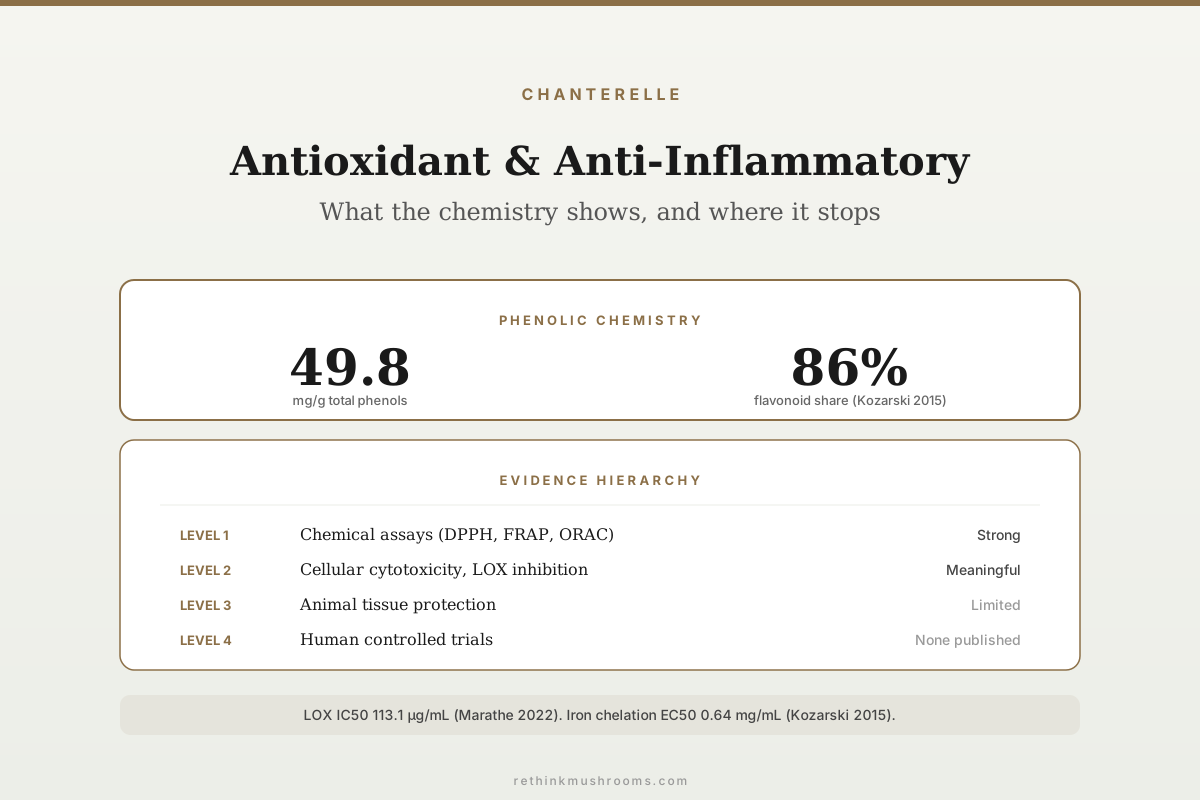
49.8 mg/g total phenols
Kozarski et al. (2015) quantified phenolic compounds in Cantharellus cibarius methanolic extract at 49.8 mg per gram, with flavonoids at approximately 86% of that total, and documented specific antioxidant and enzyme-inhibitory activity through defined EC50 values.
Kozarski et al., Food & Function, 2015
EC50 1.21 mg/mL
lipid peroxidation inhibition (Kozarski 2015)
IC50 113.1 µg/mL
lipoxygenase inhibition (Marathe 2022)
No Human Trials
no controlled human data for chanterelle
Kozarski et al., Food & Function, 2015
 View as image ↗
Chanterelle antioxidant and anti-inflammatory research is overwhelmingly chemical and cellular, not clinical. Golden chanterelle (Cantharellus cibarius) has well-characterized phenolic content, documented activity in four standard antioxidant assays, and a specific anti-inflammatory mechanism through lipoxygenase inhibition that links its chemistry to a defined inflammatory pathway. What it does not have is any human controlled trial measuring oxidative stress biomarkers, inflammatory markers, or clinical endpoints. This article walks through the specific numbers, named studies, and the evidence gap that separates laboratory activity from documented human benefit.
For the broader chanterelle context, see the sibling article on what is chanterelle? health benefits beyond gourmet cooking. For the distinctive nutritional angle, see chanterelle and vitamin D: one of the best natural sources and chanterelle vitamin D2 and carotenoid content: the golden mushroom's nutritional edge.
Key Takeaways
- Kozarski et al. (2015) measured 49.8 mg/g total phenols in Cantharellus cibarius methanolic extract, with flavonoids representing approximately 86% of the total phenolic content (Food & Function)
- Kozarski reported EC50 of 1.21 mg/mL for lipid peroxidation inhibition and EC50 of 0.64 mg/mL for iron chelating activity, identifying iron chelation as the dominant antioxidant mechanism
- Marathe et al. (2022) demonstrated anti-angiogenic activity in the chick chorioallantoic membrane assay and quantified lipoxygenase inhibition at IC50 113.1 µg/mL for the ethanol extract, establishing a specific anti-inflammatory mechanism (Nutrition and Cancer)
- Ebrahimzadeh et al. (2015) fractionated methanolic chanterelle extract and found distinct antioxidant roles per fraction: n-butanol highest in phenols (40.97 mg GAE/g), n-hexane strongest in nitric oxide scavenging (77.21%), ethyl acetate strongest in DPPH scavenging (33.43%)
- Rezic et al. (2023) measured aqueous chanterelle extract antioxidant capacity at 41.54 µM TE/L (FRAP) and 38.72 µM TE/L (ORAC) when extracted at 70°C, with p-hydroxybenzoic, protocatechuic, and gallic acid as dominant phenolics (Molecules)
- No controlled human trial has measured chanterelle effects on oxidative stress biomarkers, inflammatory markers, or clinical outcomes (Chen et al., 2024)
What Chanterelle's Antioxidant Chemistry Actually Contains
The antioxidant activity of Cantharellus cibarius is driven by a mix of phenolic acids, flavonoids, carotenoids, and trace bioactive compounds. The phenolic profile has been characterized in multiple studies with consistent identification of a core set of compounds.
Rezic et al. (2023), publishing in Molecules, used HPLC to identify p-hydroxybenzoic acid, protocatechuic acid, and gallic acid as the most abundant phenolics in aqueous chanterelle extracts, with somewhat higher concentrations when extraction was carried out at 70°C compared to 25°C.[1] Malic acid, pyrogallol, and oleic acid were also identified by GC-MS from derivatized extracts.
Kozarski et al. (2015) reported total phenolic content of 49.8 mg/g in methanolic extract, with flavonoids representing approximately 86% of that total.[2] This is a high flavonoid-to-phenol ratio by mushroom standards and is one of the chemical features distinguishing chanterelle from Boletus, Agaricus, and other commonly studied edible fungi.
Chen et al. (2024), in a comprehensive review published in Food & Function, described chanterelle's bioactive profile as including phenolic compounds, vitamin precursors, indole derivatives, and carotenoids, with documented antioxidant, antimicrobial, immunoregulatory, anti-inflammatory, antitumor, neuroprotective, antidiabetic, and prebiotic activity in vitro or in vivo.[3] The breadth of activity categories is consistent with a polyphenolic chemistry acting through multiple signaling pathways rather than a single mechanism.
The Antioxidant Assay Numbers in Context
Chanterelle has been tested in essentially every standard in-vitro antioxidant assay: DPPH, ABTS, FRAP, ORAC, hydrogen peroxide scavenging, nitric oxide scavenging, reducing power, metal chelation, and lipid peroxidation inhibition. The numbers vary substantially by extraction method, solvent, and assay, which is typical for mushroom phenolic research.
Ebrahimzadeh et al. (2015), publishing in the International Journal of Medicinal Mushrooms, fractionated methanolic extract of golden chanterelle from northern Iran into n-hexane, chloroform, ethyl acetate, n-butanol, and aqueous fractions, then tested each across six assay systems.[4]
| Fraction | Key activity | Value |
|---|---|---|
| n-butanol | Total phenol content | 40.97 mg GAE/g |
| n-hexane | Flavonoid content | 40.01 mg QE/g |
| n-hexane | Nitric oxide scavenging | 77.21% |
| ethyl acetate | DPPH scavenging | 33.43% |
| chloroform | Fe2+ chelation | 86.13% |
| aqueous | Reducing power | Highest among fractions |
The picture is not a single compound responsible for antioxidant activity but a distributed phenolic chemistry where different compound classes drive different assays. This is consistent with most edible mushroom antioxidant literature and is not specific to chanterelle.
Rezic et al. (2023) measured antioxidant capacity in aqueous chanterelle extracts using FRAP and ORAC, with the highest values recorded at 70°C extraction: 41.54 ± 1.54 µM TE/L (FRAP) and 38.72 ± 2.47 µM TE/L (ORAC).[1] The temperature dependence is worth noting: extraction conditions materially change the measured antioxidant value of a given mushroom, which is part of why mushroom antioxidant marketing numbers are often unreproducible.
Fogarasi et al. (2021), publishing in Molecules, compared four extraction solvents (acidic water, ethanol/water/acetic acid, hexane, diethyl ether) for chanterelle and Boletus edulis and found that acidic water extracted the highest amount of polyphenolic compounds and produced the highest TPC and TEAC values, with a very strong positive correlation between TPC and TEAC across extracts.[5] No correlation was found between total flavonoid content and either TPC or TEAC, indicating that the flavonoid fraction is not the dominant driver of the measured antioxidant capacity in that protocol.
Kumari et al. (2011), publishing in Food Science and Technology International, analyzed 18 different wild Cantharellus species from the northwestern Himalayas and documented substantial inter-species variation in both total phenol content and antioxidant capacity.[6] The practical implication: "chanterelle antioxidant activity" as a single value is an oversimplification. The activity of the chanterelle in front of you depends on species, geographic origin, harvest conditions, and preparation method.
The Lipid Peroxidation and Iron Chelation Mechanism
Kozarski et al. (2015) reported specific EC50 values that place the chanterelle antioxidant mechanism more precisely than bulk assay values can. Lipid peroxidation inhibition was measured at EC50 1.21 mg/mL and iron chelating activity at EC50 0.64 mg/mL.[2] The authors explicitly concluded that the antioxidant activity operates primarily through iron chelation rather than hydrogen atom transfer or electron transfer.
This is a meaningful mechanistic statement because iron chelation prevents the Fenton reaction, which generates hydroxyl radicals from hydrogen peroxide and iron in biological systems. A food component that chelates iron has a plausible mechanism of oxidative stress reduction in tissues with high iron turnover (liver, gut mucosa) independent of bulk radical scavenging. Whether this translates to measurable human effect is a separate question; the mechanism is specific and well-characterized.
The Anti-Inflammatory Mechanism: Lipoxygenase Inhibition
Marathe et al. (2022), publishing in Nutrition and Cancer, moved chanterelle's anti-inflammatory evidence from general assay activity to a defined enzyme-level mechanism.[7] Petroleum ether and ethanol extracts of C. cibarius were tested for lipoxygenase (LOX) inhibition against ascorbic acid as positive control. IC50 values were:
- Petroleum ether extract: 135.4 µg/mL
- Ethanol extract: 113.1 µg/mL
- Ascorbic acid (control): 41.5 µg/mL
The ethanol extract was the more potent LOX inhibitor, consistent with a phenolic-rich extraction profile. The authors also documented dose-dependent anti-angiogenic activity in the chick chorioallantoic membrane (CAM) assay, with correlation established between LOX inhibition and the anti-angiogenic effect. LOX inhibition is the same pathway targeted by zileuton and other pharmacological inflammation suppressors, which links the chanterelle finding to a clinically relevant mechanism.
The limitation is that IC50 values measured on isolated enzyme systems do not automatically translate to pharmacological LOX inhibition in humans at dietary chanterelle doses. The concentrations at which chanterelle extracts inhibit LOX in vitro are unlikely to be achieved in serum from normal consumption of whole chanterelle mushrooms. What the study does establish is a specific mechanistic handle on the "anti-inflammatory" claim, which is a meaningful upgrade over general assay-level evidence.
Cellular and Cytotoxic Evidence
Beyond pure antioxidant and anti-inflammatory chemistry, chanterelle extracts have shown selective cytotoxic activity in tumor cell lines. Kozarski et al. (2015) documented selective activity against human cervix adenocarcinoma HeLa, breast carcinoma MDA-MB-453, and myelogenous leukemia K562 cells, compared to normal human fetal lung fibroblasts (MRC-5) and bronchial epithelial cells (BEAS-2B).[2] The same extract also showed antihypertensive activity through angiotensin converting enzyme inhibition (IC50 0.063 mg/mL) and selective antimicrobial activity against Gram-positive bacteria.
Rezic et al. (2023) reported cytotoxic activity against human breast adenocarcinoma MDA-MB-231, with IC50 of 375 µg/mL for the 25°C aqueous extract.[1] These are cell culture findings, not animal or human studies, and they demonstrate bioactivity of the chanterelle chemistry against specific cellular targets without establishing any dose-response relevance to dietary consumption.
What the Evidence Does Not Show
The evidence does not establish that chanterelle consumption reduces oxidative stress or inflammation in humans. Three specific gaps explain the limitation.
No human pharmacokinetic data. The absorption, distribution, and metabolism of chanterelle phenolic compounds in human subjects have not been published. This means the in-vitro IC50 and EC50 values cannot be compared to achievable plasma concentrations after eating chanterelle.
No measurement of oxidative stress biomarkers in vivo. No controlled trial has measured plasma F2-isoprostanes, urinary 8-OHdG, lipid peroxidation products, or related markers before and after chanterelle consumption in human subjects.
No clinical endpoint data. No trial has measured any disease-relevant clinical outcome from chanterelle intake in human populations. The clinical relevance of the assay, cell culture, and CAM-assay findings is uninferred.
Chen et al. (2024), in the comprehensive review, framed this constraint explicitly: the potential of chanterelle as a functional food is supported by in-vitro and limited in-vivo animal data, and clinical validation is the key missing step.[3] The authors also flagged heavy metal accumulation as an ongoing safety consideration specific to C. cibarius because of its ecology as a soil-bound wild-harvested species.
How Chanterelle Compares to Other Antioxidant Mushrooms
Among edible mushrooms, chanterelle's antioxidant profile sits in the middle of the distribution. Chaga (Inonotus obliquus) and reishi (Ganoderma lucidum) have substantially higher phenolic and melanin content and produce larger assay values. Turkey tail, maitake, and lion's mane have better-studied immune and neurological mechanisms. Chanterelle's distinguishing chemistry is the high flavonoid-to-phenol ratio, the lipoxygenase inhibition mechanism, and the combined nutritional profile (particularly ergosterol/vitamin D2 and carotenoids) that adds food-level relevance to the bioactive chemistry.
For a broader comparative framework, see the cross-cluster article on chaga vs. other superfoods for antioxidant power: a comparison. For chanterelle's distinct nutritional contribution that links these findings to the larger dietary picture, see chanterelle nutritional profile: a complete analysis.
Practical Implications for Dietary Use
The evidence summarized above supports a specific, narrow set of practical statements.
Chanterelle is a bioactive food, not an inert one. The phenolic and flavonoid content, ergosterol/vitamin D2, carotenoids, and polysaccharides together place chanterelle among edible mushrooms with documented in-vitro bioactivity. This is a meaningful statement even without clinical confirmation because it establishes a plausible mechanistic basis for effects that other commonly consumed foods lack.
Extraction method determines the antioxidant profile. Fogarasi et al. (2021) and Rezic et al. (2023) both demonstrated that aqueous and higher-temperature extractions maximize measured phenolic yield.[5][1] Raw chanterelle and lightly cooked chanterelle therefore deliver different antioxidant fractions than broths, soups, or longer simmering preparations.
Species and source vary meaningfully. Kumari et al. (2011) documented substantial differences across 18 wild Cantharellus species from a single geographic region.[6] The "chanterelle" label covers a range of closely related fungi with variable bioactive profiles, so any claim attached to a single number will obscure real variation.
Clinical inference is premature. The available evidence does not support claims that eating chanterelle reduces inflammation, oxidative stress, or disease risk in humans. The chemistry is interesting, the cellular evidence is consistent, the mechanistic pathway (LOX inhibition, iron chelation) is defined, and the clinical trial has not been conducted. These facts hold simultaneously.
Evidence Gaps Worth Naming Explicitly
The chanterelle literature has a characteristic shape: many in-vitro papers with overlapping assay methodologies, a handful of cell culture studies with cytotoxic and anti-angiogenic endpoints, very limited animal work, and no controlled human trials. The gaps between these tiers of evidence are the places where marketing claims most often outrun the data.
Specific measurements that have not been published for chanterelle: human plasma pharmacokinetics of any chanterelle phenolic compound, bioavailability comparisons with other phenolic food sources, human oxidative stress biomarker response to chanterelle consumption, chronic intake safety in controlled populations, and outcomes in any disease context where anti-inflammatory activity would be clinically relevant (arthritis, inflammatory bowel disease, cardiovascular inflammation).
Chen et al. (2024) identified closing these gaps as the key research direction, with particular emphasis on standardization of extract composition and characterization of processing effects on bioactive yield.[3]
The Bottom Line
Chanterelle has well-characterized antioxidant chemistry dominated by phenolic acids and flavonoids, with iron chelation as the primary mechanism and lipoxygenase inhibition as a specific anti-inflammatory handle. In-vitro assay and cell culture evidence is consistent. Human pharmacokinetic and clinical trial data are absent. The honest claim is that chanterelle has meaningful bioactive chemistry and an unmeasured clinical profile.
Frequently Asked Questions
Sources & References
- 1RTHM-00849·Režić Mužinić, Nikolina et al. (2023). “Golden Chanterelle or a Gold Mine? Metabolites from Aqueous Extracts of Golden Chanterelle (Cantharellus cibarius) and Their Antioxidant and Cytotoxic Activities..” Molecules (Basel.Study breakdown →PubMed →↩
- 2RTHM-00381·Kozarski, Maja et al. (2015). “Nutraceutical properties of the methanolic extract of edible mushroom Cantharellus cibarius (Fries): primary mechanisms..” Food & function.Study breakdown →PubMed →↩
- 3RTHM-00870·Chen, Xinlei et al. (2024). “Insights into chemical components, health-promoting effects, and processing impact of golden chanterelle mushroom Cantharellus cibarius..” Food & function.Study breakdown →PubMed →↩
- 4RTHM-00370·Ebrahimzadeh, Mohammad Ali et al. (2015). “Antioxidant Activity of Different Fractions of Methanolic Extract of the Golden Chanterelle Mushroom Cantharellus cibarius (Higher Basidiomycetes) from Iran..” International journal of medicinal mushrooms.Study breakdown →PubMed →↩
- 5RTHM-00686·Fogarasi, Melinda et al. (2021). “Comparison of Different Extraction Solvents for Characterization of Antioxidant Potential and Polyphenolic Composition in Boletus edulis and Cantharellus cibarius Mushrooms from Romania..” Molecules (Basel.Study breakdown →PubMed →↩
- 6RTHM-00222·Kumari, D et al. (2011). “Nutritional composition and antioxidant activities of 18 different wild Cantharellus mushrooms of northwestern Himalayas..” Food science and technology international = Ciencia y tecnologia de los alimentos internacional.Study breakdown →PubMed →↩
- 7RTHM-00786·Marathe, Sandesh J et al. (2022). “Anti-Angiogenic Effect of Cantharellus cibarius Extracts, its Correlation with Lipoxygenase Inhibition, and Role of the Bioactives Therein..” Nutrition and cancer.Study breakdown →PubMed →↩