Chanterelle
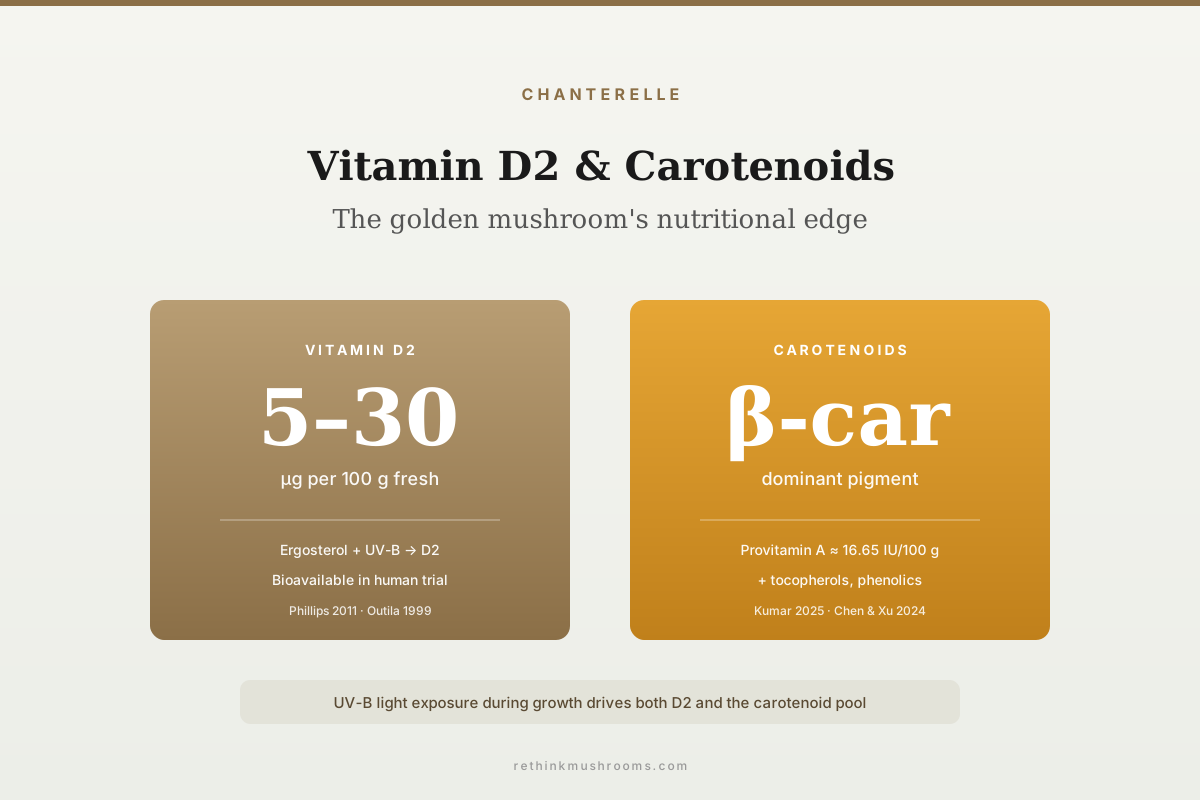
5–30 µg D2 / 100 g
Wild chanterelles combine among the highest measured natural vitamin D2 concentrations of any food with a β-carotene-dominated carotenoid profile that gives the fruiting body its golden color.
Phillips et al., J. Agric. Food Chem., 2011; Kumar et al., Food Sci. Nutr., 2025
β-carotene dominant
the pigment behind the gold
UV-B drives both
D2 and carotenoids track light exposure
Tocopherols + phenolics
rounding out the antioxidant pool
Phillips et al., J. Agric. Food Chem., 2011; Kumar et al., Food Sci. Nutr., 2025
 View as image ↗
Most edible mushrooms are valued for a single standout nutrient. Chanterelles are unusual in carrying two in the same fruiting body. Phillips and colleagues (2011) placed Cantharellus in the top tier of vitamin D2 concentrations in a U.S. retail survey at 5.2–28.1 µg per 100 g fresh weight, alongside morel and maitake and roughly a hundred times the level of cultivated button.[1] Kumar and colleagues (2025), in the most comprehensive recent review of Cantharellus cibarius, confirmed that the sporocarp also contains β-carotene as the dominant carotenoid, along with tocopherols, phenolics, and vitamin D precursors, making the golden chanterelle a combined D2-plus-antioxidant carrier rather than a single-vitamin food.[2] The chanterelle vitamin D2 carotenoid pairing is the "nutritional edge" the species offers over nearly every cultivated mushroom on the produce shelf.
For the dedicated deep-dive on chanterelle D2 bioavailability, see chanterelle and vitamin D: one of the best natural sources. For the full compositional picture, see chanterelle nutritional profile: a complete analysis and what is chanterelle? health benefits beyond gourmet cooking.
Key Takeaways
- Wild Cantharellus tubaeformis contained 29.82 µg/100 g of vitamin D2 in Mattila et al.'s HPLC analysis, among the highest values recorded in any food
- Phillips et al. (2011) confirmed a 5.2–28.1 µg/100 g range for retail chanterelle in the United States, placing it in the "high D2" mushroom tier
- β-carotene is the dominant carotenoid in C. cibarius, and is the pigment responsible for the golden color (Kumar et al., 2025)
- Kumar 2025 reports vitamin A activity of approximately 16.65 IU/100 g from chanterelle carotenoids, the highest among the vitamins measured in the species
- Both vitamin D2 and the carotenoid pool accumulate in response to UV-B light exposure during growth, so sunlit wild chanterelles carry more of both than shade-grown cultivars
- Barros et al. (2008) quantified tocopherols in Portuguese wild chanterelle, adding a fat-soluble vitamin E contribution to the antioxidant profile
- Rezic et al. (2023) and Kozarski et al. (2015) identified gallic, protocatechuic and p-hydroxybenzoic acids as the dominant phenolic acids in aqueous and methanolic chanterelle extracts, supporting measurable FRAP and ORAC activity
What Gives Chanterelle Its Golden Color: The Carotenoid Profile
The chanterelle's name in many languages (girolle, Pfifferling, lisička) centers on its color, and the color is a direct readout of carotenoid content. Kumar et al. (2025) synthesised the compositional literature on C. cibarius and listed carotenoids among the main classes of bioactive metabolites, with β-carotene as the dominant species identified by HPLC across multiple analyses.[2] Chen and Xu (2024), in their critical review of chanterelle chemistry, drew the same conclusion: the vitamin precursor pool in the fruiting body includes provitamin A carotenoids dominated by β-carotene, with smaller amounts of related xanthophylls.[3]
The practical nutritional implication is that chanterelle's pigment is not inert decoration. β-carotene is a provitamin A carotenoid, cleaved in the intestinal mucosa to retinal by β-carotene 15,15'-monooxygenase, making it a genuine dietary precursor to vitamin A. Kumar 2025 reported vitamin A activity of 16.65 IU/100 g as the highest vitamin entry in the chanterelle vitamin panel, a figure derived from the carotenoid content rather than from preformed retinol (which mushrooms do not synthesise).[2]
The related chanterelle species Cantharellus cinnabarinus (the cinnabar-red chanterelle) carries a different carotenoid emphasis, with canthaxanthin as the dominant crystalline pigment rather than β-carotene, a finding that originally put canthaxanthin on the biochemistry map when Haxo isolated it from that species in the mid-twentieth century. For the yellow-orange golden chanterelle (C. cibarius), β-carotene dominates and canthaxanthin is a minor component at most.
The Vitamin D2 Side Of The Ledger
Vitamin D2 content in chanterelle is documented across multiple independent analyses and is covered in depth in the dedicated article on chanterelle and vitamin D. The short version:
- Wild C. tubaeformis reached 29.82 µg/100 g in the foundational Mattila et al. 1994 HPLC analysis, and C. cibarius measured 12.8 µg/100 g in the same study.
- Phillips et al. (2011) measured U.S. retail chanterelle samples at 5.2–28.1 µg/100 g, placing the genus in the "high D2" tier alongside morel and maitake.[1]
- The D2 is biologically active in humans: Outila et al. (1999) fed C. tubaeformis to vitamin-D-insufficient adults at 14 µg/day for three weeks and showed a serum 25-hydroxyvitamin D rise statistically indistinguishable from a matched ergocalciferol supplement.[4]
- The broader UV-mushroom RCT literature (Urbain et al., 2011; Cashman et al., 2016; Leung et al., 2021) confirms that mushroom D2 raises serum 25(OH)D at doses equivalent to pharmaceutical ergocalciferol.[5][6][7]
The density comparison matters for framing. A 100-g serving of wild funnel chanterelle as measured by Mattila 1994 delivers roughly twice the U.S. RDA for vitamin D (15 µg/day) and roughly a third of the RDA even at the low retail end.
UV-B Light Drives Both D2 and Carotenoids In Parallel
The D2 side of the ledger and the carotenoid side share a regulatory driver: ultraviolet light during growth. For vitamin D2, the mechanism is photochemical. Keegan and colleagues (2013) reviewed the mushroom photobiology in detail and showed that ergosterol in the fungal cell membrane absorbs UV-B photons in the 280–315 nm band and undergoes a ring-opening reaction to previtamin D2, which isomerises thermally to ergocalciferol (D2).[8] Koyyalamudi et al. (2009) demonstrated the reaction rate in cultivated Agaricus bisporus and showed that short UV exposure produces substantial D2 in minutes, with the reaction running wherever ergosterol meets UV-B photons.[9]
For carotenoids in fungi, light functions as a regulatory signal rather than a direct photochemical driver. Light-responsive transcription factors (the white-collar complex and its homologues) upregulate the carotenoid biosynthesis pathway in many basidiomycetes and ascomycetes, so fruiting bodies that develop under higher irradiance accumulate more pigment. The ecological consequence for chanterelle is that the same environmental variable, forest-floor UV-B exposure, pushes up both the D2 pool (by converting available ergosterol) and the carotenoid pool (by inducing the biosynthesis genes). Wild chanterelles flushing in sunlit forest light gaps therefore carry more of both than a shaded flush of the same species on the same slope.
Jiang and colleagues (2020) quantified the light-dose-response relationship for mushroom drying, showing that UV-B exposure during the drying step continues to convert ergosterol to D2 in the post-harvest product.[10] The practical implication is that a sunlit wild chanterelle that is also sun-dried accumulates D2 twice, at growth and at preservation, arriving at the plate with substantially more D2 than its fresh-weight baseline.
Tocopherols, Phenolics And Minor Vitamins Round Out The Antioxidant Pool
Chanterelle's nutritional edge extends past the flagship D2 and β-carotene into a supporting cast of fat-soluble and water-soluble antioxidants. Barros and colleagues (2008), in their comprehensive analysis of Portuguese wild edible mushrooms, quantified tocopherols (vitamin E family) in C. cibarius and documented the presence of multiple tocopherol and tocotrienol isoforms, adding a measurable vitamin E contribution to the fat-soluble vitamin profile.[11]
On the phenolic side, Kozarski and colleagues (2015) analysed a methanolic extract of C. cibarius and measured total phenols at 49.8 mg/g extract, with flavonoids accounting for about 86% of the total phenol content, lipid peroxidation inhibition at EC50 = 1.21 mg/mL, and iron chelating activity at EC50 = 0.64 mg/mL.[12] Rezic Mužinić and colleagues (2023) extended the phenolic characterization using GC-MS and HPLC on aqueous extracts, identifying p-hydroxybenzoic acid, protocatechuic acid and gallic acid as the dominant phenolic acids, with FRAP values of 41.54 µM TE/L and ORAC values of 38.72 µM TE/L at the 70 °C extraction.[13]
Ebrahimzadeh and colleagues (2015) fractionated a methanolic extract of Iranian C. cibarius and showed the n-hexane fraction carried 40.01 mg quercetin-equivalent/g of flavonoids and 77.21% nitric oxide scavenging activity, while the n-butanol fraction held 40.97 mg gallic-acid-equivalent/g of total phenols.[14] Witkowska and colleagues (2011) ranked chanterelle among the stronger antioxidant wild edible mushrooms in a comparative assay panel, consistent with the phenolic and carotenoid content independently reported above.[15]
The broader picture matters because the antioxidants do not act in isolation. β-carotene is a lipophilic singlet-oxygen quencher. Tocopherols are lipophilic chain-breaking radical scavengers. Phenolic acids and flavonoids are hydrophilic radical scavengers and iron chelators. Vitamin D2 is not itself a potent antioxidant at nutritional doses but contributes to calcium homeostasis and downstream redox signalling. The chanterelle package spans the lipid and aqueous phases of the cell, with no single nutrient carrying the whole burden.
How Chanterelle Compares To Other Edible Mushrooms On Nutrient Density
A side-by-side comparison with the mushrooms that actually compete for kitchen space clarifies where chanterelle sits.
| Nutrient (per 100 g fresh) | Wild chanterelle | White button (non-UV) | Shiitake (non-UV) | Oyster (non-UV) |
|---|---|---|---|---|
| Vitamin D2 | 5.2–29.8 µg | 0.1–0.3 µg | 0.4 µg | 0.7 µg |
| β-carotene / provitamin A | Present, ~16.65 IU/100 g | Trace | Trace | Trace |
| Tocopherols | Present, multiple isoforms | Low | Low | Low |
| Total phenolics | Moderate (Kozarski 2015, Rezic 2023) | Low | Moderate | Moderate |
Sources: Phillips 2011 for D2; Kumar 2025 for chanterelle provitamin A; Barros 2008 for tocopherols; Kozarski 2015 and Rezic 2023 for phenolics.[1][2][11][12][13]
The cultivated mushrooms are not low-nutrition foods, but they do not carry the combined D2-plus-carotenoid load that wild chanterelle does. UV irradiation of cultivated species (described in Leung 2021) brings D2 up to and sometimes above wild levels, but the carotenoid gap remains because the biosynthesis is species-dependent, not simply light-dependent.[7] Chanterelle pairs the vitamin-D and carotenoid contributions by genus.
Cooking, Drying And Storage: Nutrient Retention
Vitamin D2 is reasonably heat-stable. Keegan 2013 summarised the retention literature and showed modest losses at typical cooking temperatures, with the absolute D2 concentration remaining high enough to deliver nutritionally meaningful amounts per serving.[8] Jiang 2020 showed that UV-assisted drying can increase D2 content relative to the fresh starting material because the photoreaction continues through drying.[10]
β-carotene is less robust than D2 to thermal degradation and oxidation. The carotenoid's conjugated double-bond system is susceptible to isomerisation (trans-to-cis) and oxidative cleavage, particularly at high temperatures, in the presence of oxygen, or after extended storage. Chen 2024 reviewed the processing impact literature for C. cibarius specifically and noted that gentle heat (boiling, light sautéing) retains more of the carotenoid pool than aggressive methods such as deep-frying or prolonged oven-drying.[3] Cold storage protects both D2 and β-carotene; prolonged storage at ambient temperature in light allows carotenoid degradation.
The phenolic pool is water-soluble and leaches into cooking liquids. Rezic 2023's finding that 70 °C aqueous extraction pulls more gallic, protocatechuic and p-hydroxybenzoic acid out of chanterelle tissue than 25 °C extraction confirms that mushroom broth is not an inert cooking byproduct. It carries a measurable fraction of the phenolic antioxidant pool and should not be discarded if the goal is to capture that part of the nutrient package.[13]
Limitations Of The Evidence
Species variability is large. The "chanterelle" sold at retail may be C. cibarius, C. tubaeformis, C. formosus (the Pacific golden), or other regional species. Kumari et al. (2011) documented composition variation across 18 different wild Cantharellus species from the Himalayan region, making clear that even within the genus the nutrient profile is not one number.[16] Reporting that "chanterelle has X µg D2 per 100 g" glosses over the species identity behind the measurement.
Carotenoid quantification for C. cibarius specifically is less exhaustive than the D2 quantification. The presence and dominance of β-carotene is well-established across multiple reviews, but the precise mg/100 g values published in the peer-reviewed record are fewer than the HPLC datasets available for vitamin D2. The "~16.65 IU vitamin A/100 g" figure from Kumar 2025 is derived from carotenoid content but is a secondary summary rather than a large primary-data aggregate.[2]
Light-history variability applies equally to both nutrients. A chanterelle that grew under dense canopy will be lower in D2 and lower in pigment than a chanterelle that grew under a sunlit canopy gap. Visual color intensity is a crude but directionally useful proxy: deeply golden specimens carry more β-carotene by definition, and the same sunlight exposure that drove the pigmentation also drove ergosterol-to-D2 conversion.
The human-bioassay evidence is strongest for vitamin D2, where Outila 1999 directly tested C. tubaeformis in humans.[4] For chanterelle β-carotene bioavailability specifically, no published human bioassay exists. The inference that chanterelle β-carotene behaves like other food-sourced β-carotene (roughly 6 µg food β-carotene = 1 µg retinol activity equivalent) is biochemically defensible but extrapolated rather than directly measured in the species.
The heavy-metal accumulation caveat is real. Chanterelle is known to accumulate cadmium and other heavy metals from the soil, and the concentration depends on harvesting location. Chen 2024 flagged this as a meaningful practical consideration for wild-harvest consumption, particularly near industrial or roadside sites.[3]
Finally, the Cantharellus genus includes other bioactive components beyond the vitamin-D-and-carotenoid pairing. Marathe and colleagues (2022) showed anti-angiogenic activity of C. cibarius extracts in preclinical models, an activity not explained by D2 or β-carotene alone.[17] For the adjacent antioxidant and anti-inflammatory picture, see chanterelle antioxidant and anti-inflammatory properties.
What The Evidence Actually Establishes
The chanterelle "nutritional edge" claim is supported by a precise, citable set of findings:
- Cantharellus is in the top tier of natural food vitamin D2 concentrations (Mattila 1994, Phillips 2011), with human bioavailability directly confirmed for C. tubaeformis (Outila 1999).
- β-carotene is the dominant carotenoid in C. cibarius and accounts for the golden coloration, contributing provitamin A activity (Kumar 2025, Chen 2024).
- Tocopherols, flavonoids and phenolic acids (gallic, protocatechuic, p-hydroxybenzoic) add fat-soluble and water-soluble antioxidant contributions measurable by DPPH, FRAP, ORAC and lipid peroxidation inhibition assays (Barros 2008, Kozarski 2015, Ebrahimzadeh 2015, Rezic 2023, Witkowska 2011).
- UV-B light exposure during growth drives both the D2 pool and the carotenoid pool, linking the two nutrients to the same environmental variable (Keegan 2013, Koyyalamudi 2009, Jiang 2020).
- Gentle cooking retains most of the D2; β-carotene is more heat- and oxygen-sensitive and benefits from shorter, cooler preparation; phenolics leach into cooking liquid (Chen 2024, Rezic 2023).
The claim that chanterelle has a nutritional edge over cultivated mushrooms is not marketing language. It reflects a reproducible pattern in the peer-reviewed composition and human-bioassay literature.
The Bottom Line
Wild chanterelles combine vitamin D2 concentrations among the highest measured in any natural food (5.2–29.8 µg/100 g) with a β-carotene-dominated carotenoid pool that delivers provitamin A activity and drives the golden color. Tocopherols, flavonoids and phenolic acids round out a fat- and water-soluble antioxidant profile unusual among edible mushrooms. Both D2 and carotenoids accumulate in response to UV-B light during growth, and gentle cooking preserves most of the nutrient package.
Frequently Asked Questions
Sources & References
- 1RTHM-00230·Phillips, Katherine M et al. (2011). “Vitamin D and sterol composition of 10 types of mushrooms from retail suppliers in the United States..” Journal of agricultural and food chemistry.Study breakdown →PubMed →↩
- 2RTHM-00931·Kumar, Ajay et al. (2025). “Nutritional, Nutraceutical, and Medicinal Potential of Cantharellus cibarius Fr.: A Comprehensive Review..” Food science & nutrition.Study breakdown →PubMed →↩
- 3RTHM-00870·Chen, Xinlei et al. (2024). “Insights into chemical components, health-promoting effects, and processing impact of golden chanterelle mushroom Cantharellus cibarius..” Food & function.Study breakdown →PubMed →↩
- 4RTHM-00031·Outila, T A et al. (1999). “Bioavailability of vitamin D from wild edible mushrooms (Cantharellus tubaeformis) as measured with a human bioassay..” The American journal of clinical nutrition.Study breakdown →PubMed →↩
- 5RTHM-00237·Urbain, P et al. (2011). “Bioavailability of vitamin D₂ from UV-B-irradiated button mushrooms in healthy adults deficient in serum 25-hydroxyvitamin D: a randomized controlled trial..” European journal of clinical nutrition.Study breakdown →PubMed →↩
- 6RTHM-00419·Cashman, Kevin D et al. (2016). “Effect of Ultraviolet Light-Exposed Mushrooms on Vitamin D Status: Liquid Chromatography-Tandem Mass Spectrometry Reanalysis of Biobanked Sera from a Randomized Controlled Trial and a Systematic Review plus Meta-Analysis..” The Journal of nutrition.Study breakdown →PubMed →↩
- 7RTHM-00698·Leung, Mei Fong et al. (2021). “Vitamins D and D2 in Cultivated Mushrooms under Ultraviolet Irradiation and Their Bioavailability in Humans: A Mini-Review..” International journal of medicinal mushrooms.Study breakdown →PubMed →↩
- 8RTHM-00292·Keegan, Raphael-John H et al. (2013). “Photobiology of vitamin D in mushrooms and its bioavailability in humans..” Dermato-endocrinology.Study breakdown →PubMed →↩
- 9RTHM-00159·Koyyalamudi, Sundar Rao et al. (2009). “Vitamin D2 formation and bioavailability from Agaricus bisporus button mushrooms treated with ultraviolet irradiation..” Journal of agricultural and food chemistry.Study breakdown →PubMed →↩
- 10RTHM-00623·Jiang, Qiyong et al. (2020). “UV induced conversion during drying of ergosterol to vitamin D in various mushrooms: Effect of different drying conditions..” Trends in food science & technology.Study breakdown →PubMed →↩
- 11RTHM-00126·Barros, Lillian et al. (2008). “Chemical composition and biological properties of portuguese wild mushrooms: a comprehensive study..” Journal of agricultural and food chemistry.Study breakdown →PubMed →↩
- 12RTHM-00381·Kozarski, Maja et al. (2015). “Nutraceutical properties of the methanolic extract of edible mushroom Cantharellus cibarius (Fries): primary mechanisms..” Food & function.Study breakdown →PubMed →↩
- 13RTHM-00849·Režić Mužinić, Nikolina et al. (2023). “Golden Chanterelle or a Gold Mine? Metabolites from Aqueous Extracts of Golden Chanterelle (Cantharellus cibarius) and Their Antioxidant and Cytotoxic Activities..” Molecules (Basel.Study breakdown →PubMed →↩
- 14RTHM-00370·Ebrahimzadeh, Mohammad Ali et al. (2015). “Antioxidant Activity of Different Fractions of Methanolic Extract of the Golden Chanterelle Mushroom Cantharellus cibarius (Higher Basidiomycetes) from Iran..” International journal of medicinal mushrooms.Study breakdown →PubMed →↩
- 15RTHM-00238·Witkowska, Anna M et al. (2011). “Comparative study of wild edible mushrooms as sources of antioxidants..” International journal of medicinal mushrooms.Study breakdown →PubMed →↩
- 16RTHM-00222·Kumari, D et al. (2011). “Nutritional composition and antioxidant activities of 18 different wild Cantharellus mushrooms of northwestern Himalayas..” Food science and technology international = Ciencia y tecnologia de los alimentos internacional.Study breakdown →PubMed →↩
- 17RTHM-00786·Marathe, Sandesh J et al. (2022). “Anti-Angiogenic Effect of Cantharellus cibarius Extracts, its Correlation with Lipoxygenase Inhibition, and Role of the Bioactives Therein..” Nutrition and cancer.Study breakdown →PubMed →↩