Chanterelle
12–30 µg D2 / 100 g
Wild chanterelles contain among the highest natural concentrations of vitamin D2 of any food tested, and a controlled human bioassay confirms the D2 raises serum 25-hydroxyvitamin D comparably to a pharmaceutical supplement.
Mattila et al., J. Agric. Food Chem., 1994; Outila et al., Am. J. Clin. Nutr., 1999
Ergosterol + UV-B
the photochemical pathway to D2
Wild ≫ Cultivated
sunlight exposure drives the difference
Bioavailable in Humans
RCT-confirmed serum 25(OH)D rise
Mattila et al., J. Agric. Food Chem., 1994; Outila et al., Am. J. Clin. Nutr., 1999
 View as image ↗
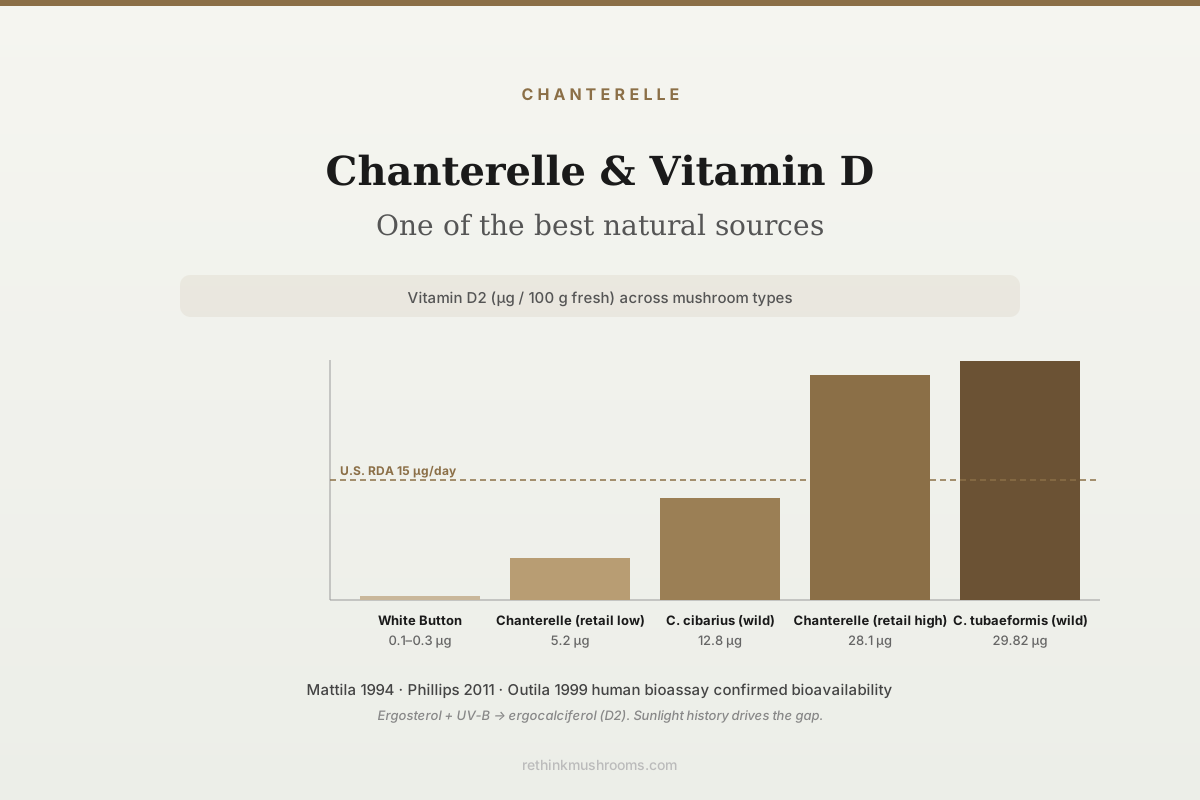
Wild chanterelles are one of the densest natural food sources of vitamin D known. Mattila and colleagues (1994) quantified 12.8 micrograms of ergocalciferol per 100 grams fresh weight in Cantharellus cibarius and 29.82 micrograms per 100 grams in Cantharellus tubaeformis, the funnel chanterelle, values that sit at the top end of the range for any food tested by HPLC. Phillips and colleagues (2011) later confirmed the pattern at retail in the United States, placing chanterelle alongside morel and maitake in the "high" vitamin D2 category at 5.2 to 28.1 micrograms per 100 grams, an order of magnitude above the button and crimini samples on the same shelf.[1] Those numbers set up the real question the evidence has to answer. A food can be rich in vitamin D2 on a laboratory assay and still fail to raise serum 25-hydroxyvitamin D in humans. Chanterelles have been subjected to exactly that human test, and the test returned a clear answer.
For the full range of this mushroom's nutrition, see chanterelle nutritional profile: a complete analysis and what is chanterelle? health benefits beyond gourmet cooking.
Key Takeaways
- Cantharellus tubaeformis (funnel chanterelle) contained 29.82 µg/100 g of ergocalciferol in Mattila et al. (1994), among the highest vitamin D2 values measured in any food
- Cantharellus cibarius (golden chanterelle) contained 12.8 µg/100 g in the same analysis, also far above the button mushroom reference
- Phillips et al. (2011) confirmed the "high D2" pattern at U.S. retail: chanterelle grouped with morel and maitake at 5.2–28.1 µg/100 g
- Outila et al. (1999) ran a human bioassay: a 14-µg/day dose of D2 from C. tubaeformis for three weeks raised serum 25(OH)D comparably to the same dose as a pharmaceutical ergocalciferol supplement
- The D2 in chanterelles is produced when ergosterol in the fruiting body is photochemically converted by UV-B light, so sun-exposed wild chanterelles carry far more than shade-grown cultivars
- Drying under sunlight or UV can further raise D2; Jiang et al. (2020) showed UV-driven ergosterol-to-D2 conversion during drying is a reproducible way to boost the final D2 content
How Chanterelles Make Vitamin D2
The biochemistry is the same in chanterelles as in any other vitamin D2 producing organism. Ergosterol, the dominant sterol of fungal cell membranes, absorbs UV-B photons in the 280–315 nm range and undergoes a photochemical ring-opening to previtamin D2, which then isomerises thermally to ergocalciferol (vitamin D2). Keegan and colleagues (2013) reviewed the photobiology in detail and showed the mushroom pathway is quantitatively analogous to the human skin pathway, where 7-dehydrocholesterol converts to previtamin D3 under the same UV-B wavelengths.[2]
Two features of the mushroom pathway matter for chanterelles specifically. Ergosterol concentration sets a ceiling on how much D2 a fruiting body can produce, and chanterelles carry substantial ergosterol in their caps and gills. Phillips et al. (2011) reported ergosterol in the chanterelle samples in the same range as other cultivated mushrooms, meaning the substrate is present.[1] UV-B exposure in the field is the variable that determines how much of that ergosterol actually becomes D2. Chanterelles grow in forest-floor light gaps, often under broken canopy, and receive substantially more UV-B than shade-grown button mushrooms produced in climate-controlled cultivation houses. That environmental difference explains the order-of-magnitude gap in measured D2 content between wild chanterelle and retail white button.
Koyyalamudi and colleagues (2009) demonstrated the same ergosterol-to-D2 conversion in Agaricus bisporus under controlled UV irradiation and showed the reaction is fast enough to generate substantial D2 within minutes of exposure.[3] The implication for wild chanterelles is that field sunlight, even diffuse forest-floor UV-B, is enough to drive meaningful D2 accumulation in the fruiting body over the days it sits above ground before picking.
How Much Vitamin D Is Actually In Chanterelles
The numbers vary substantially across studies, because the ecological variables (species, light exposure, age of fruiting body, season, drying conditions) are variables that matter. A synthesis of the peer-reviewed values gives the following picture.
| Source | Species | Vitamin D2 (µg/100 g fresh) |
|---|---|---|
| Mattila 1994 | C. tubaeformis (wild) | 29.82 |
| Mattila 1994 | C. cibarius (wild) | 12.8 |
| Phillips 2011 | Chanterelle (U.S. retail) | 5.2–28.1 |
| Witkowska 2011 | Wild edible mushrooms (incl. chanterelle) | High ergosterol, confirmed D precursor range |
The Phillips 2011 retail survey is the most practically relevant dataset for consumers in the United States, because it measured what was actually available to buy.[1] The wide retail range (5.2 to 28.1 µg/100 g) reflects differences in source, handling and sunlight history. The low end still beats every non-UV-treated cultivated mushroom measured in the same study, where D2 ran 0.1 to 0.3 µg/100 g for white button, crimini and portabella.
For perspective, the U.S. RDA for vitamin D is 15 µg/day (600 IU) for adults. A 100-gram serving of wild funnel chanterelle as measured by Mattila 1994 delivered roughly 29.82 µg, about twice the RDA. Even the low retail end of the Phillips 2011 range (5.2 µg/100 g) represents more than a third of the RDA per 100-gram serving. Few whole foods outside of oily fish and fortified products approach these concentrations.
Wild Versus Cultivated: Why Sunlight Drives The Gap
The separation between wild chanterelle D2 content and cultivated button D2 content is not a property of the mushroom, it is a property of the growing conditions. Jiang and colleagues (2020) demonstrated the controllability of the ergosterol-to-D2 conversion by drying mushrooms under different UV exposure regimes, showing that D2 content in the final product is predictable from UV-B dose delivered.[4] Applying the same principle to chanterelle ecology, a wild Cantharellus flush that emerges under a light-gap in the forest canopy and persists for several days of sunlit hours will accumulate substantial D2 from its native ergosterol pool. A button mushroom grown indoors in darkness until harvest will not, because the photochemical step never runs.
Leung and colleagues (2021) reviewed the cultivated-mushroom literature and showed that controlled UV irradiation of cultivated species can bring their D2 content up to, and in some cases above, wild-mushroom levels, confirming that the species is not the limiting factor.[5] The practical consequence is that a wild-harvested chanterelle from a sunlit flush is a high-D2 food by virtue of its light history, and a pale chanterelle grown in deep shade will carry substantially less. Consumers who want to use chanterelle as a vitamin D source have leverage: sunlit wild harvest, or gill-side-up sun exposure before drying, measurably raises D2.
Is Mushroom Vitamin D2 Actually Bioavailable In Humans?
This is the question that distinguishes a real food source of vitamin D from a laboratory curiosity. For chanterelle specifically, the answer is yes, and it comes from a dedicated human bioassay.
Outila and colleagues (1999) conducted a controlled feeding study at the University of Helsinki in 27 volunteers with baseline serum 25-hydroxyvitamin D under 60 nmol/L, a population actually vitamin D insufficient.[6] The subjects were randomised into three groups of nine. Group 1 received wild Cantharellus tubaeformis mushrooms providing 14 µg of ergocalciferol per day with lunch for three weeks (excluding weekends). Group 2 received a matched 14 µg/day ergocalciferol supplement. Group 3 received no vitamin D. The serum 25(OH)D rise in the mushroom group was statistically significant and comparable to the rise in the supplement group, establishing that the D2 inside C. tubaeformis is released during digestion and absorbed to the same quantitative endpoint as pharmaceutical ergocalciferol.
Outila's finding has been corroborated in broader mushroom research. Urbain and colleagues (2011) ran a randomised controlled trial of UV-B-irradiated button mushrooms in vitamin-D-deficient adults and showed a serum 25(OH)D rise that tracked dose.[7] Mehrotra and colleagues (2014) tested D2-enriched mushrooms in prediabetic adults and again showed bioavailability comparable to supplementation.[8] Cashman and colleagues (2016) reanalysed biobanked sera from a UV-mushroom RCT using LC-MS/MS, the most specific analytical method available, and confirmed the 25(OH)D rise was driven by 25(OH)D2, not 25(OH)D3, demonstrating that the signal is genuinely mushroom-derived and not confounded by background skin synthesis.[9]
The chanterelle-specific Outila bioassay, in combination with the broader UV-mushroom RCT literature, converges on a simple conclusion. Mushroom vitamin D2 is absorbed, is hydroxylated in the liver to 25(OH)D2, and raises total serum 25-hydroxyvitamin D at doses equivalent to ergocalciferol supplements. Chanterelle is not a marginal source at the laboratory level and is not a marginal source at the human-physiology level.
How D3 and D2 Compare
Some studies have reported that vitamin D3 raises serum 25(OH)D somewhat more efficiently than D2 at equal doses, particularly at higher single-bolus doses. At the typical dietary or modest-supplement doses relevant to mushroom consumption, the gap narrows. Leung 2021 summarised the trial evidence and concluded mushroom-derived D2 is a clinically meaningful contributor to vitamin D status, with the caveat that very high pharmacological doses may show some D2-versus-D3 divergence.[5] The relevant comparison for a consumer is against the alternative of no dietary vitamin D, not against pharmaceutical D3 megadoses. Against that relevant alternative, chanterelle D2 performs.
Phillips and colleagues (2012) also identified small amounts of vitamin D4 (22,23-dihydroergocalciferol) in several mushroom species, expanding the vitamin D family known to occur naturally in fungi.[10] D4 is biologically active but quantitatively minor compared to D2 in chanterelle, and the D2 signal dominates the serum response.
Drying, Cooking and Storage: Does The D2 Survive?
A concern raised by any heat-sensitive micronutrient is whether cooking destroys it. The vitamin D2 evidence is reassuring. Jiang and colleagues (2020) characterised ergosterol-to-D2 conversion during drying of several mushrooms, including thermal and UV-B drying regimes, and found that UV exposure during drying actually increased D2 content in the final product, not decreased it.[4] D2 is more thermostable than many water-soluble vitamins and survives typical sautéing and drying temperatures.
Keegan and colleagues (2013) noted that vitamin D in mushrooms is reasonably stable during normal storage and cooking, with losses that are modest compared to the absolute D2 concentrations involved.[2] A practical implication is that a wild chanterelle sun-dried gill-side-up or dehydrated under UV light will concentrate its D2 (by removing water mass) and can retain the vitamin D well in storage. Cooking does not erase the benefit.
Chanterelle Versus Other Food Sources Of Vitamin D
Setting chanterelle against the other notable natural dietary sources of vitamin D gives a clearer sense of scale.
- Wild chanterelle (C. tubaeformis, Mattila 1994): up to 29.82 µg/100 g
- Fatty fish (e.g. salmon, cooked): ~10–15 µg/100 g, varying by species and wild versus farmed
- Fortified milk (U.S.): ~1 µg/100 g (≈2.5 µg per cup)
- Egg yolks: ~0.5–1 µg per yolk
- White button mushroom (non-UV): 0.1–0.3 µg/100 g
On a per-100-gram basis, wild chanterelle outperforms every food in this list except UV-treated or naturally UV-exposed sibling mushrooms (morel, maitake) and some fish-liver products. The comparison shifts when realistic serving sizes are considered, but the central point holds. Few plant-kingdom or fungi-kingdom foods come close to the vitamin D2 density of sun-exposed chanterelle.
Limitations Of The Evidence
The chanterelle-specific evidence is stronger than it is for most mushrooms, because Outila 1999 tested C. tubaeformis directly in humans. Several limitations are still worth stating plainly.
Species matters. C. tubaeformis (funnel chanterelle) tested higher than C. cibarius (golden chanterelle) in Mattila 1994, and retail samples in Phillips 2011 spanned a wide range. A consumer buying "chanterelle" at retail may be getting a species or a light-history batch that sits at the low end of the range, not the 29.82 µg/100 g top end.
The Outila bioassay is a single 27-subject, three-group study. The result is internally coherent and directionally consistent with the broader UV-mushroom RCT literature, but chanterelle-specific human data have not been replicated in a second trial.
The D2-versus-D3 efficacy question is unsettled at high doses. At typical dietary levels the difference is small, but someone relying on mushroom D2 as a sole vitamin D source at low latitudes with limited skin synthesis should recognise that the ceiling on D2-driven serum 25(OH)D rise may be somewhat lower than D3-driven rise.
The light-history variability is large. Two visually similar chanterelle batches can carry very different D2 loads depending on sunlight exposure during growth and drying. Without analytical measurement of a specific batch, a consumer cannot know whether a given dish delivers 5 µg or 25 µg of D2 per 100 grams.
Finally, the Cantharellus genus has other bioactive components. Marathe and colleagues (2022) showed anti-angiogenic activity of C. cibarius extracts in preclinical models, which is a separate line of evidence unrelated to vitamin D content but illustrates that chanterelle is not a single-compound food.[11] Witkowska and colleagues (2011) also found chanterelle ranked well among wild edible mushrooms for antioxidant capacity.[12] For the full compositional picture see chanterelle antioxidant and anti-inflammatory properties and chanterelle vitamin D2 and carotenoid content: the golden mushroom's nutritional edge.
What The Evidence Actually Establishes
The published evidence supports a precise set of claims, each traceable to named studies:
- Wild chanterelles, especially C. tubaeformis, contain among the highest natural vitamin D2 concentrations of any food, with 29.82 µg/100 g fresh weight measured in Mattila 1994 and retail ranges of 5.2–28.1 µg/100 g in Phillips 2011
- The D2 is produced by UV-B photochemical conversion of ergosterol in the fruiting body, so light exposure during growth is the dominant variable driving content
- In a human bioassay, C. tubaeformis delivering 14 µg D2/day raised serum 25-hydroxyvitamin D comparably to a matched ergocalciferol supplement over three weeks (Outila 1999)
- UV-B-irradiated and naturally UV-exposed mushrooms more broadly have been shown to raise serum 25(OH)D in multiple RCTs (Urbain 2011, Mehrotra 2014, Cashman 2016)
- Drying and cooking do not meaningfully reduce the D2 content at typical preparation temperatures; UV-assisted drying can increase it (Jiang 2020)
That evidence base makes chanterelle one of the most empirically defensible natural food sources of vitamin D known. Not theoretically high because of its laboratory D2 concentration, but empirically high because the D2 has been tested in humans and shown to work.
The Bottom Line
Wild chanterelles contain vitamin D2 at concentrations among the highest measured in any natural food, with C. tubaeformis reaching 29.82 µg/100 g in Mattila 1994 and retail samples spanning 5.2–28.1 µg/100 g in Phillips 2011. A dedicated human bioassay (Outila 1999) showed the D2 is absorbed and raises serum 25-hydroxyvitamin D comparably to ergocalciferol supplementation. Sunlight history during growth drives the variability, and ordinary cooking preserves the D2.
Frequently Asked Questions
Sources & References
- 1RTHM-00230·Phillips, Katherine M et al. (2011). “Vitamin D and sterol composition of 10 types of mushrooms from retail suppliers in the United States..” Journal of agricultural and food chemistry.Study breakdown →PubMed →↩
- 2RTHM-00292·Keegan, Raphael-John H et al. (2013). “Photobiology of vitamin D in mushrooms and its bioavailability in humans..” Dermato-endocrinology.Study breakdown →PubMed →↩
- 3RTHM-00159·Koyyalamudi, Sundar Rao et al. (2009). “Vitamin D2 formation and bioavailability from Agaricus bisporus button mushrooms treated with ultraviolet irradiation..” Journal of agricultural and food chemistry.Study breakdown →PubMed →↩
- 4RTHM-00623·Jiang, Qiyong et al. (2020). “UV induced conversion during drying of ergosterol to vitamin D in various mushrooms: Effect of different drying conditions..” Trends in food science & technology.Study breakdown →PubMed →↩
- 5RTHM-00698·Leung, Mei Fong et al. (2021). “Vitamins D and D2 in Cultivated Mushrooms under Ultraviolet Irradiation and Their Bioavailability in Humans: A Mini-Review..” International journal of medicinal mushrooms.Study breakdown →PubMed →↩
- 6RTHM-00031·Outila, T A et al. (1999). “Bioavailability of vitamin D from wild edible mushrooms (Cantharellus tubaeformis) as measured with a human bioassay..” The American journal of clinical nutrition.Study breakdown →PubMed →↩
- 7RTHM-00237·Urbain, P et al. (2011). “Bioavailability of vitamin D₂ from UV-B-irradiated button mushrooms in healthy adults deficient in serum 25-hydroxyvitamin D: a randomized controlled trial..” European journal of clinical nutrition.Study breakdown →PubMed →↩
- 8RTHM-00340·Mehrotra, A et al. (2014). “Bioavailability of vitamin D2 from enriched mushrooms in prediabetic adults: a randomized controlled trial..” European journal of clinical nutrition.Study breakdown →PubMed →↩
- 9RTHM-00419·Cashman, Kevin D et al. (2016). “Effect of Ultraviolet Light-Exposed Mushrooms on Vitamin D Status: Liquid Chromatography-Tandem Mass Spectrometry Reanalysis of Biobanked Sera from a Randomized Controlled Trial and a Systematic Review plus Meta-Analysis..” The Journal of nutrition.Study breakdown →PubMed →↩
- 10RTHM-00261·Phillips, Katherine M et al. (2012). “Vitamin D4 in mushrooms..” PloS one.Study breakdown →PubMed →↩
- 11RTHM-00786·Marathe, Sandesh J et al. (2022). “Anti-Angiogenic Effect of Cantharellus cibarius Extracts, its Correlation with Lipoxygenase Inhibition, and Role of the Bioactives Therein..” Nutrition and cancer.Study breakdown →PubMed →↩
- 12RTHM-00238·Witkowska, Anna M et al. (2011). “Comparative study of wild edible mushrooms as sources of antioxidants..” International journal of medicinal mushrooms.Study breakdown →PubMed →↩