Chanterelle
14–54% protein (dry weight, reported range)
Cantharellus cibarius is genuinely protein-dense and low in fat, but the single figure usually quoted sits at the very top of a fourfold range. Beneath the headline is a mushroom with a dense mineral panel, structural polysaccharides, and among the highest natural vitamin D2 values measured in any food.
Kumar et al., Food Science & Nutrition, 2025; Phillips et al., J. Agric. Food Chem., 2011
Protein-Dense, Low Fat
13.7–53.7% protein, ~2.9% fat dry weight
Dense Mineral Panel
K far ahead of P, Ca; Fe, Cu, Se variable
β-glucans + Mannans
structural and bioactive polysaccharides
Kumar et al., Food Science & Nutrition, 2025; Phillips et al., J. Agric. Food Chem., 2011
 View as image ↗
Most public-facing nutrition summaries of chanterelle collapse the mushroom into a few round-number calorie and vitamin values borrowed from USDA tables. The peer-reviewed literature is both more detailed and more interesting — and considerably less settled. Cantharellus cibarius has been analysed in controlled laboratory studies for macronutrients, minerals, amino acids, polysaccharides, carotenoids, phenolics and specific bioactive compounds. Some of those numbers converge tightly. Others disagree by a factor of two or more between labs analysing the same species, and the popular summaries almost always quote the highest value without mentioning the spread.
Kumar and colleagues (2025) compiled the most recent comprehensive review of the species, and it is the single best entry point to the primary data.[1] Kumari and colleagues (2011) separately analysed 18 wild Cantharellus samples from the northwestern Himalayas, confirming the genus-level macronutrient picture across a broad geographic sample.[2] This article reports what those studies actually found, including where they contradict each other.
For the bigger picture on this mushroom, see what is chanterelle? health benefits beyond gourmet cooking and the dedicated deep-dives in chanterelle and vitamin D: one of the best natural sources, chanterelle vitamin D2 and carotenoid content: the golden mushroom's nutritional edge and chanterelle antioxidant and anti-inflammatory properties.
Key Takeaways
- Reported crude protein across Cantharellus species spans 13.71%–53.7% of dry weight; the widely-quoted "53.7% protein" figure is the top of that range, and a separate analysis of C. cibarius reported 21.57 g/100 g dry weight (Kumar et al., 2025)
- Phillips et al. (2011) measured chanterelle in the top vitamin D2 tier at 5.2–28.1 µg/100 g fresh weight, alongside morel and maitake — roughly two orders of magnitude above untreated white button, crimini and portabella at 0.1–0.3 µg/100 g
- Outila et al. (1999) ran the human bioavailability test: 14 µg/day of ergocalciferol from wild C. tubaeformis raised serum 25-hydroxyvitamin D no differently from a matched 14 µg/day supplement (P = 0.317), and both beat no supplementation
- Kumari et al. (2011) analysed 18 wild Cantharellus samples and confirmed a high-protein, high-carbohydrate, low-fat profile with significant phenolic content and antioxidant capacity — that study measured ash, not an itemised mineral panel
- Chen et al. (2024) catalogued the full chemical fingerprint: polysaccharides including β-glucans and branched mannans, phenolics, carotenoids, ergosterol, fatty acids and a broad amino acid panel
- C. cibarius contains branched mannans (characterised by Lemieszek et al., 2019) with documented in vitro antitumor activity that was selective for colon cancer cells over normal colon epithelium
- Wild chanterelle bioaccumulates copper, cadmium, mercury and lead; blanching removes roughly 11–36% of cadmium and 15–35% of mercury, which helps but does not make a contaminated-site harvest safe (Kumar et al., 2025)
Macronutrients: Protein-Dense, But Read The Range
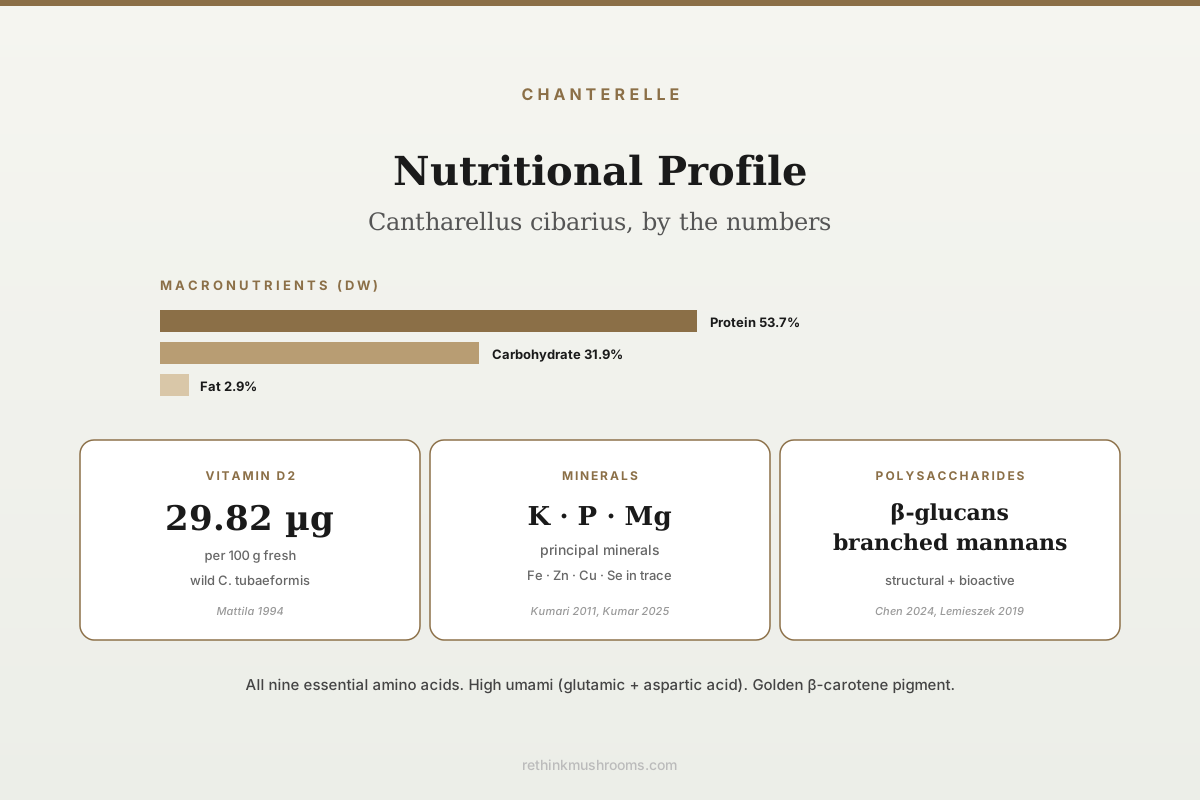
The macronutrient profile of C. cibarius is one of its most striking features, and also the one most often misreported. Kumar et al. (2025) compiled values from across the literature and reported dry-weight composition of 53.7% protein, 31.9% carbohydrate and 2.9% fat for C. cibarius, positioning chanterelle as high-protein and low-fat among wild edible mushrooms.[1]
That is the figure almost every summary quotes. The same review also reports the context that makes it interpretable: crude protein across Cantharellus species has been observed at 13.71%–53.7% of dry weight, and a separate analysis of C. cibarius specifically put protein at 21.57 g/100 g dry weight — less than half the headline number.[1] The carbohydrate figure shows the same pattern: 31.9% in one analysis, 66.07 g/100 g dry weight in another.[1]
The Number Behind The Number
“53.7% Protein” Is The Ceiling, Not The Average
Reported crude protein across Cantharellus species spans roughly fourfold. The headline figure sits at the very top of that range, and a separate analysis of the same species — C. cibarius — came in at well under half of it. Both numbers are in the literature. Neither is “the” protein content of a chanterelle.
21.57%
C. cibarius — Ouzouni 2009
same species, different lab
53.7%
C. cibarius — Muszynska 2016
the figure everyone quotes
crude protein, % of dry weight
Also reported by the same review
A separate analysis put carbohydrate at 66.07 g/100 g DW — roughly double. The spread is not a rounding difference.
On a plate (derived)
The dry-weight range applied to fresh chanterelle, which is roughly nine-tenths water. Derived here, not reported directly.
Source: Kumar et al. (2025), Food Science & Nutrition 13(1):e4641 [ref 1], compiling Ugbogu et al. 2020 (13.71%–53.7% crude protein across Cantharellus species), Muszyńska et al. 2016 (53.7% protein / 31.9% carbohydrate / 2.9% fat DW) and Ouzouni et al. 2009 (21.57 g protein and 66.07 g carbohydrate per 100 g DW). Plotted values are as reported; the fresh-weight band is derived from the dry-weight range and is shown as an approximation.
Kumari and colleagues (2011) analysed 18 different wild Cantharellus samples from the northwestern Himalayas, measuring moisture, total carbohydrates, dietary fiber, crude fat, ash, nitrogen and protein alongside amino acid content by HPLC. They found the wild mushrooms to be rich sources of protein and carbohydrates with low fat, consistent with the genus-level picture.[2] That consistency across geographically distinct sampling is one of the stronger signals in the mushroom nutrition literature: the genus reproduces a recognisable macronutrient signature across substrates and climates, even as the specific values move.
Dietary fiber and carbohydrate structure deserve closer attention than the raw carbohydrate number suggests. Chen and colleagues (2024) reviewed the chemical composition of C. cibarius in detail and showed that a significant fraction of the carbohydrate pool is non-starch polysaccharide, including β-glucans and structurally distinctive branched mannans.[3] The implication is that the "carbohydrate" number on a proximate analysis does not translate into rapidly absorbed sugar, but into a mix of cell-wall polysaccharides and oligosaccharides that behave more like dietary fiber.
The Vitamin Panel
Chanterelle's vitamin profile is dominated by a signature result: exceptional vitamin D2 content, driven by UV-B-mediated conversion of ergosterol in the fruiting body. Phillips and colleagues (2011) surveyed 10 types of mushrooms from U.S. retail suppliers and placed chanterelle in the high vitamin D2 group at 5.2–28.1 µg/100 g fresh weight, alongside morel and maitake. In the same analysis, Agaricus bisporus — white button, crimini and portabella — and enoki measured 0.1–0.3 µg/100 g, with shiitake and oyster at 0.4–0.7 µg/100 g.[4] That is roughly two orders of magnitude of separation, measured within a single study by a single method, which is what makes the comparison trustworthy.
For C. cibarius specifically, Kumar et al. (2025) report fresh chanterelle at 14.2 µg/100 g fresh weight, with dried sporocarps holding 0.12–6.3 µg/g of ergocalciferol after two to six years of storage.[1]
One Analysis, Ten Mushrooms, One Axis
Where Chanterelle Actually Sits On Vitamin D2
All four bands below come from the same study, measured the same way, so they can be compared directly. Chanterelle groups with morel and maitake at the top — roughly two orders of magnitude above untreated button mushroom, and above even UV-treated portabella at the high end.
Morel, chanterelle, maitake
5.2–28.1Portabella, UV-treated
3.4–20.9Shiitake, oyster
0.4–0.7White button, crimini, portabella, enoki
0.1–0.3vitamin D2, µg / 100 g fresh weight
A single-species figure
Dried sporocarps held 0.12–6.3 µg/g of ergocalciferol after two to six years of storage (Kumar 2025 [1]).
Does it absorb? One human trial
Mushroom vs. matched supplement, both 14 µg/day for 3 weeks: no significant difference in serum 25(OH)D. Both beat no supplementation (Outila 1999 [5], n = 27).
Read the bands as bands. These are ranges across sampled composites, not single values, and the authors specifically flag significant variability among composites for some mushroom types. A chanterelle at the bottom of its band carries less vitamin D2 than a UV-treated portabella at the top of its own.
Sources: Phillips et al. (2011), J Agric Food Chem 59:7841–7853 [ref 4] — all four plotted bands, µg/100 g fresh weight across 10 mushroom types sampled nationwide in the United States. Kumar et al. (2025) [ref 1] — 14.2 µg/100 g FW for fresh C. cibarius and 0.12–6.3 µg/g in dried sporocarps. Outila et al. (1999), Am J Clin Nutr 69:95–98 [ref 5] — human bioassay, 27 volunteers, 14 µg/day for 3 weeks.
Concentration in the food is only half the question. Outila and colleagues (1999) tested whether any of it is actually absorbed, using wild Cantharellus tubaeformis in a controlled human bioassay.[5]
Outila et al. (1999) · The American Journal of Clinical Nutrition
- Population
- 27 volunteers with baseline serum 25-hydroxyvitamin D below 60 nmol/L (mean 38.5 nmol/L), randomised into three groups of nine
- Intervention
- Wild Cantharellus tubaeformis supplying 14 µg ergocalciferol per day with lunch, on weekdays for three weeks
- Comparator
- A matched ergocalciferol supplement at 14 µg/day, and a third group receiving no supplementation
- Finding
- At three weeks, serum 25-hydroxyvitamin D did not differ significantly between the mushroom group and the supplement group (P = 0.317). Both differed significantly from the unsupplemented control (P = 0.032 and P = 0.004 respectively).
positive Small and short, but a genuine randomised human trial with a supplement comparator — the strongest single piece of evidence in the chanterelle nutrition literature. It establishes bioavailability of D2 from mushrooms, and nothing beyond that.
Outila et al. (1999), Am J Clin Nutr 69:95–98 [ref 5]
Beyond vitamin D, the Kumar 2025 review catalogued B-vitamins — thiamin, riboflavin, niacin, pantothenic acid — plus ascorbic acid and vitamins A and E, with concentrations varying across growth stage and drying protocol.[1] The B-vitamin contribution is quantitatively modest on a per-100-gram fresh basis but consistent with the general mushroom pattern. Phillips and colleagues (2012) also identified small quantities of vitamin D4 in several mushroom species, expanding the natural vitamin D family present in fungi.[6]
Provitamin A carotenoids are a secondary but distinctive feature of Cantharellus. The characteristic golden colour of C. cibarius comes from β-carotene and related carotenoids, and Chen et al. (2024) documented the pigment composition in detail.[3] The carotenoid density separates chanterelle from most other cultivated mushrooms, which are white or brown, and contributes to both the visual identity and the antioxidant capacity of the fruiting body. The dedicated chanterelle vitamin D2 and carotenoid content article covers this combination in detail.
The Mineral Panel
Chanterelles carry a full mineral panel with potassium far in front. Kumar et al. (2025) report potassium at 67,411.93 mg/kg dry weight, an order of magnitude above phosphorus at 5,126.47 mg/kg and calcium at 973.17 mg/kg.[1] A separate survey of Cantharellus species in the same review found the highest levels of calcium, followed by potassium and iron — a different ordering, and a reminder that mineral content tracks the growing site as much as the species.[1]
Selenium illustrates the variance at its most extreme. One analysis reported high selenium in C. cibarius at 63 µg/g dry weight; others reported it as low, at 0.61 and 0.153 mg/kg dry weight.[1] Those figures differ by about five orders of magnitude. Both are in the peer-reviewed record. Any claim that chanterelle "is a good selenium source" is quoting one end of that spread and ignoring the other.
Sodium content in wild mushrooms is generally low, and the low-sodium, high-potassium pattern is nutritionally favourable in the context of typical Western diets where the opposite predominates. Kumari's 18-sample Himalayan panel measured ash content — the total mineral residue — rather than itemising individual elements, so it supports the general picture of a mineral-rich genus without providing element-by-element values.[2]
C. cibarius is specifically documented to accumulate copper, cadmium, mercury and lead.[1] The practical question is what preparation removes, and the literature answers it with numbers.
What Preparation Actually Removes
Wild Chanterelle Bioaccumulates — And Some Of It Washes Out
C. cibarius is documented to accumulate copper, cadmium, mercury and lead from its substrate. The same literature measures how much ordinary preparation strips back out. These are reported reduction and leaching rates — useful, partial, and not a substitute for knowing where the mushroom grew.
Rinse · Radiocaesium (¹³⁷Cs, ¹³⁴Cs)
~30%~45 seconds under running tap water, fruiting bodies halved
Blanch (fresh) · Mercury (Hg)
15%gently boiling water, sliced, 5–15 min
Blanch (fresh) · Cadmium (Cd)
11–36%measured range across studies
Blanch (deep-frozen) · Mercury (Hg)
35%sliced, previously deep-frozen fruiting bodies
Pickling / processing · Mercury (Hg), total
up to 39%fresh pickled 15–37%; deep-frozen processed 37–39%
reduction / leaching, % of starting content
The limit of the technique. Even the best of these figures removes well under half the contaminant load, and blanching also leaches water-soluble vitamins and minerals into the discarded water. Preparation reduces exposure; it does not make a mushroom from a contaminated site safe. Harvest site remains the controlling variable.
Source: Kumar et al. (2025), Food Science & Nutrition 13(1):e4641 [ref 1], compiling primary processing studies on C. cibarius — blanching reduced cadmium by approximately 11% ± 7% to 36% ± 7%; blanching sliced fruiting bodies for 5–15 min leached 15% of mercury (35% when deep-frozen); total mercury leaching was 15–37% for fresh pickled and 37–39% for deep-frozen processed material; a ~45 s tap-water rinse improved radiocaesium removal by roughly 30%. Values are as reported and are not safety thresholds.
Wild Harvest
ModerateSite of harvest is the controlling variable for contaminant load
Concern
Cantharellus cibarius bioaccumulates copper, cadmium, mercury and lead from its substrate, and mineral values reported for clean-site research samples do not generalise to wild harvests from roadside, industrial or otherwise contaminated ground. Reported reductions from blanching — roughly 11–36% for cadmium and 15–35% for mercury — remove well under half the load, and blanching simultaneously leaches water-soluble vitamins and minerals into the discarded cooking water.
What the research says
Treat published mineral figures as coming from research-grade samples of known provenance. For foraged chanterelle, provenance is the intervention that matters; preparation is a partial secondary measure, not a remedy.
Particularly relevant for: Regular or high-volume consumers of foraged wild mushrooms, foragers harvesting near roads, industrial sites or historically contaminated ground, and anyone advised to limit heavy-metal or cadmium intake
What to do
Source wild chanterelle from known clean ground or a reputable supplier, vary harvest sites rather than repeatedly picking one, and speak with a qualified healthcare provider before making foraged wild mushrooms a dietary staple. This article is educational and is not medical advice.
Kumar et al. (2025), Food Sci Nutr 13(1):e4641 [ref 1]
Amino Acid Composition
Protein quality in chanterelle is a function of the amino acid profile, not just total protein. Chen and colleagues (2024) catalogued the amino acid composition of C. cibarius and reported a full complement of essential and non-essential amino acids.[3] Kumar et al. (2025) quantify the pattern: across Cantharellus species, glutamic acid is the most abundant at 12.90 g and aspartic acid at 7.74 g per 100 g of protein, with leucine at 7.56 g and tryptophan lowest at 0.92 g.[1]
Lysine and threonine — the amino acids most commonly limiting in cereal-based diets — are both present at nutritionally meaningful levels, reported at 5.74 and 8.98 mg/g dry weight respectively in C. cibarius.[1] Threonine at 8.98 mg/g is described as the highest-quantity amino acid on that measure, which is an unusual profile for an edible fungus.
The abundance of glutamic and aspartic acid is relevant beyond nutrition. These two are the primary drivers of the umami taste profile, which explains the gastronomic reputation of chanterelle and the depth of savoury flavour it contributes to cooked dishes. The amino acid contribution is nutritionally broad but quantitatively modest on a fresh-weight basis, consistent with the roughly 90% water content of the fresh mushroom.[1]
Beta-Glucans And Bioactive Polysaccharides
The carbohydrate fraction of chanterelle is not a simple pool of starch and sugar. The dominant polysaccharides are structural — chitin, cell-wall glucans — and bioactive: β-glucans and branched mannans. Chen and colleagues (2024) characterised the polysaccharide landscape and identified β-1,3 and β-1,6 glucans as significant components of the fruiting body, with branched mannans as a Cantharellus-specific structural feature.[3] Quantitatively, β-glucan content in dried C. cibarius samples has been measured across a wide range of 0.38–14.90 mg/g, varying with preparation and extract type.[1]
Lemieszek and colleagues (2019) isolated a branched mannan from C. cibarius, designated CC2a, and tested it against human colon cancer cells. It suppressed proliferation and disrupted membrane integrity in LS180 colon cancer cells while leaving normal CCD841 CoN colon epithelial cells unaffected, acting through interference with NF-κB pathway signalling.[7] That selectivity between cancerous and normal cells of the same tissue is the notable part of the result. The same group had earlier reported neuroprotective activity of C. cibarius polysaccharide fractions across in vitro models of trophic stress, excitotoxicity and oxidative stress.[8]
These are cell-culture findings, not clinical endpoints. What they establish is that the polysaccharide fraction of chanterelle is not merely structural bulk — it is a pool of molecules with defined, measurable biological activity. What they do not establish is any effect in a human being who eats a chanterelle.
For antioxidant and anti-inflammatory mechanisms from these and related compounds, see chanterelle antioxidant and anti-inflammatory properties.
Phenolics, Antioxidants And Other Bioactives
Chanterelle carries a phenolic fraction that contributes to its antioxidant capacity, but its standing relative to other wild edibles is more specific than usually reported. Witkowska and colleagues (2011) compared 16 popular wild-growing edible species as antioxidant sources.[9] On total polyphenol content and on the FRAP, TEAC and DPPH assays, the top performers were consistently Boletus and Leccinum species — chanterelle was not among them. On one measure, however, C. cibarius led the entire panel: it showed the strongest ferrous-ion chelating ability of all 16 species tested, with an EC50 of 8.02 mg/mL against 12.10 mg/mL for the weakest.[9]
That is a more useful finding than a general "high antioxidant" label. Metal chelation and radical scavenging are different mechanisms, and chanterelle is comparatively strong at the former rather than being broadly superior at everything.
Fogarasi and colleagues (2021) compared four extraction solvents for polyphenolic characterisation in C. cibarius and Boletus edulis from Romania, quantifying multiple phenolic compounds and confirming how strongly measured values depend on the extraction protocol.[10] Marathe and colleagues (2022) identified anti-angiogenic activity of C. cibarius petroleum ether and ethanol extracts using a chick chorioallantoic membrane assay, with a dose-dependent response benchmarked against silibinin and lenalidomide, and correlated the activity with lipoxygenase inhibition.[11]
Ergosterol, the dominant fungal sterol and the precursor for UV-generated vitamin D2, is present in quantity: fresh chanterelle has been measured at 24.7 mg ergosterol, alongside smaller amounts of ergosta-7-enol, ergosta-7,22-dienol and ergosta-5,7-dienol.[1]
How Processing Affects The Numbers
Fresh chanterelle is rarely eaten raw. Drying and cooking alter the measured nutritional profile, and the direction of change differs by nutrient. Chen and colleagues (2024) reviewed the processing literature and summarised the key patterns.[3]
- Water mass removal during drying concentrates all other nutrients on a per-gram basis, so dried chanterelle shows roughly ten times the nutrient density of fresh by mass
- Vitamin D2 is stable or increased under UV-assisted drying, because the ergosterol-to-D2 photochemical conversion continues during the drying step
- Vitamin D2 does decline over long storage: dried sporocarps retained 0.12–6.3 µg/g after two to six years[1]
- Water-soluble vitamins (B-complex, vitamin C) lose some fraction to cooking water when boiled, with retention better under dry-heat preparation
- Heat-labile antioxidants show modest losses during typical sautéing, but baseline concentrations are high enough that cooked chanterelle still contributes meaningful antioxidant capacity
- Protein and mineral content are largely preserved across cooking methods, because neither is heat-labile in the relevant temperature range
The practical consequence is that typical preparation methods, from quick sautéing to proper sun or oven drying, preserve the nutritionally important features of chanterelle without dramatic losses. The one genuine trade-off is blanching: it measurably reduces contaminant load, and it measurably leaches water-soluble nutrients at the same time.
Limitations Of The Composition Data
The numbers in this article are drawn from named peer-reviewed studies, but several caveats apply before any specific value is taken as a universal reference.
Between-study variation is the dominant caveat, not a footnote. As set out above, reported protein for the genus spans 13.71%–53.7% of dry weight, carbohydrate figures differ roughly twofold for the same species, and selenium estimates differ by orders of magnitude.[1] When a source quotes a single confident number for chanterelle nutrition, it has almost certainly picked one study out of several that disagree.
Species variation is substantial. C. cibarius, C. tubaeformis, C. minor and other Cantharellus species share a composition signature but differ in specific values. The vitamin D2 literature makes the point directly: Phillips 2011 measured retail chanterelle across a 5.2–28.1 µg/100 g fresh-weight band, and the human bioavailability work of Outila 1999 used C. tubaeformis rather than C. cibarius — related species, different data.[4]
Ecogeographic variation is also substantial. Kumari's 18-sample Himalayan analysis showed range across samples within a single region, and cross-regional comparisons widen the variance further.[2] Soil composition, climate, canopy cover and season all feed into final composition.
Analytical method matters. Fogarasi 2021 showed that extraction solvent choice alone changes reported phenolic concentrations substantially for the same mushroom sample.[10] Comparing "chanterelle polyphenol content" across studies without accounting for method differences produces misleading aggregates.
Most bioactivity evidence is preclinical. Branched mannan antitumor activity, polysaccharide neuroprotection and extract anti-angiogenic activity are all in vitro or animal-model findings. Clinical human trials on C. cibarius as a whole food are essentially absent. The vitamin D2 bioavailability trial in Outila 1999 is the main exception, and its conclusions are narrowly about D2 absorption — not about cancer, cognition, inflammation, or any other proposed health effect.
Finally, wild chanterelle can carry heavy metals from contaminated substrate, and mineral values reported for clean-site research samples do not generalise to wild harvests from polluted regions.
Summary Of Values
| Nutrient | Approximate value | Primary source |
|---|---|---|
| Protein (dry weight) | 13.71–53.7% across Cantharellus spp.; 21.57 g/100 g and 53.7% both reported for C. cibarius | Kumar 2025 |
| Carbohydrate (dry weight) | 31.9% in one analysis; 66.07 g/100 g in another | Kumar 2025 |
| Fat (dry weight) | ~2.9% | Kumar 2025 |
| Vitamin D2 (fresh) | 5.2–28.1 µg/100 g retail chanterelle; 14.2 µg/100 g for fresh C. cibarius | Phillips 2011; Kumar 2025 |
| Vitamin D2 bioavailability | 14 µg/day from mushroom ≈ matched supplement (P = 0.317) | Outila 1999 |
| Potassium, phosphorus, calcium | 67,411.93 / 5,126.47 / 973.17 mg/kg dry weight | Kumar 2025 |
| Selenium | Contested: 63 µg/g DW in one report; 0.61 and 0.153 mg/kg DW in others | Kumar 2025 |
| β-glucans | 0.38–14.90 mg/g in dried samples; plus branched mannans | Kumar 2025; Chen 2024 |
| Amino acids | Glutamic 12.90 g, aspartic 7.74 g per 100 g protein; threonine 8.98 and lysine 5.74 mg/g DW | Kumar 2025 |
| Carotenoids | β-carotene and related; source of golden pigment | Chen 2024 |
| Ergosterol | 24.7 mg in fresh chanterelle; dominant sterol and D2 precursor | Kumar 2025 |
| Metal chelation | Strongest ferrous-ion chelating ability of 16 wild species (EC50 8.02 mg/mL) | Witkowska 2011 |
The Bottom Line
Cantharellus cibarius is a protein-dense, low-fat mushroom rich in dietary fiber and structural polysaccharides including β-glucans and branched mannans, and it carries one of the highest natural vitamin D2 concentrations of any food. The important qualification is that the widely-quoted "53.7% protein" figure is the ceiling of a range that runs down to 13.71%, and comparable disagreement exists for carbohydrate and selenium. The vitamin D2 finding is the most solid claim in the whole profile: Phillips 2011 measured chanterelle roughly two orders of magnitude above untreated button mushroom in a single controlled comparison, and Outila 1999 showed in a randomised human trial that the D2 is absorbed as well as a matched supplement. The mineral panel is dominated by potassium, amino acid composition is broad with unusually high threonine, and the bioactive polysaccharide work is genuine but entirely preclinical. Species and growing-site variation are substantial, and wild-harvest heavy-metal accumulation is a real caveat that preparation only partially addresses.
Frequently Asked Questions
Sources & References
- 1RTHM-00931·Kumar, Ajay et al. (2025). “Nutritional, Nutraceutical, and Medicinal Potential of Cantharellus cibarius Fr.: A Comprehensive Review..” Food science & nutrition.Study breakdown →PubMed →↩
- 2RTHM-00222·Kumari, D et al. (2011). “Nutritional composition and antioxidant activities of 18 different wild Cantharellus mushrooms of northwestern Himalayas..” Food science and technology international = Ciencia y tecnologia de los alimentos internacional.Study breakdown →PubMed →↩
- 3RTHM-00870·Chen, Xinlei et al. (2024). “Insights into chemical components, health-promoting effects, and processing impact of golden chanterelle mushroom Cantharellus cibarius..” Food & function.Study breakdown →PubMed →↩
- 4RTHM-00230·Phillips, Katherine M et al. (2011). “Vitamin D and sterol composition of 10 types of mushrooms from retail suppliers in the United States..” Journal of agricultural and food chemistry.Study breakdown →PubMed →↩
- 5RTHM-00031·Outila, T A et al. (1999). “Bioavailability of vitamin D from wild edible mushrooms (Cantharellus tubaeformis) as measured with a human bioassay..” The American journal of clinical nutrition.Study breakdown →PubMed →↩
- 6RTHM-00261·Phillips, Katherine M et al. (2012). “Vitamin D4 in mushrooms..” PloS one.Study breakdown →PubMed →↩
- 7RTHM-00568·Lemieszek, Marta K et al. (2019). “Cantharellus cibarius branched mannans inhibits colon cancer cells growth by interfering with signals transduction in NF-ĸB pathway..” International journal of biological macromolecules.Study breakdown →PubMed →↩
- 8RTHM-00516·Lemieszek, Marta K et al. (2018). “Neuroprotective properties of Cantharellus cibarius polysaccharide fractions in different in vitro models of neurodegeneration..” Carbohydrate polymers.Study breakdown →PubMed →↩
- 9RTHM-00238·Witkowska, Anna M et al. (2011). “Comparative study of wild edible mushrooms as sources of antioxidants..” International journal of medicinal mushrooms.Study breakdown →PubMed →↩
- 10RTHM-00686·Fogarasi, Melinda et al. (2021). “Comparison of Different Extraction Solvents for Characterization of Antioxidant Potential and Polyphenolic Composition in Boletus edulis and Cantharellus cibarius Mushrooms from Romania..” Molecules (Basel.Study breakdown →PubMed →↩
- 11RTHM-00786·Marathe, Sandesh J et al. (2022). “Anti-Angiogenic Effect of Cantharellus cibarius Extracts, its Correlation with Lipoxygenase Inhibition, and Role of the Bioactives Therein..” Nutrition and cancer.Study breakdown →PubMed →↩