Mushroom Supplement Sourcing
3 different Quality Problems
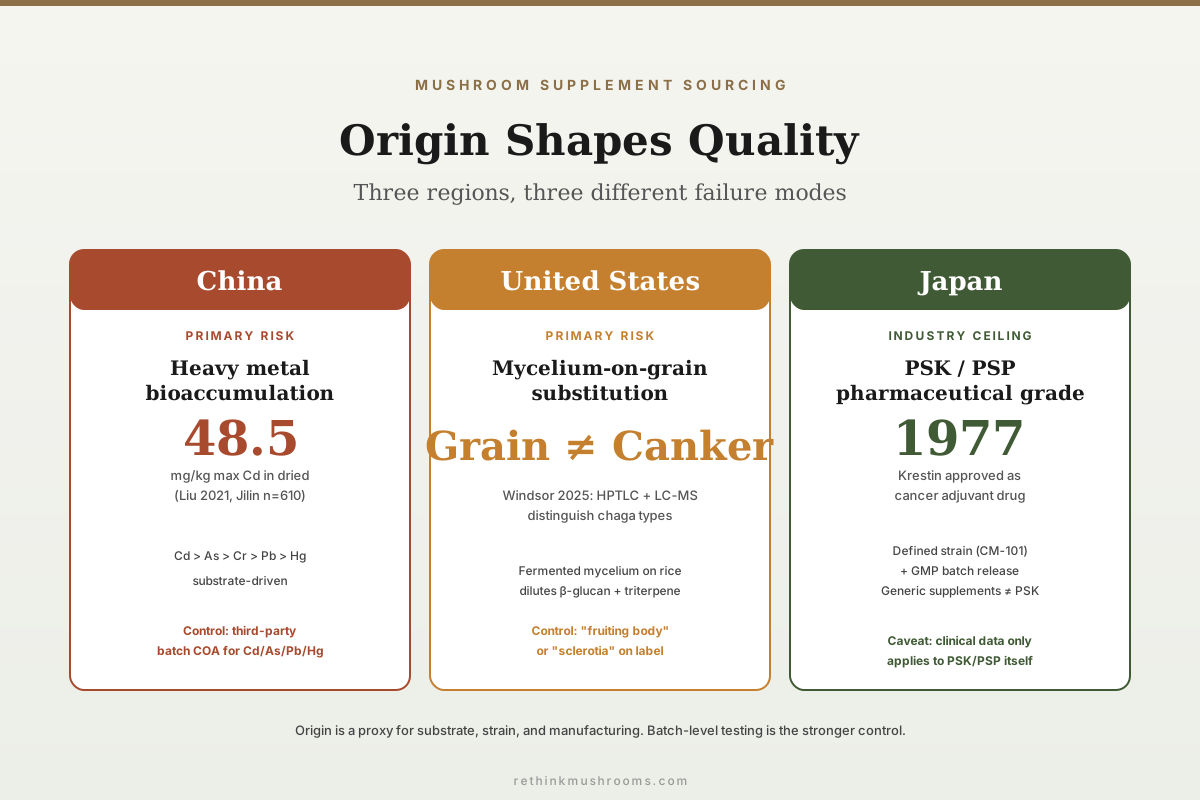
Chinese-origin mushrooms show measurable cadmium and arsenic exceedances; Japanese PSK and PSP are manufactured under pharmaceutical standards with defined strain identity; North American mycelium-on-grain products substitute fermented grain substrate for fruiting body bioactives. Each origin has a distinct quality profile that maps to distinct failure modes.
Liu et al., J Food Sci, 2021; Windsor et al., IJMS, 2025
Cd up to 48.5 mg/kg
Jilin Province dried mushroom survey documented cadmium ranges exceeding Chinese regulatory limits across 610 samples (Liu et al., 2021)
Mycelium + grain
North American 'chaga' supplements commonly contain fermented grain substrate rather than wild canker (Windsor et al., 2025)
PSK since 1977
Japan approved Kureha's polysaccharide-K as a prescription cancer adjuvant, manufactured under pharmaceutical GMP from a single Trametes versicolor strain
Liu et al., J Food Sci, 2021; Windsor et al., IJMS, 2025
 View as image ↗
Origin labels on mushroom supplements are not interchangeable. Chinese sourcing brings real heavy-metal exposure risk driven by substrate contamination and the bioaccumulation physiology of white-rot fungi. Japanese sourcing brings the highest regulatory standard in the industry, where two isolated polysaccharides (PSK and PSP) are produced as prescription drugs under pharmaceutical manufacturing practice. North American sourcing brings its own failure mode: widespread substitution of fermented mycelium-on-grain products that dilute or eliminate the bioactive fraction consumers expect.[1][2] For the broader sourcing context, see where do most mushroom supplements come from? supply chain guide and the related chinese vs. north american mushroom supplements: does origin matter?.
Key Takeaways
- Liu et al. (2021) analysed 610 mushroom samples from Jilin Province, China, and found cadmium ranges of 0.006 to 48.52 mg/kg in dried samples, with cadmium and arsenic concentrations exceeding Chinese national standards (Cd ≤ 0.2 mg/kg for most species)
- Ab Rhaman et al. (2021) documented that mushrooms from white-rot fungi groups actively bioaccumulate heavy metals through their mycelium, with substrate composition (sawdust, straw, agricultural waste) directly determining contamination load in the finished product
- Windsor et al. (2025) used HPTLC, LC-ELSD, LC-PDA/DAD, LC-QToF-MS, and multivariate analysis to differentiate wildcrafted chaga canker from North American chaga supplements containing mycelia fermented on grain; the two product categories were chemically distinct on multiple marker compounds
- Berger et al. (2022) compared proteins, polysaccharides, metabolites, and toxin profiles of mycelium versus fruiting bodies across Agaricus bisporus, Pleurotus ostreatus, and Lentinus edodes, documenting substantial compositional differences that argue against interchangeable marketing claims
- Mirończuk-Chodakowska and Witkowska (2020) measured β-glucan content in 18 wild and 3 commercial mushroom species using the Megazyme and Congo red methods, showing species and sourcing explain most of the variance in the bioactive fraction that drives immune activity
- Japanese pharmaceutical production of PSK (Krestin) from Trametes versicolor strain CM-101 and PSP from strain Cov-1 operates under drug-approval standards with defined strain, extraction protocol, and release specifications that dietary supplement production does not match
Why Origin Actually Matters
The phrase "quality" covers four distinct properties that origin affects differently:
- Contamination load. Heavy metals, pesticides, microbial contaminants, radionuclides. Driven by soil, substrate, and cultivation environment.
- Species and strain identity. Whether the label organism is actually what's in the capsule, and whether the specific strain matches what clinical studies used.
- Bioactive concentration. β-glucans, triterpenoids, polyphenols, and species-specific compounds, which depend heavily on whether the product is fruiting body, mycelium, or mycelium-on-grain.
- Manufacturing integrity. Extraction protocol, solvent system, drying temperature, adulteration testing, batch-to-batch consistency.
Different origins fail on different axes. China's failure mode is dominated by contamination and bioaccumulation. The North American industry's failure mode is dominated by product identity (mycelium on grain sold as fruiting body extract). Japan's isolated-compound manufacturing sets the pharmaceutical ceiling but does not generalise to Japanese whole-mushroom dietary supplements, which have no equivalent regulatory structure.
The China Quality Profile: Bioaccumulation Physiology, Substrate Contamination
Wood-rotting and soil-inhabiting fungi are exceptional metal accumulators. They actively uptake cadmium, arsenic, lead, and mercury from substrate, and the concentration in the finished mushroom typically exceeds soil concentration by factors of 10 to 100 for cadmium specifically. This is biology, not an incidental quality problem. Any mushroom, regardless of origin, is subject to substrate bioaccumulation. The reason China features prominently in contamination literature is the combination of (a) industrial-agricultural substrate composition, (b) historical soil contamination from manufacturing, and (c) the concentration of global mushroom supplement production in specific Chinese provinces.
Liu et al. (2021) sampled 610 mushrooms across nine cities in Jilin Province, a major cultivation region.[1] The dried sample data ranged from 0.007 to 3.31 mg/kg lead, 0.006 to 48.52 mg/kg cadmium, 0.003 to 0.56 mg/kg mercury, and 0.008 to 57.34 mg/kg arsenic. The upper end of the cadmium range is more than 240 times the Chinese regulatory standard (Cd ≤ 0.2 mg/kg) for most edible species. Fresh samples ran lower because drying concentrates metals 8 to 10-fold, but even fresh samples commonly exceeded arsenic and cadmium thresholds. The authors calculated target hazard quotients indicating measurable chronic exposure risk for regular consumers of contaminated batches.
Ab Rhaman et al. (2021) reviewed substrate-driven heavy metal translocation across the mushroom cultivation literature.[3] Agricultural biomass substrates (sawdust, paddy straw, wheat straw, oil palm waste, sugarcane bagasse, corn cobs) carry variable heavy metal loads inherited from the original farming system. The fungi then concentrate these metals during colonisation. The practical consequence is that even a clean regulatory intent at the cultivation facility cannot overcome substrate contamination, and batch-level testing is the only reliable control point.
A separate 2024 survey of nine edible mushroom species from China's mid-western region quantified the metal hierarchy: Cd > As > Cr > Pb > Hg, with cadmium, arsenic, lead, and mercury exceeding Chinese maximum standards by 22.95%, 8.20%, 1.64%, and 3.28% respectively on average across samples. The pattern is consistent across Chinese cultivation regions: cadmium and arsenic dominate the exceedance profile.
The North American Quality Profile: Mycelium on Grain
The dominant North American quality problem is not contamination but product identity. A substantial fraction of North American "mushroom" supplements contain not the fruiting body or wildcrafted material but mycelium fermented on sterilised grain (typically rice, rye, or millet), then dried and powdered without separating the mycelium from the substrate. The finished product is commonly labelled by the mushroom species name without disclosing the grain content.
Windsor et al. (2025) produced the definitive analytical comparison for chaga specifically.[2] Using five orthogonal analytical techniques (High-Performance Thin-Layer Chromatography, Liquid Chromatography with Evaporative Light Scattering Detection, LC with Photo/Diode Array Detection, Liquid Chromatography-Quadrupole Time-of-Flight Mass Spectrometry, and multivariate chemometric analysis), the group differentiated wildcrafted chaga canker from North American mycelium-on-grain products. The two product categories were distinguishable on multiple marker compounds including triterpenoids, melanin content, and β-glucan fraction composition. The implication is direct: a "chaga" product made from fermented grain does not deliver the same bioactive fraction profile as a wildcrafted canker product, and the two should not be marketed or consumed interchangeably.
The analytical finding generalises beyond chaga. Berger et al. (2022) ran a comparable characterisation across three of the most widely cultivated edible species: Agaricus bisporus (button mushroom), Pleurotus ostreatus (oyster), and Lentinus edodes (shiitake).[4] Mycelium and fruiting body produced different proteins, different polysaccharide compositions, different metabolite profiles, and different toxin profiles. In some species, mycelium contained metabolites not present in fruiting body and vice versa. The takeaway is that mycelium and fruiting body are not equivalent biological material, and the choice of which to use as supplement starting material is not interchangeable from a bioactive-delivery standpoint.
The cost structure explains why mycelium-on-grain dominates North American low-to-mid-price-point products. Fruiting body cultivation requires controlled environmental conditions over weeks; mycelium fermentation on sterilised grain completes in days and uses inexpensive feedstock. A kilogram of mycelium-on-grain product can cost 5 to 10 times less than a kilogram of fruiting body extract. Labels often use indistinguishable terminology ("mushroom supplement," "mushroom complex," "whole mushroom powder") without disclosing the substrate content.
For the mycelium-versus-fruiting-body distinction in depth, see north american mushroom quality: the functional mushroom council standards.
The Japanese Quality Profile: Pharmaceutical Precedent
Japan occupies a different regulatory tier because two isolated medicinal mushroom polysaccharides were approved as prescription drugs. Kureha Chemical's polysaccharide-K (PSK, brand name Krestin) received Japanese regulatory approval in 1977 as an immunomodulator for cancer adjuvant therapy, manufactured from a specific Trametes versicolor strain (CM-101) under pharmaceutical good manufacturing practice. The extraction protocol, protein-to-polysaccharide ratio, molecular weight distribution, endotoxin limits, residual solvent specifications, and batch release criteria are all defined at drug-approval standards. PSP (polysaccharopeptide, from strain Cov-1) has comparable regulatory status in China.
This pharmaceutical standard does not generalise automatically to Japanese whole-mushroom dietary supplements. A Japanese-origin reishi or shiitake supplement is not manufactured under PSK-equivalent standards; it operates under general food or nutraceutical regulation, which is closer to US dietary supplement regulation than to pharmaceutical drug regulation. What Japan offers to the global mushroom supplement supply chain is (a) the PSK and PSP clinical legacy that anchors the evidence base for turkey tail, (b) a cultural and regulatory history of treating isolated fungal polysaccharides as pharmaceuticals rather than loosely as supplements, and (c) a strain-identity standard that has not been matched elsewhere.
The implication for a buyer evaluating Japanese-labelled whole-mushroom supplements: the PSK clinical data do not automatically apply. The data apply to the specific pharmaceutical preparation from Kureha. Generic Trametes versicolor from Japanese sources does not deliver PSK unless explicitly labelled and standardised as such, and essentially no generic "turkey tail" supplement is standardised to the PSK clinical preparation.
Strain Identity and β-Glucan Content Across Origins
Mirończuk-Chodakowska and Witkowska (2020) measured β-glucan content in 18 wild and 3 commercial mushroom species using two analytical methods.[5] β-glucan content varied more than 10-fold across species and also varied within species by cultivation environment and harvest time. Commercial button mushroom (A. bisporus) contained notably less β-glucan than most wild species, with the gap not attributable to processing but to species biology. The methodological point that matters for origin comparisons: the Megazyme method (enzyme-based) and Congo red method (dye-binding) give different numerical answers for the same sample, so β-glucan claims on labels are only meaningful if the analytical method is specified.
For cultivation origin to matter at the β-glucan level, the question has to be species-controlled. A Chinese-grown Lentinula edodes and a Japanese-grown L. edodes can differ on β-glucan content if the strains differ, the substrate differs, or the post-harvest processing differs, but they are not guaranteed to differ. Origin by itself does not determine β-glucan content; origin is a proxy for strain, substrate, and processing decisions that individually drive the outcome.
Head-to-Head Comparison Table
| Quality Axis | China | United States | Japan |
|---|---|---|---|
| Heavy metal contamination risk | High (Cd, As dominate); Liu 2021 Jilin survey documents ranges 10-240× regulatory limits | Low to moderate; US soil contamination less severe for mushroom-suitable substrates | Low; strict post-Fukushima radionuclide and metal testing for food-grade products |
| Fruiting body vs. mycelium-on-grain | Mixed; both product types produced at scale | Mycelium-on-grain common in low-to-mid price-point supplements | Fruiting body dominant in traditional supplement products |
| Strain identity and standardisation | Variable; PSP manufactured under Chinese pharmaceutical standards for the approved indication | Generally not disclosed on labels | PSK and PSP approved as prescription drugs with defined strain identity; generic supplements do not match this standard |
| Regulatory framework for supplements | Food and dietary supplement regulation; pharmaceutical pathway for PSP | Dietary Supplement Health and Education Act (DSHEA) framework; no pre-market approval | Food and supplement regulation for whole mushrooms; pharmaceutical for PSK/PSP |
| Analytical method disclosure on labels | Variable; improving for export products | Variable; often absent | Defined for pharmaceutical products; variable for supplements |
| Most common failure mode | Substrate-driven heavy metal bioaccumulation (Liu 2021; Ab Rhaman 2021) | Mycelium-on-grain dilution of bioactive fraction (Windsor 2025) | Misapplication of PSK clinical data to non-PSK products |
Practical Implications for Buyers
For contamination risk, origin-based screening has limits. A third-party batch certificate for heavy metals (preferably including cadmium, arsenic, lead, and mercury) is a stronger control than an origin label. Products that disclose the certificate, the testing laboratory, and the testing method sit above those that do not, regardless of origin.
For bioactive identity, the specific question to ask is whether the product is fruiting body extract or mycelium on grain. Windsor et al. (2025) established analytical methods that can distinguish them; most consumer-facing labels do not disclose this distinction. Regulatory terminology is inconsistent, which is why the Functional Mushroom Council and similar industry bodies have proposed labelling standards. For the details on that standardisation effort, see north american mushroom quality: the functional mushroom council standards.
For the Japanese standard, clinical evidence for PSK and PSP applies specifically to those preparations from their specific strains under their specific manufacturing protocols. A general "turkey tail" supplement from any origin, including Japan, is not automatically covered by the PSK clinical evidence base.
For the organic-versus-non-organic comparison, see organic vs. non-organic mushroom supplements: is it worth the premium?.
The Bottom Line
Origin matters for mushroom supplement quality, but not on a single axis. Chinese sourcing carries documented heavy metal contamination risk driven by substrate bioaccumulation; a 610-sample Jilin Province survey found cadmium ranges from 0.006 to 48.52 mg/kg in dried samples (Liu et al., 2021). North American sourcing's principal failure mode is mycelium-on-grain substitution for fruiting body material, which delivers a measurably different bioactive profile (Windsor et al., 2025; Berger et al., 2022). Japan's pharmaceutical-standard PSK and PSP manufacturing sets the industry ceiling but applies only to those specific preparations, not to generic Japanese-origin whole-mushroom supplements. Third-party batch heavy-metal certification is a stronger quality control than origin labels, and fruiting-body-versus-mycelium-on-grain disclosure matters more than country of origin for bioactive identity. Origin is a proxy for cultivation decisions that individually drive quality outcomes rather than a direct determinant of quality.
Frequently Asked Questions
Sources & References
- 1RTHM-00705·Liu, Sijie et al. (2021). “Pollution level and risk assessment of lead, cadmium, mercury, and arsenic in edible mushrooms from Jilin Province, China..” Journal of food science.Study breakdown →PubMed →↩
- 2RTHM-02209·Windsor, Coleton et al. (2025). “What This 2025 Chaga Supplement Authentication Study Actually Found.” International journal of molecular sciences.Study breakdown →PubMed →↩
- 3RTHM-00669·Ab Rhaman, Siti Maryam Salamah et al. (2021). “Mushroom Quality Related with Various Substrates' Bioaccumulation and Translocation of Heavy Metals..” Journal of fungi (Basel.Study breakdown →PubMed →↩
- 4RTHM-00743·Berger, Ralf G et al. (2022). “Mycelium vs. Fruiting Bodies of Edible Fungi-A Comparison of Metabolites..” Microorganisms.Study breakdown →PubMed →↩
- 5RTHM-00637·Mirończuk-Chodakowska, Iwona et al. (2020). “Evaluation of Polish wild Mushrooms as Beta-Glucan Sources..” International journal of environmental research and public health.Study breakdown →PubMed →↩