Supplement Sourcing
26.3% label-accurate
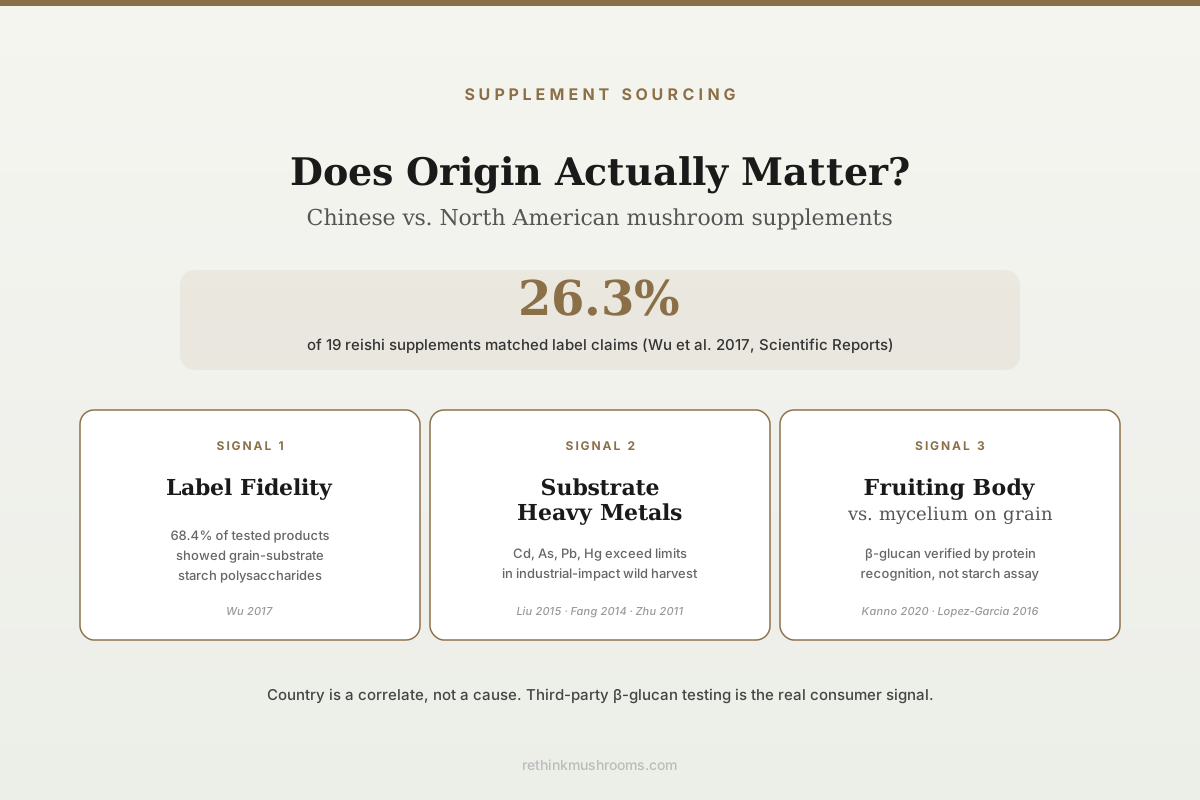
Wu et al. (2017) tested 19 batches of Ganoderma lucidum (reishi) dietary supplements on the U.S. market using HPTLC, GC-MS and polysaccharide mapping. Only five (26.3%) had measured ingredients that matched their labels.
Wu et al., Scientific Reports, 2017
Label Fidelity
the audit signal that dominates quality
Heavy Metal Risk
bioaccumulation is a real substrate-level concern
Fruiting Body vs Mycelium
the supply-chain axis that actually moves β-glucan
Wu et al., Scientific Reports, 2017
 View as image ↗
The "Chinese versus North American" framing is the most common consumer question about mushroom supplements, and it is also the framing most likely to mislead. Origin is a correlate, not a causal variable. The variables that actually determine whether a mushroom supplement contains what its label claims are label fidelity against independent chemical assay, substrate cleanliness and heavy-metal load, and whether the product is fruiting body extract or mycelium grown on grain. Each of those has been studied in peer-reviewed work, and the numbers are unambiguous enough to evaluate origin claims on their merits. Wu and colleagues (2017) audited 19 batches of Ganoderma lucidum supplements purchased in the United States and reported that only 26.3% had measured active ingredients matching their labels, 42.1% contained detectable triterpenes, and 68.4% contained starch-like polysaccharides (consistent with grain substrate dilution).[1] The label fidelity problem is the dominant quality signal. Country of origin sits well below it.
For the broader supply-chain landscape see where do most mushroom supplements come from? supply chain guide and the related china vs. us vs. japan grown mushroom supplements: does origin affect quality?, north american mushroom quality: the functional mushroom council standards and organic vs. non-organic mushroom supplements: is it worth the premium?.
Key Takeaways
- Wu et al. (2017) audited 19 reishi supplements in the U.S. market and found only 26.3% matched their labels, with starch-like polysaccharides in 68.4% indicating grain-substrate dilution
- Lopez-Garcia et al. (2016) used MALDI-TOF to profile polysaccharides across commercial mushroom supplements and found substantial batch-to-batch variability within and across products
- Chinese wild-harvested mushroom surveys (Liu 2015, Fang 2014, Zhu 2011) document cadmium, arsenic, lead and mercury concentrations that in some samples exceed national maximum limits
- The quality axis that most consistently separates supplements is fruiting body extract versus mycelium grown on grain, not country of origin
- Kanno et al. (2020) developed a specific β-glucan quantification method using an artificial recognition protein that can distinguish mushroom β-glucan from cereal grain starch
- Mironczuk-Chodakowska et al. (2020) surveyed wild Polish mushrooms as β-glucan sources and reported substantial species-level variation, showing that β-glucan content is not intrinsic to geography
Fact Check
Does a 'Made in China' label mean lower quality?
The claim
“Chinese-grown mushroom supplements are inherently lower quality and less safe than North American ones.”
A common consumer heuristic, reinforced by marketing that sells 'North American grown' as a premium quality tier.
What research shows
Context DependentThe dominant quality failures — label inaccuracy and grain-substrate dilution — appear across the US market regardless of origin. Wu et al. (2017) found only 26.3% of tested reishi products matched their labels, and did not segment by country.
Origin is a weak proxy. Heavy-metal risk tracks wild-harvest and contaminated substrate rather than nationality, and the axis that actually moves quality is fruiting-body extract versus mycelium grown on grain — a per-manufacturer choice made in both regions.
Wu et al. (2017) [ref 1]; heavy-metal surveys Liu 2015 [ref 2], Fang 2014 [ref 3], Zhu 2011 [ref 4] (article body).
What The Quality Audits Actually Found
Wu et al. (2017) · Scientific Reports
- Population
- 19 batches of commercial Ganoderma lucidum (reishi) dietary supplements purchased on the US market
- Intervention
- Chemical characterization by HPTLC, GC-MS, colorimetric polysaccharide assay, PACE and HPSEC-MALLS-RID
- Comparator
- Each product's measured composition versus its own label claims
- Finding
- Only 5 of 19 (26.3%) matched their labels; G. lucidum triterpenes in 8 of 19 (42.1%); 1,3-β-D-glucan in 5 of 19 (26.3%); starch-like polysaccharides in 13 of 19 (68.4%).
narrow-scope Rigorous multi-method chemistry, but a single species (reishi) at one point in time — a strong directional signal, not a fixed market-wide rate.
Wu et al. (2017), Scientific Reports 7:7792 [ref 1]
Wu and colleagues (2017) in Scientific Reports is the most carefully analysed quality audit of mushroom supplements available in the peer-reviewed literature.[1] The research team purchased 19 batches of commercial Ganoderma lucidum (reishi, lingzhi) dietary supplements on the U.S. market and subjected each to a panel of analytical methods: colorimetric assay for polysaccharide content, high-performance thin-layer chromatography (HPTLC), gas chromatography-mass spectrometry (GC-MS), polysaccharide mapping via carbohydrate gel electrophoresis (PACE), and high-performance size exclusion chromatography with multi-angle laser light scattering and refractive index detection (HPSEC-MALLS-RID).
The headline findings:
- Measured ingredients matched label claims in 5 of 19 products (26.3%)
- Triterpenes, a hallmark of Ganoderma fruiting body, were detected in 8 of 19 (42.1%)
- Starch-like polysaccharides (consistent with grain substrate) were detected in 13 of 19 (68.4%)
- 1,3-β-D-glucan, the signature bioactive polysaccharide, was detected in only 5 of 19 (26.3%)
The starch-like polysaccharide fraction is the most informative single data point. Ganoderma fruiting body does not contain meaningful starch. A product where starch dominates the polysaccharide profile is, at best, a mycelium-on-grain product in which most of the mass is undigested grain substrate, and at worst, a product adulterated with cheap carbohydrate filler. The 68.4% hit rate in the Wu 2017 sample indicates a structural problem in the U.S. reishi supplement market, not a bad batch.
The Label-Fidelity Audit
What 19 US Reishi Supplements Actually Contained
Wu et al. (2017) chemically tested 19 batches of commercial Ganoderma lucidum supplements sold in the United States, without segmenting by country of origin. The denominator stays fixed at 19 so the shortfall — and the grain-dilution marker — are visible at a glance.
Matched their label claims
5 of 19 · 26.3%Measured ingredients in accordance with the printed label
Contained G. lucidum triterpenes
8 of 19 · 42.1%Ganoderic acids — the fruiting-body hallmark, by HPTLC
Contained immune-active 1,3-β-D-glucan
5 of 19 · 26.3%The signature bioactive polysaccharide
Contained starch-like polysaccharides
13 of 19 · 68.4%Grain-substrate marker — consistent with mycelium-on-grain dilution
Only about one in four products matched its label, while roughly two in three carried a starch-like polysaccharide signature consistent with grain-substrate dilution — a failure mode driven by fruiting-body-versus-mycelium manufacturing choices, not by the country printed on the bottle.
Source: Wu et al. (2017), Scientific Reports 7:7792 [ref 1].
Wu 2017 did not segment the 19 products by stated country of origin. The dataset does not answer "are Chinese-sourced products more or less label-accurate than North American." It does establish that across products sold in the U.S., the majority fail an objective chemical audit. Country of origin is not the primary explanatory variable.
The Heavy Metal Question
Mushrooms are efficient bioaccumulators of soil metals, and the bioaccumulation problem is the single issue where Chinese-origin concern has the strongest published support, though the data are about wild harvest and soil-substrate cultivation, not country per se.
Liu and colleagues (2015) surveyed wild edible mushrooms from 16 locations in Yunnan Province, China and analysed samples for Mn, Fe, Cu, Zn, As, Cd and Pb.[2] The study found that concentrations of toxic metals (As, Pb, Cd) exceeded Chinese national standard values in most of the sampled locations. Fang and colleagues (2014) analysed rice and edible mushrooms from across China for Pb, Cd, As and Hg and reported that mushrooms accumulated these elements to a greater degree than rice from comparable substrate.[3] Zhu and colleagues (2011) independently assessed heavy metals in wild edible mushrooms from Yunnan and reached consistent conclusions.[4]
The relevant mechanism is not Chinese-specific. Mushroom mycelium concentrates cations from substrate, so any mushroom, anywhere, grown on contaminated soil or wild-harvested from polluted land accumulates the metals in that substrate. The Yunnan studies document the issue in a region with substantial historical mineral mining and industrial activity, which explains the elevated readings. Wild mushrooms from industrial-impact regions of Europe and North America show comparable contamination when the substrate is similarly impacted.
What the heavy metal evidence actually supports:
- Wild-harvested mushrooms from any industrial-impact region carry a substantive contamination risk
- Soil-grown mushrooms from any contaminated agricultural substrate carry the same risk
- Mycelium grown on controlled non-soil substrate (e.g., oats, brown rice) in clean cultivation carries a low risk, regardless of country
- Fruiting body cultivated on controlled sterile substrate (e.g., sawdust log) in clean cultivation also carries a low risk
The Chinese origin concern is a proxy for the substrate and wild-harvest questions. A Chinese fruiting body extract grown under controlled cultivation with third-party heavy-metal testing can easily be lower-risk than a North American wild-harvest product without testing.
Safety
ModerateHeavy-metal bioaccumulation in wild-harvested and contaminated-substrate mushrooms
Concern
Mushrooms concentrate cations from their substrate. Wild-harvest surveys from Yunnan, China document cadmium, arsenic, lead and mercury exceeding national maximum limits in some samples (Liu 2015; Fang 2014; Zhu 2011).
What the research says
The mechanism is substrate-driven, not country-specific. Controlled cultivation on clean, non-soil substrate substantially lowers risk regardless of origin, while wild-harvest from any industrial-impact region carries comparable risk. A third-party heavy-metal certificate of analysis on the finished product is the signal that actually matters.
Particularly relevant for: Anyone using wild-harvested mushroom products, or supplements sold without third-party heavy-metal testing
What to do
This is educational information, not medical advice. Prefer products with a published third-party heavy-metal certificate of analysis, and consult a clinician about supplement use if you are pregnant, nursing, or managing a health condition.
Liu et al. (2015) [ref 2]; Fang et al. (2014) [ref 3]; Zhu et al. (2011) [ref 4]
The Real Supply-Chain Axis: Fruiting Body Vs. Mycelium On Grain
The quality axis that actually separates good mushroom supplements from poor ones runs along a different dimension than country of origin: fruiting body extract versus mycelium grown on a grain substrate.
Mushrooms have two distinct physical phases. Mycelium is the vegetative network of hyphae that colonises substrate. Fruiting body is the visible mushroom that emerges from colonised substrate to produce spores. The bioactive compound profile differs between these phases. Triterpenes in reishi (ganoderic acids) are concentrated in the late-maturation fruiting body and are largely absent from mycelium. β-glucan polysaccharides are present in both, but the β-glucan concentration in a fruiting body extract is typically multiples higher than in a mycelium-on-grain product, because the grain substrate mass dilutes the mycelium mass in the final powder.
This is the structural explanation for Wu 2017's finding that 68.4% of tested reishi products contained starch-like polysaccharides. A mycelium-on-grain product, by construction, contains more grain mass than mycelium mass in the final powder. Grain starch dominates the polysaccharide readout. The product is not inherently fraudulent, but its active-compound density is far lower than a fruiting body extract with the same gram-of-product label.
Lopez-Garcia and colleagues (2016) used MALDI-TOF mass spectrometry to compare polysaccharide profiles across commercial mushroom supplements from multiple species and reported substantial batch-to-batch variability within the same product line and across the same species from different manufacturers.[5] Polysaccharide fingerprinting is a useful objective method for separating genuine fruiting body material from grain-substrate mycelium products, and the Lopez-Garcia data confirms that the two categories are distinguishable on chemical analysis.
For North American producers, the fruiting body versus mycelium distinction is largely a manufacturer-specific choice, not a country-level policy. The Functional Mushroom Council has worked toward standards here, discussed in north american mushroom quality: the functional mushroom council standards. Chinese producers span the same range, from large fruiting body extract operations to grain-substrate mycelium mills.
β-Glucan As An Objective Quality Signal
β-glucan content, measured by a method that specifically detects mushroom β-glucan and excludes cereal starch, is the single most informative quality metric for mushroom supplements. Two peer-reviewed methodologies are relevant.
Kanno and colleagues (2020) developed a quantification method using a novel artificial β-glucan recognition protein that binds 1,3-β-glucan selectively and is not confounded by cereal starch or other non-β-glucan polysaccharides.[6] Applied to a panel of culinary-medicinal mushrooms, the method reproducibly separated mushroom β-glucan content from grain-substrate contaminant polysaccharide. This is the kind of analytical method that an honest manufacturer can use to verify their own product and that an independent audit body can use to evaluate label claims objectively.
Mironczuk-Chodakowska and colleagues (2020) surveyed wild Polish mushrooms as β-glucan sources and reported substantial species-level variation, with some species delivering substantially more β-glucan per unit dry weight than others.[7] The practical consequence is that β-glucan content depends on species, growing conditions and extract preparation, not on the country the product was manufactured in.
A consumer-facing implication: a label that reports specific β-glucan percentage, ideally verified by a method that excludes cereal starch, is a stronger quality signal than any country-of-origin claim. A label that reports only "polysaccharides" as a percentage (which can include grain starch) is a much weaker signal, because the Wu 2017 data shows polysaccharide content can be dominated by grain substrate in many commercial products.
What Country Of Origin Actually Does Signal
Country of origin is not irrelevant, but its informational content is indirect. The plausible origin-correlated signals are:
- Regulatory framework. U.S. supplements fall under DSHEA (dietary supplement regulation), which is not the same as drug regulation and does not require pre-market approval of efficacy or purity. Chinese domestic supplement regulation has its own framework, and Chinese exported products entering the U.S. market fall under U.S. DSHEA plus relevant import-testing requirements. None of these frameworks mandates the kind of chemical assay Wu 2017 performed.
- Substrate-contamination prior probability. Mushroom cultivation in regions with substantial industrial-impact soil carries higher contamination risk. Neither country is a single substrate; the question is the specific operation.
- Supply-chain transparency. A shorter, more traceable supply chain, typically associated with producers who publish third-party lab results, is more informative than the stated country of origin. Many high-quality supplements sold in North America are made from raw mushroom material imported from several Asian producers, and some are made from North American cultivation. In both cases, the label fidelity depends on the specific manufacturer's quality control.
The operational question consumers should ask is not "where was this grown" but "what did an independent lab measure in the final product." Wu 2017, Lopez-Garcia 2016 and Kanno 2020 collectively establish that the analytical methods to answer that question exist and work. A product whose manufacturer publishes third-party assay data clears the primary hurdle. A product that does not, regardless of country of origin, carries the same uncertainty as the Wu 2017 sample.
Limitations Of The Evidence
The peer-reviewed evidence on this question has some specific boundaries that should be stated plainly.
Wu 2017 sampled 19 products in a single species (reishi) at a single point in time. The 26.3% label-fidelity figure is a strong signal but is not a census of the current market, and more recent market developments (including improvements by some manufacturers in response to the audit) are not captured. The methodology is reproducible and the directional finding is corroborated by Lopez-Garcia 2016 and by industry quality-standards groups, but a reader should not treat 26.3% as a fixed universal rate.
The heavy-metal literature on Chinese wild mushrooms is substantive but largely focused on wild-harvest in specific provinces, notably Yunnan. It does not measure the heavy-metal profile of cultivated mushroom extracts from controlled Chinese cultivation houses, and it does not measure North American cultivated extracts for comparison. The comparative data that would answer "is origin a meaningful heavy-metal predictor for controlled-cultivation extracts" does not exist in the peer-reviewed literature. What exists is the generic bioaccumulation mechanism plus region-specific wild-harvest surveys.
The fruiting body versus mycelium quality distinction is established at the chemical composition level. The clinical-effect comparison between fruiting body extracts and mycelium-on-grain products at equivalent β-glucan doses has not been adequately studied in controlled human trials. The composition gap predicts a biological gap, and the in vitro literature is consistent with it, but the clinical endpoint evidence is limited.
Finally, the industry-funded or advocacy-funded "74% of reishi is not authentic" statistic is often cited and is derived from Wu 2017, but the original paper's language is more precise (26.3% matched labels; 68.4% contained starch-like polysaccharides). Readers should track back to the original methodology rather than the round-number derivative.
The Bottom Line
The peer-reviewed evidence establishes that label fidelity, not country of origin, is the dominant quality question in mushroom supplements. Wu et al. (2017) found only 26.3% of tested reishi products matched their labels, with grain-substrate dilution the major failure mode. Heavy-metal bioaccumulation in wild and contaminated-substrate mushrooms is documented across Chinese surveys (Liu 2015, Fang 2014, Zhu 2011) but is a substrate problem, not a country problem per se. The practical quality axis is fruiting body extract versus mycelium on grain, and the objective consumer signal is third-party lab-verified β-glucan content by a method that excludes cereal starch.
Frequently Asked Questions
Sources & References
- 1RTHM-00499·Wu, Ding-Tao et al. (2017). “Evaluation on quality consistency of Ganoderma lucidum dietary supplements collected in the United States..” Scientific reports.Study breakdown →PubMed →↩
- 2RTHM-00394·Liu, Borui et al. (2015). “Study of heavy metal concentrations in wild edible mushrooms in Yunnan Province, China..” Food chemistry.Study breakdown →PubMed →↩
- 3RTHM-00320·Fang, Yong et al. (2014). “Concentrations and health risks of lead, cadmium, arsenic, and mercury in rice and edible mushrooms in China..” Food chemistry.Study breakdown →PubMed →↩
- 4RTHM-00242·Zhu, Fangkun et al. (2011). “Assessment of heavy metals in some wild edible mushrooms collected from Yunnan Province, China..” Environmental monitoring and assessment.Study breakdown →PubMed →↩
- 5RTHM-00437·López-García, Marta et al. (2016). “MALDI-TOF to compare polysaccharide profiles from commercial health supplements of different mushroom species..” Food chemistry.Study breakdown →PubMed →↩
- 6RTHM-00625·Kanno, Takashi et al. (2020). “Quantification of β-Glucan from Culinary-Medicinal Mushrooms Using Novel Artificial β-Glucan Recognition Protein..” International journal of medicinal mushrooms.Study breakdown →PubMed →↩
- 7RTHM-00637·Mirończuk-Chodakowska, Iwona et al. (2020). “Evaluation of Polish wild Mushrooms as Beta-Glucan Sources..” International journal of environmental research and public health.Study breakdown →PubMed →↩