Poria & Kidney Health
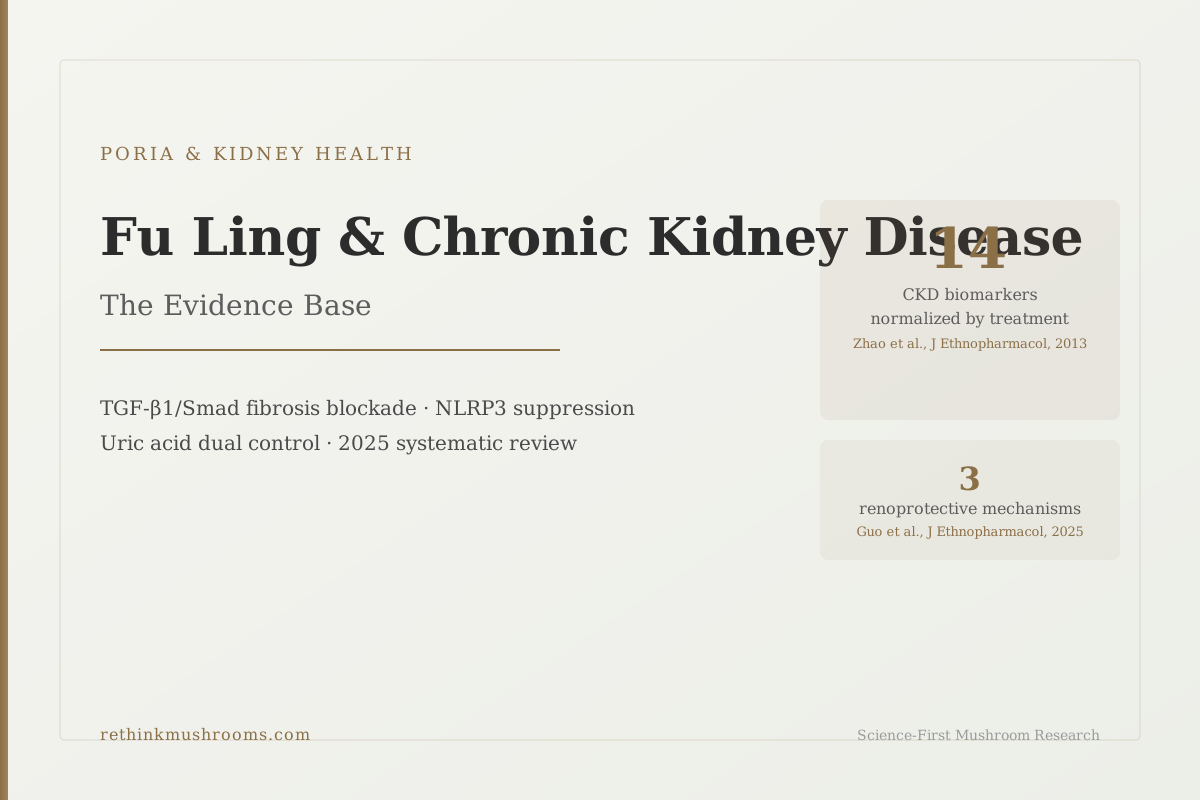
14 CKD biomarkers normalized
Urine metabolomics showed Poria cocos surface layer treatment corrected 14 urinary markers of chronic renal injury and attenuated fibrosis progression in animal models.
Zhao et al., J Ethnopharmacol, 2013
3 mechanisms
fibrosis blockade, NLRP3 suppression, and uric acid reduction
2,000 years
Fu Ling used in TCM for kidney and water metabolism conditions
2025
first dedicated systematic review of Poria triterpenoids and kidney protection
Zhao et al., J Ethnopharmacol, 2013
 View as image ↗
In 2013, two research teams independently used a then-cutting-edge technique called urine metabolomics to study what Poria cocos does to kidneys under stress. They didn't measure one or two markers. They mapped the full profile of small molecules in the urine of animals with chronic renal injury, compared it against healthy animals, and asked how much of that profile shifted back toward normal after Poria treatment.
The answer, in the Journal of Ethnopharmacology study: 14 urinary biomarkers normalized.
That kind of broad metabolic correction is not what a single targeted drug produces. It suggests Poria's effect on the kidney touches multiple systems simultaneously, including energy metabolism, oxidative defense, and nitrogen waste handling. The 2,000-year reputation of Fu Ling in Chinese medicine for kidney and water conditions starts to look less like tradition and more like observation recorded before the tools existed to explain it.
This article reviews what the research shows about Fu Ling and chronic kidney disease: the metabolomic window, the three CKD-fibrosis pathways Poria blocks in animal models, the hyperuricemic kidney disease evidence, and the 2025 review that synthesized this field for the first time. For a broader introduction to Poria's full health profile, see What Is Poria? Fu Ling, One of the Most Important Mushrooms in TCM.
Key Takeaways
- Zhao et al. (2013, J Ethnopharmacol) used urine metabolomics to show that Poria cocos surface layer treatment normalized 14 urinary biomarkers of chronic renal injury and attenuated fibrosis progression in adenine-induced CKD rats
- A companion study by Zhao et al. (2013, J Proteome Res) confirmed Poria epidermis corrected early-stage renal injury markers by modulating taurine metabolism, the tricarboxylic acid cycle, and oxidative phosphorylation in kidney cells
- Guo et al. (2025) published the first dedicated systematic review of Poria triterpenoids and kidney protection, categorizing three mechanisms: Nrf2-mediated oxidative defense in acute injury, TGF-β1/Smad and Wnt/β-catenin fibrosis blockade in CKD, and dual uric acid control in hyperuricemic nephropathy
- Yang et al. (2015) showed Wu Ling San, a Poria-containing TCM formula, blocked the TLR4/MyD88 inflammatory cascade and NLRP3 inflammasome activation in hyperuricemic kidney injury, cutting off the immune signal that drives kidney cell damage
- Liang et al. (2021) confirmed a dual mechanism for hyperuricemic nephropathy: Poria up-regulates the ABCG2 transporter that excretes uric acid and down-regulates xanthine oxidase that produces it, reducing serum uric acid, creatinine, and urea nitrogen in treated animals
- Human clinical trial evidence in CKD patients is sparse. The mechanistic and animal data are substantial, but the translation to human kidney disease has not been established in controlled clinical trials
Fu Ling's 2,000-Year Kidney Reputation: Why Researchers Investigated
Fu Ling (Poria cocos, also called Wolfiporia extensa) appears in the Shennong Bencao Jing, the oldest surviving Chinese pharmacopeia, compiled around the first century CE. Kidney and urinary applications are listed among its primary indications. Over two millennia it became one of the most frequently prescribed herbs in Chinese medicine, a core ingredient in dozens of kidney-supporting formulas.
The TCM rationale was expressed through concepts like "draining dampness" and supporting the kidney's role in water metabolism. In modern terms, TCM was observing and codifying diuresis, fluid retention, and filtration function. What practitioners recorded across generations is now being examined at the molecular level by researchers with tools the original physicians could not have imagined.
The preparations used in kidney research are specific and deserve attention. Most Western Poria supplements use the inner sclerotium, called Fu Shen, which is rich in polysaccharides and most studied for immune and calming effects. The outer epidermis of the sclerotium, Fu-Ling-Pi in TCM, is the fraction most associated with diuretic and kidney-protection applications. A surface layer fraction between these two carries the highest concentration of lanostane triterpenoids, and the Guo 2025 review identified these triterpenoids as the primary drivers of renoprotective pharmacology.
Chen et al. (2020) provided the most comprehensive pre-2025 review of Wolfiporia cocos pharmacology, confirming that kidney activity involves at least three distinct mechanisms: diuresis mediated by triterpenoids, anti-inflammation from polysaccharides, and anti-fibrosis from the surface layer fraction's activity on the TGF-β1/Smad signaling pathway.[4]
For more on which fraction contains which compounds, see Poria Bioactive Compounds: Pachymic Acid, Triterpenoids, and Beta-Glucans. For the full TCM history and formula context, see Poria cocos in Traditional Chinese Medicine: 2,000 Years of Clinical Use.
What Urine Metabolomics Found: 14 Kidney Biomarkers Corrected by One Treatment
In 2013, Zhao et al. published two papers that remain the most analytically detailed evidence for Fu Ling's kidney activity in any experimental system.
The Journal of Ethnopharmacology study used rats with adenine-induced chronic renal injury, a well-validated animal model that produces progressive kidney damage resembling human CKD features including elevated creatinine (the waste protein kidneys filter from blood), fibrosis, and tubular damage.[2] Animals treated with Poria cocos surface layer showed normalization of 14 urinary metabolite biomarkers compared to untreated injured controls. Fibrosis progression was attenuated. The metabolic fingerprint of treated kidneys moved substantially closer to the healthy control profile.
A companion paper in the Journal of Proteome Research used higher-resolution profiling (UPLC Q-TOF mass spectrometry) to examine early-stage renal injury.[1] This analysis identified three specific metabolic systems that Poria corrected: taurine metabolism (taurine is an amino acid derivative that acts as an antioxidant in kidney tissue), the tricarboxylic acid cycle (the main pathway cells use to generate energy from nutrients), and oxidative phosphorylation (the process by which cells make ATP using oxygen). All three were disrupted by renal injury. All three shifted back toward normal with Poria treatment. This was the first metabolomic map of Poria's renal effects.
The significance of these findings is that they are not a pharmacological coincidence. A compound that moves 14 independent kidney biomarkers toward normal is interacting with kidney biology at multiple levels. Targeting energy metabolism, antioxidant systems, and metabolite clearance simultaneously is exactly what a kidney struggling with chronic injury needs.
Three Pathways to CKD Protection: How Poria Blocks Kidney Fibrosis at the Cellular Level
The most serious long-term consequence of CKD is kidney fibrosis. Fibrosis is the process by which functioning nephron tissue is gradually replaced by scar tissue that cannot filter blood. Once established, fibrosis cannot be reversed. The molecular signals that drive kidney fibrosis have been mapped in considerable detail over the past two decades, and several of them are targets of Poria triterpenoids.
Guo et al. (2025) published the first systematic review specifically dedicated to Poria triterpenoids and kidney protection, synthesizing decades of research into a mechanistic framework.[6] In the context of CKD, their analysis identified two primary anti-fibrotic pathways:
TGF-β1/Smad pathway: TGF-β1 (transforming growth factor-beta 1) is the central molecular signal that instructs kidney cells to transform into myofibroblasts, the cell type that deposits collagen and forms scar tissue. Smad proteins are the messengers that carry the TGF-β1 signal from the cell surface into the nucleus, where it activates fibrosis genes. Poria triterpenoids suppress TGF-β1 production and interfere with Smad protein signaling, reducing the fibrosis instruction at multiple steps in the cascade.
Wnt/β-catenin pathway: A parallel fibrosis pathway runs through beta-catenin, a protein that accumulates in cell nuclei when Wnt signaling is activated. Chronic kidney injury activates Wnt signaling, and the resulting beta-catenin accumulation drives a separate set of fibrosis and cell-proliferation genes. Poria extract inhibits this pathway as well.
For acute kidney injury rather than CKD, the 2025 review also identified Nrf2 activation as a key protective mechanism. Nrf2 is the master regulator of the cell's own antioxidant defense genes. When Poria triterpenoids activate Nrf2, the cell switches on its internal protection against oxidative stress, which is one of the primary drivers of acute nephron damage.
Wu Ling San and the NLRP3 Inflammasome: Ancient Formula, Molecular Mechanism
Wu Ling San (Five-Ingredient Powder with Poria) is one of the most studied TCM formulas globally. It appears in the Shang Han Lun, a foundational clinical text from around the second century CE, and has been prescribed continuously for kidney and water metabolism conditions ever since. Poria (Fu Ling) is one of its five core herbs. The others are alisma, polyporus, atractylodes, and cinnamon twig.
Yang et al. (2015) investigated Wu Ling San in a mouse model of kidney injury caused by elevated uric acid, a clinically relevant condition because hyperuricemia is both a common cause and accelerator of CKD.[3] The mechanistic findings traced a specific immune signaling chain:
TLR4 is a receptor on the surface of kidney immune cells that detects danger signals from damaged tissue. When TLR4 is activated, it recruits an adapter protein called MyD88. MyD88 then activates NF-κB (nuclear factor kappa B), the master switch for inflammatory gene expression. NF-κB in turn activates the NLRP3 inflammasome, a multi-protein complex that functions like an alarm system for intense inflammation. When NLRP3 assembles and fires, it triggers the release of IL-1β, one of the most potent pro-inflammatory signals in the body. In chronic kidney disease, persistent IL-1β release sustains inflammatory damage that accelerates nephron loss.
Wu Ling San blocked this cascade at multiple points. Animals treated with the formula showed reduced TLR4 activity, suppressed NLRP3 assembly, and substantially lower IL-1β concentrations in kidney tissue. Kidney function markers improved in parallel.
The study's value is both mechanistic and historical. A molecular immune mechanism that twenty-first-century immunologists characterized and named appears to be suppressed by a clinical formula that an ancient physician prescribed based on pattern observation 1,800 years ago.
For more on the TCM formula tradition surrounding Poria and kidney disease, see Poria and Chronic Kidney Disease: Renoprotective Evidence from TCM Formulas.
The Uric Acid-Kidney Link: How Fu Ling Targets a Specific CKD Trigger
Hyperuricemia, persistently elevated uric acid in the blood, is increasingly recognized as both a cause and an accelerator of chronic kidney disease. Uric acid crystals can deposit directly in kidney tubules and cause mechanical damage. Even without crystal deposition, high circulating uric acid drives inflammation and oxidative stress in kidney tissue through inflammatory pathways, compounding the damage.
Liang et al. (2021) tested Poria cocos extract directly in hyperuricemic mice and tracked what happened to both uric acid levels and kidney function markers.[5] The mechanistic findings showed a dual mechanism that is unusually specific for a natural compound:
Poria up-regulated ABCG2, a transporter protein that functions in intestinal cells and kidney tubule cells to actively pump uric acid out of the body. Higher ABCG2 activity means more uric acid is excreted rather than retained. Simultaneously, Poria down-regulated xanthine oxidase, the enzyme that catalyzes the final chemical steps that produce uric acid from purines in the first place. Less enzyme activity means the body produces less uric acid at the source.
The result of making less uric acid and excreting more of it simultaneously: serum uric acid fell. Creatinine levels (elevated when kidneys cannot filter adequately) also fell. Urea nitrogen (another kidney filtration marker) fell. Kidney tissue histology showed reduced tubular damage.
Guo et al. (2025) confirmed this dual ABCG2/xanthine oxidase mechanism in their systematic review and categorized hyperuricemic nephropathy as one of the three primary contexts where Poria triterpenoids show renoprotective evidence.[6]
For more on how Poria approaches kidney stone risk through diuresis and uric acid reduction, see Poria and Kidney Stone Prevention.
Where the 2025 and 2026 Research Leaves This Field
The 2025 Guo review in the Journal of Ethnopharmacology was not just a literature summary. It was the first paper specifically dedicated to synthesizing all renoprotective research on Poria triterpenoids as a class, mapping which mechanisms are established, which are emerging, and where the gaps are.[6] The review organized the kidney evidence into three clinical contexts: acute kidney injury, CKD with fibrosis, and hyperuricemic nephropathy, and mapped the specific molecular pathways documented for each.
The 2026 narrative review in Frontiers in Nutrition extended this picture with evidence from the 2023 to 2025 period.[7] New data covered polysaccharide-mediated kidney protection (distinct from the triterpenoid mechanisms that dominate the earlier literature), AQP2 modulation (AQP2 is a water channel protein in kidney collecting duct cells that determines how much water the kidney retains; Poria polysaccharides appear to regulate its expression), and emerging evidence for Poria in diabetic kidney disease, a form of CKD caused by long-term high blood glucose damaging kidney filtration units.
Together, these reviews signal that the Poria-kidney field is maturing. The mechanistic diversity now documented across three different molecular pathways in three different disease models, using animal studies with increasingly sophisticated readouts, provides a pharmacological picture that supports the historical observation without yet explaining it completely.
For a comparative view of how Poria's kidney mechanisms compare to its diuretic mechanisms in the context of normal renal function, see Poria and Renal Function: Diuretic Mechanisms.
The Honest Gap: What the Evidence Does and Does Not Show
The research profile above is genuinely compelling for an herbal compound. Metabolomics showing 14 biomarker corrections. Three distinct anti-fibrotic pathways. A specific dual mechanism for uric acid control. Formula-level mechanistic evidence bridging TCM observation and molecular pharmacology. Two comprehensive reviews in 2025 and 2026 synthesizing years of animal research.
But almost all of this evidence comes from animal models or cell studies.
CKD patients in clinical practice face a disease that is staged, complex, often accompanied by other conditions (diabetes, hypertension, cardiovascular disease), managed with medications that have their own renal considerations, and subject to individual variation that animal experiments cannot capture. The gap between a rat model of adenine-induced kidney injury and a human with stage 3 CKD is not bridged by any of the studies reviewed here.
Human clinical trials of Fu Ling specifically in CKD patients are sparse. The most relevant human evidence involves TCM formula combinations that include Poria, particularly Wu Ling San, in conditions adjacent to kidney disease. These formula studies cannot isolate Poria's contribution from the other herbs. Isolated Poria extract clinical trials in CKD patients have not been published.
This is not a call against further investigation of Fu Ling's kidney effects. The animal mechanisms are specific enough, and the preclinical evidence substantial enough, that well-designed human trials would be scientifically justified. The 2026 Frontiers review explicitly identifies diabetic kidney disease as a promising area for human investigation.[7]
For CKD patients who encounter Fu Ling in TCM contexts or are curious about the research, the honest summary is: the mechanistic animal evidence is real and specific, the traditional use is long-standing, and the human clinical evidence needed to confirm these effects in actual kidney disease patients has not been generated yet.
For the broader traditional and modern kidney health research on Poria, see Poria and Kidney Health: Traditional and Modern Research.
The Bottom Line
Animal research on Fu Ling (Poria cocos) and chronic kidney disease shows three documented CKD-protective mechanisms: blocking TGF-β1/Smad and Wnt/β-catenin fibrosis pathways, suppressing NLRP3 inflammasome-driven inflammation, and dually controlling uric acid by increasing ABCG2 excretion and decreasing xanthine oxidase production. Urine metabolomics studies confirmed 14 urinary biomarkers of chronic renal injury normalize with Poria surface layer treatment. The 2025 Guo review was the first systematic synthesis of these mechanisms. Human clinical trial evidence in CKD patients remains sparse, and the leap from animal models to established human treatment has not been made.
Frequently Asked Questions
Sources & References
- 1. Source details for this reference are not yet available.
- 2. Source details for this reference are not yet available.
- 3. Source details for this reference are not yet available.
- 4. Source details for this reference are not yet available.
- 5. Source details for this reference are not yet available.
- 6. Source details for this reference are not yet available.
- 7. Source details for this reference are not yet available.