Poria & Kidney Health
14 of 15 Biomarkers
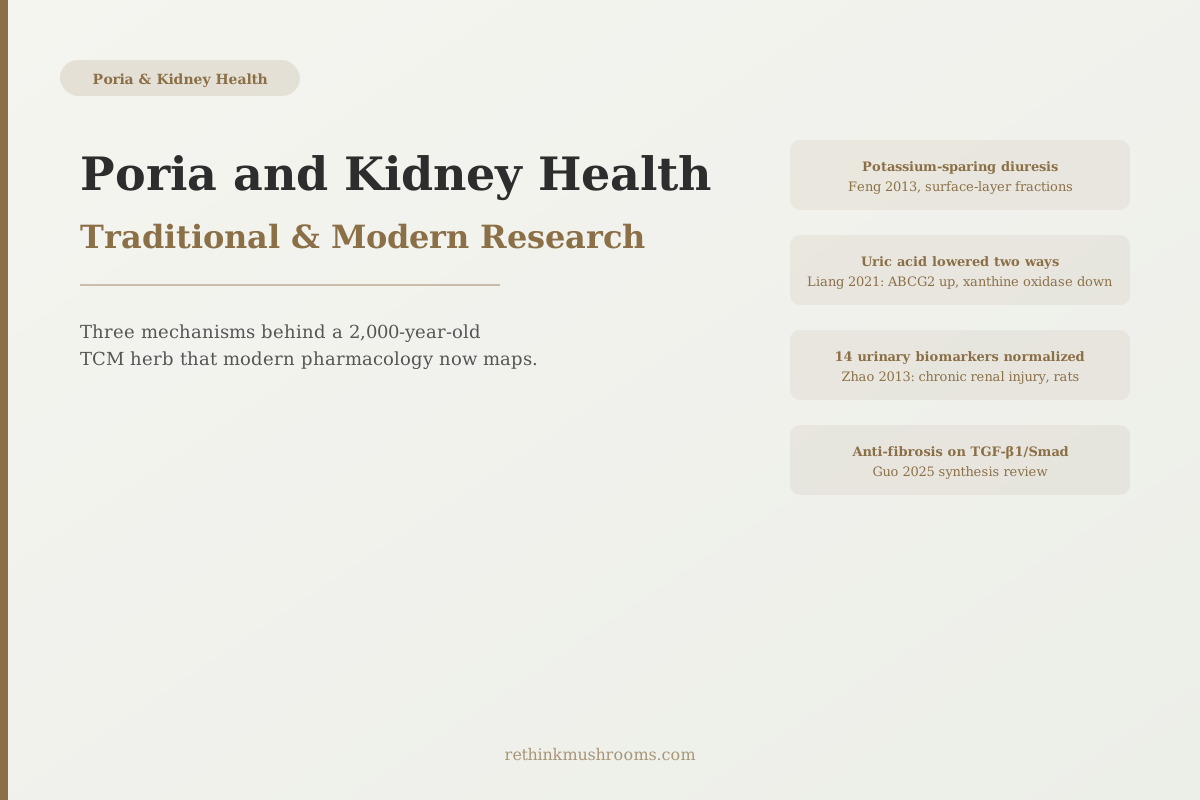
When researchers profiled the urine of rats with chronic kidney injury, they identified fifteen metabolite biomarkers of damage. After treatment with the surface layer of the Poria mushroom, fourteen of them shifted back toward the control range.
Zhao et al., Journal of Ethnopharmacology, 2013
2,000+ years
of traditional use for water-metabolism and edema disorders
Potassium-sparing
diuretic effect documented at the fraction level (Feng 2013)
Animal-stage
evidence: no randomised human trial of Poria alone in diagnosed CKD
Zhao et al., Journal of Ethnopharmacology, 2013
 View as image ↗
In 2013, a research team in China collected urine samples from rats with adenine-induced chronic kidney injury and ran them through a mass spectrometer. They were looking for the molecular fingerprints of damage. They identified fifteen of them. Then they treated the rats with the surface layer of a fungus called Poria cocos and ran the same analysis again. Fourteen of the fifteen biomarkers had shifted back toward the control range.[4]
The fungus had already been used in Chinese medicine for water-metabolism disorders for 2,000 years. That 2013 paper, and the wave of pharmacology that followed it, is part of why the conversation about poria mushroom kidney health has changed in the last fifteen years. Modern research has begun to map the specific mechanisms behind the herb's long-standing reputation — though, as this article will show, the mapping is far more complete in rodents than in people.
This article is the hub for the cluster on Poria and the kidneys, walking through what TCM understood, what modern pharmacology has now shown, and where the evidence base still has real gaps. For the broader picture of the mushroom itself, see the pillar guide on Poria, one of the most important mushrooms in TCM.
Key Takeaways
- Poria has been used in Traditional Chinese Medicine for water-metabolism and edema disorders for over 2,000 years, and it remains one of the most-prescribed herbs in the tradition
- The diuretic activity is concentrated in the surface layer of the mushroom (Fu-Ling-Pi), not the inner sclerotium (Fu-Ling) that most commercial supplements use — the 2025 renoprotective review states directly that the surface layer is the stronger diuretic (Guo et al., Acta Pharmacologica Sinica, 2025)
- Feng's 2013 study found the ethyl acetate and n-butanol fractions of the epidermis produced a marked diuretic effect that spared potassium, which the authors attributed to lanostane tetracyclic triterpenoids
- Wu's 2014 study identified the water-side mechanism: Poria's sclederma fraction down-regulated aquaporin-2 via the AVP–V2R–AQP2 axis, and produced less electrolyte disturbance than furosemide in the same experiment
- Liang's 2021 study showed Poria extract sharply lowered serum uric acid in hyperuricemic mice and improved creatinine and urea nitrogen, with the mechanism traced to up-regulation of ABCG2, a urate excretion transporter
- The 2025 Guo review catalogues renoprotective signalling across TGF-β1/Smad, Wnt/β-catenin, IκB/NF-κB and Keap1/Nrf2 pathways — but essentially all of this evidence is preclinical
- There is no randomised controlled trial of Poria as a single agent in patients with diagnosed kidney disease. This is the central limitation of the entire evidence base.
Why Poria Mushroom Has Been a Kidney Health Anchor in TCM for 2,000 Years
Poria has a 2,000-year-old reputation in Chinese medicine that modern science has been quietly catching up with for the last fifteen years.
The mushroom's currently accepted name is Wolfiporia cocos, with the older synonym Poria cocos still used across most of the literature.[5] The fungus grows underground on the roots of pine trees in East Asia and forms a dense, potato-like underground body called a sclerotium. In Chinese medicine, the whole sclerotium is called Fu-Ling, and its outer skin is Fu-Ling-Pi.[1] The two parts have distinct uses, which becomes important once the modern data starts coming in.
Poria appears in some of the most-prescribed formulas in Chinese medicine. Wu Ling San, a five-herb diuretic formula, is used for water retention and urinary symptoms. Gui Zhi Fu Ling Wan combines Poria with cinnamon and peony. Zhen Wu Tang uses it for edema in patients with what TCM describes as "yang deficiency." All three formulas have been in continuous clinical use for centuries, and Poria is a core ingredient in each. For more on the broader herbal tradition, see Poria cocos in Traditional Chinese Medicine: 2,000 years of clinical use.
The traditional indications are consistent across the modern review literature: promoting urination, dispersing dampness, reducing edema, relieving nephrosis, and calming the mind.[5][10] What TCM did not have was the molecular detail. The herb was used. Why it worked sat unanswered until pharmacology and metabolomics caught up.
Two Parts of One Mushroom: Why the Skin Matters More Than the Inside
The most important detail in any conversation about Poria and the kidneys is which part of the mushroom is being discussed. This is the detail almost every supplement label gets wrong.
The Poria sclerotium has two layers. The outer layer, called Fu-Ling-Pi, is the dark brown or black skin. The inner layer, called Fu-Ling, is the pale, dense body inside. Most commercial Poria supplements use the inner sclerotium, because that part is larger and easier to extract. But the diuretic and renal activity in the research literature is concentrated in the skin.
The clearest statement of this comes from the 2025 review by Guo and colleagues in Acta Pharmacologica Sinica, the most focused synthesis of Poria's renal pharmacology published to date. It reports directly that the surface layer of P. cocos shows a stronger diuretic effect than the whole sclerotium, and that lanostane and 3,4-seco-lanostane tetracyclic triterpenoids are the main components responsible.[8] Feng's 2013 fractionation study, covered in the next section, worked exclusively with the epidermis for the same reason.[2]
Broader reviews of the whole mushroom identify two principal active classes — triterpenes and polysaccharides — with pharmacological effects spanning anti-tumour, anti-inflammatory, immunomodulatory, and liver and kidney protection.[5][9] The inner sclerotium is where most polysaccharide research sits; the epidermis is where the diuretic research sits.
For deeper coverage of the diuretic mechanism specifically, see Poria and renal function: diuretic mechanisms. For the underlying compound classes, see Poria's bioactive compounds: pachymic acid, triterpenoids, and beta-glucans.
The practical implication is direct. Kidney-related research overwhelmingly uses Fu-Ling-Pi or whole sclerotium with the skin retained. It does not use the de-skinned inner mushroom that shows up in most Western supplement bottles. When the studies in this article describe a renal effect, that effect was in most cases demonstrated using the surface-layer fraction.
Supplement labelling
Does a Poria supplement give you the kidney effect studied in the research?
The claim
“Any Poria cocos supplement delivers the diuretic and kidney-related effects reported in the literature.”
Supplement labels list 'Poria cocos' as a single ingredient without specifying which part of the sclerotium was used.
What research shows
MisleadingThe diuretic research was performed on the epidermis — Fu-Ling-Pi, the dark outer skin. The 2025 renoprotective review states the surface layer is a stronger diuretic than the sclerotium as a whole, and Feng's fractionation work isolated the active fractions from the epidermis specifically.
This does not make inner-sclerotium products worthless — the polysaccharide research on immune and sleep endpoints uses the interior. It means the fraction studied for kidney and water-metabolism endpoints is usually not the fraction in the bottle, and labels rarely disclose which one you are getting.
Guo et al., Acta Pharmacologica Sinica, 2025 [8]; Feng et al., J Ethnopharmacol, 2013 [2]
The First Mechanism: A Diuretic That Doesn't Drain Potassium
Feng and colleagues, publishing in the Journal of Ethnopharmacology in 2013, ran what is still the cleanest fraction-level diuretic study on Poria. They split the surface-layer extract into multiple chemical fractions and tested each in rats. The ethyl acetate and n-butanol fractions produced a marked diuretic effect. The finding the authors emphasised was that this was a potassium-sparing diuresis, which they attributed to triterpenoid components of intermediate polarity — particularly the lanostane tetracyclic triterpenoids.[2] They concluded the data pointed to at least two mechanisms operating at once.
Most pharmaceutical diuretics work by forcing the kidneys to dump sodium, and potassium follows the sodium out. That is why hospital patients on furosemide get their potassium checked closely, and why low potassium is one of the most common complications of long-term diuretic use. A diuretic that pulls water without depleting potassium is a structurally different kind of compound.
The second mechanism became clearer in 2014. Wu and colleagues gave an aqueous extract of Poria sclederma to rats with chronic heart failure and compared it head-to-head against furosemide.[11] Urine output rose significantly and urine osmolality fell. Both the mRNA and protein expression of aquaporin-2 — the water channel that controls how much water the kidney reclaims in its collecting ducts — were down-regulated, alongside reduced plasma vasopressin and reduced vasopressin type 2 receptor expression. The authors described the effect as running through the AVP–V2R–AQP2 axis. Two details from that experiment matter: Poria caused less electrolyte disturbance than furosemide, and it reduced plasma BNP in the heart-failure rats where furosemide did not.
Claim vs Evidence Reach
Three Renal Mechanisms — and Where Each One Stops
Poria’s kidney research is often summarised as three established mechanisms. Each is real at the level it was measured. None has been tested in people. The right-hand column is empty for every row, and that is the single most important fact on this page.
Diuresis
[2, 11]Saline-loaded + chronic heart failure
The popular claim
“Increases urine output while sparing potassium”
What the study actually showed
Epidermis fractions raised urine output with a K⁺-sparing profile (Feng 2013). Sclederma down-regulated aquaporin-2 via the AVP–V2R–AQP2 axis and caused less electrolyte disturbance than furosemide (Wu 2014).
Human trial
NoneUrate excretion
[6]Hyperuricemic Kunming, n = 8/group
The popular claim
“Lowers serum uric acid and protects the kidney from urate injury”
What the study actually showed
Serum urate fell from 526 µmol/L to 151–178 (ethanol extract) and 62–69 (water extract), p < 0.01. Creatinine, urea nitrogen and histology improved. Mechanism traced to ABCG2 up-regulation — excretion only, not xanthine oxidase inhibition.
Human trial
NoneAnti-fibrosis signalling
[8]Review of preclinical literature
The popular claim
“Slows the scarring that drives chronic kidney disease”
What the study actually showed
Surface-layer ethanol extract improved acute injury, the acute-to-chronic transition, and CKD states including diabetic kidney disease. Signalling spans TGF-β1/Smad, Wnt/β-catenin, IκB/NF-κB and Keap1/Nrf2.
Human trial
NoneThe pattern
The mechanistic depth here is genuinely unusual for a herbal medicine — specific fractions, a named water channel, a named urate transporter. That depth is easy to mistake for clinical proof. It is not. The gap between “we know how it works in a rat” and “it helps a patient” has not been crossed, and it was already being flagged in the review literature in 2011.
Source: Feng 2013; Wu 2014; Liang 2021; Guo 2025 (see references)
Pachymic acid is the best-known member of the lanostane triterpenoid class in Poria. The 2022 review by Wei and colleagues catalogued its documented biological properties — cytotoxic, anti-inflammatory, antihyperglycemic, antiviral, antibacterial, sedative-hypnotic, and anti-ischemia/reperfusion — while noting that the underlying mechanisms of pachymic acid remain incompletely understood.[7] That review does not report a hyperuricemic-kidney-injury effect for pachymic acid specifically, and this article does not claim one.
The summary of the modern picture is that Poria is a real diuretic in animal models. The effect is documented at the fraction level, it is reproducible, and on the water side the mechanism is understood down to a specific channel. It is also a structurally unusual diuretic, because it does not appear to pull potassium out with the sodium.
The Second Mechanism: Pushing Uric Acid Out Through ABCG2
The kidney work that gets the least public attention is Poria's effect on uric acid. Hyperuricemia — chronically elevated uric acid in the blood — is a major driver of gout and a contributor to chronic kidney disease. Urate crystals deposit in joints, where they cause gout pain, and in kidney tubules, where they cause hyperuricemic nephropathy.
Liang's 2021 paper in Pharmaceutical Biology used a hyperuricemic mouse model and tested whether Poria cocos extracts could lower the urate burden.[6] The magnitude of the effect was the striking part. Serum uric acid in the hyperuricemic control group sat at 526 ± 112 μmol/L. The ethanol extract brought it down to between 151 and 178 μmol/L across three doses. The water extract brought it down further, to between 62 and 69 μmol/L. Both results were statistically significant at p < 0.01.
Liang et al. (2021) · Pharmaceutical Biology
- Population
- Hyperuricemic Kunming mice (n = 8 per group)
- Intervention
- Poria cocos ethanol extract (PCE) or water extract (PCW), 50 / 100 / 200 mg/kg orally
- Comparator
- Untreated hyperuricemic control (serum uric acid 526 ± 112 μmol/L)
- Finding
- Serum uric acid fell to 151–178 μmol/L with the ethanol extract and 62–69 μmol/L with the water extract (both p < 0.01). Serum creatinine, urea nitrogen and kidney histology all improved. ALT, AST and ALP were unaffected. The mechanism was traced to increased ABCG2 mRNA and protein expression.
positive Large, dose-consistent effect — but in mice, over a short model, with no human counterpart.
Liang et al., Pharmaceutical Biology, 2021 [6]
Two things stood out beyond the headline numbers. First, the kidney damage markers moved with the urate. Serum creatinine and blood urea nitrogen both improved, and histological staining showed the extracts partially attenuated the renal dysfunction caused by hyperuricemia. Liver enzymes were unaffected, which argues against a general toxicity confound.
Second, the mechanism was pinned to a specific transporter. Liang's team found that Poria elevated the expression of ABCG2 — the ATP-binding cassette super-family G member 2 — at both the mRNA and protein level. ABCG2 pumps urate out of the body, and reduced ABCG2 function is a well-established cause of hyperuricemia in humans. Molecular docking work in the same paper predicted five Poria compounds as the most likely bioactives.
One clarification is worth making, because it is frequently stated incorrectly. Liang's study demonstrates the excretion side of the equation: more urate leaving through ABCG2. It does not report an effect on xanthine oxidase, the enzyme that produces uric acid. Claims that Poria "blocks uric acid production and increases excretion at the same time" are not supported by this paper.
For the kidney-stone-specific implications, see Poria and kidney stone prevention.
The Third Mechanism: Interfering With Scar Tissue Signalling
Chronic kidney disease progresses through a process called fibrosis. Healthy kidney tissue gets replaced by scar tissue over time, and the scarring is what eventually destroys the kidney's filtering capacity.
Several molecular pathways drive that fibrosis, and they are well-known targets in CKD drug development. Two are usually written as TGF-β1/Smad and Wnt/β-catenin. Both names refer to chains of proteins that switch on the genes responsible for laying down scar tissue. Drugs that interrupt these chains slow fibrosis.
The 2025 Guo review is the source that maps Poria onto this territory in detail. It reports that ethanol extract of the surface layer and its components improved acute kidney injury, the acute-injury-to-CKD transition, and chronic kidney disease states including diabetic kidney disease, nephrotic syndrome and tubulointerstitial nephropathy, and protected against renal fibrosis.[8] The signalling it catalogues is broader than the two headline fibrosis pathways: TGF-β1/Smad, Wnt/β-catenin, IκB/NF-κB and Keap1/Nrf2, plus effects on the renin-angiotensin system, matrix metalloproteinases, the aryl hydrocarbon receptor, and endogenous metabolites.
That breadth is worth reading carefully in both directions. It is a genuine catalogue of renoprotective signalling. It is also, almost entirely, preclinical — cell and rodent work, not trials in patients.
The 15-Biomarker Test: Reading the Urine for Damage
Zhao's team published two metabolomic papers in 2013 that together represent the most specific mechanistic window into Poria's kidney effect.
The first, in the Journal of Pharmaceutical and Biomedical Analysis, used UPLC Q-TOF/HSMS mass spectrometry to map the metabolic fingerprint of adenine-induced chronic kidney disease in rats.[3] Nineteen metabolites were identified as potential CKD biomarkers. After treatment with Poria cocos epidermis, ten of them — including eicosapentaenoic acid, docosahexaenoic acid, several lysophospholipids, indoxyl sulfate, hippuric acid, p-cresol sulfate and allantoin — returned to control levels. The disrupted processes the authors named were fatty acid metabolism, phospholipid metabolism, purine metabolism and tryptophan metabolism.
The second paper, in the Journal of Ethnopharmacology, applied the same approach to urine.[4] Fifteen urinary biomarkers were identified, eleven of them tied to adenine metabolism and amino acid metabolism. Fourteen of the fifteen shifted after treatment with Poria's surface layer: eight — including adenine, hypoxanthine, creatine, methionine and phenylalanine — reversed to control levels, while six more moved toward the high-control group.
The Number Behind the Headline
What “Poria Normalised 14 Biomarkers” Actually Means
Two separate 2013 papers are usually collapsed into one claim. Restoring the denominators changes the reading: the shifts are real and broad, but only a subset returned all the way to control levels, and the two studies measured different sample matrices and different metabolic pathways.
Zhao 2013 — renal profiling
J Pharm Biomed Anal · Adenine-induced CKD rats
19 biomarkers identified
- 10Reversed to control level
- 9Not reported as reversed
Pathways implicated
Fatty acid, phospholipid, purine and tryptophan metabolism
Zhao 2013 — urinary metabonomics
J Ethnopharmacol · Adenine-induced CKD rats (urine)
15 biomarkers identified
- 8Reversed to control level
- 6Shifted toward high control
- 1Not reported as shifted
Pathways implicated
Adenine and amino acid metabolism (11 of 15 biomarkers)
Reading it honestly
“14 of 15” comes from the urinary paper and counts every biomarker that moved, in either direction of correction. Only 8 returned to true control levels. Both studies used the same chemical (adenine) injury model in rats — a reproducible lesion, but not a stand-in for human diabetic or hypertensive kidney disease.
Source: Zhao et al., 2013 (two papers — see references)
That kind of finding is unusual in herbal-medicine pharmacology. Most studies show a single endpoint moving in the right direction. Zhao's metabolomic approach showed a coordinated shift across multiple metabolic systems at once. The honest reading is that the herb pulls the rodent kidney's metabolic state back toward baseline along several axes — not that it repairs one specific lesion.
Two caveats belong with this result. The reversals are not uniform: only eight of the fifteen returned to true control levels. And adenine-induced kidney injury is a chemical model, not a reproduction of human diabetic or hypertensive kidney disease.
For the deep dive on the CKD-specific evidence base, see Fu Ling for chronic kidney disease: evidence base.
The 2025–2026 Picture: What the Latest Reviews Add
Three recent reviews have done the synthesis work that the earlier scattered animal studies needed.
The 2025 review by Guo and colleagues in Acta Pharmacologica Sinica is the dedicated renal synthesis, and it is the single most useful source in this area — the surface-layer diuretic comparison, the disease-state coverage from acute injury through diabetic kidney disease, and the signalling catalogue all come from it.[8]
The 2025 review by Lei and colleagues in the Journal of Ethnopharmacology took a wider angle, describing Poria across its full documented pharmacology rather than the kidney alone.[9]
The 2026 update by Guo and colleagues in Frontiers in Nutrition — a different Guo from the 2025 renal review — is the most recent comprehensive summary, covering research from 2023 to 2025.[10] It identifies polysaccharides and triterpenoids as the core active ingredients and lists renal protection alongside digestive function, sleep quality, immune regulation, antioxidant activity, anticancer properties and glucose-lipid metabolism. Its distinctive contribution is the emphasis on gut microbiota and glycolipid metabolism as mediating mechanisms, which extends the renal story beyond the triterpenoid-and-water-channel account.
For TCM formula combinations specifically, see Poria and chronic kidney disease: renoprotective evidence from TCM formulas.
The Honest Limits: What the Evidence Doesn't Yet Show
The case for Poria's kidney activity is strong at the mechanism level and weak at the human clinical level. Responsible coverage has to lead with that, not bury it.
- Cell studiescompleted
Fraction and compound-level work; molecular docking of candidate bioactives (Liang 2021)
- Animal studiescurrent
Rat diuresis and metabolomics (Feng 2013, Zhao 2013 ×2, Wu 2014); hyperuricemic mice (Liang 2021); broad rodent renoprotection catalogued in Guo 2025
- Case reportsmissing
No published case series of Poria used alone for diagnosed kidney disease
- Small human trialsmissing
No controlled trial of Poria as a single agent with renal endpoints
- Large RCTsmissing
None
- Meta-analysesmissing
None for Poria alone with kidney outcomes
Every renal finding described in this article comes from cell or rodent work. The mechanistic depth is genuine and unusually detailed for a herbal medicine — but the ladder stops before it reaches human patients, and nothing here has been tested against clinical kidney outcomes in a controlled trial.
Feng 2013 [2]; Zhao 2013 [3][4]; Wu 2014 [11]; Liang 2021 [6]; Guo 2025 [8]
Almost all of the renoprotective data comes from rodent studies. Feng's diuretic data came from rats. Zhao's metabolomic data came from rats. Wu's aquaporin data came from rats. Liang's hyperuricemia data came from mice. The models are well-designed and the findings are internally consistent. But rats with chemically induced kidney injury are not human patients with diabetic kidney disease, IgA nephropathy, or polycystic kidney disease.
There are no randomised controlled trials of Poria as a single agent in patients with diagnosed CKD. The TCM formulas containing Poria have been studied in human populations, but those trials test multi-herb combinations rather than isolated Poria, and pulling the Poria-specific contribution out of a Wu Ling San trial requires assumptions the trials themselves do not test.
This gap is not new, and it has been flagged from inside the review literature for over a decade. Ríos, reviewing Poria's chemistry and pharmacology in Planta Medica in 2011, concluded plainly that the number of research papers on the fungus's clinical properties was insufficient to establish either its efficacy or its safety from a scientific point of view.[1] Fifteen years of mechanistic work has since deepened the preclinical picture considerably. It has not closed the clinical gap.
Is Poria Mushroom Safe for Kidney Health Concerns?
This is one of the questions that brings people to articles like this one, and it deserves a direct answer rather than a hedge — including where the honest answer is "we don't know."
Poria has been used in Chinese medicine for two thousand years and is classified as a food-homologous herb in the modern Chinese materia medica, which reflects a long record of use without obvious acute harm. In the animal studies covered here, safety signals were reassuring as far as they went: Liang's hyperuricemic mice showed no adverse effects on ALT, AST or ALP,[6] and Wu's heart-failure rats had less electrolyte disturbance on Poria than on furosemide.[11]
What does not exist is a body of controlled human safety data. Ríos's 2011 assessment — that the clinical literature was insufficient to establish safety scientifically — has not been superseded by a formal human toxicology programme.[1] Long traditional use and clean rodent liver enzymes are meaningful, but they are not the same evidence base as a clinical safety trial, and they say very little about people whose kidneys are already compromised.
Kidney disease
ModeratePoria is not established as safe for people with diagnosed kidney disease
Concern
The renal evidence for Poria is entirely preclinical, and no controlled human safety data exists for its use in people with impaired kidney function. Poria has a genuine diuretic effect, so its volume-depleting action can stack with prescription diuretics already in use, even though the potassium-sparing profile differs structurally from loop diuretics like furosemide. People with advanced CKD, on dialysis, or with a kidney transplant typically manage tightly balanced fluid, electrolyte and immunosuppressant regimens where an unmeasured diuretic input is a real risk.
What the research says
Anyone with diagnosed kidney disease, or taking prescription diuretics, should treat Poria as a medication-relevant addition and raise it with the nephrology team managing their care before starting it — not after. This is particularly important around transplant immunosuppression and dialysis fluid management, where the margin for error is narrow.
Particularly relevant for: People with diagnosed CKD, dialysis patients, transplant recipients, and anyone on prescription diuretics
What to do
Discuss with your nephrologist or prescribing clinician before use. This article is research education, not medical advice, and nothing in it should be used to start, stop or change any treatment.
Ríos, Planta Medica, 2011 [1]; Liang et al., Pharmaceutical Biology, 2021 [6]; Wu et al., J Ethnopharmacol, 2014 [11]
One more practical consideration applies regardless of health status. Supplement quality varies enormously, and the Fu-Ling versus Fu-Ling-Pi distinction is rarely disclosed on commercial labels. A product marketed for kidney support that uses inner-sclerotium powder is using a different fraction from the one the renal research was performed on.
For broader context on the parallel TCM kidney tradition involving a different mushroom, see Cordyceps sinensis and kidney transplant: traditional use.
The Bottom Line
Poria's kidney reputation is 2,000 years old, and modern pharmacology has mapped several plausible mechanisms behind it — all in animals. The surface layer (Fu-Ling-Pi), not the inner sclerotium most supplements use, carries the diuretic activity: Feng's 2013 fractionation study found a potassium-sparing diuresis from the epidermis attributed to lanostane triterpenoids, and Wu's 2014 study traced the water-side mechanism to down-regulation of aquaporin-2 via the AVP–V2R–AQP2 axis, with less electrolyte disturbance than furosemide. Liang's 2021 study showed a large reduction in serum uric acid in hyperuricemic mice — from 526 μmol/L to as low as 62 μmol/L — alongside improved creatinine and urea nitrogen, with the mechanism traced to up-regulation of the urate exporter ABCG2 (not, as is often claimed, to xanthine oxidase inhibition). Zhao's two 2013 metabolomic papers showed coordinated normalisation of urinary and renal biomarkers, though only a subset returned fully to control levels. The 2025 Guo review catalogues renoprotective signalling across TGF-β1/Smad, Wnt/β-catenin, IκB/NF-κB and Keap1/Nrf2. The decisive limitation is unchanged since Ríos flagged it in 2011: there is no randomised trial of Poria as a single agent in people with diagnosed kidney disease, and no controlled human safety data in that population.
Frequently Asked Questions
Sources & References
- 1RTHM-00431·Ríos, José-Luis (2011). “Chemical constituents and pharmacological properties of Poria cocos..” Planta medica.Study breakdown →PubMed →↩
- 2RTHM-00519·Feng, Ya-Long et al. (2013). “Diuretic activity of some fractions of the epidermis of Poria cocos..” Journal of ethnopharmacology.Study breakdown →PubMed →↩
- 3RTHM-00575·Zhao, Ying-Yong et al. (2013). “Renal metabolic profiling of early renal injury and renoprotective effects of Poria cocos epidermis using UPLC Q-TOF/HSMS/MSE..” Journal of pharmaceutical and biomedical analysis.Study breakdown →PubMed →↩
- 4RTHM-00576·Zhao, Ying-Yong et al. (2013). “Urinary metabonomic study of the surface layer of Poria cocos as an effective treatment for chronic renal injury in rats..” Journal of ethnopharmacology.Study breakdown →PubMed →↩
- 5RTHM-01268·Nie, Anzheng et al. (2020). “Phytochemistry and Pharmacological Activities of Wolfiporia cocos (F.A. Wolf) Ryvarden & Gilb..” Frontiers in pharmacology.Study breakdown →PubMed →↩
- 6RTHM-01388·Liang, Danling et al. (2021). “Hypouricaemic and nephroprotective effects of Poria cocos in hyperuricemic mice by up-regulating ATP-binding cassette super-family G member 2..” Pharmaceutical biology.Study breakdown →PubMed →↩
- 7RTHM-01632·Wei, Chunyong et al. (2022). “Pharmacological profiles and therapeutic applications of pachymic acid (Review)..” Experimental and therapeutic medicine.Study breakdown →PubMed →↩
- 8RTHM-02090·Guo, Zhi-Yuan et al. (2025). “Poria cocos: traditional uses, triterpenoid components and their renoprotective pharmacology..” Acta pharmacologica Sinica.Study breakdown →PubMed →↩
- 9RTHM-02126·Lei, Juanhong et al. (2025). “A multidimensional perspective on Poria cocos, an ancient fungal traditional Chinese medicine..” Journal of ethnopharmacology.Study breakdown →PubMed →↩
- 10RTHM-02230·Guo, Yanquan et al. (2026). “Research progress on the pharmacological effects of Poria cocos: a narrative update..” Frontiers in nutrition.Study breakdown →PubMed →↩
- 11RTHM-00658·Wu, Zhen-Li et al. (2014). “Sclederma of Poria cocos exerts its diuretic effect via suppression of renal aquaporin-2 expression in rats with chronic heart failure..” Journal of ethnopharmacology.Study breakdown →PubMed →↩