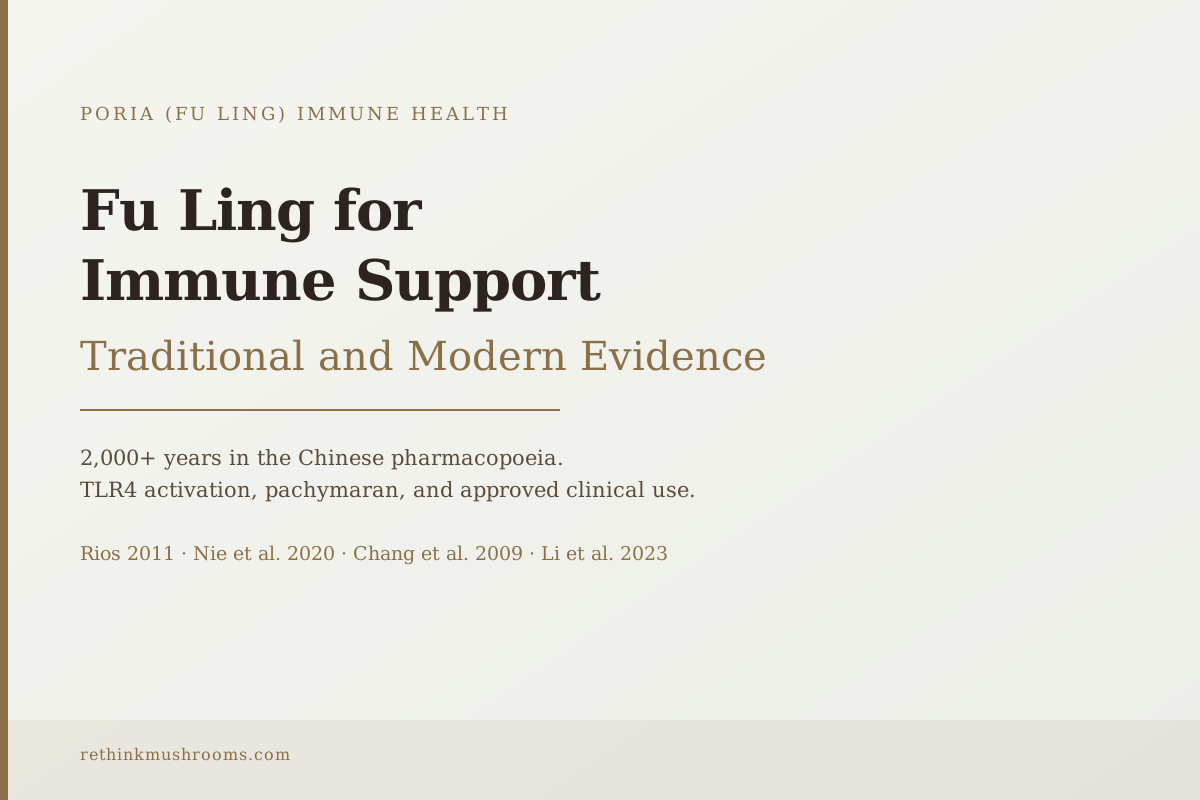
Poria (Fu Ling) Immune Health
2,000+ years
Fu Ling (Poria cocos) has been documented in the Chinese pharmacopoeia since ~200 AD. Modern research identifies two compound classes with opposite immune effects: polysaccharides that activate, triterpenoids that regulate.
Rios, Planta Medica, 2011
TLR4
Poria's immune-activating protein engages the TLR4 receptor, distinct from most mushrooms' beta-glucan pathway
4 variants
structurally distinct polysaccharides from different Poria tissues, each with a different immune activity profile
Approved
Poria polysaccharide approved as an adjunctive antitumor drug in China
Rios, Planta Medica, 2011
 View as image ↗
The sclerotium that grows underground on pine tree roots has been consumed for immune support and longevity in China for more than 2,000 years. In the oldest systematic pharmacopoeia in Chinese medicine, Shennong's Classic of Herbal Medicine (written approximately 200 AD), Fu Ling appears as a primary tonifying agent and a superior-class herb, a category reserved for substances considered safe for extended daily use. The formula it is most famous for, Si Jun Zi Tang (the Four Gentlemen Decoction), pairs Fu Ling with Ginseng, Atractylodes, and Licorice for what TCM practitioners have described for a thousand years as supporting "spleen and stomach" function, a conceptual category that includes digestive resilience, energy, and immune strength.
The modern name is Poria cocos or Wolfiporia extensa. A 2011 pharmacological review by Rios documented the historical record alongside the chemistry: Poria cocos contains two primary bioactive classes, beta-(1→3)-d-glucan polysaccharides and lanostane triterpenoids, and these two classes act on the immune system in distinct and sometimes opposite directions.[1] That bidirectional nature is exactly why Fu Ling has been prescribed for both "strengthening" and "calming" immune conditions across two millennia. This article connects the traditional evidence to the laboratory research, and is honest about where the evidence runs out. For a broader overview of the mushroom itself, see the complete Fu Ling and Poria guide.
Key Takeaways
- Rios 2011 documented 2,000+ years of TCM use and identified the two primary compound classes in Poria cocos: polysaccharides (immune-stimulating) and lanostane triterpenoids (anti-inflammatory and immunomodulating), each with distinct mechanisms.
- Chen et al. 2004 showed that Fu Ling polysaccharide fractions induced differentiation and inhibited proliferation in human leukemia cell lines, one of the earliest laboratory validations of its immune-relevant activity.
- Chang et al. 2009 identified a novel Poria cocos protein (distinct from its polysaccharides) that activates macrophages via the TLR4 receptor, a signaling pathway not typically associated with fungal beta-glucans.
- Li et al. 2023 isolated four structurally different polysaccharides from different parts of Poria cocos and found each had a different immune activity profile, showing that "Poria polysaccharide" on a supplement label describes a heterogeneous class, not a single compound.
- Chen et al. 2010 found that carboxymethylated-sulfated beta-(1→3)-d-glucan (pachymaran) showed significantly stronger immunopotentiation and anti-tumor activity than unmodified Poria polysaccharide.
- Li et al. 2019 documented that Poria polysaccharide is officially approved as an adjunctive antitumor drug in China, representing regulatory acknowledgment of its immune-mediated anti-cancer effects at a clinical level.
Two Thousand Years in the Chinese Pharmacopoeia: What Fu Ling Was Used For
Fu Ling's first systematic documentation appears in the Shennong Bencao Jing, written around 200 AD and the foundational reference text of classical Chinese herbal medicine. The text places Fu Ling in the highest-grade category of materia medica, alongside Ginseng and Astragalus, substances considered nontoxic and suitable for long-term use to build constitutional strength rather than only for acute conditions.
The TCM framework describes three main actions attributed to Fu Ling. The first is "tonifying the spleen and fortifying the middle," meaning it supports the digestive and metabolic center of the body, which in TCM theory is also the root of immune vitality. The second is "calming the heart and quieting the spirit" (an anxiolytic and sedative application that modern research has explored through different mechanisms). The third is "resolving dampness and promoting water metabolism," which maps loosely to reducing inflammatory fluid accumulation.
In the Si Jun Zi Tang (Four Gentlemen Decoction), one of the most frequently prescribed classical formulas, Fu Ling's role is specifically to "resolve dampness" and prevent the formula's tonifying ingredients from causing the heavy, stagnant sensation that enriching herbs can produce. TCM practitioners recognized that immune strengthening without inflammation control was incomplete, and Fu Ling's presence in the formula provided both. This conceptual pairing of stimulation and modulation anticipates what laboratory science later confirmed: Poria's polysaccharides and triterpenoids do, in fact, operate on opposing sides of the immune activation dial.
What makes Rios's 2011 review particularly useful as a bridge is that it takes this 2,000-year clinical record seriously as a starting hypothesis rather than dismissing it as folk medicine.[1] The pharmacological properties ascribed to Fu Ling in classical texts, including immune strengthening, anti-inflammatory effects, and calming action, each found corresponding bioactive compound classes when the chemistry was worked out. That alignment between traditional prescription rationale and identified molecular mechanisms is unusual in pharmacognosy, and it's part of why Poria research has attracted sustained interest.
What Modern Research Found When It Looked
Laboratory interest in Poria cocos accelerated in the 1990s and 2000s as analytical chemistry methods became capable of isolating and characterizing specific compounds from complex fungal extracts.
Nie and colleagues' 2020 review synthesized the entire pharmacological evidence base for Wolfiporia cocos across all health domains.[2] It is the most comprehensive available map of what the research has found: immune activation, anti-tumor activity, neurological effects, kidney protection, metabolic regulation, and skin effects, all with compound-by-compound evidence mapping. In the immune domain specifically, the review documents macrophage activation, natural killer (NK) cell enhancement, T cell support (both CD3+CD4+ helper T cells and CD8+ cytotoxic T cells), and increases in circulating antibody levels (IgG, IgA, IgM) across animal and in vitro experiments.
That list of immune cell types is more specific than the "immune support" language used in most consumer health writing. The research is not describing a vague general boost. It is describing which specific cells in which specific immune compartments show responses to Poria compounds. Macrophages and NK cells are first-responders in the innate immune system, activating before the body has had time to build targeted antibodies. T cells are central to the adaptive immune response, providing targeted killing of infected and tumor cells. Antibodies provide long-term immune memory and blocking function. Fu Ling's polysaccharides appear to engage all three compartments, which is what the TCM concept of "building defensive qi" operationalizes in molecular terms.
For a deeper exploration of how Poria's pharmacology works across all its applications, see The Pharmacology of Wolfiporia extensa: How Poria Works.
The Laboratory Evidence: From Cell Studies to Molecular Pathways
The first direct laboratory evidence of Fu Ling's effect on immune-relevant cells came from Chen and colleagues in 2004.[3] Their in vitro experiments found that a polysaccharide fraction from Fu Ling induced cell differentiation and inhibited proliferation in two human leukemia cell lines (U937 and HL-60). This was preclinical work using cancer cell cultures rather than patients, but it demonstrated that Fu Ling's polysaccharides could interact with human immune cell lines in biologically meaningful ways. It was the kind of early-stage signal that motivates subsequent mechanistic work.
Chang and colleagues made a more specific discovery in 2009, and it was somewhat unexpected.[4] They isolated a novel protein from Poria cocos, distinct from the polysaccharide fraction, that activated mouse macrophages through the Toll-like receptor 4 (TLR4) pathway. TLR4 is the receptor on immune cells that normally responds to lipopolysaccharide, the cell wall component of gram-negative bacteria. It is a pattern recognition receptor for infection, not a typical target for fungal compounds. Poria cocos contains a protein that engages this bacterial-detection pathway, which means Fu Ling's immune activation operates through at least two distinct routes: the beta-glucan polysaccharide pathway and this TLR4-activating protein pathway. Most medicinal mushroom immune research focuses on beta-glucan binding to the Dectin-1 receptor. Poria also works through TLR4, which is a mechanistically different route.
The polysaccharide evidence became more refined in 2010, when Chen and colleagues characterized the superior immunopotentiating activity of the carboxymethylated-sulfated form of Poria's primary beta-(1→3)-d-glucan.[6] This chemically modified version, known as pachymaran, showed significantly stronger immune activation and anti-tumor activity compared to the unmodified polysaccharide. The structural modifications (addition of carboxymethyl and sulfate chemical groups to the glucan backbone) enhanced the molecule's biological activity, making pachymaran the most studied Poria immune compound in subsequent research. For more on pachymaran specifically, see Pachymaran: Poria's Signature Polysaccharide and Immune Research.
Why Not All Poria Preparations Are Equivalent
One of the most practically important recent findings comes from Li and colleagues in 2023.[5] Their study isolated four structurally distinct polysaccharides from different anatomical parts of Poria cocos: the sclerotium (the main body), the mycelium, and the fermentation broth supernatant. Each of the four polysaccharides showed a different immunomodulatory profile. The structures differed, and the biological activity differed with them.
This finding has a direct implication for supplement evaluation. A product label claiming "Poria polysaccharide" or listing a polysaccharide percentage is describing a class of chemically heterogeneous compounds. Which polysaccharides are present, and in what ratios, depends on which anatomical part of the fungus was used, how it was extracted, and how the extract was processed. A standard beta-glucan assay tells you the total quantity of beta-glucan measured but not the structural identity of the compounds being measured, nor their relative immune activity.
The anatomical distinction is also relevant to traditional practice. Classical Chinese medicine uses different Poria forms for different purposes:
- The white inner sclerotium (Bai Fu Ling): the most common form, highest in polysaccharides, used for immune tonification and digestive support.
- The reddish outer bark or skin (Fu Shen Pi): higher in triterpenoids, used for their anti-inflammatory and calming properties.
- The inner section surrounding a pine root (Fu Shen): the "spirit-calming" form, used more for the anxiolytic and sedative applications.
Each of these parts has a different compound profile, and Li 2023's data confirms that this anatomical distinction translates to different immune activity patterns in the laboratory.[5] Products using hot-water extraction of the inner sclerotium deliver polysaccharide-rich material with immune-stimulating activity. Products using ethanol extraction of the bark prioritize triterpenoids with anti-inflammatory and immunomodulating properties. Raw powder preparations deliver both fractions but in concentrations that depend heavily on grinding and processing, and with fewer water-soluble polysaccharides than dedicated hot-water extracts.
From Traditional to Clinically Applied: The China Approval
The most significant regulatory acknowledgment of Fu Ling's immune activity is the official approval of Poria polysaccharide as an adjunctive antitumor drug in China. Li and colleagues documented this in a 2019 review of the molecular basis for Poria polysaccharide as a clinical cancer treatment.[7] In clinical oncology practice in China, Poria polysaccharide extracts are used alongside conventional chemotherapy to support immune function during and after treatment.
The mechanism is indirect but well-characterized. Chemotherapy kills cancer cells but also suppresses the immune system, reducing NK cells, T cells, and macrophage activity. Poria polysaccharides counteract this suppression by activating the same immune cell populations that chemotherapy depletes. Li's review documents both the immune activation mechanisms (macrophage, NK cell, and T cell stimulation through multiple signaling pathways) and the clinical context within which these mechanisms have been applied.
This regulatory approval is meaningful as an evidence quality signal. China's National Medical Products Administration reviewed the clinical evidence for Poria polysaccharide's adjunctive use in oncology and found it sufficient for drug approval. That does not mean the evidence is equivalent to a Phase III RCT demonstrating clinical efficacy for immune outcomes in healthy adults. It means that for a specific clinical use case (immune support during chemotherapy), the evidence reached a threshold for formal clinical application.
Traditional Fu Ling dosing in classical herbalism was 9 to 15 grams of dried sclerotia daily, typically simmered in water (decocted) for 20 to 40 minutes to extract the water-soluble polysaccharides. Modern supplement products typically use standardized hot-water extracts, ranging from 300 to 1,500 milligrams per day. These figures reflect traditional use patterns and clinical research protocols used in the studies above, not human dose-finding trials specifically for immune endpoints in healthy people.
What the Evidence Establishes and Where It Stops
The research on Fu Ling's immune activity is mechanistically coherent and historically grounded. Rios 2011 establishes the chemistry and TCM context;[1] Nie 2020 provides the most comprehensive pharmacological map;[2] Chen 2004 and Chang 2009 give the early mechanistic anchors;[3][4] Chen 2010 establishes pachymaran's superior potency;[6] Li 2023 establishes the structural heterogeneity;[5] and Li 2019 provides the regulatory anchor.[7]
What the evidence does not yet establish is clinical efficacy for specific immune outcomes in healthy human populations. Almost all mechanistic data comes from in vitro cell culture studies or mouse models. The clinical-use data in China is primarily in oncology, not general wellness. Human randomized controlled trials specifically studying immune outcomes in healthy adults are not available in the reviewed literature.
The honest framing is: Fu Ling has one of the strongest mechanistic rationales for immune activity among traditionally-used medicinal mushrooms, backed by 2,000 years of consistent clinical application in a sophisticated medical tradition, and a growing body of preclinical research that has progressively mapped the molecular pathways involved. The gap between that foundation and RCT-level proof in healthy human immune endpoints is real. For more detail on each specific mechanism, see Poria Polysaccharides and Immune Cell Activation, Poria and Immune Health: Immunomodulatory Research, and Poria and Autoimmune Regulation: Balancing the Immune Response.
For the deeper TCM history of Fu Ling across all its applications beyond immunity, see Poria cocos in Traditional Chinese Medicine: 2,000 Years of Clinical Use.
The Bottom Line
Fu Ling (Poria cocos) has been used for immune support in Chinese medicine for over 2,000 years, with the classical rationale validated by modern research: its polysaccharides activate macrophages, NK cells, and T cells via multiple receptor pathways (including TLR4), while its triterpenoids modulate overactive immune responses. Recent work shows that "Poria polysaccharide" describes a structurally heterogeneous class with varying immune activity depending on source and structure. Most evidence is from cell culture and animal studies; human RCTs for immune endpoints in healthy adults are not available. Poria polysaccharide is approved as an adjunctive antitumor drug in China, representing the highest-level regulatory acknowledgment of its immune-mediated clinical application.
Frequently Asked Questions
Sources & References
- 1. Source details for this reference are not yet available.
- 2. Source details for this reference are not yet available.
- 3. Source details for this reference are not yet available.
- 4. Source details for this reference are not yet available.
- 5. Source details for this reference are not yet available.
- 6. Source details for this reference are not yet available.
- 7. Source details for this reference are not yet available.