Poria Immune Health & Immunomodulation
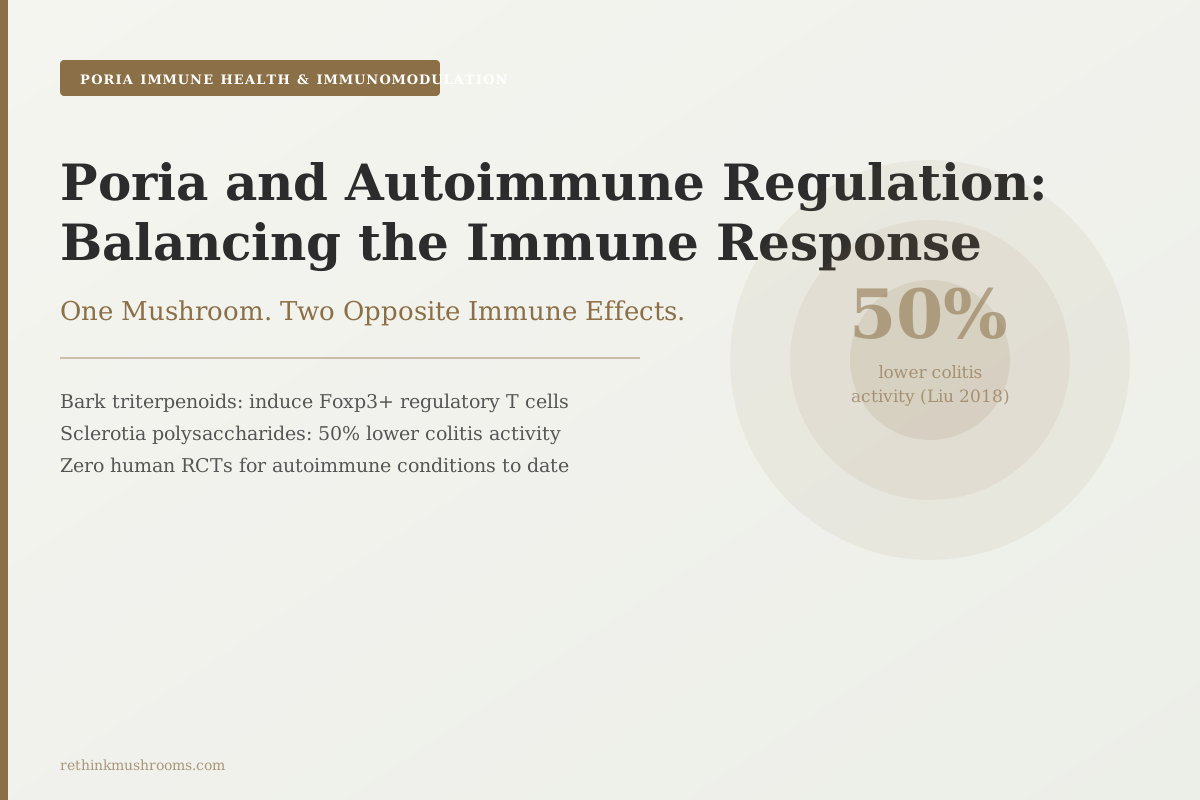
50% lower colitis activity
Liu et al. (2018) found Poria's CMP33 polysaccharide cut disease activity in colitis mice by half. Bae 2016 separately showed that Poria bark induces regulatory T cells that quiet overactive immunity.
Liu et al., Food & Function, 2018
Foxp3+ Tregs
induced by Poria bark via the AhR pathway (Bae 2016)
Th2 → Th1
Poria protein suppresses IgE and allergic cytokines (Lu 2014)
0 human RCTs
for autoimmune conditions; all evidence is preclinical
Liu et al., Food & Function, 2018
 View as image ↗
Most mushroom articles tell a simple story: this fungus boosts your immune system. Poria breaks that story. The same mushroom that activates macrophages and natural killer cells through its starchy interior can also calm an overactive immune system through its dark outer bark. Poria cocos autoimmune regulation works in both directions, and the two effects come from physically different parts of the same fungus. This article is part of the pillar guide to Poria (Wolfiporia extensa / Fu Ling).
The clearest evidence for the suppressive side is a 2016 study from Bae and colleagues. They fed Poria cocos bark extract to mice with atopic dermatitis and food allergy and found that the extract triggered a specific type of immune cell, the regulatory T cell (marked by a protein called Foxp3), to expand and dampen the inflammation driving the disease.[1] No competitor health site covers this finding. Most still describe Poria as a generic "immune booster," which gets the mechanism backwards for half of what the mushroom does.
Key Takeaways
- Poria cocos has two opposite immune effects: its sclerotia (interior) polysaccharides activate immune cells, while its bark (outer rind) triterpenoids suppress overactive immunity
- Bae et al. (2016) showed oral Poria bark extract reduced atopic dermatitis and food allergy in mice by inducing Foxp3+ regulatory T cells through the aryl hydrocarbon receptor pathway[1]
- Lu et al. (2014) cloned a Poria protein that shifted mice from a Th2-dominant immune state toward Th1, lowering IgE and allergic cytokines linked to atopic skin disease[2]
- Liu et al. (2018) found a Poria polysaccharide called CMP33 cut colitis disease activity by 50% and lowered tissue damage scores by 36 to 44% in inflammatory bowel disease mice[3]
- Wan et al. (2024) extended that finding by showing Poria polysaccharide also restored healthy gut bacteria balance alongside calming intestinal inflammation[4]
- All Poria autoimmune evidence to date comes from animal models and lab cell studies. No human randomized trials have tested Poria for any autoimmune condition.
How Poria Cocos Autoimmune Regulation Works in Two Directions
Poria looks unusual when you cut one open. The interior is a dense white tuber called the sclerotia, made mostly of complex sugars called polysaccharides. The outer skin is a darker, woody rind called the bark, made mostly of waxy compounds called triterpenoids. These two layers contain almost entirely different chemistry, and they do almost opposite things to the immune system.
The sclerotia polysaccharides, including the long beta-glucan chain that gives Poria most of its bulk, are immune activators. They bind a sensor on macrophages called TLR4 and trigger those cells to release inflammatory signals like IL-6 and TNF-alpha. Macrophages then patrol the body looking for threats. This is what most mushroom marketing means by "immune support." Our companion article on Poria polysaccharides and immune cell activation covers that pathway in depth.
The bark triterpenoids do the opposite. Compounds like pachymic acid block the same inflammatory signals the polysaccharides turn on. They also push the immune system to make more regulatory T cells, the body's built-in brakes on inflammation. When Bae and colleagues fed mouse models of atopic dermatitis with Poria bark extract, the mice got better, not because their immunity got stronger, but because it got more controlled.[1]
This is the tension a single-direction "immune booster" story cannot hold. In an autoimmune disease, an allergy, or eczema, the immune system is already attacking too hard. Stimulating it further would make things worse. The bark side of Poria offers the opposite tool. Our overview of Poria's immunomodulatory research covers how this dual action shows up across the wider research base. For the broader mechanistic frame, our companion piece on triterpenes vs. polysaccharides explains how these two compound classes produce opposite effects across many medicinal mushrooms.
The practical implication: when a Poria supplement is sold as an immune booster, what it does to your body depends on which part of the fungus is in the bottle, how it was extracted, and whether the product specifies bark, sclerotia, or whole-mushroom material. The same species can produce two different effects.
What Bae 2016 Actually Did: Poria Bark, AhR, and the Foxp3+ Switch
The Bae study is the centerpiece of Poria's autoimmune evidence. The team gave oral Poria cocos bark extract to mice in two disease models: atopic dermatitis (an allergic skin condition) and food allergy.[1] Both conditions are driven by an immune system that has gone into overdrive against something harmless: pollen, dust, or food protein. In humans, similar mechanisms drive eczema, hay fever, and parts of inflammatory bowel disease.
The mice on Poria bark extract had less skin inflammation, less swelling, and less of the hallmark Th2 cytokines that drive allergic disease. To find out why, the researchers looked at the regulatory T cells in the gut and lymph nodes. These are the cells whose job is to recognize friendly proteins (or innocuous environmental ones) and send out signals telling other immune cells to stand down. Foxp3 is the master regulator gene that defines this cell type. The Poria bark mice had more Foxp3+ regulatory T cells than the control mice, and the Tregs were more active.
The mechanism turned out to involve a sensor protein called the aryl hydrocarbon receptor, or AhR. AhR is one of the body's pathways for detecting compounds in food and the environment, and it has a known role in tipping naive immune cells toward becoming regulatory T cells. The bark extract activated AhR, AhR drove Foxp3+ Treg expansion, and the Tregs damped down the overactive Th2 response.
This is a direct mechanistic chain: Poria bark → AhR activation → Foxp3+ Treg induction → reduced atopic and allergic symptoms. The point is that Poria did not "boost" the immune system. It taught the immune system to back off in a controlled, antigen-specific way. That is what regulatory T cells do.
The same Foxp3+ Treg pathway is the one the body uses against autoimmune attack in the joints, the gut, and the central nervous system. When Tregs fail, autoimmune disease tends to follow. When Tregs expand, conditions like inflammatory bowel disease, multiple sclerosis, and rheumatoid arthritis tend to settle, at least in animal models. The Bae finding therefore suggests Poria bark might be relevant to a wider range of autoimmune conditions than just atopic skin disease, a hypothesis the research community has yet to test directly.
The Th1/Th2 Rebalance: How Poria Calms Allergic Inflammation
The Bae study is not the only mechanism for Poria's calming effect. Two years earlier, Lu and colleagues took a different approach: they cloned a specific protein out of Poria cocos and tested what it did to the immune system in an atopic dermatitis mouse model.[2]
Allergic and atopic conditions are dominated by what immunologists call a Th2 response. Th2 means a particular kind of helper T cell that releases cytokines (IL-4, IL-5, IL-13) telling B cells to make antibodies of the IgE class, the antibody type that fires off mast cells and causes allergy symptoms. A healthy immune system balances Th2 against Th1, the helper T cell type that fights bacteria and viruses. In atopic dermatitis, eczema, and hay fever, the balance has tipped too far toward Th2.
The cloned Poria protein in the Lu study pushed the balance back. Mice given the protein had higher Th1 markers, lower Th2 cytokines, and less IgE in their blood. Their atopic dermatitis symptoms eased. This is a different mechanism from the Bae regulatory T cell pathway, but the result is similar: less allergic inflammation, less Th2 dominance.
For an autoimmune reader, the relevance is that allergic and atopic conditions sit on a spectrum with several autoimmune diseases. Both involve the immune system attacking something it should not. Both are tied to Th2/Th1 imbalance and to weak regulatory T cell control. A compound that quiets the Th2 side while supporting the Th1 side is, mechanistically, the kind of compound that could matter in eczema, food allergy, and possibly conditions like ulcerative colitis where Th2 imbalance plays a role.
The honest caveat is that the Lu protein is not what most consumers are getting in a Poria capsule. Off-the-shelf Poria supplements rarely standardize for individual proteins. The Lu work is a mechanism-of-action study, not a guide to product selection. What it tells us is that Poria contains at least one compound, and probably several, that pushes the immune balance away from allergic inflammation rather than toward it.
The IBD Evidence: A 50% Reduction in Colitis Activity
The strongest quantified outcome data for Poria in an autoimmune-style condition comes from inflammatory bowel disease (IBD) models in mice. Liu and colleagues isolated a specific Poria polysaccharide they named CMP33 and tested it in a standard chemically induced colitis model.[3]
The numbers are concrete. Mice given CMP33 had a disease activity index (a composite score of weight loss, stool consistency, and bleeding) that was 50% lower than untreated colitis mice. Histopathology scores, which grade tissue damage in the colon under a microscope, were 36 to 44% lower depending on the section sampled. Mortality was reduced by half. CMP33 also brought down the inflammatory cytokines TNF-alpha, IL-1 beta, and IL-6 in the colon tissue.
These are not subtle effects. In a colitis model where untreated mice typically lose significant gut tissue and a portion die from the inflammation, cutting the disease score in half is a strong signal.
A 2024 study from Wan and colleagues extended the picture. They tested Poria cocos polysaccharide in a different colitis model (DSS-induced ulcerative colitis) and found similar anti-inflammatory effects, plus a striking secondary outcome: the polysaccharide also corrected the disrupted balance of gut bacteria that DSS colitis produces.[4] Mice on Poria polysaccharide had higher levels of friendly bacteria like Lactobacillus and lower levels of inflammation-promoting species. The gut barrier held up better. NF-κB-driven inflammatory signaling in the colon was suppressed.
Wan 2024 is the first Poria study to clearly link the immune-calming effect to a microbiota effect. This matters because the gut microbiota is one of the most active areas of autoimmune research. Many autoimmune conditions, IBD most obviously, but also rheumatoid arthritis, multiple sclerosis, and type 1 diabetes, are associated with shifts in gut bacteria. A compound that calms gut inflammation and restores microbiota balance touches both halves of that loop.
The cluster article on Fu Ling for immune support covers how this maps to the traditional Chinese medicine framing of Poria as a digestive and immune tonic, and the pharmacology of Wolfiporia extensa article goes deeper on the underlying compound chemistry.
The Triterpenoid Anti-Inflammatory Layer: Pachymic Acid and NF-κB
Underneath the high-level effects on regulatory T cells and gut bacteria, there is a molecular layer that explains why Poria's bark and triterpenoids damp inflammation in the first place. That layer is the NF-κB pathway, and it is the central inflammatory switch in almost every immune cell.
NF-κB is a protein that sits in the cytoplasm of most cells until an inflammatory signal arrives. When TLR4 fires (the same receptor Poria polysaccharide activates), or when an injury or infection sends out alarm signals, NF-κB moves into the cell nucleus and turns on dozens of inflammation genes, including TNF-alpha, IL-6, and the enzymes that make nitric oxide. NF-κB is the gas pedal of inflammation. Triterpenoids from Poria press the brake.
Lee and colleagues used a bioactivity-guided isolation in 2017 to identify which specific Poria triterpenoids do this.[5] They took Raw264.7 macrophages (a cell line that is the lab workhorse for studying inflammation) and stimulated them with LPS, the bacterial endotoxin that maximally activates NF-κB. Then they tested individual lanostane triterpenoids from Poria sclerotia for their ability to block the resulting inflammatory cytokine output. Several compounds, including pachymic acid and dehydropachymic acid, showed significant NF-κB suppression at micromolar doses.
Gui and colleagues (2021) took the most studied of these compounds, pachymic acid, into a more complex model: rats with LPS-induced pneumonia.[6] Pachymic acid suppressed lung inflammation, reduced cell death in lung tissue, and inhibited both the NF-κB pathway and a parallel pathway called MAPK. The MAPK pathway is the second major inflammation switch alongside NF-κB. Inhibiting both at the same time is unusual for a natural compound and suggests pachymic acid acts at a high level in the inflammatory cascade.
For autoimmune readers, this is the mechanism that ties everything together. NF-κB and MAPK are the pathways through which most autoimmune flares produce their damage. Compounds that block both pathways are exactly what anti-inflammatory drugs aim to do. The Poria bark triterpenoids do it through dietary intake at doses achievable from Poria extracts in the lab. Again, all of this is mouse and cell data, not human autoimmune trials.
Network Pharmacology Maps 22 Compounds to 26 Inflammatory Targets
A 2023 study from Jin and colleagues used a relatively new technique called network pharmacology to map all the active compounds in Wolfiporia extensa to their molecular targets in the body.[7] They identified 22 active compounds in the mushroom and matched them to 26 different inflammatory signaling targets, including the PI3K/AKT, TNF, and MAPK pathways.
The takeaway is not a single mechanism but a multi-target picture. Poria does not work like a drug that hits one receptor. It works like a botanical mixture that touches many points along the inflammatory cascade at once. This is consistent with the picture from the individual studies: TLR4 activation by polysaccharides on one side, NF-κB inhibition by triterpenoids on another, AhR-driven Treg induction in the gut, MAPK damping in lung tissue, microbiota normalization downstream.
That breadth is part of what makes the autoimmune story plausible. Single-target drugs work when one pathway is the problem. Autoimmune diseases tend to involve many pathways failing together, which is why broad-acting biologics and corticosteroids dominate treatment. A natural compound that touches 26 targets is not the same as a corticosteroid, but it is closer in mechanism to a multi-pathway drug than to a clean single-target compound.
The Honest Limit: Why Mouse Mechanism Isn't Human Outcome
Every study cited above is in mice or in cell culture. There are no published human randomized controlled trials of Poria for any autoimmune condition. There are no published human RCTs of Poria for atopic dermatitis, food allergy, eczema, ulcerative colitis, Crohn's disease, rheumatoid arthritis, or any other autoimmune disorder. The traditional Chinese medicine record contains thousands of years of clinical use of Fu Ling, but that is observational data within a different diagnostic framework, not RCT evidence.
What the existing evidence does show is a consistent mechanistic story: Poria contains compounds that induce regulatory T cells, shift Th1/Th2 balance, suppress NF-κB and MAPK signaling, and restore gut microbiota. Each of those mechanisms is, on its own, the kind of thing you want when calming overactive immunity. The animal disease models (atopic dermatitis, food allergy, IBD, pneumonia) produced clinically meaningful improvement.
What the evidence does not yet show is whether any of that translates into measurable benefit in humans with these conditions. Mouse colitis is not human ulcerative colitis. The doses that worked in mice (often hundreds of milligrams per kilogram of body weight) do not scale linearly to humans. Bioavailability, intestinal absorption, and metabolism all differ between species. A mechanism that is real in a mouse may produce no clinical signal in a person, or it may take a very different dose form to do so.
The fair summary: Poria has the strongest preclinical autoimmune story of almost any medicinal mushroom currently in the popular literature. Bae 2016, Liu 2018, and Wan 2024 are well-conducted animal studies with concrete numbers. The mechanism is multi-pathway and aligns with how autoimmune conditions actually go wrong. The next move belongs to clinical research. Until those trials run, the appropriate frame is "mechanistically promising, preclinically supported, clinically untested."
The Bottom Line
Poria cocos has a dual-mode immune effect that no other commonly studied medicinal mushroom matches as cleanly: bark triterpenoids and a cloned protein quiet overactive immunity by inducing Foxp3+ regulatory T cells (Bae 2016) and rebalancing Th1/Th2 (Lu 2014), while polysaccharides from the sclerotia calm gut inflammation in IBD models with concrete outcomes (Liu 2018, Wan 2024). The molecular layer involves NF-κB and MAPK suppression by lanostane triterpenoids like pachymic acid (Lee 2017, Gui 2021) and a multi-target network spanning 26 inflammatory pathways (Jin 2023). All evidence is preclinical; no human autoimmune RCTs exist.
Frequently Asked Questions
Sources & References
- 1. Source details for this reference are not yet available.
- 2. Source details for this reference are not yet available.
- 3. Source details for this reference are not yet available.
- 4. Source details for this reference are not yet available.
- 5. Source details for this reference are not yet available.
- 6. Source details for this reference are not yet available.
- 7. Source details for this reference are not yet available.