Functional Mushroom Market
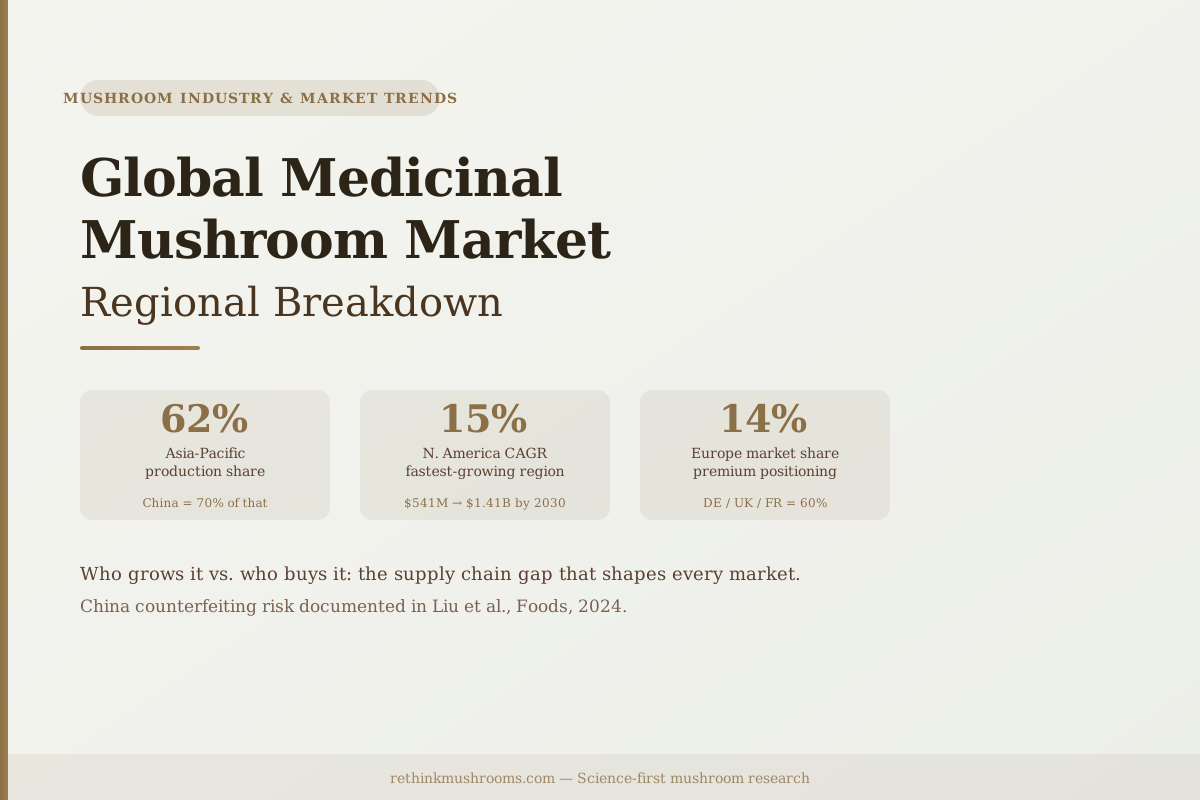
~70% of Asia-Pacific production from China
China's production dominance is documented alongside significant counterfeiting and mislabeling risks that flow directly into Western supplement supply chains.
Liu et al., Foods, 2024
62%
of global medicinal mushroom production from Asia-Pacific
15% CAGR
North America supplement market growth projected through 2030
60%+
of European consumption concentrated in Germany, UK, and France
Liu et al., Foods, 2024
 View as image ↗
The geography of the global medicinal mushroom market involves a structural split that market reports rarely explain clearly. One region, Asia-Pacific, produces most of the world's medicinal mushrooms. Another region, North America, represents the fastest-growing consumer demand. The country that dominates production, China, is also where documented supply chain quality problems originate. And the region where regulatory caution is highest, Europe, is where premium pricing is most sustainable.
Understanding the regional breakdown requires separating three questions: who grows the mushrooms, who buys the supplements, and where growth is accelerating. The answers point in different geographic directions and create a supply chain dynamic that shapes every market in the world.
For the broader market context including size estimates, CAGR projections, and the product segment breakdown, see The Functional Mushroom Market: Size, Growth, and Projections. This article focuses on the regional structure.
Key Takeaways
- Asia-Pacific accounts for approximately 62% of global medicinal mushroom production, with China responsible for roughly 70% of that regional total (Liu et al., 2024).
- China's production dominance is accompanied by documented counterfeiting and mislabeling in commercial markets, a quality risk that travels directly into Western supplement supply chains.
- North America is the fastest-growing major region at a projected 15.0% CAGR, with the supplement market growing from $541.77M in 2023 toward $1.41B by 2030 (industry estimates).
- Europe holds approximately 14% of the global market, with Germany, the UK, and France accounting for more than 60% of European consumption.
- Japan and South Korea produce significantly less volume than China but at substantially higher quality standards, commanding premium positioning in export markets.
- The cultivation infrastructure advantage in Asia-Pacific stems from traditional medicine knowledge systems that predate the modern nutraceutical industry by centuries (Gopal et al., 2022; Chang & Wasser, 2018).
The Global Picture at a Glance
The regional market breakdown reflects both where mushrooms grow best and where consumers are willing to pay for them.
| Region | Production Share | Consumer Market | CAGR Trajectory |
|---|---|---|---|
| Asia-Pacific | ~62% of global production | Domestic + major exporter | Moderate growth, mature cultivation |
| North America | Minor producer | ~30.7% of global market (2026 est.) | 15.0% CAGR (fastest major region) |
| Europe | Growing producer | ~14% of global market | 8-10% CAGR, premium pricing |
| Rest of World | Emerging | Small but expanding | Variable |
The gap between production share and consumer market share explains the global supply chain: Asia-Pacific grows the raw materials, North America and Europe purchase the finished products.
Asia-Pacific's 62% Production Share: Why Three Countries Drive the Category
The scale of Asia-Pacific's production dominance is not accidental. It reflects thousands of years of accumulated cultivation knowledge, traditional medicine infrastructure, and the species diversity found in the region's forests and agricultural systems.
Gopal and colleagues documented the depth of commercial cultivation infrastructure across China, Japan, and South Korea in a 2022 analysis. The review found that Asia-Pacific dominates global mushroom commerce not just because of geographic scale but because of the convergence of traditional medicine roots, large-scale cultivation infrastructure developed over generations, and expanding export capacity built in response to Western demand. [1]
Within Asia-Pacific, production is not evenly distributed. China accounts for approximately 70% of the region's total output, Japan for about 15%, and South Korea for roughly 10%. The remaining production comes from several other countries including Malaysia, India, and Australia, each with smaller but growing cultivation sectors.
The reason China dominates by such a large margin is a combination of land availability, labor economics, and government-supported agricultural development. China's investment in Lentinula edodes (Shiitake) and Ganoderma lucidum (Reishi) cultivation infrastructure in particular has created production capacity that other countries have not replicated at comparable scale.
Chang and Wasser reviewed the history of this market convergence in 2018, documenting how traditional eastern herbal medicine traditions provided the scientific and commercial foundation for the modern nutraceutical industry's interest in medicinal mushrooms. [4] The credibility of Reishi, Shiitake, and Maitake in Japanese and Chinese medicine created the consumer trust infrastructure that Western supplement brands later built on.
China: 70% of Asia-Pacific Output and the Quality Risk That Comes With It
China's production scale creates an unavoidable supply chain reality: the majority of medicinal mushrooms and mushroom-derived ingredients entering Western supplement markets originate in China. That concentration creates both efficiency and risk.
Liu and colleagues published a systematic review of counterfeiting and mislabeling in China's commercial mushroom market in 2024. The findings document a significant and systemic problem: counterfeited and mislabeled mushroom products are widespread in Chinese commercial markets, and the quality control infrastructure to catch these problems before products enter export supply chains is inconsistent. [2]
The practical consequence for Western consumers is that a supplement labeled with a specific mushroom species and a specific bioactive content may not accurately reflect what is in the product. This is not a problem unique to Chinese suppliers, but the scale of China's production dominance means that quality inconsistency in Chinese commercial markets propagates globally.
The downstream effect was measured directly in the US market. Wu and colleagues tested Reishi (Ganoderma lucidum) dietary supplements sold in the United States and found significant quality inconsistency across products: substantial variation in active compound content, some products falling well below label claims, and inconsistency in the material itself (whether the product derived from fruiting bodies or mycelium). [3]
This quality inconsistency is part of the story behind the current North American market consolidation. Premium brands emphasizing transparency about their sourcing and testing are differentiating from the commodity end of the market precisely because the commodity supply chain has a documented quality problem. The premium pricing that established brands command, and the ongoing market consolidation toward trusted suppliers, is in part a market response to the concerns raised by studies like Liu 2024 and Wu 2017.
For consumers, this is where the fruiting body versus mycelium debate intersects directly with supply chain geography. See Fruiting Body vs. Mycelium: The Great Mushroom Supplement Debate and Mycelium on Grain: Why It's Controversial in the Supplement Industry for what the quality standards debate means for product selection.
Japan and South Korea: Premium Quality, Smaller Volume
Japan and South Korea occupy a different position in the global market. Their combined production volume is far smaller than China's, but their products command significantly higher prices and face fewer quality traceability concerns.
Japan's mushroom cultivation industry built its reputation on controlled growing environments, rigorous traceability standards, and cultivation methods developed for consistency rather than volume. Japanese Reishi, Shiitake, and Maitake products command premium prices in export markets specifically because Japanese agricultural standards provide third-party verification that Chinese supply chains often cannot match at equivalent price points.
Gopal and colleagues' 2022 analysis of Asian mushroom commercialization highlights that Japan and South Korea have focused on value-added products rather than raw volume, developing downstream processing capabilities for extracts, powders, and pharmaceutical-grade ingredients. [1] This strategic positioning means that Japanese and South Korean suppliers are not competing on price with Chinese raw material production; they are competing on quality and traceability with premium Western brands.
South Korea's mushroom industry has expanded significantly over the past decade, with particular strength in Maitake (Grifola frondosa) and specialty Shiitake varieties. South Korean exports to North America and Europe have grown as Western brands seek alternatives to Chinese-origin ingredients that come with established quality verification.
The price premium for Japanese and South Korean origin mushroom ingredients is substantial, which limits their share of the overall volume market but makes them essential for the premium end of the supplement and functional food categories.
North America: The Fastest-Growing Major Region at 15% CAGR
North America is not a major producer of medicinal mushrooms, but it is currently the fastest-growing consumer market. Industry market analysis projects North America's medicinal mushroom supplement market at approximately $541.77 million in 2023, growing toward $1.41 billion by 2030 at a 15.0% CAGR. This growth rate exceeds any other major regional market.
Several factors drive North American demand acceleration.
Consumer awareness of functional mushrooms has expanded significantly since 2020. NBJ survey data from 2024 indicates that approximately 37% of consumers in the United States report eating or drinking functional mushrooms, compared to 27% who take them as capsule supplements. This shift in consumption pattern, from supplement aisle to food and beverage aisle, is expanding the addressable market beyond the core supplement user base.
Lion's Mane has emerged as the dominant growth species in North America, driven by consumer interest in cognitive health applications. Combination formulas, which blend multiple mushroom species and often combine them with other adaptogens, are the fastest-growing product format at approximately $70 million in 2024, ahead of single-species products. E-commerce has become the dominant channel, with an estimated 62% of US functional mushroom purchases made online in 2024, up from 48% in 2021.
The 2026 market consolidation that retail data shows is a short-term correction within a longer structural growth story. Some retailers have reported category sales down 30-40% compared to 2023's peak growth year, and M&A activity has accelerated with Real Mushrooms acquiring Mushroom Science and Giorgi Mushroom Co. acquiring L.F. Lambert Spawn Co. These developments reflect a market maturing rather than declining: the initial consumer enthusiasm phase is giving way to a quality-driven consolidation phase where verified brands gain share at the expense of undifferentiated commodity products.
The full US market analysis, including channel breakdown and species-by-species sales data, is at Mushroom Supplement Sales in the US: Market Analysis.
Europe: Regulatory Restraint, Premium Positioning, 14% Market Share
Europe holds approximately 14% of the global medicinal mushroom market, a smaller share than North America but with different growth characteristics and regulatory constraints.
Germany, the United Kingdom, and France together account for more than 60% of European consumption. Germany's established herbal medicine tradition (the country is one of the world's largest markets for phytopharmaceuticals) provides a consumer base already comfortable with plant and fungal-derived health products. The UK's post-Brexit regulatory evolution is creating new positioning opportunities for functional food categories. France's market is smaller but growing, particularly in the premium functional food and beverage segment.
The European market's defining characteristic is regulatory caution. The European Food Safety Authority (EFSA) applies stricter standards to health claims on supplement and food products than the US FDA operates under. In practice, this means European mushroom supplement brands cannot make the direct cognitive, immune, or athletic performance claims that US brands place prominently on labels. Marketing language in Europe emphasizes general wellness and traditional use rather than specific health outcomes.
This regulatory environment creates a bifurcated competitive dynamic. On one hand, stricter claims standards create barriers that protect established brands from new entrants making aggressive performance claims. On the other, they limit the consumer education potential that direct health claims provide, slowing category growth relative to North America.
The premium positioning that characterizes European mushroom products is partly a response to this regulatory reality and partly a reflection of broader European consumer preferences. Organic certification, traceability documentation, and single-origin sourcing command higher prices in European markets than in comparable North American products. European premium brand premiums over entry-level products are typically higher than equivalent premiums in the US market.
Europe's CAGR projection of 8-10% is lower than North America's 15%, but the absolute margin per unit sold in premium European channels is higher, making the European market attractive for quality-focused brands even at lower growth rates.
The Supply Chain Gap That Bridges Production and Consumer Markets
The regional picture, taken together, describes a market with a significant supply chain gap. Asia-Pacific produces most of the raw materials. North America and Europe consume most of the finished products. The two are connected by a supply chain that has documented quality inconsistency at its source.
This gap has commercial consequences. North American and European brands that source from Chinese producers face the quality traceability challenge documented by Liu and colleagues in 2024. [2] The quality inconsistency Wu and colleagues measured in US-market Reishi supplements in 2017 remains relevant context for the current market environment. [3]
The brands growing fastest in North America are those that have addressed this supply chain gap directly: through domestic cultivation (a small but growing segment), through Japanese or South Korean sourcing (premium positioning), or through robust third-party testing protocols applied to Chinese-origin inputs.
Domestic North American cultivation is still a tiny fraction of total supply, but it is growing. Small-scale and mid-scale mushroom farms have expanded significantly in the United States and Canada since 2020, partly in response to consumer demand for domestic-origin products and partly because cultivation technology has made smaller-scale operations economically viable.
The supply chain structure will not shift dramatically in the near term; China's cultivation infrastructure advantage is too deep to reverse quickly. What is shifting is how Western brands manage, verify, and communicate about that supply chain. As the market matures, the regional breakdown is less about where mushrooms grow and more about who can guarantee the quality of what was grown.
The growth driver analysis behind these regional dynamics, including why North America's 15% CAGR is likely to sustain over the next several years, is at The $45 Billion Mushroom Market: Where Is the Growth Coming From? and The Functional Mushroom Market: $50B+ Projected by 2030.
The Bottom Line
Asia-Pacific produces approximately 62% of the world's medicinal mushrooms, with China accounting for 70% of that regional total. North America is the fastest-growing consumer market at a projected 15% CAGR, driven by mainstream wellness adoption and e-commerce expansion. Europe holds about 14% of the market with stricter health claims regulation but sustainable premium pricing. The central supply chain tension documented in peer-reviewed literature is that China's production dominance comes with significant counterfeiting and mislabeling risk (Liu et al., 2024), and quality inconsistency in Chinese-origin ingredients has been directly measured in Western-market supplements (Wu et al., 2017).
Frequently Asked Questions
Sources & References
- 1RTHM-01525·Gopal, Judy et al. (2022). “Scrutinizing the Nutritional Aspects of Asian Mushrooms, Its Commercialization and Scope for Value-Added Products..” Nutrients.Study breakdown →PubMed →↩
- 2RTHM-01935·Liu, Jinlin et al. (2024). “The Situation of Counterfeited and Mislabeled Commercialized Edible Mushrooms in China and the Development of Possible Controls..” Foods (Basel.Study breakdown →PubMed →↩
- 3RTHM-00499·Wu, Ding-Tao et al. (2017). “Evaluation on quality consistency of Ganoderma lucidum dietary supplements collected in the United States..” Scientific reports.Study breakdown →PubMed →↩
- 4RTHM-00946·Chang, Shu Ting et al. (2018). “Current and Future Research Trends in Agricultural and Biomedical Applications of Medicinal Mushrooms and Mushroom Products (Review)..” International journal of medicinal mushrooms.Study breakdown →PubMed →↩