Functional Mushroom Market Size, Growth & Regional Analysis
42% beverage launch growth
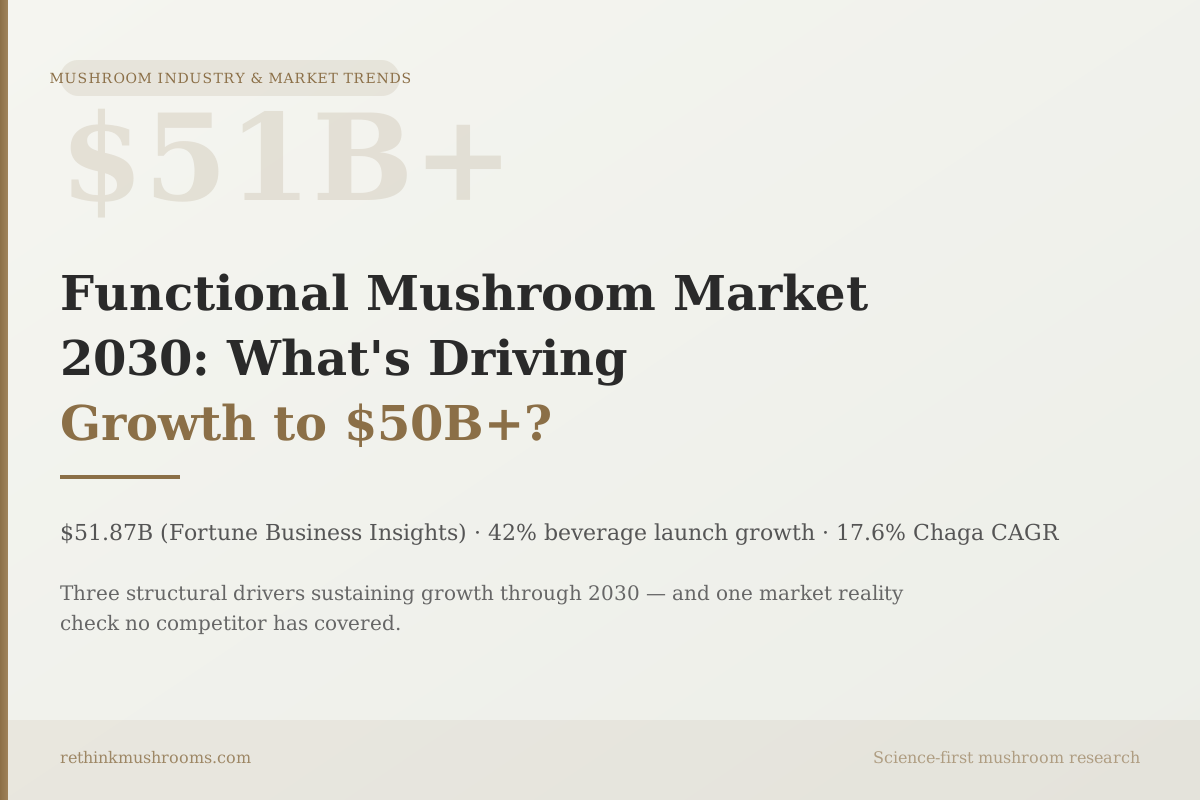
Mushroom-infused beverage product launches grew 42% between 2022 and 2025, making beverages the fastest-growing category in a market multiple analysts project will exceed $50 billion by 2030.
Yang et al., Frontiers in Cellular and Infection Microbiology, 2025
$51.87B
global functional mushroom market projected by 2030 (Fortune Business Insights)
17.6%
projected annual growth rate for Chaga through 2030, the fastest among individual species
~50%
of edible mushrooms qualify as functional food based on documented bioactive profiles (Niego et al., 2021)
Yang et al., Frontiers in Cellular and Infection Microbiology, 2025
 View as image ↗
Two reputable market research firms looked at the same industry and produced 2030 projections that are $14 billion apart. Fortune Business Insights says $51.87B. Grand View Research says $65.83B. Neither firm made an error. They are counting different things, and that discrepancy is actually one of the most informative facts about the functional mushroom market 2030 growth story.
Understanding what drives this market to either number requires separating three distinct growth engines: the supplement segment, the functional food and beverage segment, and an emerging category that most market coverage ignores entirely. That third driver is mushrooms as a meat alternative. Each engine has different structural dynamics, different research backing, and different 2030 trajectories.
For a full breakdown of the market's current size and the methodology behind competing estimates, see The Functional Mushroom Market: Size, Growth, and Projections.
Key Takeaways
- Fortune Business Insights projects $51.87B by 2030 (8.8% annual growth rate); Grand View Research projects $65.83B (11.2% annual growth rate): the $14B gap reflects scope differences, not measurement error
- Yang et al. 2025 documented 42% growth in mushroom-infused beverage product launches between 2022 and 2025, identifying beverages as the fastest-growing application segment
- Boro et al. 2025 identifies plant-based diet trends as an independent secondary growth driver for edible mushrooms, separate from supplement demand
- Niego et al. 2021 found approximately 50% of edible mushrooms qualify as functional food based on documented bioactive compound profiles: the market is built on real biochemical diversity
- Chaga is projected to grow at a 17.6% compound annual rate through 2030, the fastest among individual mushroom species; combination formulas are growing at 16% annually
- Chang and Wasser's 2018 review documented that this market was already built on a convergence of eastern traditional medicine and western nutraceutical investment: the structural foundation predates the recent hype cycle by decades
Why Two Firms Project Numbers $14 Billion Apart for 2030
The scope difference explains almost everything.
Mordor Intelligence, using a narrow definition that counts dietary supplements only, estimated the global functional mushroom market at roughly $12 billion for 2025. Grand View Research, using a definition that includes supplements, functional foods and beverages, pharmaceutical applications, and cosmetics, arrived at $31.71B for 2023 growing to $65.83B by 2030. Fortune Business Insights, counting a slightly different category mix, landed at $51.87B by 2030.
None of these numbers is wrong. A market defined as "dietary supplements containing mushroom extracts" is a real market with real revenue. So is a market defined as "all commercial products in which a mushroom's health-relevant bioactive compounds are a primary ingredient." The first market is a subset of the second. The 3x to 4x variation across reports is entirely explained by where each firm draws that line.
This matters for understanding the 2030 projection because the fastest-growing applications (functional beverages, adaptogenic snacks, mushroom-fortified foods) fall outside the narrow supplement definition but inside the broader one. A consumer who adds lion's mane powder to a morning smoothie, drinks a mushroom coffee blend, and takes an evening reishi capsule would be counted as three separate data points in the broad definition and one in the narrow one.
The CAGR (compound annual growth rate) differences follow from the same logic. An 8.8% annual growth rate for the supplement segment is a different number than an 11.2% rate for the full category. Both projections can be accurate simultaneously.
The 2026 Reality Check: Why Some Retailers Report 30–40% Category Declines
The $50B+ projection does not mean the market is growing cleanly in a straight line.
In early 2026, industry reporting from FoodNavigator described some retailers seeing functional mushroom category sales down 30 to 40 percent from 2024 peaks. The same period saw notable consolidation: Real Mushrooms acquiring Mushroom Science, Giorgi Mushroom Co. acquiring L.F. Lambert Spawn Co. These are not the moves of a market in crisis. They are the moves of a maturing category where the early hype phase is compressing into a more durable competitive landscape.
This pattern is common in supplement and functional food categories. The initial growth surge attracts many brands, most of which compete primarily on packaging and marketing rather than product differentiation. When consumer scrutiny increases and first-time buyers make repeat decisions based on whether they felt any effect, the category consolidates toward brands that can substantiate their claims. What looks like a 30% decline in retail SKU count can coexist with a 15% CAGR in the underlying category revenue; the winners absorb the losers' volume.
The structural drivers that built this market to its current scale did not disappear in 2026. What changed is the competitive environment. For a detailed look at the quality controversy that is reshaping brand dynamics, see Fruiting Body vs. Mycelium: The Great Mushroom Supplement Debate and Mycelium on Grain: Why It's Controversial in the Supplement Industry.
The Scientific Foundation That Makes the 2030 Number Credible
Markets built on hype tend not to maintain 8–11% annual growth rates for a decade. Markets built on documented biochemistry with improving research evidence do.
A 2021 review by Niego and colleagues in Nutrients[1] conducted a comprehensive mapping of bioactive compounds across commercially traded mushroom species. They found that roughly 50% of edible mushrooms qualify as functional food based on documented bioactive profiles. Beta-glucans, triterpenoids, and ergothioneine are among the most commercially significant. This is the market's real foundation: not any single claimed health effect, but a broad catalogue of compounds with well-characterized properties across dozens of species.
The convergence that built this market was documented years before the recent wellness trend cycle. Chang and Wasser's 2018 review in the International Journal of Medicinal Mushrooms[2] traced how eastern herbal medicine traditions, which had used medicinal mushrooms for centuries, met rising western nutraceutical investment infrastructure. By 2018, that convergence was already generating the research pipeline, distribution networks, and consumer education that the market runs on today. The 2025 spike in consumer awareness is downstream of a foundation built over 30 years.
Ishara and colleagues' 2022 review in the Journal of Food Biochemistry[3] identified the specific bioactive compounds that make mushrooms worth building products around: polysaccharides, eritadenine, chitosan, and mevinolin. These compounds are molecules with well-documented activity in peer-reviewed literature. Polysaccharides include the immune-relevant beta-glucans. Eritadenine is the compound in shiitake linked to cholesterol metabolism. Chitosan is the fiber component. Mevinolin, found in oyster mushrooms, has a structure related to cholesterol-lowering statins. When a new clinical trial finds an effect attributable to one of these molecules, it expands the evidence base that the market runs on.
A 2023 review by Lysakowska and colleagues in Molecules[4] documented how that research is increasingly translating into commercial product applications across beverages, supplements, and nutraceuticals. Each new application category is a new revenue stream, which is part of why the broad-definition market projections keep rising even as the supplement-only segment moderates.
Why Beverages Will Drive More Growth Than Supplements From Here
The most consequential shift in the functional mushroom market through 2030 is not which species are growing fastest. It is a channel shift: beverages are overtaking capsules as the primary consumer touchpoint.
Yang and colleagues published the first systematic review of medicinal mushroom applications in functional beverages in Frontiers in Cellular and Infection Microbiology in 2025.[5] Their review documented 42% growth in mushroom-infused beverage product launches between 2022 and 2025: coffees, teas, hydration drinks, and ready-to-drink adaptogenic formulas. The review also confirmed that bioactive stability in beverage matrices varies significantly with processing method, meaning that not all these products deliver equivalent doses of active compounds. But the launch volume tells us something real: brand investment is following consumer behavior, and consumers are increasingly reaching for functional mushrooms in beverage form rather than capsule form.
NBJ 2024 survey data found that 37% of consumers reported eating or drinking functional mushrooms, while only 27% reported taking capsule supplements. The food and beverage channel has already overtaken supplements as the primary consumer touchpoint, even though the supplement segment commands higher per-unit margins and is more easily quantified by market research firms. By 2035, industry analysts project that the food and beverage segment will surpass supplements in total revenue as well.
Mushroom coffee is the most visible product in this segment, but it is a crowded and increasingly scrutinized category. For a look at what the product launch surge means for consumers and for the $50B+ projection, see How Mushroom Coffee Became a Billion-Dollar Category.
Beverage launches are also where the 500+ new global SKUs introduced between 2022 and 2025 are most concentrated. Each new SKU represents a manufacturer committing capital to functional mushroom supply chains. Supply chain investment, more than marketing, is the best indicator of which growth projections represent real structural commitment versus speculation.
The Meat Analog Factor: A Growth Engine Market Reports Miss
There is a secondary driver for the edible mushroom market that almost no market report covers: the rise of mushrooms as a meat alternative.
Boro and colleagues published a comprehensive review in Food Research International in 2025[6] examining mushrooms as meat analogues. Their key finding is that plant-based diet trends and the meat substitute market are generating demand for edible mushrooms that is structurally independent of supplement or functional food demand. A consumer buying portobello mushrooms as a burger substitute or shiitake for protein-forward cooking is not the same consumer as the one buying lion's mane capsules for cognitive support. But both contribute to edible mushroom market revenue.
This matters for the 2030 projection in two ways. First, it adds a demand floor that is not subject to the supplement hype cycle. Even if functional mushroom supplement demand contracted, the culinary and plant-based diet channel would sustain edible mushroom production at scale. Second, the meat analog use case creates a different consumer relationship with mushrooms. Someone who has been cooking with oyster mushrooms for two years because of their texture and nutritional profile is a more receptive consumer for functional claims than someone introduced to mushrooms only through a supplement label.
The broader edible mushroom market (including culinary, medicinal, and meat analog applications) was estimated at $50–65 billion in 2024 globally. The functional mushroom segment that Fortune Business Insights and Grand View Research track is a subset of that figure. The meat analog driver is the part of the market that the functional supplement framing typically misses.
For the full picture of what is driving US consumer spending specifically, including the breakdown between supplement and food channels, see Mushroom Supplement Sales in the US: Market Analysis.
Species-Level Forecasts: Chaga at 17.6%, Combinations at 16%
The headline $50B+ number conceals significant variation at the species level. Not all mushrooms are growing at the same rate.
Reishi (Ganoderma lucidum, the woody bracket fungus most associated with immune support and traditional longevity medicine) holds the largest product segment share at approximately 31.4% in 2025. That reflects its long history in traditional medicine and the depth of its clinical research record. Shiitake held about 34% of the global edible mushroom market in 2023 across culinary and functional applications. Lion's Mane represents approximately 25.79% of the North American supplement market, reflecting the cognitive health research tailwind it has benefited from over the past decade.
The fastest projected growth comes from species earlier in their commercial development cycle. Chaga, the birch fungus used primarily as an antioxidant and immune support ingredient, is projected to grow at a 17.6% compound annual rate through 2030. That is the highest individual species projection in the major market analyses. Canada is projected at a 17.1% annual growth rate for its national market, partly because of its position as a significant Chaga sourcing territory.
Combination formulas (products that blend multiple mushroom species, such as the lion's mane, reishi, and cordyceps combinations that dominate consumer-facing wellness brands) grew from approximately $25M each for single-species products to $70M for combination products in 2024 in the North American market. Combination formulas are projected to continue growing at 16% annually through 2027, outpacing single-species growth. This pattern suggests consumers are seeking broad-spectrum support rather than single-compound targeting, which benefits the category's overall credibility.
For a broader look at what this growth pattern means across the $45B market and which drivers are sustaining it, see The $45 Billion Mushroom Market: Where Is the Growth Coming From?.
Regional Winners to 2030: North America's Acceleration vs. Asia-Pacific's Scale
Asia-Pacific produced approximately 62% of global medicinal mushrooms in 2024, with China accounting for around 70% of that regional output. This production dominance is the foundation of the global market's supply chain, but it is not where the fastest growth is happening.
North America is projected at a 15.0% annual growth rate through 2030, growing from $541.77M in supplements specifically in 2023 to approximately $1.41B by 2030. Canada, driven by growing domestic production and Chaga sourcing, is projected at 17.1%. These are the fastest regional growth rates in the market because North America is in the adoption acceleration phase. The consumer base that will sustain the market for the next decade is being built now.
Europe contributes approximately 14% of the global market, with Germany, the United Kingdom, and France accounting for around 60% of European consumption. European growth is driven by nutraceutical maturity and organic/premium positioning, which creates higher average selling prices even at lower volume than Asia-Pacific. For a full regional analysis including the supply chain risks from China's market dominance, see Global Medicinal Mushroom Market: Regional Breakdown.
The supply-side dynamic that will most shape the 2030 picture is whether quality infrastructure in Asia-Pacific keeps pace with Western demand for traceable, standardized ingredients. A 2024 review in Foods documented widespread counterfeiting and mislabeling in the Chinese commercial mushroom market, a structural risk for a global supply chain in which China is the dominant producer. Brands and regions that can credibly guarantee supply chain transparency are positioned to capture the premium pricing that will drive North America's 15% annual growth rate. Those that cannot will face growing consumer skepticism.
The 2026 consolidation wave (Real Mushrooms acquiring Mushroom Science, Giorgi Mushroom Co. acquiring L.F. Lambert Spawn Co., the growing regulatory conversation about label transparency) is, from one angle, an industry becoming more professional. The market that reaches $50B+ by 2030 will be one where clinical evidence, supply chain traceability, and honest labeling are competitive advantages rather than optional extras. The structural growth drivers are durable. The hype-cycle froth is burning off. What remains is a market built on real bioactive chemistry with a genuine research foundation: exactly the conditions that sustain decade-long growth rates.
For context on what investment is flowing into adjacent mushroom categories, including the fast-growing psilocybin segment that is not counted in functional food market projections, see The Psilocybin Industry: Investment, Companies, and Future Outlook.
The Bottom Line
The functional mushroom market is on a credible path to $50B+ by 2030, but the specific number depends on what is being counted: supplement-only estimates run lower (8.8% annual growth to $51.87B) while full-category estimates run higher (11.2% annual growth to $65.83B). Three structural growth engines are driving both: the beverage segment accelerating past supplements as the primary consumer touchpoint (Yang et al. 2025 documented 42% product launch growth), a meat analog demand floor that is independent of the supplement hype cycle (Boro et al. 2025), and a research pipeline built on genuine bioactive chemistry documented in peer-reviewed literature since at least the 1980s (Chang and Wasser 2018, Niego et al. 2021, Ishara et al. 2022). The 2026 market shakeout is a normal consolidation event, not a structural reversal. The fastest growth to 2030 will accrue to brands that can prove supply chain transparency and dosing consistency.
Frequently Asked Questions
Sources & References
- 1RTHM-01414·Niego, Allen Grace et al. (2021). “Macrofungi as a Nutraceutical Source: Promising Bioactive Compounds and Market Value..” Journal of fungi (Basel.Study breakdown →PubMed →↩
- 2RTHM-00946·Chang, Shu Ting et al. (2018). “Current and Future Research Trends in Agricultural and Biomedical Applications of Medicinal Mushrooms and Mushroom Products (Review)..” International journal of medicinal mushrooms.Study breakdown →PubMed →↩
- 3RTHM-01542·Ishara, Jackson et al. (2022). “Nutraceutical potential of mushroom bioactive metabolites and their food functionality..” Journal of food biochemistry.Study breakdown →PubMed →↩
- 4RTHM-00843·Łysakowska, Paulina et al. (2023). “Medicinal Mushrooms: Their Bioactive Components, Nutritional Value and Application in Functional Food Production-A Review..” Molecules (Basel.Study breakdown →PubMed →↩
- 5RTHM-02215·Yang, Jing-Ya et al. (2025). “Innovative applications of medicinal mushrooms in functional foods and nutraceuticals: a focus on health-boosting beverages..” Frontiers in cellular and infection microbiology.Study breakdown →PubMed →↩
- 6RTHM-02059·Boro, Sibo et al. (2025). “Edible mushrooms as meat analogues: A comprehensive review of nutritional, therapeutic, and market potential..” Food research international (Ottawa.Study breakdown →PubMed →↩