Mushroom Market
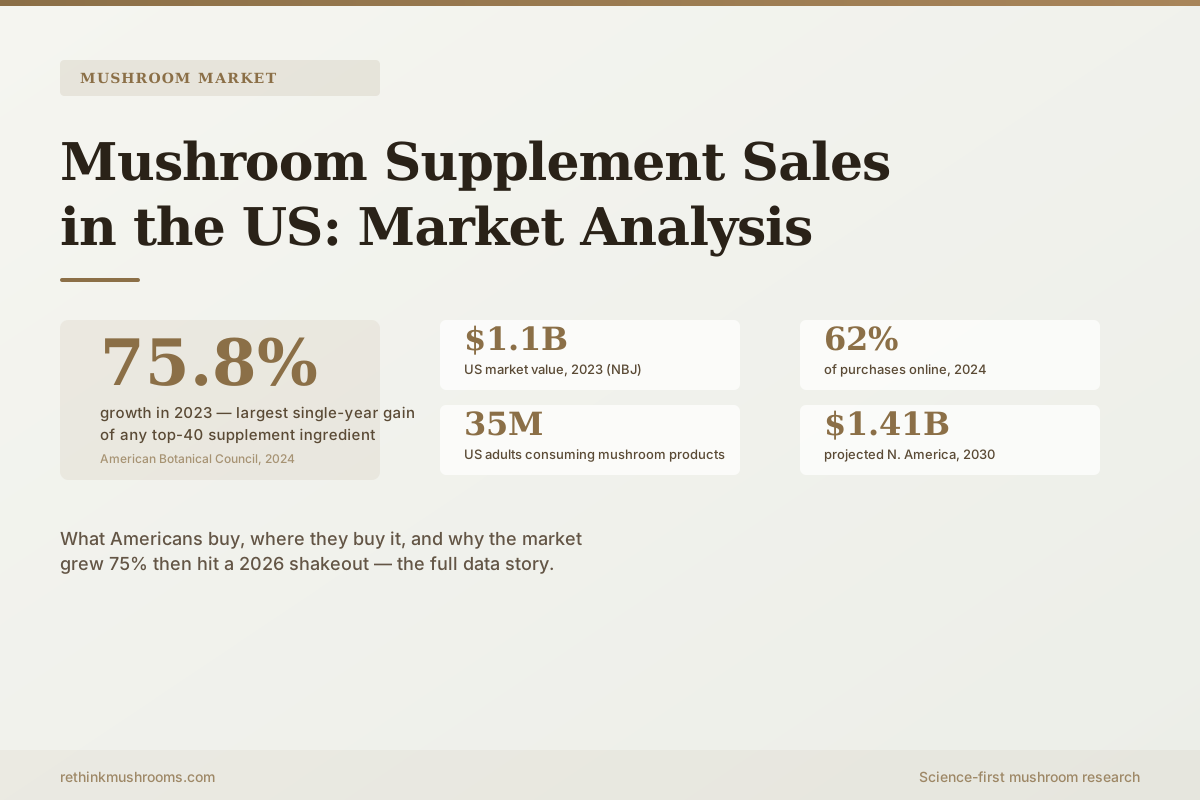
75.8% growth in 2023
Mushroom supplement sales grew more in a single year than any other top-40 ingredient in mainstream retail — the largest one-year gain on record for the category.
American Botanical Council, 2024
$1.1B
total US functional mushroom market value, 2023 (NBJ)
35M
US adults consuming mushroom products in 2024
62%
of US supplement purchases made online in 2024
American Botanical Council, 2024
 View as image ↗
Mushroom supplement sales in the US grew 75.8% in 2023, the largest single-year gain of any top-40 supplement ingredient in mainstream retail, according to the American Botanical Council. Total US functional mushroom food and supplement revenue crossed $1.1 billion that same year (Nutrition Business Journal). Then, three years later, some retailers began reporting category sales down 30 to 40%.
Both of those facts are accurate. What sits between them is the more useful analysis.
This article covers the US mushroom supplement market: what Americans are actually buying, where they buy it, what the quality data shows, and what the 2023 surge and 2026 consolidation together tell us about where the category is headed. For global market sizing and projections across all product categories, see The Functional Mushroom Market: Size, Growth, and Projections.
Key Takeaways
- US functional mushroom food and supplement sales reached $1.1 billion in 2023 (NBJ), representing 75.8% growth — the largest single-year gain of any top-40 supplement ingredient in mainstream retail
- The supplement-only North America market was $541.77 million in 2023; the $1.1B figure reflects a broader scope that includes functional mushroom foods, coffees, and beverages
- 37% of Americans consume functional mushrooms in food or drink form versus 27% as capsule supplements (NBJ, 2024), which is why supplement-only tracking misses more than half of the market's footprint
- Reishi leads US type-share at 29.4%; lion's mane holds 25.79% of North American supplement revenue; combination formulas reached $70M in 2024, outpacing individual lion's mane and cordyceps products
- 62% of US mushroom supplement purchases were made online in 2024, up from 48% in 2021, with DTC mushroom coffee brands and Amazon driving the channel shift
- By 2026, some retailers reported category sales down 30-40%, even as M&A activity accelerated: Real Mushrooms acquired Mushroom Science; Giorgi Mushroom Co. acquired L.F. Lambert Spawn Co.
Supplements vs. the Broader Category: Why the Numbers Differ by $500 Million
"How much is the US mushroom supplement market worth?" is one of the most searched questions about this category. The honest answer is that it depends on what you count.
The Nutrition Business Journal's 2024 tracking report put total US functional mushroom food and supplement revenue at $1.1 billion in 2023. That figure covers mushroom coffees, teas, functional foods, gummies, and loose powders alongside traditional capsule supplements.
If you isolate capsule and powder dietary supplements only, the North American figure was $541.77 million in 2023 (Grand View Research). Same market, same year, numbers that differ by a factor of two.
The gap exists because market reports choose different scopes and don't always disclose the choice. A source citing "$478 million" and another citing "$1.1 billion" for the same US period aren't contradicting each other; they're measuring different parts of the same category. Łysakowska et al.'s 2023 review in Molecules documented that medicinal mushroom applications now span functional beverages, gummies, and nutraceutical bars alongside capsule supplements.[5] This diversification of form is the structural reason supplement-only revenue substantially undercounts the category's commercial footprint.
The broader $1.1 billion figure is the more useful number for understanding how Americans experience the market. Most people encounter functional mushrooms first through a mushroom coffee or gummy, not a capsule. The supplement tracking number is accurate but narrow.
The Year Mushroom Supplements Grew 75%: What Made 2023 Different
Three things converged in 2023 to produce a growth rate that hadn't been seen in any major supplement category in years.
Post-pandemic interest in immune health had already moved a large segment of consumers toward functional ingredients. Then lion's mane began generating substantial media coverage around cognitive health and neurogenesis research, pulling a new demographic into the category: younger, productivity-focused buyers who hadn't previously purchased mushroom products. And mushroom coffee, led initially by brands like Four Sigmatic and then a wave of imitators, gave retailers a visually compelling new shelf format that drove impulse purchases from consumers who might never search "mushroom supplement" directly.
The NBJ's 2024 consumer survey quantified the food-versus-supplement split: 37% of Americans report consuming functional mushrooms in food or beverage form, compared to 27% who take capsule supplements. That 10-percentage-point gap between food and supplement consumption explains why traditional supplement tracking consistently undercounts the category.
Yang et al.'s 2025 review in Frontiers in Cellular and Infection Microbiology documented that mushroom-infused beverage product launches grew 42% between 2022 and 2025.[3] The 75.8% supplement growth figure that year was partly a function of the beverage category pulling supplement buyers in its wake: once a consumer started drinking mushroom coffee, many added a lion's mane or reishi capsule to their routine. By 2024, approximately 35 million US adults were consuming mushroom products in some form.
For a deeper look at the consumer demand drivers behind the category's growth, see Mushroom Coffee and the Adaptogens Boom: Market Analysis and Consumer Trends.
What Americans Are Actually Buying: Reishi, Lion's Mane, and the Rise of Combination Formulas
The US mushroom supplement market has a clear species hierarchy, but the most interesting story is the shift toward products that blend multiple species together.
Reishi holds the largest share of the US type market at 29.4% in 2024. It's held this position for years, backed by a long track record in Asian herbal medicine traditions and a relatively broad evidence base for immune and stress-related applications. Lion's mane accounts for 25.79% of North American supplement market revenue, driven almost entirely by its cognitive health positioning, which reached mainstream consumer awareness around 2022 through social media.
The more telling data point is what happened to combination formulas. Products blending multiple species reached $70 million in US revenue in 2024, while individual lion's mane and cordyceps supplements each stood around $25 million. Consumers appear to be seeking umbrella functional support rather than targeting a specific application with a single species. "Immune complex" and "cognitive support blend" formulations have become the fastest-growing product format in the category.
Chaga is the fastest-growing individual species at a projected 17.6% compound annual growth rate through 2030. Its positioning as an antioxidant-rich adaptogen fits the broader functional health narrative without requiring consumers to understand specific bioactive mechanisms. Cordyceps, which captured significant consumer attention via the fitness community around 2021 to 2022, has seen growth moderate as the clinical trial data became more widely understood: most documented performance benefits apply to untrained or moderately trained individuals, not experienced athletes. Revenue remains significant, but the initial surge has stabilized.
Why US Supplement Markets Grow Faster Than European Ones: The DSHEA Effect
The US supplement market operates under the Dietary Supplement Health and Education Act (DSHEA), passed in 1994. Under DSHEA, a product can be sold as a dietary supplement without pre-market FDA approval, provided it does not claim to diagnose, treat, or cure a specific disease. Dwyer et al.'s 2018 review in Nutrients laid out the regulatory structure in detail: manufacturers must ensure their products are safe, but they are not required to prove efficacy before market entry.[1]
This is the structural reason US supplement markets tend to grow faster than European counterparts. In the EU, health claims must go through a formal pre-approval process with the European Food Safety Authority. A botanical ingredient may have decades of use and a substantial published research base and still wait years for claim approval. In the US, a brand can launch a new lion's mane product based on existing safety data and published literature and be on Amazon within weeks.
DSHEA's lower barriers produce two simultaneous outcomes. They enable rapid market innovation and fast consumer access to new functional ingredients. They also mean that no independent body has confirmed, before products reach store shelves, that most mushroom supplements actually contain what their labels claim. Quality assurance is left to manufacturers and voluntary third-party certification programs, which are applied inconsistently across the market.
The 75.8% growth year that the US supplement market produced in 2023 would likely have taken several additional years to materialize under EU regulatory conditions. The trade-off is that the same permissive environment also allowed undifferentiated, low-quality products to flood the market in the growth phase.
75% Growth, Documented Quality Problems: The Supply Chain Risk
The US mushroom supplement market grew explosively in 2023. During that same period, the underlying quality issues in the supply chain remained largely unresolved.
Wu et al.'s 2017 analytical study in Scientific Reports tested Reishi (Ganoderma lucidum) dietary supplements collected from the US market and found significant variation in potency and compound concentration across products.[2] That study predates the category's 2023 expansion, but the supply chain dynamics it documented have not been resolved by market growth. Reishi remains the most widely adulterated species in the commercial supplement market.
The supply chain problem originates primarily upstream. Approximately 70% of global medicinal mushroom production comes from China — a production concentration with significant implications for the US market, detailed further in Global Medicinal Mushroom Market: Regional Breakdown. Liu et al.'s 2024 review in Foods documented widespread counterfeiting and mislabeling in China's commercial mushroom market, finding that misrepresentation is a systemic issue rather than an edge case.[4] Since most US mushroom supplement brands source raw ingredients from Chinese suppliers, this creates a direct quality risk that reaches the American consumer without reliable interception.
A second quality problem is specific to the US market's manufacturing landscape. Many supplements are produced from mycelium grown on grain substrate rather than from fruiting bodies. Because the grain is not fully separated before processing, a product marketed as "lion's mane supplement" can legally contain primarily grain starch with minimal actual mushroom content. This labeling gap is the central controversy in what the industry calls the fruiting body versus mycelium debate. For a detailed breakdown of the evidence on both sides, see Fruiting Body vs. Mycelium: The Great Mushroom Supplement Debate and Mycelium on Grain: Why It's Controversial in the Supplement Industry.
The quality problem is one of the structural headwinds for premium market growth. Brands that can credibly demonstrate higher quality through dual extraction, standardized beta-glucan content reporting, and verified fruiting body sourcing are commanding higher price points. That premium pricing opportunity is part of what's driving consolidation activity in 2026.
62% of Purchases Are Now Online: Where the US Market Actually Lives
In 2021, roughly 48% of US mushroom supplement purchases were made through e-commerce channels. By 2024, that figure had risen to 62%.
The shift reflects broader direct-to-consumer trends in the supplement industry, but the mushroom category moved online faster than most. Several factors explain the pace. Functional mushroom product formats, particularly gummies, powders, and single-serve drink packets, ship easily and store well. The category benefited disproportionately from content marketing: mushroom coffee brands built substantial audiences on TikTok and YouTube before achieving traditional retail listings, so their customers were already accustomed to buying directly from the brand. And Amazon's supplement marketplace allowed small, high-quality brands to achieve national reach without the capital requirements of retail shelf placement.
Yang et al.'s 2025 review noted that mushroom-infused beverage formats, the category's fastest-growing product type, are primarily sold through DTC and specialty e-commerce rather than traditional retail channels.[3] Many mushroom coffee brands specifically operate subscription-based DTC models, which generates recurring revenue but also means their sales volume doesn't appear in traditional retail tracking.
Mainstream retail remains relevant, particularly for single-species capsule supplements at Whole Foods, Vitamin Shoppe, and Target. But the 62% online share means that any market analysis relying primarily on brick-and-mortar retail scanner data is systematically undercounting where the category's revenue actually lives.
The 2026 Shakeout: Some Retailers Down 30-40%, M&A Activity Rising
After years of consistent growth, the US mushroom supplement market began showing signs of category stress in early 2026. FoodNavigator-USA reported in March 2026 that some specialty retailers were tracking mushroom category sales down 30 to 40% from prior-year levels.
Two simultaneous trends explain the dynamic.
First, the 75.8% single-year growth rate in 2023 attracted a large volume of undifferentiated competitors. When a category grows that fast, new brands launch quickly, often with lower quality controls and commodity pricing strategies. That influx of lower-quality products eroded category trust with consumers who tried cheap products, had underwhelming experiences, and reduced repeat purchases. The brands that suffered most in the 2026 slowdown were the undifferentiated middle-market products, not the quality leaders.
Second, the market is maturing rather than collapsing. The M&A activity happening alongside the retail declines tells a different story: Real Mushrooms, widely recognized as one of the highest-quality brands in the US market, acquired Mushroom Science, one of the oldest established supplement companies in the category. Giorgi Mushroom Co., a major Pennsylvania-based commercial cultivator, acquired L.F. Lambert Spawn Co., a prominent spore and substrate supplier. These consolidations signal that sophisticated industry participants see long-term structural value in the category even as underfunded entrants exit.
The pattern is familiar across supplement category cycles. The growth phase attracts both committed operators and opportunists. The shakeout removes the opportunists. What remains is typically a more consolidated market with clearer quality tiers and sustainable margins. For the structural forces driving long-term category growth, see The $45 Billion Mushroom Market: Where Is the Growth Coming From? and The Functional Mushroom Market: $50B+ Projected by 2030.
From $541M to $1.41B: What the Projections Show for North America Through 2030
Grand View Research projects the North American supplement-specific mushroom market will grow from $541.77 million in 2023 to $1.41 billion by 2030, a compound annual growth rate of approximately 15%.
Several structural factors support that trajectory. The demographic that drove 2022 to 2023 demand is young (the peak buyer cohort was 25 to 35 years old) and tends to retain functional supplement habits once established. E-commerce infrastructure continues to reduce the cost of reaching new buyers. And peer-reviewed literature on mushroom bioactives continues to accumulate, giving quality brands progressively stronger scientific grounding for their positioning. Łysakowska et al.'s 2023 review in Molecules documented the growing research base underpinning the commercial claims for mushroom-based functional foods and supplements, providing the scientific foundation that drives consumer trust and brand longevity.[5]
Canada is projected to grow at a 17.1% CAGR through 2030, slightly ahead of the US figure, partly due to a more favorable regulatory environment for natural health products. The combined North American market outlook is driven by supplement-category adoption deepening among existing consumers and first-time buyers entering through food and beverage channels.
The important caveat is that these projections were built on pre-2026 data. If the 2026 consolidation leads to sustained erosion of consumer trust rather than a quality-driven rebound, the 15% CAGR scenario softens. The structural demand fundamentals remain intact. The execution risk is whether the brands that survive the shakeout can rebuild category credibility fast enough to sustain premium pricing through 2030.
The Bottom Line
US mushroom supplement sales reached $1.1 billion in 2023 with 75.8% growth, the largest single-year gain in any top-40 supplement ingredient. The supplement-only segment sits at $541.77 million (North America, 2023) and is projected to reach $1.41 billion by 2030. Quality inconsistencies remain a documented challenge across the supply chain, and a 2026 retail slowdown at some outlets is running alongside category consolidation M&A activity, suggesting the market is maturing rather than declining.
Frequently Asked Questions
Sources & References
- 1RTHM-00954·Dwyer, Johanna T et al. (2018). “Dietary Supplements: Regulatory Challenges and Research Resources..” Nutrients.Study breakdown →PubMed →↩
- 2RTHM-00499·Wu, Ding-Tao et al. (2017). “Evaluation on quality consistency of Ganoderma lucidum dietary supplements collected in the United States..” Scientific reports.Study breakdown →PubMed →↩
- 3RTHM-02215·Yang, Jing-Ya et al. (2025). “Innovative applications of medicinal mushrooms in functional foods and nutraceuticals: a focus on health-boosting beverages..” Frontiers in cellular and infection microbiology.Study breakdown →PubMed →↩
- 4RTHM-01935·Liu, Jinlin et al. (2024). “The Situation of Counterfeited and Mislabeled Commercialized Edible Mushrooms in China and the Development of Possible Controls..” Foods (Basel.Study breakdown →PubMed →↩
- 5RTHM-00843·Łysakowska, Paulina et al. (2023). “Medicinal Mushrooms: Their Bioactive Components, Nutritional Value and Application in Functional Food Production-A Review..” Molecules (Basel.Study breakdown →PubMed →↩