Psilocybin & Neuroscience
3x more brain disruption
Psilocybin disrupts brain connectivity more than 3 times as much as methylphenidate (Ritalin) at equivalent doses, according to a 2024 Nature study; the disruption follows a structured pattern, not random noise.
Siegel et al., Nature, 2024
15-30%
reduction in claustrum activity, the brain's connectivity gatekeeper (Barrett 2020)
4 steps
from psilocin binding to cross-network communication
Oceanic boundlessness
the specific experience that correlates with hyperconnectivity (Mortaheb 2024)
Siegel et al., Nature, 2024
 View as image ↗
The common description of psilocybin's brain effects is that it "increases connectivity" or "makes the brain hyperconnected." Both phrases are approximately right but skip the mechanism entirely. How does a drug that binds serotonin receptors end up making brain regions that normally ignore each other start communicating? The answer involves a four-step causal chain, and each step has experimental evidence behind it. This article walks through that chain using the studies that have established it. For the broader story of what psilocybin does to the brain's self-referential network, see our guide to psilocybin and the default mode network.
The question of how psilocybin makes brain regions communicate is not just academically interesting. Understanding the mechanism is what allows researchers to link specific brain changes to specific clinical outcomes, and to predict who will respond to psilocybin therapy and why.
Key Takeaways
- The brain normally operates in tightly segregated networks that rarely communicate across their boundaries; this organization enables focused, efficient processing
- Psilocin binds serotonin 5-HT2A receptors concentrated in layer V of the cortex, disrupting the coordinated firing patterns that maintain these network boundaries
- Barrett et al. (2020) found that psilocybin reduces activity in the claustrum (a small brain structure that orchestrates conscious awareness) by 15-30%, effectively removing a key gating mechanism between networks
- Preller et al. (2020) mapped the temporal sequence: early in a session, within-network coherence breaks down; later, cross-network connections form as the gating is removed
- Siegel et al.'s 2024 Nature paper found psilocybin causes more than 3 times the brain connectivity disruption of methylphenidate (Ritalin), and produces a structured pattern shared across individuals rather than random noise
- Mortaheb et al. (2024) showed that the hyperconnected state correlates specifically with oceanic boundlessness (the subjective sense of unity and boundary dissolution) rather than with visual hallucinations alone
Why Brain Regions Don't Usually Talk to Each Other
The brain is not a single computing unit. It's organized into distinct functional networks, groups of regions that coordinate with each other to handle specific tasks: one network for attention and task execution, one for processing the external world, one for self-referential thought and memory, one for social cognition.
These networks maintain their separation most of the time, and that separation is useful. When you're focused on a problem, you need the attention network to be active and the self-referential network (which generates mind-wandering) to be quiet. When one network activates, others typically suppress. In technical terms, some networks are "anti-correlated," meaning they move in opposite directions.
This is normal and healthy. But it also means that under ordinary circumstances, regions in different networks don't communicate much. The visual processing system rarely cross-talks with the memory system. The emotional regulation circuitry doesn't typically feed directly into the attention network.
Psilocybin changes this. The question is how.
Step 1: Psilocin Binds Serotonin Receptors and Disrupts Normal Neural Firing
After ingestion, psilocybin is converted to psilocin in the body. Psilocin is the compound that actually enters the brain and binds to receptors.
The receptor it primarily targets is the serotonin 5-HT2A receptor. This is a specific subtype of the serotonin family that is highly concentrated in layer V of the cerebral cortex, the outermost layer of the brain responsible for complex processing and the long-range connections between brain regions.
When psilocin binds to these receptors, it changes how the neurons in this layer fire. The neurons that normally maintain coordinated, rhythmic firing patterns begin firing in a more disordered way. This is not random noise; the Siegel 2024 Nature paper showed the disruption is patterned and consistent across individuals.[1]
The theoretical framework that best explains this level comes from Carhart-Harris et al.'s 2014 paper in Frontiers in Human Neuroscience, which proposed the "entropic brain" model.[4] The core idea: psychedelics increase neural entropy, the degree of disorder or unpredictability in neural activity. High entropy means the brain is operating in a less constrained, more flexible state. The predictive patterns that normally keep certain connections strong and others suppressed become temporarily relaxed.
More neural disorder doesn't mean the brain stops working. It means the brain is no longer constrained to its habitual patterns. That creates the conditions for unusual communication to emerge.
For a deeper exploration of the entropic brain theory and how it unifies different psychedelic effects, see our article on the entropic brain theory.
Step 2: The Claustrum Loses Its Gatekeeping Role
The brain has a small, thin structure called the claustrum tucked between the cortex and the basal ganglia. For most of brain science history, the claustrum was poorly understood. In recent years, it has been proposed as a critical coordinator of conscious awareness: it integrates signals from across the brain into a coherent moment-to-moment experience.
One way to think of the claustrum's normal function: it orchestrates which signals from which regions get privileged access to conscious awareness at any given moment. It helps determine what sensory inputs reach awareness, which memories are activated, and which attentional signals are heeded. In this sense, it acts as a gating mechanism.
Barrett et al.'s 2020 study in NeuroImage tested psilocybin's effects on the claustrum specifically in 40 participants, using fMRI imaging during the acute drug state.[2] The findings were striking: psilocybin reduced claustrum activity by 15-30% compared to baseline, and disrupted its synchronization with the networks it normally coordinates, specifically the systems handling perception, memory, and attention.
When the gatekeeper reduces its activity, the gates open more freely. Sensory signals that would normally be screened out reach awareness. Memory-associated regions begin contributing to perception. Attentional signals flow to areas they don't normally reach.
This is one mechanistic explanation for why psilocybin users describe experiences that mix sensory modalities (sounds having visual qualities), unusual memory integration, and deeply attentive engagement with ordinarily ignored details. The gating has been relaxed.
Step 3: Cross-Network Connections Form as the Session Unfolds
The claustrum mechanism explains how gating is reduced. But the actual cross-network communication that follows has its own temporal structure, and this structure maps onto the arc of the psilocybin experience.
Preller et al.'s 2020 study in Biological Psychiatry was the first to systematically map the time-dependent changes in connectivity across an entire psilocybin session, using a randomized controlled trial design with 25 participants.[3]
The findings revealed a two-phase pattern.
In the early phase, while psilocin concentrations are rising and peak experience hasn't yet arrived, the primary change is within-network disruption: the tight internal coordination of individual networks begins breaking down. The default mode network (the self-referential circuit) starts firing less coherently. The attention network loses its usual internal synchrony. This is the brain releasing its habitual organizational structure.
In the later phase, as plasma psilocin reaches its peak, cross-network connections form. Regions that are normally in different networks start communicating. The default mode network and task-positive network (which are typically anti-correlated) begin coupling. Networks that were separate become temporarily joined.
Preller's team showed these changes are dose-dependent: higher doses produce larger disruptions and more extensive cross-network coupling, consistent with a dose-response relationship. This aligns with the receptor-level data showing that higher psilocin concentrations produce greater 5-HT2A occupancy.
Step 4: The Scale and Structure of Psilocybin's Brain Effects
The most comprehensive recent characterization of psilocybin's connectivity effects came from Siegel et al.'s 2024 paper in Nature, published in one of the highest-impact scientific journals, using precision fMRI methodology with high temporal resolution.[1]
The headline finding: psilocybin caused more than 3 times the brain connectivity disruption of methylphenidate (the stimulant drug sold as Ritalin) at comparable doses. The magnitude of the psilocybin effect was distinctive and uniquely large.
But Siegel's team found something more subtle and important than mere magnitude: the disruption is not random. The brain on psilocybin is not in a state of chaotic noise. Instead, psilocybin reorganizes higher-order brain networks (the ones richest in 5-HT2A receptors) in a patterned, structured way. And that pattern is shared across people: every participant's psilocybin brain maps looked more similar to other participants' psilocybin brains than to their own normal brain.
This is a remarkable finding. It means psilocybin creates a recognizable, common altered state with a specific brain signature, not an idiosyncratic drug effect that varies arbitrarily between people. The structured nature of the disruption is consistent with it acting through a specific biological mechanism rather than by producing general chemical chaos.
For a visual exploration of what these brain maps look like, see our article on the connectome on psilocybin.
The Experience Connection: Why Hyperconnectivity Produces Oceanic Boundlessness
Understanding the brain mechanism is one thing. Connecting it to the subjective experience (what it feels like) is another.
Mortaheb et al.'s 2024 study in Biological Psychiatry: Cognitive Neuroscience and Neuroimaging specifically examined which aspect of the psilocybin experience correlates with dynamic (time-varying) hyperconnectivity, using 24 participants and real-time connectivity measurement.[5]
The finding was specific: dynamic hyperconnectivity correlated most strongly with "oceanic boundlessness," the subjective sense of ego dissolution, unity, and boundary loss that is often described as the most therapeutically and spiritually significant aspect of the psilocybin experience. Hyperconnectivity correlated less strongly with visual hallucinations.
This specificity matters. It suggests that the mechanism described above (claustrum gating reduction, cross-network communication, and the dissolution of boundaries between normally segregated regions) produces a specific subjective consequence: the felt dissolution of the boundary between self and world.
The brain's self-referential circuit (the default mode network, responsible for the internal narrative of "I am a separate entity") is one of the networks that gets disrupted and begins cross-talking with systems it normally doesn't communicate with. When the neurological substrate of self-referential processing loses its segregated status, the subjective experience is a dissolution of the felt sense of being separate, which is what researchers call oceanic boundlessness.
Why This Matters for Therapy: Rigid Networks, Disruption, and What Comes After
The therapeutic relevance of cross-network communication comes from what happens to people who are stuck in rigid neural patterns.
Depression, anxiety, addiction, and trauma are all associated with over-rigid brain network configurations. The same thought patterns, the same emotional loops, the same habitual responses cycle repeatedly because the underlying network patterns are maintained with unusual rigidity. The networks that generate these patterns don't communicate with the networks that could offer alternatives.
Carhart-Harris's entropic brain framework proposes that psilocybin's increased entropy temporarily dissolves these rigid patterns, creating a window during and immediately after the experience during which the brain is more flexible and more receptive to new patterns.[4]
Whether the new connections formed during the psilocybin state persist or influence how networks re-organize after the drug clears is an active research question. For the REBUS model of how psilocybin relaxes the brain's habitual predictions, a complementary theoretical framework, see our article on the REBUS model.
For the fMRI evidence on how long connectivity changes persist after the session ends, and how those lasting changes correlate with antidepressant outcomes, see our article on functional connectivity changes under psilocybin.
A Summary of the Four-Step Mechanism
Taking the research together, the mechanism by which psilocybin makes brain regions communicate follows a coherent four-step sequence:
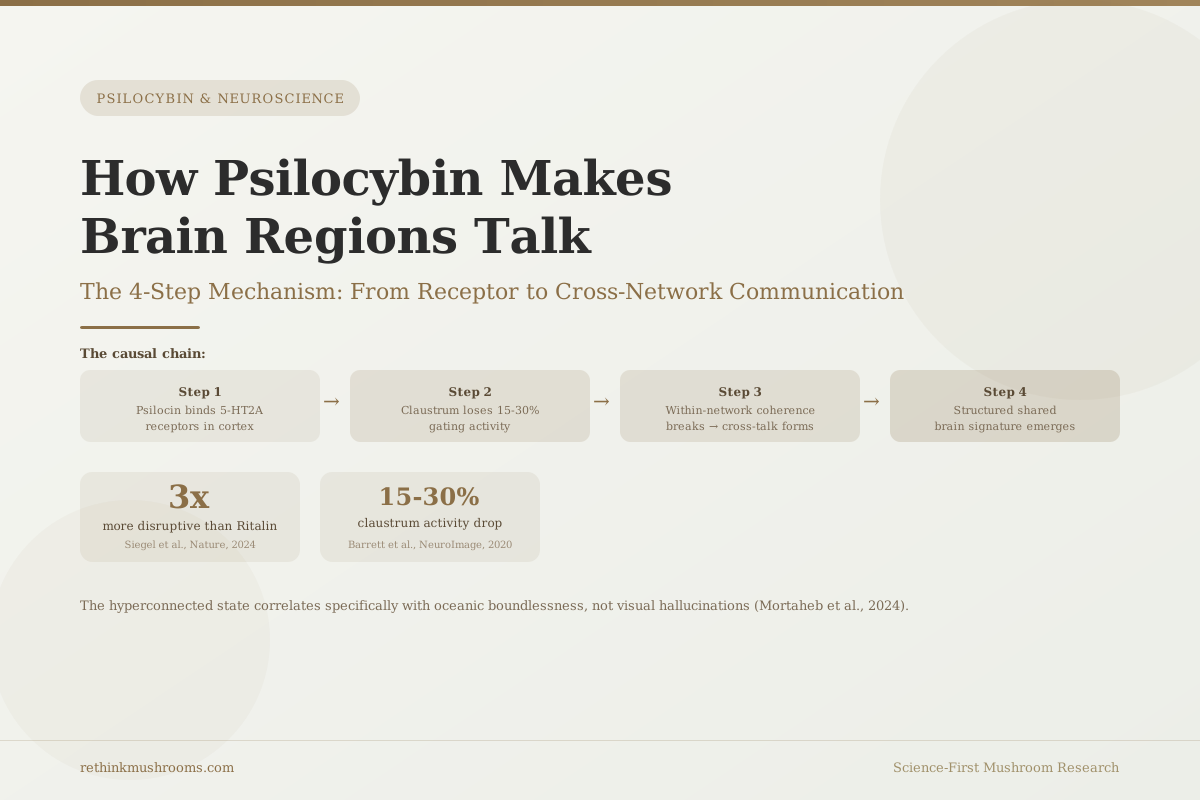
Step 1: Psilocin binds 5-HT2A receptors in cortical layer V, disrupting the coordinated firing patterns that maintain network boundaries.
Step 2: The claustrum (the brain's gating mechanism for conscious awareness) reduces its activity by 15-30%, removing the coordinating structure that keeps networks separated.
Step 3: Early in the session, within-network coherence breaks down; later, cross-network connections form between regions that are normally anti-correlated.
Step 4: The result is a structured reorganization of higher-order brain networks, producing a recognizable brain state shared across individuals, one associated specifically with the subjective experience of oceanic boundlessness.
For the broader picture of all the ways psilocybin changes brain connectivity and what those changes mean for consciousness and depression, see our article on psilocybin and brain connectivity. For the full view of how integration and segregation work across the session, see our article on psilocybin and global brain connectivity.
The Bottom Line
Psilocybin enables cross-network brain communication through a four-step mechanism: psilocin binds 5-HT2A receptors and disrupts coordinated neural firing; the claustrum loses 15-30% of its gating activity (Barrett et al., 2020); within-network coherence breaks down early, followed by cross-network connectivity later in the session (Preller et al., 2020); and the resulting reorganization produces a structured, shared brain state that is more than 3 times as disruptive as methylphenidate (Siegel et al., Nature, 2024). This cross-network state correlates specifically with oceanic boundlessness, the subjective dissolution of self-world boundaries, rather than with visual hallucinations (Mortaheb et al., 2024). The mechanism also provides a theoretical basis for psilocybin's antidepressant effects: disrupting rigid, over-segregated network patterns may create a window for new connections to form.
Frequently Asked Questions
Sources & References
- 1. Source details for this reference are not yet available.
- 2. Source details for this reference are not yet available.
- 3. Source details for this reference are not yet available.
- 4. Source details for this reference are not yet available.
- 5. Source details for this reference are not yet available.