Regulatory notice: Psilocybin is classified as a Schedule I controlled substance in the United States and is similarly restricted in most countries. Possession, use, or distribution is illegal under federal law regardless of state or local rules. This article discusses psilocybin's mechanisms in the context of published research and theoretical frameworks. Nothing here constitutes medical advice or encouragement to obtain or use controlled substances.
Mushroom Stacking and Combinations
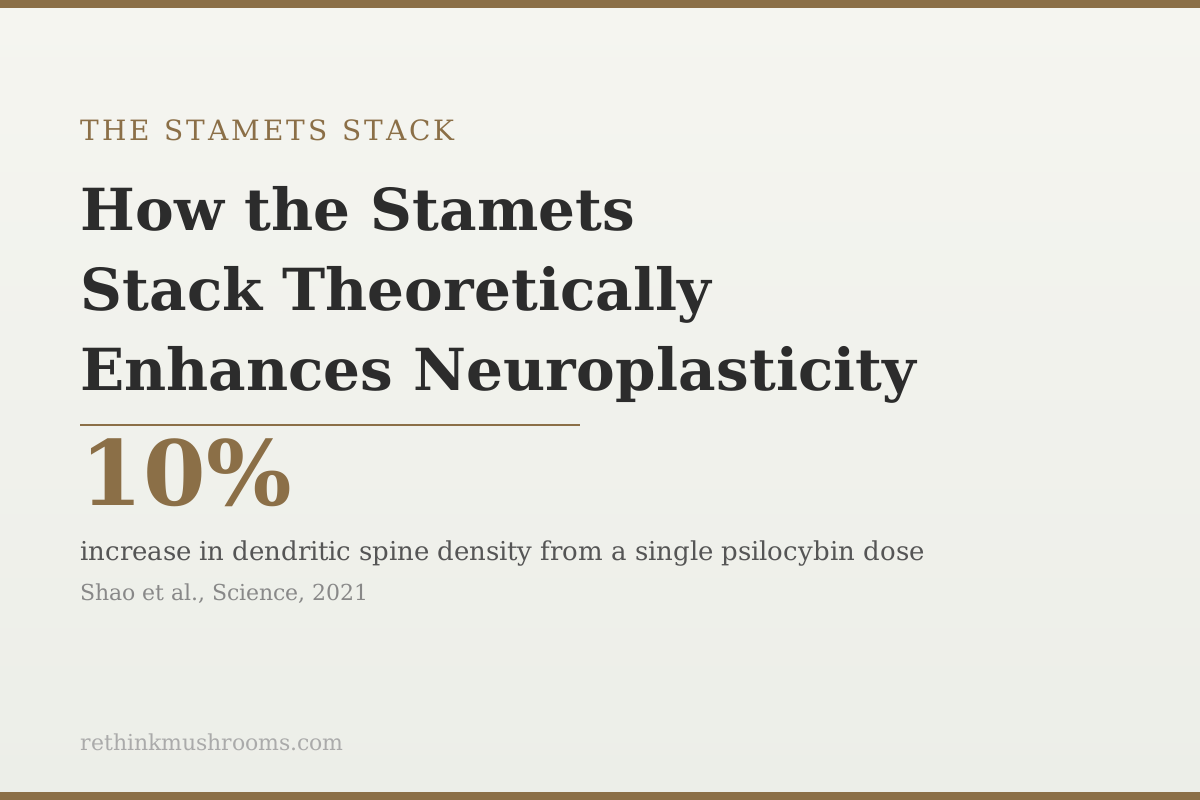
10% increase in dendritic spine density from psilocybin
A single dose of psilocybin produced approximately 10% higher dendritic spine density in the frontal cortex of mice, with effects beginning within 24 hours and persisting for at least one month. This structural brain change is the neuroplasticity foundation that the Stamets Stack is theoretically built around.
Shao et al., Science, 2021
TrkB
the BDNF receptor that psilocybin directly binds; this is now understood to mediate neuroplasticity, separate from 5-HT2A hallucinogenic effects (Sonda et al., 2025)
NGF
nerve growth factor stimulated by lion's mane erinacines; acts on TrkA and TrkB receptors, the same receptor family as BDNF (Wong et al., 2012)
Theoretical
status of the Stack's synergy hypothesis: the combination has not been tested in a clinical trial; each component has separate evidence
Shao et al., Science, 2021
 View as image ↗
The Stamets Stack is a proposed microdosing combination named after mycologist Paul Stamets: a small sub-perceptual dose of psilocybin combined with lion's mane mushroom and niacin. The claimed purpose is enhanced neuroplasticity. The combination has not been tested in a controlled clinical trial. But the mechanistic logic behind it has gotten more interesting since 2021, when two lines of research converged in a way that no competitor in this space appears to have noticed.
The first line: psilocybin physically restructures brain connections. Shao and colleagues published in Science in 2021 that a single psilocybin dose caused approximately 10% higher dendritic spine density in the mouse frontal cortex, with effects appearing within 24 hours and persisting for at least one month.[1] The second line: psilocybin achieves this not by interacting with the hallucinogenic receptor (5-HT2A) but by directly binding TrkB, the receptor that the brain's primary neuroplasticity signal molecule (BDNF) binds. This discovery, documented in Sonda et al. (2025), reframes why the Stack's combination might have mechanistic coherence: lion's mane stimulates production of a nerve growth factor that acts on the same receptor family that psilocybin is now known to directly target.[2]
For context on combining medicinal mushrooms generally, see combining medicinal mushrooms: the ultimate stacking guide.
Key Takeaways
- A single psilocybin dose produced approximately 10% higher dendritic spine density in mouse frontal cortex within 24 hours, with effects persisting at least one month; this structural change is the brain plasticity mechanism the Stamets Stack is theoretically designed to leverage (Shao et al., Science, 2021)
- Psilocybin's neuroplastic effects are now understood to be mediated primarily through direct TrkB binding (the receptor for BDNF, the brain's primary neuroplasticity signal), NOT through 5-HT2A activation (the hallucinogenic receptor); a 2025 finding that separates the plasticity mechanism from the perceptual effects (Sonda et al., 2025)
- Lion's mane mushroom stimulates production of nerve growth factor (NGF) through its bioactive compounds erinacines and hericenones; NGF signals through TrkA and TrkB receptors, the same receptor family that psilocybin directly binds (Wong et al., 2012; Lai et al., 2013)
- The theoretical synergy of the Stack centers on TrkB: psilocybin opens a plasticity window via TrkB direct binding; lion's mane supplies NGF that also activates TrkA/TrkB; both may be acting on the same neuroplasticity-promoting pathway simultaneously
- Niacin is the least-evidenced component of the Stack; Stamets hypothesizes it causes peripheral vasodilation improving mushroom compound delivery, but this specific mechanism has no peer-reviewed evidence in the context of the Stack
- No clinical trial has tested the Stamets Stack as a combination; the neuroplasticity claims are theoretical extrapolations from separate mechanistic studies of each component
What the Stamets Stack Is and What It Claims
Paul Stamets, the mycologist and founder of Fungi Perfecti, proposed a specific microdosing protocol combining three components:
- Psilocybin mushrooms at a sub-perceptual microdose (typically 0.1-0.3g dried mushroom)
- Lion's mane mushroom at a functional dose (typically 50-200mg dried or 5+ grams)
- Niacin (vitamin B3) at a flushing dose (typically 100-200mg)
The proposed mechanism is that psilocybin creates a neuroplasticity window, lion's mane provides neurotrophin signals that act within that window, and niacin enhances delivery of these compounds through peripheral vasodilation.
The Stack has generated significant interest in psychedelic wellness communities. It has also generated significant skepticism from researchers who note that it has never been tested as a combination in any clinical study. What has changed in recent years is the quality of the mechanistic case for why the combination might make sense, driven by better understanding of psilocybin's molecular targets.
Psilocybin Creates Structural Brain Changes
The neuroplasticity claim for psilocybin is not theoretical at the level of structural brain changes. Shao and colleagues published compelling preclinical evidence in Science in 2021.[1]
They examined dendritic spines, the tiny protrusions on neurons that receive signals from other neurons. Dendritic spine density is a physical measure of how many synaptic connections a neuron has. In mouse frontal cortex neurons, psilocybin produced:
- Approximately 10% higher total dendritic spine density
- Onset within 24 hours of a single dose
- Persistence for at least one month after administration
This represents genuine structural change at the level of neural architecture, not just transient neurotransmitter modulation. New dendritic spines represent new synaptic connections. More synaptic connections, particularly in the frontal cortex, are associated with more flexible thinking, better pattern recognition, and improved resilience following stress or injury.
The animal model is mice, and the translation to humans requires caution. But the structural finding is specific, measured, and replicated across multiple individual cells in the study. It is the clearest evidence that psilocybin does more than alter consciousness temporarily; it physically reorganizes the connectivity structure of brain cells.
The TrkB Discovery: Psilocybin's Plasticity Works Through the BDNF Receptor
The most important recent development in understanding psilocybin's neuroplasticity mechanism is the TrkB finding, reviewed in Sonda et al. (2025).[2]
For decades, psilocybin's effects were attributed to its primary target: 5-HT2A receptors, the serotonin receptors responsible for hallucinogenic perception. The assumption was that the neuroplastic effects were downstream of the hallucinogenic receptor activation.
The emerging research has separated these two effects at the receptor level. Psilocybin binds 5-HT2A, which produces the perceptual and cognitive effects of a full psychedelic dose. But psilocybin also directly binds TrkB, the receptor for BDNF (brain-derived neurotrophic factor). TrkB activation is the primary driver of neuroplasticity: it stimulates dendritic spine growth, promotes synapse formation, and supports neuronal survival.
Critically, experiments separating these two receptor pathways found that the antidepressant and neuroplastic effects track with TrkB binding, not with 5-HT2A activation. This means the neuroplasticity mechanism is at least partly independent of the hallucinogenic mechanism. Structural plasticity can be driven by psilocybin through TrkB even at doses too low to cause meaningful perceptual effects, which is the theoretical basis for why microdosing might still affect neuroplasticity without producing a full psychedelic experience.
This finding is a paradigm shift in understanding what psilocybin actually does in the brain when neuroplasticity is the target. The hallucinogenic receptor is not the mechanism; the neuroplasticity receptor is.
Lion's Mane: NGF Stimulation and the TrkA/TrkB Connection
Lion's mane mushroom (Hericium erinaceus) contains two classes of bioactive compounds that stimulate production of nerve growth factor (NGF): hericenones from the fruiting body and erinacines from the mycelium.
Wong and colleagues reviewed the neuroregenerative potential of lion's mane in 2012 and documented the evidence for NGF stimulation, including mechanisms relevant to peripheral nerve injury recovery.[3] Lai and colleagues confirmed the neurotrophic properties of Malaysian Hericium erinaceus in 2013, adding to the evidence base for lion's mane's ability to stimulate neurotrophic factor production.[4]
NGF (nerve growth factor) is a neurotrophic factor in the same biological family as BDNF. NGF signals by binding to TrkA receptors primarily, but also to TrkB. Both TrkA and TrkB are tyrosine kinase receptors that, when activated, trigger intracellular signaling cascades that promote neuronal growth, synapse formation, and survival.
This is where the theoretical connection to psilocybin's TrkB mechanism becomes relevant: psilocybin directly binds TrkB and activates the BDNF signaling pathway. Lion's mane stimulates NGF production, and NGF acts through the same Trk receptor family (primarily TrkA, with some TrkB activity). Both compounds are operating on overlapping molecular machinery for neuroplasticity promotion.
For a deeper exploration of lion's mane's specific brain-boosting compounds, see hericenones and erinacines: lion's mane's brain-boosting compounds and how lion's mane supports synaptic plasticity.
The Theoretical Synergy: Why TrkB Is the Convergence Point
The mechanistic argument for the Stamets Stack, at its strongest, works like this:
Psilocybin creates a "neuroplasticity window" by directly activating TrkB receptors. Within this window, the brain is in a state of heightened structural plasticity, more capable of forming new connections and reorganizing existing ones. This window appears to open rapidly (within 24 hours per Shao et al.) and persist for an extended period.
Lion's mane, by stimulating NGF production, supplies an additional neurotrophic signal that also acts on the Trk receptor family. If psilocybin has already primed TrkB and created a state of heightened plasticity, the NGF signal may have more substrate to work with than it would in a brain not in this state. The combination might produce more plastic benefit than either component alone.
Niacin, per Stamets' hypothesis, causes peripheral vasodilation that could improve circulation and delivery of the active compounds.
This is a theoretical framework, not a proven mechanism. The specific claim that psilocybin + lion's mane produces greater neuroplasticity than either alone has not been tested in any study. What is established: psilocybin activates TrkB and produces structural brain changes. Lion's mane stimulates NGF which acts on the same receptor family. The convergence on the Trk pathway is the most plausible mechanistic basis for why the combination might have additive effects. For the lion's mane and BDNF research specifically, see lion's mane and BDNF: what the research shows.
Niacin: The Least-Evidenced Component
Niacin's presence in the Stack is the component with the weakest mechanistic evidence in this specific context. Stamets' hypothesis is that the flushing dose of niacin (which causes peripheral vasodilation and the characteristic skin flush) improves delivery of psilocybin and lion's mane compounds through better blood flow.
There is general evidence that niacin increases cerebral blood flow and that it interacts with BDNF/TrkB pathways in some research contexts (particularly stroke recovery research). But no study has tested whether niacin specifically improves the neuroplastic effects of the psilocybin + lion's mane combination, and the delivery enhancement hypothesis is speculative.
The honest assessment: niacin may contribute something to the Stack, or it may be irrelevant to the neuroplasticity mechanism. The peripheral vasodilation effect is real (it is what causes the skin flush); whether this meaningfully improves compound delivery to the brain is not established.
Some practitioners of the Stack use niacinamide (a non-flushing form of niacin) instead, eliminating the vasodilation effect entirely. This suggests that even within the Stack's user community, niacin's proposed mechanism is not universally accepted.
What the Stack Does Not Have: Clinical Evidence
Being explicit about what is missing is important for anyone evaluating the Stamets Stack.
There is no clinical trial testing the three-component combination for any neuroplasticity or cognitive outcome. The mechanistic case is built from three separate lines of research: psilocybin's structural plasticity in animal models (Shao 2021), psilocybin's TrkB binding mechanism (Sonda 2025), and lion's mane's neurotrophic factor stimulation (Wong 2012, Lai 2013). These findings have not been combined in a study testing whether the Stack produces greater neuroplasticity than each component alone.
The available evidence supports:
- Psilocybin causes structural brain changes consistent with increased neuroplasticity in animal models
- Psilocybin's neuroplastic effects are mediated by TrkB binding, not just 5-HT2A activation
- Lion's mane stimulates NGF production and supports neurotrophic processes
- Both mechanisms converge on the Trk receptor family
The available evidence does not support:
- Any specific claim about the combination producing synergistic neuroplasticity in humans
- Any specific dose ratio or timing protocol being optimal
- Niacin's specific contribution to neuroplastic outcomes
The theoretical framework is the most mechanistically coherent version of the Stack's rationale currently available. It remains theoretical.
The Bottom Line
The Stamets Stack's neuroplasticity mechanism rests on two converging research lines: psilocybin's structural brain effects (10% dendritic spine density increase with 1-month persistence, Shao et al., Science, 2021) and psilocybin's TrkB direct binding mechanism (Sonda et al., 2025), which separates the neuroplastic effects from the hallucinogenic 5-HT2A pathway. Lion's mane's NGF stimulation (Wong et al., 2012; Lai et al., 2013) acts through the same Trk receptor family, creating a theoretical convergence that justifies the combination mechanistically more than any prior explanation could. Niacin is the least-evidenced component. No clinical trial has tested the three-component combination, and the synergy remains theoretical.
Frequently Asked Questions
Sources & References
- 1RTHM-01434·Shao, Ling-Xiao et al. (2021). “Psilocybin induces rapid and persistent growth of dendritic spines in frontal cortex in vivo..” Neuron.Study breakdown →PubMed →↩
- 2RTHM-02182·Sonda, Sonia et al. (2025). “Emerging mechanisms of psilocybin-induced neuroplasticity..” Trends in pharmacological sciences.Study breakdown →PubMed →↩
- 3RTHM-00500·Wong, Kah-Hui et al. (2012). “Neuroregenerative potential of lion's mane mushroom, Hericium erinaceus (Bull.: Fr.) Pers. (higher Basidiomycetes), in the treatment of peripheral nerve injury (review)..” International journal of medicinal mushrooms.Study breakdown →PubMed →↩
- 4RTHM-00295·Lai, Puei-Lene et al. (2013). “Neurotrophic properties of the Lion's mane medicinal mushroom, Hericium erinaceus (Higher Basidiomycetes) from Malaysia..” International journal of medicinal mushrooms.Study breakdown →PubMed →↩