Mushroom Coffee Market & Brands
5.58% projected CAGR through 2035
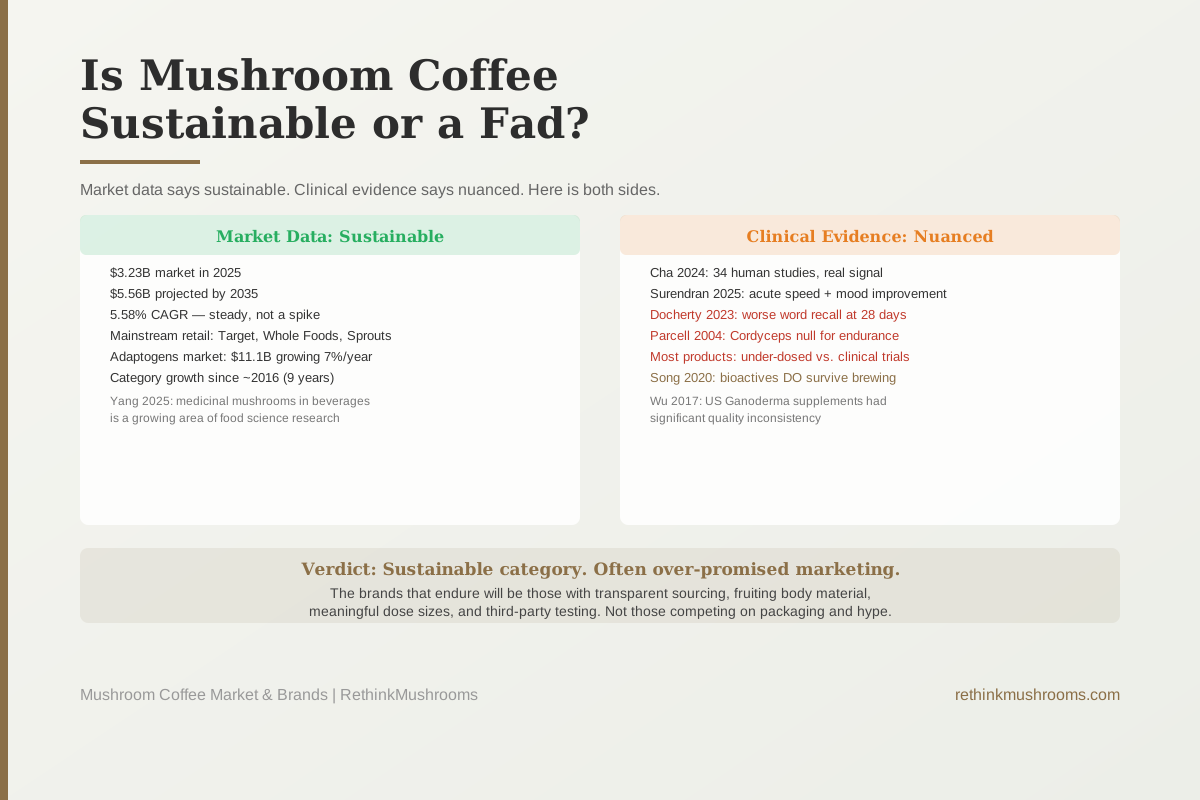
Commercial market-research firms put mushroom coffee at $3.23B in 2025 growing to $5.56B by 2035. Those are vendor forecasts rather than peer-reviewed measurements, and they answer a different question than the clinical literature does.
Commercial market analysis, 2025 — not peer-reviewed
24 of 34
studies in Cha 2024 were epidemiological; the 10 intervention trials were mixed
under-dosed
most products vs the doses used in clinical trials
null at 5 weeks
Parcell 2004: Cordyceps CS-4 at 3 g/day did not improve endurance (n=22)
Commercial market analysis, 2025 — not peer-reviewed
 View as image ↗
The honest answer to whether mushroom coffee is a fad is that it depends which part of the claim you are evaluating, because the market question and the efficacy question are answered by two completely different bodies of evidence.
The commercial forecasts say sustainable. The category has grown steadily since roughly 2016, and market-research firms project compound annual growth of 5 to 6 percent through 2035. That is the kind of trajectory that describes an enduring category rather than a temporary spike.
The clinical literature says something more complicated, and it says it about mushrooms, not about mushroom coffee. Most products contain doses well below what trials have used. Several of the best-controlled trials returned null or mixed results even at doses far above what a commercial cup delivers. And the studies most often cited to prove that "the bioactives survive brewing" did not measure the compounds the marketing attributes to them.
Those things are simultaneously true, and holding both is more useful than either "it's definitely real" or "it's just hype."
For the broader functional mushroom market context, see The Functional Mushroom Market: Size, Growth, and Projections.
Key Takeaways
- Commercial forecasts put the mushroom coffee market at roughly $3.23B in 2025 with 5 to 6% projected annual growth through 2035. These are vendor market-research products, not peer-reviewed measurements, and their methodologies are generally not disclosed — treat the direction as more informative than the decimal places
- A 2024 systematic review (Cha et al., Neuroscience and Biobehavioral Reviews) covered 34 human studies. The split matters: the 24 epidemiological studies showed a significant benefit of mushroom-containing dietary patterns, while the 10 intervention trials produced mixed results
- The two best-controlled acute trials in healthy young adults both missed their primary outcomes. Surendran 2025 (n=18, 3 g of a 10:1 extract) found no significant effect on global cognition or mood, with only the pegboard test improving. Docherty 2023 (n=41, 1.8 g) found faster Stroop performance but significantly worse immediate word recall accuracy in the same session
- Parcell 2004 (n=22 trained cyclists) gave 3 g/day of Cordyceps CS-4 for 5 weeks and found no improvement in VO2peak, ventilatory threshold, or time-trial performance. Critically, 3 g/day is the same dose used in the positive Mori 2009 lion's mane trial — so this null cannot be explained away as under-dosing
- Song 2020 confirmed cordycepin and beta-glucan are present in a manufactured Cordyceps coffee, but at substantially reduced levels: cordycepin fell from 11,533 mg/kg in the raw mushroom to 2,275 mg/kg in the coffee. Kala 2024, frequently cited alongside it, measured bioelements and chlorogenic acids — not cordycepin, beta-glucan, or hericenones
- Only 5 of 19 US Reishi supplements (26.3%) matched their label claims in a 2017 analysis, a quality-control problem that carries directly into mushroom coffee
What the Market Data Says, and What It Is
The mushroom coffee category has behaved like a maturing consumer goods segment rather than a wellness fad. Fads show sharp search and sales spikes followed by sharp declines. Mushroom coffee has shown consistent growth across multiple years with no major reversal, has cleared mainstream retail, and has attracted established food-industry investment.
Commercial analyses project the category at approximately $3.23 billion in 2025, growing to $5.56 billion by 2035 at a compound annual growth rate of about 5.6 percent. Before leaning on those numbers, it is worth being precise about what they are.
The peer-reviewed literature does corroborate the direction, if not the decimals. Niego and colleagues, reviewing macrofungi as a nutraceutical source in 2021, reported that the global medicinal mushroom market was projected to increase by USD 13.88 billion between 2018 and 2022, and identified converging consumer trends — interest in eastern herbal medicine, preference for natural and organic products, demand for gut-healthy products, and growth in sports nutrition — as the structural drivers.[8] A 2025 review by Yang and colleagues covering medicinal mushrooms in functional foods described a rapidly growing market for mushroom-based beverages and documented biotechnological advances in cultivation and value-added products.[5]
Mainstream retail penetration is the more telling signal. Mushroom coffee moved from specialty health food stores into national grocery and big-box chains between 2020 and 2025. Shelf space at that level is expensive and slow to win, and retailers do not generally allocate it to categories they expect to collapse.
So: the market case is reasonable, and it rests on retail behavior and multiple independent forecasts pointing the same way. It does not rest on any of those forecasts being precisely right.
What the Clinical Evidence Actually Shows
The science is more nuanced than the category's marketing suggests, in both directions. There is a real signal connecting mushroom consumption and cognitive function. There are also genuine null results, and the strongest of them are not explained by low doses.
A 2024 systematic review by Cha and colleagues in Neuroscience and Biobehavioral Reviews evaluated 34 human studies on mushroom consumption and neurocognitive and mood outcomes across the lifespan.[1] The internal split is the part that gets lost in summary: of those 34 studies, 24 were epidemiological and 10 were intervention trials. The epidemiological studies revealed a significant benefit of dietary patterns including mushrooms of any species on cognition and mood, in both healthy and compromised populations. The intervention studies were mixed.
That distinction is not a technicality. Epidemiological studies observe what people already eat; they cannot separate mushroom consumption from the other habits of people who eat mushrooms regularly. Intervention trials give people a defined dose and measure what changes. When the observational signal is strong and the interventional signal is mixed, the honest reading is that the association is real but the causal claim is unsettled — which is exactly what Cha and colleagues concluded, calling for further trials with adequate sample sizes and appropriately sensitive neurocognitive tests.
The most recent lion's mane trial, published in Frontiers in Nutrition in 2025 by Surendran and colleagues, is often cited in marketing as positive evidence. Read directly, it is more restrained than that.[3] Eighteen healthy adults aged 18 to 35 took a single 3 g dose of a 10:1 Hericium erinaceus fruiting body extract in a double-blind, placebo-controlled crossover design, with cognitive and mood assessments at baseline and 90 minutes post-dose. The result: no significant effect on composite measures of global cognitive function or mood. One individual test — the pegboard, a psychomotor task — improved. The authors' own conclusion was that acute consumption "did not demonstrate a significant overall improvement in cognitive performance and mood compared to the placebo," and that any benefits may be task- or domain-specific.
Surendran et al. (2025) · Frontiers in Nutrition
- Population
- 18 healthy adults aged 18-35, randomised double-blind placebo-controlled crossover
- Intervention
- Single acute dose of 3 g of a 10:1 Hericium erinaceus fruiting body extract
- Comparator
- Matched placebo, within-subject crossover
- Finding
- No significant effect on composite measures of global cognitive function or mood at 90 minutes post-dose. Of the individual tests spanning executive function, working memory, psychomotor skills, attention and processing speed, only the pegboard test showed improved performance.
null This is a null result on the pre-specified composite outcomes with one positive individual test. It is frequently cited as evidence that lion's mane improves cognition acutely; the authors concluded the opposite, and called for chronic-supplementation trials and work to establish optimal dosage.
Surendran et al., Frontiers in Nutrition, 2025; 12:1405796
Note the dose. Three grams of a 10:1 extract is a large serving by any commercial standard — nominally equivalent to 30 g of starting material. It is roughly six to thirty times what a cup of mushroom coffee delivers, and it still did not move the composite outcome.
The Honest Null Results
A fair analysis requires covering the trials that did not show benefit, including the parts of mixed trials that marketing pages omit.
Docherty and colleagues ran a double-blind, parallel-groups pilot study published in Nutrients in 2023, giving 41 healthy adults aged 18 to 45 either 1.8 grams of lion's mane or placebo daily for 28 days.[2] The widely-quoted finding is that a single acute dose produced significantly faster Stroop task performance at 60 minutes (p = 0.005). The much less widely-quoted finding is that the same participants, in the same 60-minute assessment, recalled significantly fewer correct words on immediate word recall after lion's mane (interaction p = 0.007; within-treatment p = 0.013).
At the 28-day mark, the placebo group recalled significantly more words on delayed word recall at Day 29 than at Day 1, while the lion's mane group did not improve (p = 0.027) — the gain belonged to placebo. A trend toward reduced subjective stress in the supplemented group did not reach significance (p = 0.051). The authors described the negative memory effect as "difficult to explain" and urged caution given the small sample. It is also worth noting that the investigational product was supplied by a mushroom supplement company, though the authors reported the company had no role in design, analysis, or the decision to publish.
Docherty 2023 · The Full Result
The Acute Effect Came With a Cost
Both of these outcomes came from the same trial, the same participants and the same 60-minute assessment. Supplement pages cite the first row and stop.
Stroop task speed
Executive attention · response inhibition
Significantly faster at 60 minutes post-dose
Immediate word recall accuracy
Episodic memory · encoding
Significantly less accurate in the same session
And at 28 days
Delayed word recall at 28 days
p = 0.027The placebo group recalled significantly more words at Day 29 than at Day 1; the lion’s mane group did not improve. The gain belonged to placebo.
Parcell and colleagues published a randomized controlled trial in 2004 testing Cordyceps CS-4 in 22 endurance-trained male cyclists.[4] Cordyceps is the species most commonly marketed for energy and athletic performance in mushroom coffee. Participants took 3 grams per day for five weeks, with training intensity documented weekly throughout. VO2peak did not differ within or between groups. Ventilatory threshold did not change. Time-trial performance did not change.
Parcell et al. (2004) · International Journal of Sport Nutrition and Exercise Metabolism
- Population
- 22 endurance-trained male cyclists, training intensity documented and maintained throughout
- Intervention
- CordyMax Cs-4 tablets, 3 g/day for 5 weeks
- Comparator
- Placebo, randomised
- Finding
- VO2peak was statistically indistinguishable before (59.9 vs 59.1 mL/kg/min) and after (60.1 vs 57.1 mL/kg/min) supplementation. Ventilatory threshold, measured at 72% of VO2peak at baseline, did not change in either group. Time trials were 61.4 min (placebo) versus 62.1 min (treatment), with no difference between or within groups.
null The dose is the reason this null matters. At 3 g/day, this trial used the same daily dose as the positive Mori 2009 lion's mane trial and roughly six to thirty times a commercial mushroom coffee serving. Under-dosing does not explain this result.
Parcell et al., Int J Sport Nutr Exerc Metab, 2004; 14(2):236-42
This finding matters for consumer expectations. Many brands lead with energy and athletic performance claims based on Cordyceps. The most rigorous test of that claim in trained athletes, at a generous dose and over a realistic duration, found nothing. Untrained individuals, different preparations, or different endpoints might show different results — but the study that most directly tests the marketing claim is a null.
Neither of these findings means mushroom coffee does nothing. They mean the effects are conditional on dose, form, population, and outcome measured, and that confident marketing regularly outruns the evidence.
The Dose Problem: Why Under-Dosing Undermines Claims
Dose adequacy is the most consistent structural issue in mushroom coffee. Trials that showed positive cognitive effects used substantially more mushroom material than most commercial products provide.
The most-cited lion's mane cognition trial, Mori and colleagues in 2009, is a useful benchmark.[9] Thirty Japanese adults aged 50 to 80 with mild cognitive impairment were randomized into two groups of 15. The treatment group took four 250 mg tablets of 96% Hericium erinaceus dry powder three times daily — 3 grams per day — for 16 weeks. Cognitive scale scores rose significantly versus placebo at weeks 8, 12 and 16, and increased with duration of intake. Four weeks after the participants stopped taking it, their scores fell again.
Two caveats belong with that result. It is a 30-person trial, which is small, and it was conducted in adults with diagnosed mild cognitive impairment — not the healthy adults buying mushroom coffee. The washout decline is arguably its most useful feature: it suggests the effect, where present, depends on continued intake rather than accumulating permanently.
Set the doses side by side and the gap is stark.
The Dose Gap · And Its Limit
Trials Dose in Grams. Coffee Doses in Milligrams.
The gap between trial doses and a commercial serving is the strongest structural criticism of the category. Read the outcome column alongside it: two trials ran at the full 3 g/day and still came back null.
The part the dose argument cannot carry
If low dose were the whole explanation, full-dose trials would reliably show effects. Parcell 2004 and Surendran 2025 both dosed at 3 g and did not. Adequate dose is necessary for a fair test of these ingredients; it has not proven sufficient.
Most commercial mushroom coffees provide between 100 and 500 milligrams of lion's mane per serving, typically within a blend of several species. At 500 milligrams you are at roughly 28 percent of the Docherty 2023 dose and 17 percent of the Mori 2009 dose. At 150 milligrams you are at a small fraction of any dose that has shown an effect in a controlled setting.
The dose gap is real, but notice what the Parcell trial does to the simple version of this argument. If under-dosing were the whole story, then trials at full clinical doses would reliably show effects. Parcell ran 3 g/day for five weeks and found nothing; Surendran ran 3 g of a 10:1 extract and missed its primary outcome. Adequate dosing is necessary for a fair test of these ingredients. It has not proven sufficient.
This does not mean the dose in a cup is biologically zero. Mushrooms are the richest known dietary source of ergothioneine, a sulfur-containing antioxidant, with content varying more than 45-fold across species (0.15 to 7.27 mg per gram dry weight).[11] Humans possess a dedicated transporter for it: the SLC22A4 gene product OCTN1, which Grundemann and colleagues identified in 2005 as an ergothioneine transporter, moving it more than 100 times more efficiently than the compounds it had previously been assumed to carry.[12] A dedicated, high-efficiency uptake pathway is a strong hint that the body treats this compound as worth retaining. It is not, on its own, evidence that the amount in a cup of mushroom coffee produces a health outcome — that trial has not been run.
For detailed dose-adequacy analysis by brand, see Do Mushroom Coffee Products Have Enough Mushroom to Matter?.
Do Bioactives Survive the Process?
A separate question is whether mushroom compounds survive processing and brewing. The evidence here is genuinely encouraging, and it is also routinely overstated by one specific misattribution.
Song and colleagues published a 2020 study in Preventive Nutrition and Food Science developing a functional Cordyceps coffee, made by treating green coffee beans with mixed extracts from three medicinal mushrooms: Cordyceps militaris, Phellinus linteus, and Inonotus obliquus (Chaga).[6] The finished coffee did contain both target compounds: cordycepin at 2,274.70 mg/kg and beta-glucan at 2.03 percent. It also had higher polyphenol content than the control coffee (37.34 versus 27.00 mg gallic acid equivalent per gram) and slightly higher radical-scavenging activity.
The number usually quoted is 2,274.70 mg/kg. The number usually omitted is the one printed beside it: the raw Cordyceps mushroom contained 11,533.22 mg/kg. Beta-glucan told the same story, at 2.03 percent in the coffee versus 3.79, 7.06, and 8.57 percent in the raw Cordyceps, Phellinus, and Chaga respectively.
Song 2020 · The Full Table
The Compounds Survive. Most of Them Do Not.
Both figures come from the same paper. The finished coffee genuinely contains cordycepin and beta-glucan — at roughly a fifth and a half of the raw material respectively.
What the paper does support
Cordycepin and beta-glucan are present and quantifiable in the finished product. Polyphenol content was higher than control coffee (37.34 vs 27.00 mg GAE/g), and the mushroom off-flavour did not carry through.
What it does not support
That concentrations are preserved, that any of this was measured in a cup brewed at home, or that the retained amount produces a health outcome. This was a product chemistry study, with no human endpoint.
"Bioactives survive" is therefore accurate and incomplete. They survive at meaningfully reduced concentrations, and the paper reports the reduction explicitly.
The second problem is attribution. Kala and colleagues published a 2024 study in Pharmaceuticals on coffee prepared with Cordyceps militaris and Hericium erinaceus fruiting bodies, and it is frequently cited — including in earlier versions of this article — as confirming that cordycepin, beta-glucans, and hericenones survive into the brewed cup.[10] It does not show that, because it did not measure those compounds. Kala and colleagues compared machine-brewed, instant, and traditionally brewed coffee by atomic absorption spectroscopy and RP-HPLC for bioelements and phenolic acids. They found C. militaris to be the better additional source of magnesium, zinc, copper, sodium, potassium and calcium, H. erinaceus slightly higher in iron, and increases in 4-feruloylquinic acid (18.6 mg/200 mL) and 3,5-di-caffeoylquinic acid (3.76 mg/200 mL) with C. militaris added.
That is a real and useful finding about minerals and chlorogenic acids. It is not a finding about hericenones, and no study cited in this article has measured hericenone survival in a brewed beverage.
There is a further wrinkle worth knowing about hericenones specifically. Mori and colleagues, in the 2008 cell study most often cited for lion's mane's nerve growth factor mechanism, found that an ethanol extract of Hericium erinaceus promoted NGF gene expression in human astrocytoma cells in a concentration-dependent manner — but that hericenones C, D and E, tested individually, failed to do so.[13] So even if hericenone survival through brewing were demonstrated, the compound-to-mechanism link that would make it matter is not as settled as product copy implies.
Citation Audit · What Was Actually Weighed
Two Papers, Two Different Sets of Compounds
These two studies are frequently cited together to support the claim that cordycepin, beta-glucans and hericenones all survive into a brewed cup. Laid side by side, the overlap between the claim and the measurements is smaller than it looks.
Song 2020
Ref 6Prev Nutr Food Sci 25(2)
Green coffee beans treated with mixed extracts of C. militaris, P. linteus and I. obliquus; finished product assayed.
Measured
- Cordycepin (HPLC) — 2,274.70 mg/kg
- Beta-glucan (enzyme method) — 2.03%
- Total polyphenol — 37.34 mg GAE/g
- DPPH radical scavenging — 82.21%
Not measured
Kala 2024
Ref 10Pharmaceuticals 17(7)
Machine-brewed, instant and traditionally brewed coffee prepared with C. militaris and H. erinaceus fruiting bodies; compared by AAS and RP-HPLC.
Measured
- Bioelements — Mg, Zn, Cu, Na, K, Ca (C. militaris best source)
- Iron — slightly higher with H. erinaceus
- 4-feruloylquinic acid — 18.6 mg/200 mL
- 3,5-di-caffeoylquinic acid — 3.76 mg/200 mL
Not measured
Net position
Cordycepin and beta-glucan survive into a manufactured Cordyceps coffee, at reduced concentration (Song 2020). Minerals and chlorogenic acids increase when fruiting bodies are added to brewed coffee (Kala 2024). Hericenone survival in a brewed beverage has not been measured by either paper, and neither study measured an effect in a person.
The critical qualifier for all of this: compound content depends on source material. Mycelium-on-grain products carry lower and less predictable compound content before brewing ever starts, and processing does not improve on what was not there. The process is not the obstacle. The source material and the serving size are.
The Quality Gap and Why It Matters for Longevity
Wu and colleagues evaluated 19 batches of Ganoderma lucidum (Reishi) dietary supplements purchased in the United States, assessing triterpenes and polysaccharides by chromatographic methods and saccharide mapping.[7] Only 5 of the 19 products — 26.3 percent — had measured ingredients consistent with their labels. The authors concluded that quality consistency in the US market was poor.
Roughly three-quarters of products in that sample did not deliver what their label described. That is the background condition mushroom coffee is sold into.
Reading the Marketing
What 'clinically proven ingredients' does and does not mean
The claim
“The mushrooms in this coffee are clinically proven to support focus, energy and immunity.”
True statements about mushroom species studied at trial doses, transferred onto a product containing a fraction of those doses in an unverified form.
What research shows
MisleadingClinical trials tested defined material at defined doses — 3 g/day of 96% lion's mane powder in Mori 2009, 3 g/day of Cordyceps CS-4 in Parcell 2004. Those trials tested an ingredient, not the product on the shelf, and one of the two found no effect at all.
The claim also assumes the product contains what the label says. In the closest available audit, only 26.3% of US Reishi supplements matched their label claims. Without third-party testing, dose adequacy cannot be assessed even in principle.
Refs 4, 7, 9
The US supplement framework (DSHEA) does not require pre-market testing; brands self-certify their labels. Without third-party verification, a consumer cannot tell whether 500 mg of lion's mane on a label corresponds to 500 mg of fruiting body material containing hericenones and erinacines, or to dried mycelium on grain with negligible active compound content.
Consolidation pressure in the category — inflation and retail competition squeezing smaller brands — is likely to have a sorting effect. Brands with transparent sourcing, third-party testing, fruiting body material and meaningful doses are better positioned to justify premium pricing than brands competing on packaging. That is a reasonable expectation from market structure rather than a documented finding, and it is worth labelling as such.
Where This Sits on the Evidence Ladder
Stepping back from individual studies, it is worth asking how far the specific claim — that drinking mushroom coffee produces a health benefit — has actually climbed.
- Compound and product chemistrycompleted
Song 2020 quantified cordycepin and beta-glucan in a manufactured Cordyceps coffee; Kala 2024 quantified bioelements and chlorogenic acids in brewed coffee with C. militaris and H. erinaceus fruiting bodies. Both establish that measurable compounds are present. Refs 6, 10.
- Mechanistic and animal work on the ingredientscompleted
Mori 2008 showed H. erinaceus extract induced NGF gene expression in human astrocytoma cells — though hericenones C, D and E individually failed to do so. Extensive preclinical work exists for Cordyceps and Reishi. Ref 13.
- Small human trials of the isolated ingredientscurrent
Mori 2009 (n=30, MCI, positive), Docherty 2023 (n=41, mixed with a negative memory signal), Surendran 2025 (n=18, primary outcome null), Parcell 2004 (n=22, null). These test mushroom preparations at trial doses, not mushroom coffee. Refs 2, 3, 4, 9.
- Adequately powered RCT of mushroom coffee at commercial dosesmissing
No trial has given people a commercially representative mushroom coffee at a commercial serving size and measured a cognitive, energetic or immune endpoint against placebo. This is the step that would convert the category claim from plausible to demonstrated.
- Meta-analysis of mushroom coffee outcomesmissing
Not possible without the trials above. Cha 2024 pools mushroom consumption studies broadly, not mushroom coffee products, and reported mixed results across its 10 intervention trials. Ref 1.
The chemistry is established and the ingredient trials are underway and mixed. The specific claim being sold — that this product, at this dose, does something measurable — has never been directly tested. That is not the same as being disproven, but it is a long way from proven.
Refs 1, 2, 3, 4, 6, 9, 10, 13
Will Mushroom Coffee Be Popular in 5 Years?
Probably yes, with caveats.
The category has structural tailwinds: declining alcohol consumption among younger adults, demand for lower-caffeine alternatives, and the convergence of functional nutrition with beverage convenience. Niego and colleagues identified several of these same converging trends as drivers of medicinal mushroom market growth.[8] Yang and colleagues, reviewing the field in 2025, described mushroom-based beverages as a rapidly growing market supported by ongoing biotechnological development in cultivation and value-added products.[5]
The brands still prominent in five years are likely to be those that solve the dose problem, standardize on fruiting body material, invest in third-party testing, and make claims their evidence supports. Brands making confident promises about energy, focus and immunity on the back of 150 milligrams of mixed mushroom blend face increasing pressure from consumers who have started doing the dose math.
The category looks sustainable. The more aggressive marketing claims do not.
Practical Context
LowLow-risk as a beverage, but not a treatment — and not for everyone
Concern
Mushroom coffee is marketed adjacent to health outcomes (focus, immunity, energy) without having been tested as a product for any of them. The trials discussed here studied isolated mushroom preparations at doses several times larger than a commercial serving, in specific populations, with mixed results.
What the research says
Treated as a coffee alternative that may deliver some ergothioneine and polyphenols, mushroom coffee is a low-risk choice for most healthy adults. Treated as a substitute for evaluation or treatment of a cognitive, immune or energy problem, it is not supported by evidence.
Particularly relevant for: People who are pregnant or breastfeeding, immunocompromised, taking anticoagulants or immunosuppressants, or who have a mould or mushroom allergy should speak to a clinician before using concentrated mushroom extracts, which differ from culinary mushroom intake.
What to do
This article is research analysis, not medical advice. Discuss supplement use with a qualified healthcare professional, particularly if you take prescription medication or have an existing health condition.
Refs 2, 3, 4, 7, 9
For the broader mushroom industry context, see The Functional Mushroom Market: Size, Growth, and Projections.
The Bottom Line
Mushroom coffee occupies an unusual position: commercial forecasts support a sustainable category (projected 5-6% CAGR, mainstream retail penetration), while the clinical evidence answers a different question and answers it cautiously. Bioactives do survive processing — Song 2020 measured cordycepin and beta-glucan in a Cordyceps coffee, though at roughly a fifth of raw-mushroom concentration — but Kala 2024, often cited alongside it, measured bioelements and chlorogenic acids rather than cordycepin, beta-glucan or hericenones. Most products are under-dosed relative to trials, and the trials themselves are mixed even at full doses: Surendran 2025 missed its primary outcome at 3 g of a 10:1 extract, Docherty 2023 traded faster Stroop performance for worse word recall, and Parcell 2004 found nothing at 3 g/day of Cordyceps over five weeks. No trial has tested mushroom coffee at a commercial serving size against placebo. The category will likely survive and grow; the brands that endure will be those with transparent sourcing, meaningful doses, and claims that match the evidence.
Frequently Asked Questions
Sources & References
- 1RTHM-00868·Cha, Sara et al. (2024). “A review of the effects of mushrooms on mood and neurocognitive health across the lifespan..” Neuroscience and biobehavioral reviews.Study breakdown →PubMed →↩
- 2RTHM-00821·Docherty, Sarah et al. (2023). “The Acute and Chronic Effects of Lion's Mane Mushroom Supplementation on Cognitive Function, Stress and Mood in Young Adults: A Double-Blind, Parallel Groups, Pilot Study..” Nutrients.Study breakdown →PubMed →↩
- 3RTHM-00952·Surendran, Geyan et al. (2025). “Acute effects of a standardised extract of Hericium erinaceus (Lion's Mane mushroom) on cognition and mood in healthy younger adults: a double-blind randomised placebo-controlled study..” Frontiers in nutrition.Study breakdown →PubMed →↩
- 4RTHM-00075·Parcell, Allen C et al. (2004). “Cordyceps Sinensis (CordyMax Cs-4) supplementation does not improve endurance exercise performance..” International journal of sport nutrition and exercise metabolism.Study breakdown →PubMed →↩
- 5RTHM-02215·Yang, Jing-Ya et al. (2025). “Innovative applications of medicinal mushrooms in functional foods and nutraceuticals: a focus on health-boosting beverages..” Frontiers in cellular and infection microbiology.Study breakdown →PubMed →↩
- 6RTHM-00656·Song, Hyo-Nam (2020). “Functional Cordyceps Coffee Containing Cordycepin and β-Glucan..” Preventive nutrition and food science.Study breakdown →PubMed →↩
- 7RTHM-00499·Wu, Ding-Tao et al. (2017). “Evaluation on quality consistency of Ganoderma lucidum dietary supplements collected in the United States..” Scientific reports.Study breakdown →PubMed →↩
- 8RTHM-01414·Niego, Allen Grace et al. (2021). “Macrofungi as a Nutraceutical Source: Promising Bioactive Compounds and Market Value..” Journal of fungi (Basel.Study breakdown →PubMed →↩
- 9RTHM-00165·Mori, Koichiro et al. (2009). “Improving effects of the mushroom Yamabushitake (Hericium erinaceus) on mild cognitive impairment: a double-blind placebo-controlled clinical trial..” Phytotherapy research : PTR.Study breakdown →PubMed →↩
- 10RTHM-00882·Kała, Katarzyna et al. (2024). “Coffee with Cordyceps militaris and Hericium erinaceus Fruiting Bodies as a Source of Essential Bioactive Substances..” Pharmaceuticals (Basel.Study breakdown →PubMed →↩
- 11RTHM-00476·Kalaras, Michael D et al. (2017). “Mushrooms: A rich source of the antioxidants ergothioneine and glutathione..” Food chemistry.Study breakdown →PubMed →↩
- 12RTHM-00154·Gründemann, Dirk et al. (2005). “Discovery of the ergothioneine transporter..” Proceedings of the National Academy of Sciences of the United States of America.Study breakdown →PubMed →↩
- 13RTHM-00268·Mori, Koichiro et al. (2008). “Nerve growth factor-inducing activity of Hericium erinaceus in 1321N1 human astrocytoma cells..” Biological & pharmaceutical bulletin.Study breakdown →PubMed →↩