Mushroom Coffee Market & Brands
1.8–3 g/day lion's mane in the human trials
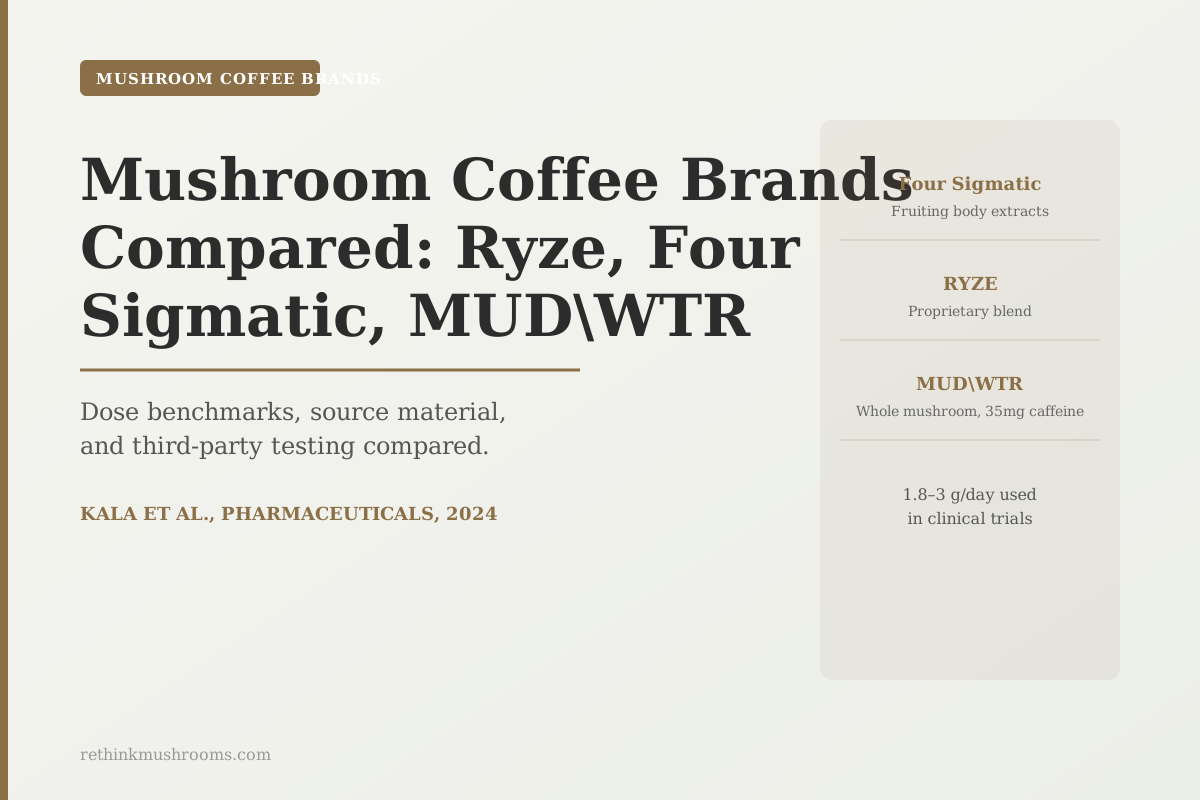
Every human trial the category cites dosed lion's mane at 1.8–3 g per day. None of the three leading brands publishes a per-serving figure that can be compared against it.
Mori et al., Phytotherapy Research, 2009; Docherty et al., Nutrients, 2023
10 studies
applied to brand-by-brand quality and dose analysis below
5 of 19
US reishi supplements matched their own labels — 26.3% (Wu 2017)
0 benefit
from 3 g/day cordyceps CS-4 for 5 weeks in 22 trained cyclists (Parcell 2004)
Mori et al., Phytotherapy Research, 2009; Docherty et al., Nutrients, 2023
 View as image ↗
When comparing mushroom coffee brands, the question that determines whether any of them are worth buying is almost never addressed: does the product contain the right compounds in amounts that research suggests matter? Part of that question has a reassuring answer. When Song analysed a cordyceps coffee made from beans treated with mushroom extracts, cordycepin and beta-glucan did survive into the finished product, at roughly a fifth and just over half of their raw-mushroom concentrations respectively.[4] Compounds can make it into a cup. The harder part is quantity: survival at reduced concentration only matters if enough went in to begin with, and that is the number brands do not publish. This comparison applies that framework to the three brands that dominate the market (Four Sigmatic, RYZE, and MUD\WTR) and the scientific evidence relevant to each. This article is part of a broader look at the functional mushroom industry and the brands shaping it.
Key Takeaways
- Cordycepin and beta-glucan do survive into a brewed mushroom coffee, but diluted: Song measured 2,274.70 mg/kg cordycepin in the finished coffee against 11,533.22 mg/kg in the raw mushroom, and 2.03% beta-glucan against 3.79% (Song, 2020)
- Four Sigmatic uses fruiting body extracts and discloses sourcing; RYZE uses a proprietary blend that doesn't disclose per-species doses; MUD\WTR uses whole mushrooms rather than extract
- Every human trial behind the category's claims dosed at 1.8–3 g per day — Mori 2009 (3 g/day, 16 weeks), Docherty 2023 (1.8 g/day), Surendran 2025 (3 g single dose), Parcell 2004 (3 g/day) — and no leading brand discloses a per-serving figure comparable to that range
- The recent healthy-adult trials are not the win the marketing implies: Docherty 2023 found faster Stroop responses but fewer correct answers on immediate word recall, and Surendran 2025 found no significant effect on overall cognition or mood
- Parcell's 2004 RCT found no endurance benefit from 3 g/day cordyceps CS-4 over 5 weeks in 22 trained male cyclists; this is the same fermented form that some commercial brands use
- Label verification fails often enough to matter: only 5 of 19 US reishi supplements (26.3%) matched their labels (Wu et al., 2017), and DNA sequencing of 19 Italian mushroom supplements identified the labelled species in just 6 (Risoli et al., 2023)
- Lion's mane hericenones come from the fruiting body; erinacines come from the mycelium. These are different compounds with different evidence bases, which matters when evaluating brands (Friedman, 2015)
The Four Things That Actually Matter When Comparing Mushroom Coffee Brands
Before getting to individual brands, four criteria determine whether a mushroom coffee product is worth analyzing at all.
Source material: fruiting body vs. mycelium on grain. This is the single most important variable. The hericenones in lion's mane that appear in cognitive research come from the fruiting body. The beta-glucans and triterpenoids in reishi that appear in immune research also come primarily from the fruiting body. A 2015 comprehensive review of lion's mane chemistry documented that hericenones are concentrated in the fruiting body, while a different group of compounds called erinacines is found in the mycelium, with distinct bioactivity profiles.[2] A product using mycelium grown on grain is a different product from one using fruiting body extract. It contains different compounds and often substantial grain starch.
Dose transparency. Most mushroom coffee brands list species without listing per-species doses. This practice is structurally similar to a protein bar listing "chicken" without saying how much protein is in the bar. A 2024 review of label compliance for immune health botanical products found widespread problems with ingredient quantity, identity, and purity, noting that the DSHEA regulatory framework allows products to reach market before proving efficacy or verifying that label claims are accurate.[3] Without disclosed per-species doses, it is impossible to evaluate whether a product reaches any clinically studied threshold.
Species selection. Not all mushroom species have equivalent evidence. Lion's mane has the deepest human trial record for cognitive effects. Cordyceps has the most studied physical performance claims, though the evidence is mixed. Reishi has the most immune research but the longest studied doses are in grams, not milligrams. Including six species at unmeasured quantities tells you less than one well-dosed species.
- Cell & Lab Studiescompleted
Extensive characterisation of hericenones, erinacines and polysaccharides, including nerve-growth-factor-stimulating activity — reviewed across fruiting body and mycelial compounds by Friedman (2015)
- Animal Studiescompleted
A substantial rodent literature underpins the neuroprotective and NGF-related rationale that the consumer claims are built on
- Case Reports & Early Seriescompleted
Early observational and open-label reports in Japan preceded the controlled work
- Small Human Trialscurrent
Mori 2009 (n = 30, mild cognitive impairment, 3 g/day, 16 weeks) was positive but intake-dependent; Docherty 2023 (n = 41, healthy adults, 1.8 g/day) was mixed; Surendran 2025 (n = 18, healthy adults, 3 g single dose) was largely null. All three are small, and two are in healthy people
- Large Randomized Trialsmissing
No large adequately powered RCT of lion's mane for cognition in healthy adults, and none at all in the form or dose a mushroom coffee delivers
- Meta-Analyses & Systematic Reviewsmissing
Too few comparable human trials, at too many different doses and durations, to pool meaningfully
Lion's mane is the best-evidenced species in the category and it still sits at the small-trial rung, with the two healthy-adult trials returning mixed and null results. Everything above that rung is missing. This is the ceiling the whole category's cognitive marketing rests on — which is why brand-level comparison can only ever be a comparison of quality and transparency, not of demonstrated effect.
Friedman, J Agric Food Chem, 2015; Mori et al., Phytotherapy Research, 2009; Docherty et al., Nutrients, 2023; Surendran et al., Frontiers in Nutrition, 2025
Third-party verification. A certificate of analysis from an independent lab using validated methods is the only way a consumer can check whether the label claim is accurate. When Wu and colleagues assayed 19 batches of US-market Ganoderma lucidum (reishi) supplements by chromatography and saccharide mapping, the measured ingredients matched the label in only 5 of them — 26.3%.[8] For brands including reishi in their formulas, this quality variation in the ingredient supply chain is a direct risk.
For the deeper explanation of why extraction method affects what compounds survive into a finished product, how extraction quality determines what you actually get covers the chemistry and economics.
| Brand | Mushroom source | Species | Dose per serving | Caffeine | Price/serving | Third-party tested |
|---|---|---|---|---|---|---|
| Four Sigmatic | Fruiting body extracts | Varies by product (L. mane, Chaga focus) | Disclosed per product | ~85–95 mg | ~$2.25 | Yes |
| RYZE | Not disclosed | 6 species: Cordyceps, L. mane, Reishi, Shiitake, Turkey Tail, King Trumpet | Proprietary blend, not disclosed | ~48 mg | ~$1.60 | Partial |
| MUD\WTR | Whole mushroom (not extract) | Chaga, Reishi, L. mane, Cacao + Masala Chai | Disclosed (not extract-level concentration) | 35 mg | ~$1.50 | Yes |
| Real Mushrooms | Fruiting body only | Varies (B2B + DTC, full species line) | Disclosed | Ingredient only (add to own coffee) | ~$1.20 | Yes, AOAC method |
| Everyday Dose | Fruiting body (lion's mane focus) | Lion's Mane + collagen + chaga | Disclosed | ~45 mg | ~$1.80 | Yes |
Four Sigmatic: Fruiting Bodies, Higher Price, and the Standard Every Brand Should Meet
Four Sigmatic is the category pioneer. Finnish founder Tero Isokauppila built the brand on a deliberate choice to use fruiting body extracts rather than mycelium, and to be transparent about it. The brand's core products center on lion's mane and chaga, with variations including cordyceps and reishi depending on the product line.
What makes Four Sigmatic distinct is traceable sourcing and dose disclosure. Kala and colleagues brewed coffee with Cordyceps militaris and Hericium erinaceus fruiting bodies and found it a meaningful source of bioelements, with C. militaris raising magnesium, zinc, copper, sodium, potassium and calcium, and chlorogenic-acid-family compounds rising alongside them.[1] It is worth being precise about what that study does and does not establish: it assayed minerals and phenolic acids, not cordycepin, beta-glucan or hericenones. The evidence that mushroom actives survive brewing comes from Song, and it is specific to cordyceps.[4]
The hericenones in their lion's mane products are the compounds with the most documented cognitive research, as distinct from the erinacines found in mycelium.[2] Whether the dose per serving approaches what clinical trials used is a separate question, but at least the compound type is aligned with the evidence.
What the Coffee Studies Actually Measured
One Study Assayed the Active Compounds. The Other Assayed Minerals.
Both papers are cited as evidence that mushroom actives survive brewing. Only Song measured them. Reading the two as interchangeable is how a minerals-and-phenolics result gets repeated as a hericenone result.
Song 2020 · HPLC + enzyme assay
Did the active compounds survive into the cup?
Green coffee beans treated with mixed Cordyceps, Phellinus and Chaga extracts
Cordycepin
11,533 → 2,275 mg/kgRaw Cordyceps mushroom vs finished coffee — about 19.7% carried through
Beta-glucan
3.79% → 2.03%Raw Cordyceps vs finished coffee; total glucan in the coffee 3.11%
Polyphenol
27.00 → 37.34 mg GAE/gControl coffee vs Cordyceps coffee — the mushroom treatment raised it
DPPH scavenging
80.56% → 82.21%Control coffee vs Cordyceps coffee; raw Cordyceps alone was 62.89%
Answer: yes, but diluted. Roughly a fifth of the cordycepin and just over half the beta-glucan concentration of the raw mushroom.
Kala 2024 · AAS + RP-HPLC
What does adding fruiting bodies contribute nutritionally?
Machine-brewed, instant and traditionally brewed coffee with H. erinaceus and C. militaris
Bioelements
Mg, Zn, Cu, Na, K, Ca, FeC. militaris was the better source; H. erinaceus slightly higher in Fe
4-feruloylquinic acid
18.6 mg/200 mLIncreased with C. militaris addition
3,5-di-caffeoylquinic acid
3.76 mg/200 mLIncreased with C. militaris addition
Not measured in this study
Neither study measured hericenones in a finished cup, which means the most commonly repeated lion’s-mane-in-coffee claim — that the cognitive compounds make it through brewing — is not the claim either paper tested. Song’s cordycepin and beta-glucan figures are real, and they are for cordyceps.
Sources: Song (2020), Preventive Nutrition and Food Science 25(2):184–193 [ref 4]; Kala et al. (2024), Pharmaceuticals 17(7):955 [ref 1].
The price premium ($2.25 per serving versus $1.50–$1.60 for competitors) reflects genuine cost differences. Fruiting body extract requires growing the mushroom to full maturity, then extracting and concentrating it, which is more expensive and time-consuming than mycelium cultivation on grain. The price difference is not primarily marketing; it reflects the ingredient supply chain.
The honest caveat: disclosing extract content is not the same as matching a trial protocol. Four Sigmatic publishes a number, which is more than its two main competitors manage, but that number is an extract weight rather than a dose equivalent to the 1.8–3 g per day the trials used, and the two cannot be directly converted. Whether commercial mushroom coffee products contain enough mushroom to matter addresses the dose-adequacy question for coffee products specifically.
RYZE: Six Species, Proprietary Blend, and the Dose Transparency Problem
RYZE markets itself as a premium mushroom coffee backed by a compelling Harvard-founders narrative. Its six-species formula (Cordyceps, Lion's Mane, Reishi, Shiitake, Turkey Tail, and King Trumpet) covers a wide range of the functional mushroom category. The product includes MCT oil for additional creaminess and positions itself on convenience and routine-building.
The sourcing for RYZE is less clear than Four Sigmatic. RYZE does not publicly specify whether its mushroom ingredients come from fruiting bodies or mycelium, and the formula uses a proprietary blend that does not disclose per-species doses.
This matters because a product listing six species at undisclosed individual amounts could contain any combination of doses. If the total mushroom blend is, say, 1 gram, and is split six ways, each species is present at a fraction that almost certainly falls well below any clinically studied threshold. Six species at trace amounts is not the same as one species at a meaningful dose.
The You 2024 review of label compliance for immune health botanical products documented that proprietary blends are common and that they create a regulatory dead zone where ingredient quantity claims cannot be verified without independent testing.[3] RYZE has released third-party testing information for some aspects of its products, but does not address per-species dose verification in a way that resolves the proprietary blend opacity.
RYZE's price ($1.60 per serving) reflects this ambiguity. It is cheaper than Four Sigmatic, and the price difference tracks with the sourcing and transparency differences. For consumers who find mushroom coffee enjoyable and want a low-caffeine alternative to regular coffee, RYZE is a reasonable product. For consumers evaluating whether the mushroom content will produce the effects the category claims, the lack of dose transparency makes RYZE harder to evaluate than its competitor.
MUD\WTR: The Anti-Coffee and the Most Transparent Ingredient Split
MUD\WTR occupies a different position in the market. Rather than blending mushroom extracts into regular coffee, it is a chai-based beverage with 35 mg of caffeine per serving, designed as a direct coffee alternative rather than a mushroom supplement in coffee form.
The key differentiator: MUD\WTR uses whole mushrooms rather than mushroom extract. This is a meaningful distinction. A whole mushroom contains mushroom compounds but at natural concentrations; an extract concentrates those compounds by removing water and filler material to produce a potency multiplier. Song developed and analysed a functional cordyceps coffee and found beta-glucan present at 2.03% in the finished product against 3.79% in the raw Cordyceps mushroom, with cordycepin dropping from 11,533.22 mg/kg to 2,274.70 mg/kg.[4] Two things follow. Compounds do carry through a mushroom-treated coffee, and they carry through at a fraction of their starting concentration. For a whole mushroom product, the bioactive concentration per gram starts lower than an extract would, and the absolute amount depends on how much whole mushroom is in the serving.
MUD\WTR is the most transparent of the three major brands about its full ingredient split. The product's Chaga, Reishi, Lion's Mane, Cacao, and Masala Chai composition is disclosed. Third-party testing information is also available. At $1.50 per serving and 35 mg caffeine, it's genuinely positioned as a different product: not a high-dose mushroom supplement in coffee form, but a lower-caffeine functional beverage with mushroom ingredients.
The honest assessment: MUD\WTR's value proposition is clearest for people reducing caffeine intake rather than people seeking clinical-grade mushroom supplementation. Its whole mushroom format is less concentrated than extract by definition, and because the mushrooms sit inside a multi-ingredient chai blend, no single species can plausibly reach the gram-scale amounts the trials used. But it is the most honest about what it is.
The Dose Math: What Clinical Trials Used vs. What Commercial Products Deliver
This is the section that brand comparison articles never include, and it's the most important one.
The lion's mane clinical trial literature used specific doses. Mori and colleagues' 2009 study, which produced the cognitive benefits that gave the category its scientific credibility, gave 30 Japanese adults aged 50 to 80 with mild cognitive impairment four 250 mg tablets of 96% Hericium erinaceus dry powder three times daily — 3 grams per day of tablet material — for 16 weeks.[9] Cognitive scores rose significantly against placebo at weeks 8, 12 and 16, then fell significantly four weeks after participants stopped taking it. That last detail is the one worth holding onto: the effect tracked ongoing intake at 3 grams a day.
A more recent controlled trial by Docherty and colleagues tested 1.8 grams per day in 41 healthy adults aged 18 to 45.[5] Participants were quicker on the Stroop task an hour after a single dose, but recalled fewer correct words on immediate word recall after dosing, and over the 28-day arm it was the placebo group that improved significantly on delayed word recall. The authors called the memory findings difficult to explain given that earlier work suggested a memory-enhancing effect. That mixed result is the most recent controlled evidence in healthy young adults, and it is rarely mentioned in brand marketing.
Docherty et al. (2023) · Nutrients
- Population
- 41 healthy adults aged 18–45, randomized double-blind parallel groups
- Intervention
- 1.8 g/day Hericium erinaceus — assessed 60 minutes after a single dose and again after 28 days
- Comparator
- Matched placebo
- Finding
- Participants were significantly quicker on the Stroop task 60 minutes post-dose (p = 0.005). They also recalled fewer correct responses on immediate word recall after dosing (p = 0.013), and over the 28-day arm the placebo group improved significantly on delayed word recall while the lion's mane group did not. Subjective stress showed a non-significant trend toward reduction at 28 days (p = 0.051).
mixed A pilot study with a small sample. The authors described the memory findings as difficult to explain given prior work, and called for larger trials. Speed improved; short-term memory measures did not.
Docherty et al., Nutrients, 2023
In 2025, Surendran and colleagues gave 18 healthy adults aged 18 to 35 a single 3 gram dose of a standardised 10:1 lion's mane fruiting body extract in a double-blind placebo-controlled crossover.[6] The result was largely null: no significant effect on composite measures of global cognitive function or mood. Performance improved on the pegboard test alone at 90 minutes, and the authors concluded any benefit may be task or domain specific. This is worth sitting with, because it is a high dose of exactly the material brands describe as premium — standardised, fruiting body, concentrated ten to one — and it did not move general cognition in healthy young people.
For cordyceps, the honest data point comes from Parcell and colleagues, who ran a rigorous RCT giving 22 endurance-trained male cyclists 3 grams per day of cordyceps CS-4 for five weeks.[7] The result: no change in VO₂peak, ventilatory threshold, or time trial performance. This is the same CS-4 fermented cordyceps form that some commercial mushroom coffee brands use. The null result in trained athletes doesn't mean cordyceps is ineffective in every population, but it is the opposite of what "energy-enhancing cordyceps" marketing implies, and it used a dose well above what a serving of coffee could plausibly deliver.
The pattern across all four trials is the same. Doses ran from 1.8 to 3 grams per day, and the results ranged from positive-but-intake-dependent to frankly null. Commercial mushroom coffees do not publish per-species amounts that can be checked against that range, and for the two brands using proprietary blends or whole mushroom, no such figure exists to publish. Whether the smaller amounts in a cup of coffee have any cumulative effect over time is simply not established in the current literature — not disproven, but untested.
The Axis Nobody Puts Their Product On
Every Trial the Category Cites Dosed at 1.8 g/day or Above
These are the four human trials this article relies on for lion’s mane and cordyceps claims. Bar length is the daily dose on a fixed 0–3,000 mg scale. Colour is the result — because a long bar is not the same as a finding.
Mori 2009 · H. erinaceus dry powder tablets (96%)
3,000 mg/day30 adults aged 50–80 with mild cognitive impairment · 16 weeks — Cognitive scores rose at weeks 8, 12 and 16 — then fell again 4 weeks after stopping [ref 9]
Surendran 2025 · 10:1 fruiting body extract
3,000 mg single dose18 healthy adults aged 18–35 · acute crossover — No significant effect on overall cognition or mood; pegboard test only [ref 6]
Parcell 2004 · Cordyceps CordyMax Cs-4 tablets
3,000 mg/day22 endurance-trained male cyclists · 5 weeks — No change in VO₂peak, ventilatory threshold or time trial [ref 7]
Docherty 2023 · H. erinaceus supplement
1,800 mg/day41 healthy adults aged 18–45 · acute + 28 days — Faster Stroop responses; fewer correct on immediate word recall [ref 5]
Where the brands land on this axis
They don’t. RYZE’s six-species proprietary blend does not disclose per-species amounts. MUD\WTR discloses its ingredient list but uses whole mushroom rather than a concentrated extract, so its serving has no extract-equivalent figure to plot. Four Sigmatic discloses extract content per product and is the only one of the three that publishes a number at all. None of the three can be placed on this scale with confidence — which is the finding, not a gap in this chart.
Sources: Mori et al. (2009), Phytotherapy Research 23(3):367–72 [ref 9]; Surendran et al. (2025), Frontiers in Nutrition 12:1405796 [ref 6]; Parcell et al. (2004), Int J Sport Nutr Exerc Metab 14(2):236–42 [ref 7]; Docherty et al. (2023), Nutrients 15(22):4842 [ref 5].
Research vs. retail
Lion's mane: what the trials gave, and what a coffee serving can tell you
What research used
1.8–3 g per day
Oral tablets, powder or standardised extract
Once daily to three times daily · Single acute dose (Surendran 2025) to 16 weeks (Mori 2009)
Mori 2009 dosed 3 g/day of 96% dry powder tablets for 16 weeks in adults aged 50–80 with mild cognitive impairment; Docherty 2023 dosed 1.8 g/day in healthy adults aged 18–45; Surendran 2025 gave a single 3 g dose of a 10:1 fruiting body extract
What supplements sell
Not disclosed in a comparable form by any of the three leading brands
Oral, dissolved in a hot beverage
Typically one serving daily
Four Sigmatic discloses extract content per product; RYZE lists six species inside an undisclosed proprietary blend; MUD\WTR discloses whole-mushroom ingredients with no extract-equivalent figure
The comparison cannot be completed, and that is the finding. Two of the three leading brands do not publish a number that can be placed against the 1.8–3 g/day range the trials used. Where a figure is published, it is for extract content rather than a dose matched to any trial protocol. Nothing here shows that mushroom coffee is underdosed in a specific measurable way; it shows that the question is unanswerable from the label.
- *Extract weight and raw-mushroom weight are not interchangeable — a 10:1 extract concentrates by mass but the surviving compound profile depends on the extraction method
- *The trial doses come from cognitive and endurance studies, not from studies of mushroom coffee as consumed
- *Mori 2009 studied adults with mild cognitive impairment, so its result does not transfer directly to healthy adults; the two healthy-adult trials were mixed and largely null
- *Absence of a clinically matched dose is not evidence of harm, and a lower dose is not established to be inert — it is untested
Mori et al., Phytotherapy Research, 2009; Docherty et al., Nutrients, 2023; Surendran et al., Frontiers in Nutrition, 2025
For readers wanting the dose question addressed comprehensively for the full product category, whether mushroom coffee products contain enough to matter covers the evidence in detail.
Can You Actually Trust What's on the Label?
The dose math above assumes that what's on the label is in the product. The supplement research suggests this assumption should not be made casually.
Wu and colleagues analysed 19 batches of commercial Ganoderma lucidum (reishi) dietary supplements sold in the United States using chromatographic methods and saccharide mapping. The measured triterpene and polysaccharide content matched the label in 5 of the 19 — 26.3%.[8] That is a compound-content check. A separate Italian team ran the identity check instead, sequencing 19 mushroom-based supplements on the Italian market against GenBank and confirming the labelled species in 6 of them.[10] The two studies asked different questions on different continents with unrelated methods, and both found roughly a quarter to a third of products passing. Reishi is an ingredient in RYZE, Four Sigmatic, and MUD\WTR, so this variation in the raw ingredient supply means even brands with good intentions may be working with inconsistent input material.
You and colleagues' 2024 review of label compliance for immune health botanical products, a category that directly includes mushroom supplements, concluded that regulatory standards under DSHEA do not require pre-market verification of ingredient identity, quantity, or efficacy.[3] This creates a situation where a company can label a product as containing a specific mushroom species at a specific potency, and unless an independent lab tests it, neither the brand nor the consumer can verify that claim with certainty.
What the regulatory framework does and doesn't guarantee
LowA mushroom coffee reaches the shelf without anyone verifying the label first
Concern
Under DSHEA, dietary supplements are marketed without pre-market verification of ingredient identity, quantity, or efficacy. You and colleagues' 2024 review of immune health botanical products — a category that explicitly includes functional mushrooms — documents adulteration and inaccurate labelling from lower-grade ingredients, non-target species and supply chain substitution. The market checks in Wu 2017 and Risoli 2023 found roughly a quarter to a third of tested products matching their labels.
What the research says
This is a verification gap, not a demonstrated hazard. Mushroom coffee at ordinary serving sizes is a food-grade product with a long history of consumption, and none of the studies cited here reported harm from these products. The practical consequence is about getting what you paid for rather than about acute risk.
Particularly relevant for: Anyone buying on a label claim, and particularly anyone taking prescription medication who is relying on an accurate ingredient list
What to do
Prefer brands publishing a third-party certificate of analysis from a named lab using a validated method, and treat an undisclosed proprietary blend as an unverifiable claim rather than a small one. If you take anticoagulants, immunosuppressants or diabetes medication, or you are pregnant or breastfeeding, check with your prescriber before adding a daily functional mushroom product — species like reishi are pharmacologically active. This article is educational and is not medical advice.
You et al., Crit Rev Food Sci Nutr, 2024; Wu et al., Scientific Reports, 2017; Risoli et al., Nutrients, 2023
The brands with the strongest quality assurance stories are those publishing third-party certificates of analysis from recognized labs using validated analytical methods. Real Mushrooms, for instance, publishes AOAC-method beta-glucan testing results for its products, making it the clearest example of what industry-leading transparency looks like, even though it operates primarily as an ingredient supplier rather than a consumer coffee product. For consumer-facing brands, Four Sigmatic and Everyday Dose both provide accessible third-party testing documentation.
Fact check
Does drinking mushroom coffee give you the benefits from the studies?
The claim
“Mushroom coffee delivers the cognitive and energy benefits demonstrated in lion's mane and cordyceps research.”
The research is real and is accurately described on many brand pages. What gets dropped in the move from citation to product claim is the dose the studies used, and the fact that the two most recent healthy-adult trials were mixed and null.
What research shows
OverstatedThe trials behind these claims dosed at 1.8–3 g per day. Mori 2009 was positive at 3 g/day over 16 weeks in adults with mild cognitive impairment, and the benefit receded within four weeks of stopping. In healthy adults, Docherty 2023 found faster Stroop responses alongside poorer immediate word recall, and Surendran 2025 found no significant effect on overall cognition or mood from a single 3 g dose of a 10:1 extract. Parcell 2004 found no endurance benefit from 3 g/day of cordyceps CS-4 in trained cyclists.
This does not establish that mushroom coffee does nothing. It establishes that the studies were run at doses no leading brand documents delivering, in populations that often differ from the buyer, and that the results in healthy adults were weak even at those doses. Compounds do survive brewing — Song 2020 measured cordycepin and beta-glucan in a finished cordyceps coffee — so the open question is quantity, not whether anything makes it into the cup.
Mori et al., Phytotherapy Research, 2009; Docherty et al., Nutrients, 2023; Surendran et al., Frontiers in Nutrition, 2025; Parcell et al., Int J Sport Nutr Exerc Metab, 2004; Song, Prev Nutr Food Sci, 2020
For the full analysis of why fruiting body sourcing matters at the ingredient level and how to verify it, the fruiting body vs. mycelium debate that defines supplement quality covers the evidence on both sides. For the broader picture of this market and where it's heading, the mushroom coffee market size and major players provides the category context. And for readers asking whether the trend has staying power, whether mushroom coffee is sustainable or a fad addresses that question directly.
The Bottom Line
The mushroom coffee brands comparison reduces to one core question: does the product use quality source material and disclose how much of it each serving contains? Four Sigmatic leads on both counts, using fruiting body extracts and disclosing sourcing. RYZE uses a proprietary blend that prevents dose verification. MUD\WTR is transparent about its whole-mushroom formula but is designed as a low-caffeine beverage rather than a concentrated supplement. Across all three, no per-serving figure is published that can be compared against the 1.8–3 g per day used in the trials, and the evidence base is weaker than product pages suggest: the two most recent lion's mane trials in healthy adults returned mixed and null results, and the best cordyceps endurance RCT found nothing at a dose far above what a cup could deliver. Choose on sourcing quality, transparency, caffeine level and taste, because those are the dimensions where the brands genuinely differ.
Frequently Asked Questions
Sources & References
- 1RTHM-00882·Kała, Katarzyna et al. (2024). “Coffee with Cordyceps militaris and Hericium erinaceus Fruiting Bodies as a Source of Essential Bioactive Substances..” Pharmaceuticals (Basel.Study breakdown →PubMed →↩
- 2RTHM-00371·Friedman, Mendel (2015). “Chemistry, Nutrition, and Health-Promoting Properties of Hericium erinaceus (Lion's Mane) Mushroom Fruiting Bodies and Mycelia and Their Bioactive Compounds..” Journal of agricultural and food chemistry.Study breakdown →PubMed →↩
- 3RTHM-02031·You, Hong et al. (2024). “Label compliance for ingredient verification: regulations, approaches, and trends for testing botanical products marketed for "immune health" in the United States..” Critical reviews in food science and nutrition.Study breakdown →PubMed →↩
- 4RTHM-00656·Song, Hyo-Nam (2020). “Functional Cordyceps Coffee Containing Cordycepin and β-Glucan..” Preventive nutrition and food science.Study breakdown →PubMed →↩
- 5RTHM-00821·Docherty, Sarah et al. (2023). “The Acute and Chronic Effects of Lion's Mane Mushroom Supplementation on Cognitive Function, Stress and Mood in Young Adults: A Double-Blind, Parallel Groups, Pilot Study..” Nutrients.Study breakdown →PubMed →↩
- 6RTHM-00952·Surendran, Geyan et al. (2025). “Acute effects of a standardised extract of Hericium erinaceus (Lion's Mane mushroom) on cognition and mood in healthy younger adults: a double-blind randomised placebo-controlled study..” Frontiers in nutrition.Study breakdown →PubMed →↩
- 7RTHM-00075·Parcell, Allen C et al. (2004). “Cordyceps Sinensis (CordyMax Cs-4) supplementation does not improve endurance exercise performance..” International journal of sport nutrition and exercise metabolism.Study breakdown →PubMed →↩
- 8RTHM-00499·Wu, Ding-Tao et al. (2017). “Evaluation on quality consistency of Ganoderma lucidum dietary supplements collected in the United States..” Scientific reports.Study breakdown →PubMed →↩
- 9RTHM-00165·Mori, Koichiro et al. (2009). “Improving effects of the mushroom Yamabushitake (Hericium erinaceus) on mild cognitive impairment: a double-blind placebo-controlled clinical trial..” Phytotherapy research : PTR.Study breakdown →PubMed →↩
- 10RTHM-01778·Risoli, Samuele et al. (2023). “Mushroom-Based Supplements in Italy: Let's Open Pandora's Box..” Nutrients.Study breakdown →PubMed →↩