King Trumpet / King Oyster & Cancer Research
3 anti-breast cancer triterpenes identified in king oyster
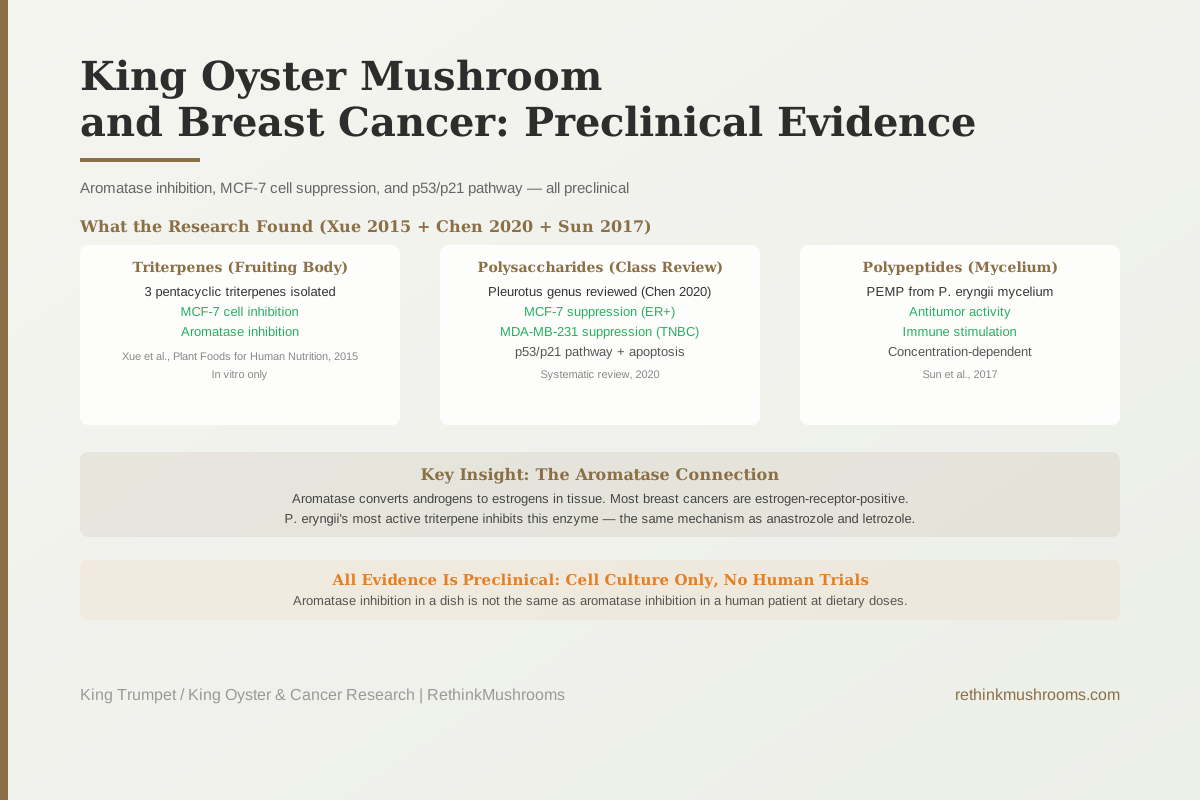
Xue and colleagues (2015) isolated three pentacyclic triterpenes from Pleurotus eryngii that showed significant inhibitory activity against MCF-7 breast cancer cells in vitro, with the most potent compound reaching an IC50 of 15.71 μM.
Xue et al., Plant Foods for Human Nutrition, 2015
MCF-7 cells
estrogen-receptor-positive breast cancer cell line tested
IC50 15.71 μM
in-vitro potency of the most active triterpene (compound 1)
preclinical only
no human clinical trials on P. eryngii for breast cancer exist
Xue et al., Plant Foods for Human Nutrition, 2015
 View as image ↗
King oyster mushroom (Pleurotus eryngii), also called king trumpet, is primarily known as a culinary mushroom with exceptional texture. The research on its potential role in cancer biology is substantially less discussed, but a 2015 study in Plant Foods for Human Nutrition identified a finding that sits at the intersection of food chemistry and breast cancer biology: three triterpene compounds isolated from P. eryngii showed significant inhibitory activity against MCF-7 breast cancer cells in culture, the standard laboratory model for the most common (estrogen-receptor-positive) form of the disease.[1]
This is preclinical research. MCF-7 is a cell line in a laboratory dish, not a human patient. But the finding is mechanistically specific — three defined molecules with measured potencies — and it is almost entirely absent from consumer health content on king oyster mushroom.
For a general introduction to king trumpet mushroom and its health profile, see What Is King Trumpet Mushroom? The Meaty Mushroom with Health Benefits.
Key Takeaways
- Xue and colleagues (Plant Foods for Human Nutrition, 2015) isolated three pentacyclic triterpenes from Pleurotus eryngii that showed significant inhibitory activity against MCF-7 breast cancer cells in vitro; the most potent (compound 1) had an IC50 of 15.71 μM, followed by compound 2 (48 μM) and lupeol (66.89 μM)
- Aromatase inhibition is a clinically validated breast cancer mechanism (the basis for the drugs anastrozole and letrozole), and some edible mushrooms show it — white button mushroom extract inhibited aromatase in a 2001 study (Grube et al.) — but P. eryngii's triterpenes were tested only for direct MCF-7 growth inhibition, not for aromatase activity
- A 2020 review (Wong et al.) cataloguing mushrooms with anti-breast-cancer activity lists Pleurotus species (among them king oyster mushroom) among fungi with documented preclinical activity, while noting that human clinical-trial evidence exists for several other mushroom genera but not for Pleurotus
- Sun and colleagues (2017) found that a polypeptide from P. eryngii mycelium (PEMP) showed concentration-dependent antitumor and immune-stimulating activity, adding a protein-derived mechanism to the triterpene findings
- All evidence is preclinical: no human clinical trials have tested king oyster mushroom or its compounds for breast cancer; the MCF-7 inhibition data comes from cell-culture experiments, not from human subjects or animal tumor models
- P. eryngii is one of the richest dietary sources of ergothioneine, an antioxidant amino acid that has been linked to reduced cancer risk in population studies, providing additional context for why dietary consumption may have cancer-adjacent benefits
What the Research Found: Three Triterpenes With Anti-Breast Cancer Activity
Xue and colleagues published a 2015 study in Plant Foods for Human Nutrition that began with an unusual approach: rather than testing polysaccharide extracts (the most common focus in mushroom cancer research), they isolated the acetic ether fraction of P. eryngii, which concentrates fat-soluble compounds, and separated out individual triterpene molecules.
Three pentacyclic triterpenes (compounds with a specific five-ring carbon skeleton) were identified by NMR and mass spectrometry and tested against MCF-7 breast cancer cells in culture. All three showed significant growth inhibitory activity compared to untreated controls. The most active, compound 1 (a tetrahydroxy ursane-type acid), had an IC50 of 15.71 μM; compound 2 followed at 48 μM, and the third compound — lupeol, a widely studied plant and mushroom triterpene — at 66.89 μM.[1]
MCF-7 is an estrogen-receptor-positive human breast cancer cell line, the standard laboratory model for testing compounds relevant to the most common form of breast cancer. It is responsive to estrogen, meaning treatments that reduce estrogen signaling (like aromatase inhibitors) are effective against it. The Xue study measured direct growth inhibition of these cells — not the specific molecular pathway responsible for it.
Xue et al. (2015) · Plant Foods for Human Nutrition
- Population
- MCF-7 estrogen-receptor-positive human breast cancer cell line (in vitro)
- Intervention
- Three purified pentacyclic triterpenes from the P. eryngii acetic-ether fraction
- Comparator
- Untreated control cells
- Finding
- All three triterpenes significantly inhibited MCF-7 growth. Compound 1 (a tetrahydroxy ursane-type acid) was most potent at IC50 15.71 μM, followed by compound 2 (48 μM) and lupeol (66.89 μM). The study did not test aromatase activity.
preliminary A clean in-vitro potency result on isolated molecules — not evidence that eating the mushroom reaches these concentrations in human breast tissue.
Xue et al., Plant Foods for Human Nutrition, 2015
The Aromatase Question: Studied in Other Mushrooms, Not Yet in King Oyster
Because MCF-7 is an estrogen-driven cell line, it is tempting to assume that any mushroom compound inhibiting it must be acting on estrogen — specifically on aromatase, the enzyme that produces estrogen in tissue. That assumption is worth examining carefully, because it is where a lot of consumer content on king oyster mushroom goes wrong.
To understand why aromatase matters at all: approximately 70 to 75 percent of breast cancers express estrogen receptors. The cancer cells use estrogen as a growth signal. Drugs that block this signal work in two ways: selective estrogen receptor modulators (like tamoxifen) block the receptor directly, while aromatase inhibitors (anastrozole, letrozole, exemestane) reduce the estrogen supply by blocking the enzyme that produces it. Aromatase inhibitors are among the most important drugs in hormone-receptor-positive breast cancer treatment.
Some edible mushrooms genuinely do inhibit aromatase. The clearest example is white button mushroom (Agaricus bisporus): a 2001 study by Grube and colleagues found that white button mushroom phytochemicals inhibited aromatase activity and suppressed breast cancer cell proliferation.[4] That finding is real, and it is often cited as the basis for the broader idea that mushrooms can be "anti-estrogenic."
The critical point for king oyster mushroom specifically: the Xue 2015 study did not test aromatase. Its triterpenes were assayed only for direct inhibition of MCF-7 cell growth, and no other published study has demonstrated aromatase inhibition by any P. eryngii compound. The aromatase mechanism belongs to a different mushroom. Extending it to king oyster mushroom is an inference, not a finding — and it is the single most common overstatement in consumer content on this topic.
Fact Check
Does king oyster mushroom inhibit aromatase like a breast cancer drug?
The claim
“King oyster mushroom inhibits aromatase, the same enzyme blocked by breast cancer drugs such as anastrozole and letrozole.”
A widely repeated claim that conflates king oyster mushroom's MCF-7 cell-inhibition data with the aromatase-inhibition findings reported for a different mushroom species.
What research shows
UnsupportedThe 2015 Xue study tested three P. eryngii triterpenes only for direct inhibition of MCF-7 cell growth (IC50 15.71 to 66.89 μM). It did not measure aromatase activity, and no published study shows any king oyster mushroom compound inhibiting aromatase.
Aromatase inhibition HAS been demonstrated for white button mushroom (Agaricus bisporus) extract by Grube and colleagues in 2001 — so the mushroom-aromatase link is real for that species, but it has not been extended to king oyster mushroom.
Xue et al., 2015 (PMID 26089128); Grube et al., 2001 (PMID 11739882)
The 2020 Review: Where King Oyster Fits Among Anti-Cancer Mushrooms
Wong and colleagues published a 2020 review in Applied Microbiology and Biotechnology cataloguing mushrooms with suppressive action on breast cancer, drawn from studies using cultured cancer cells, tumor-bearing animals, and clinical trials.[2]
King oyster mushroom (Pleurotus eryngii) appears in this review alongside oyster mushroom (P. ostreatus) and abalone mushroom (P. abalonus) among the Pleurotus species documented to have activity against breast cancer cells in preclinical models. That places king oyster mushroom within a broad and well-populated field of edible and medicinal fungi being studied for cancer-relevant effects.
Just as important is where P. eryngii does not appear. The review reserves its strongest category — antineoplastic effectiveness demonstrated in human clinical trials — for other genera: Antrodia camphorata, Cordyceps, Coriolus versicolor (turkey tail), Ganoderma lucidum (reishi), Grifola frondosa (maitake), and Lentinula edodes (shiitake). Pleurotus is not among them. In other words, the review situates king oyster mushroom firmly on the preclinical side of the evidence line.
The two cell lines most often used in this research are worth distinguishing. MCF-7 is estrogen-receptor-positive and models the most common, hormone-responsive form of breast cancer. MDA-MB-231 is triple-negative — it lacks estrogen, progesterone, and HER2 receptors — and models a harder-to-treat form that does not respond to hormone-targeted therapies. Across the mushroom-cancer literature, Pleurotus polysaccharides and protein extracts have been reported to act on both, often through apoptosis-related pathways (the controlled self-destruction of cancer cells). Activity against triple-negative cells is notable precisely because it cannot be explained by estrogen or aromatase, pointing to mechanisms independent of hormone signaling.
The Mycelium Angle: Polypeptides With Antitumor Activity
Most king oyster mushroom research focuses on the fruiting body (the visible mushroom). Sun and colleagues extended the picture in 2017 by testing a polypeptide (a small protein) from P. eryngii mycelium, which they called PEMP.[3]
PEMP showed concentration-dependent antitumor activity in cell culture (against breast, cervical, and stomach cancer cells) and also stimulated immune responses — increasing macrophage activity, TNF-α and IL-6 secretion, and TLR2 and TLR4 expression. The immune stimulation finding is relevant because cancer progression is partly a failure of immune surveillance: cancer cells evade detection by the immune system. Compounds that both directly inhibit cancer cells and activate immune cells against them work on two complementary fronts.
The mycelium origin of PEMP is practically relevant for supplement consumers: products made from P. eryngii mycelium (rather than fruiting body) may contain this polypeptide class even if fruiting-body-specific compounds like the Xue 2015 triterpenes are present in lower concentrations.
What the Evidence Does and Doesn't Say
The research on king oyster mushroom and breast cancer is early-stage preclinical work. Here is an honest accounting of what it establishes and what it does not.
What it establishes:
- Three specific triterpene compounds from P. eryngii fruiting body inhibit MCF-7 breast cancer cell growth in culture, the most potent (compound 1) at an IC50 of 15.71 μM
- Pleurotus species broadly (the genus containing king oyster mushroom) show activity against both ER-positive and triple-negative breast cancer cell lines in preclinical models
- P. eryngii mycelium contains a polypeptide (PEMP) with antitumor and immune-stimulating activity in cell culture
What it does not establish:
- That eating king oyster mushrooms prevents or treats breast cancer in humans
- That any P. eryngii compound inhibits aromatase (this has not been tested)
- That the compounds reach breast tissue at meaningful concentrations after digestion, or that the in-vitro concentrations required for effect are achievable through dietary intake
- Any evidence of effect in human patients
These are standard limitations of preclinical research. They do not mean the research is not worth knowing. They mean it represents a mechanistic signal that warrants further investigation, not a clinical recommendation.
For the broader picture of how mushroom compounds affect cancer biology, see How Mushroom Polysaccharides Kill Cancer Cells: Four Distinct Mechanisms and The Evidence for Mushroom-Based Cancer Adjuncts: A Research Review.
King Oyster Mushroom in Context: Ergothioneine and Cancer Risk
Beyond the specific breast cancer research, king oyster mushroom is one of the richest known dietary sources of ergothioneine, an antioxidant amino acid that the human body concentrates in tissues under oxidative stress. Ergothioneine has attracted research attention as a potential cancer-protective compound because oxidative stress is a driver of the DNA damage that initiates cancer.
Population data has associated higher dietary ergothioneine intake with lower cancer risk in some cohorts, though causal evidence is limited. The relevance here is contextual: the overall bioactive profile of king oyster mushroom, including ergothioneine alongside the triterpenes and polysaccharides documented in cancer research, suggests a food with multiple potentially cancer-relevant mechanisms operating in parallel.
For more on ergothioneine and longevity, see King Trumpet for Longevity: The Ergothioneine Connection.
Safety
LowPreclinical evidence is not medical advice
Concern
Cell-culture findings on king oyster mushroom compounds are sometimes presented as if the mushroom can prevent or treat breast cancer.
What the research says
No human clinical trial has tested king oyster mushroom for breast cancer. Nothing in this article should be used to guide the prevention or treatment of breast cancer, or decisions about cancer care.
Particularly relevant for: Anyone with a breast cancer diagnosis or family history, or anyone considering supplements alongside treatment
What to do
Discuss any dietary or supplement changes with your oncology team, particularly during hormone therapy.
Consensus of the preclinical evidence reviewed in this article
The Bottom Line
Three pentacyclic triterpenes isolated from Pleurotus eryngii (king oyster mushroom) by Xue and colleagues in 2015 showed significant inhibitory activity against MCF-7 breast cancer cells in vitro, the most potent at an IC50 of 15.71 μM. A 2020 review (Wong et al.) catalogues P. eryngii among Pleurotus species with preclinical anti-breast-cancer activity while noting that human clinical-trial evidence exists for other mushroom genera but not for Pleurotus. P. eryngii mycelium polypeptides add a protein-derived antitumor and immunostimulatory mechanism (Sun 2017). No P. eryngii compound has been shown to inhibit aromatase — that mechanism has been demonstrated for white button mushroom, not king oyster — and all evidence is preclinical; no human breast cancer trials on king oyster mushroom exist.
Frequently Asked Questions
Sources & References
- 1RTHM-00749·Xue, Zhaohui et al. (2015). “Structure Identification of Triterpene from the Mushroom Pleurotus eryngii with Inhibitory Effects Against Breast Cancer..” Plant foods for human nutrition (Dordrecht.Study breakdown →PubMed →↩
- 2RTHM-00664·Wong, Jack Ho et al. (2020). “Mushroom extracts and compounds with suppressive action on breast cancer: evidence from studies using cultured cancer cells, tumor-bearing animals, and clinical trials..” Applied microbiology and biotechnology.Study breakdown →PubMed →↩
- 3RTHM-00915·Sun, Yanan et al. (2017). “Antioxidant, antitumor and immunostimulatory activities of the polypeptide from Pleurotus eryngii mycelium..” International journal of biological macromolecules.Study breakdown →PubMed →↩
- 4RTHM-00034·Grube, B J et al. (2001). “White button mushroom phytochemicals inhibit aromatase activity and breast cancer cell proliferation..” The Journal of nutrition.Study breakdown →PubMed →↩