Shiitake (Lentinula edodes)
Triple bioactive protein: antifungal, HIV-1 RT inhibitor, antiproliferative, from a single shiitake compound
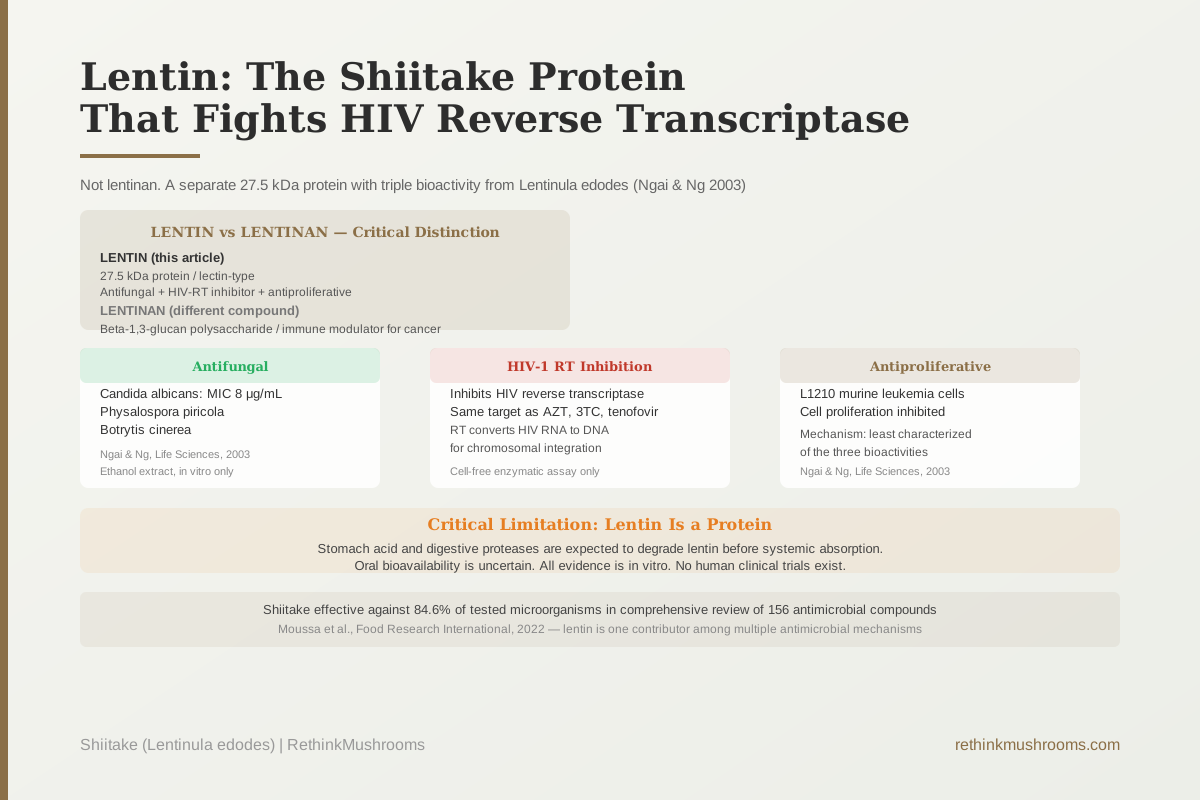
Ngai and Ng (2003) isolated lentin from shiitake fruiting bodies and found it inhibits several fungi, suppresses HIV-1 reverse transcriptase, and blocks leukemia cell proliferation: three distinct activities from a single 27.5 kDa protein.
Ngai & Ng, Life Sciences, 2003
27.5 kDa
molecular weight of lentin: a protein, not a polysaccharide; not the same as lentinan
3 fungi inhibited
lentin blocked mycelial growth of Physalospora piricola, Botrytis cinerea, and Mycosphaerella arachidicola (Ngai & Ng 2003)
in vitro only
no human clinical trials on lentin for HIV, Candida, or cancer have been conducted
Ngai & Ng, Life Sciences, 2003
 View as image ↗
Most people who know anything about shiitake mushroom know it for two things: its culinary value and lentinan, a beta-glucan polysaccharide studied for immune modulation in cancer contexts. The compound this article covers is different from lentinan in every meaningful way. It is a protein, not a polysaccharide. It was isolated from the fruiting body, not the mycelium. And its documented bioactivities include inhibiting the enzyme HIV needs to replicate inside human cells.
Lentin is not a household name even in medicinal mushroom circles. The research behind it is limited to a small number of studies, with the foundational work published by Ngai and Ng in 2003. What those studies found is worth knowing about, precisely because it represents the kind of compound that gets missed when discussions of shiitake focus only on beta-glucans.
For a broader introduction to shiitake mushroom and its health properties, see What Is Shiitake Mushroom? The Culinary Mushroom with Medicinal Power.
Key Takeaways
- Ngai and Ng (Life Sciences, 2003) isolated lentin from Lentinula edodes (shiitake) fruiting bodies: a 27.5 kDa novel lectin/protein distinct from lentinan (a beta-glucan polysaccharide), with three independent bioactivities: antifungal, HIV-1 reverse transcriptase inhibitory, and antiproliferative against leukemia cells
- Lentin inhibited mycelial growth in multiple fungal species — Physalospora piricola, Botrytis cinerea, and Mycosphaerella arachidicola — in the Ngai and Ng characterization; the study did not test the human yeast Candida albicans, and shiitake's documented anti-Candida activity comes from a separate compound (the aroma molecule lenthionine), not from lentin
- Lentin inhibited HIV-1 reverse transcriptase in vitro; reverse transcriptase is the viral enzyme HIV uses to convert its RNA genome into DNA so it can integrate into human cells, and is the same target as approved antiretroviral drugs including zidovudine (AZT)
- Shiitake sits within a broad documented antimicrobial profile: Hearst and colleagues (2009) found aqueous shiitake extract inhibited 85% of the microorganisms it was tested against (including 50% of yeasts and moulds), and Moussa and colleagues (2022) catalogued 156 antimicrobial compounds and 100+ extracts from edible mushrooms in a comprehensive review — lentin is one contributor within that larger profile
- All evidence is in vitro: lentin has not been tested in any human clinical trial for HIV, Candida infection, or cancer; it is not a treatment for any of these conditions
- A significant pharmacological limitation: lentin is a protein and may be degraded by stomach acid and digestive proteases when taken orally; this means oral bioavailability is uncertain and likely limited without specific formulation strategies
What Is Lentin? A Definition for Readers Who Know Lentinan
Lentin is a 27.5 kDa lectin-type protein isolated from the fruiting bodies of Lentinula edodes (shiitake mushroom). It is not the same as lentinan. This distinction is important enough to make clearly before anything else.
Lentinan is a polysaccharide: a long chain of sugar molecules (specifically a beta-1,3-glucan with beta-1,6-glucan branch points) that modulates immune function through interactions with gut immune receptors and has been researched as an adjuvant in cancer treatment in Japan. Lentinan is not a protein; it has no direct antiviral or antifungal activity.
Lentin is a protein: a folded chain of amino acids with a specific molecular weight (27.5 kDa) and specific three-dimensional structure. It belongs to the lectin protein class, meaning it has carbohydrate-binding properties. It inhibits the growth of fungi directly. It inhibits a viral enzyme. It blocks cancer cell proliferation.
These are not the same compound. The similar names cause frequent confusion in consumer health content, including on reputable medical information sites. The foundational distinction: lentinan is the immune-modulating beta-glucan; lentin is the antifungal, antiviral, anticancer protein.
For the lentinan side of the picture, see How Lentinan Enhances Anti-Tumor Immunity.
Fact Check
Lentin is not lentinan
The claim
“Lentin and lentinan are the same shiitake compound, just spelled two ways.”
The near-identical names get used interchangeably across consumer health content and even some medical information sites.
What research shows
MisleadingThey are chemically unrelated. Lentinan is a beta-1,3/1,6-glucan polysaccharide (a branched sugar chain) studied as an immune-modulating cancer adjuvant. Lentin is a 27.5 kDa lectin-type protein with antifungal, HIV-1 reverse transcriptase inhibitory, and antiproliferative activity.
Different molecular class, different structure, different mechanism, different documented uses. Conflating the two misattributes lentinan's clinical oncology evidence to lentin — a protein that has never been tested in a human being.
Ngai & Ng, Life Sciences, 2003 (lentin); lentinan pharmacology literature
The 2003 Discovery: What Ngai and Ng Found
Ngai and Ng published the isolation and characterization of lentin in Life Sciences in 2003.[1] The study began with a standard biochemical approach: extracting protein fractions from fresh shiitake fruiting bodies, then running them through a series of purification steps (ammonium sulfate precipitation, ion exchange chromatography, gel filtration) to isolate individual proteins.
What emerged from the purification was a novel protein with a molecular weight of 27.5 kDa and properties that had not been reported in shiitake before. The protein, which they named lentin, showed three independent bioactivities when tested:
Antifungal activity: Lentin inhibited the mycelial growth of multiple fungal species in culture: Physalospora piricola (a plant pathogen), Botrytis cinerea (the gray mold that affects wine grapes and strawberries), and Mycosphaerella arachidicola (a peanut pathogen). Those are the three species the paper reported. Worth stating plainly, because consumer content frequently gets this wrong: the human yeast pathogen Candida albicans was not among the organisms Ngai and Ng tested against lentin. Shiitake's documented anti-Candida activity is attributed to a different compound — the aroma molecule lenthionine, discussed below — not to lentin.
HIV-1 reverse transcriptase inhibition: Lentin inhibited the activity of HIV-1 reverse transcriptase (RT) in a cell-free enzymatic assay. This is a biochemical assay measuring enzyme activity, not an assay measuring HIV replication in living cells, but it demonstrates direct interaction between lentin and the viral enzyme.
Antiproliferative against leukemia cells: Lentin inhibited the proliferation of L1210 murine leukemia cells in culture. The leukemia cell inhibition adds a third mode of action to a compound that is already unusual for having two.
The triple bioactivity from a single protein is what makes lentin scientifically notable. Most natural compounds show activity in one primary area. A protein that inhibits fungi, inhibits a viral enzyme, and inhibits cancer cell growth through what appear to be distinct mechanisms represents an unusual compound profile.
Ngai & Ng (2003) · Life Sciences
- Population
- Lentin protein purified from fresh Lentinula edodes (shiitake) fruiting bodies
- Intervention
- Purified lentin applied in cell-free enzyme assays and fungal / leukemia cell cultures
- Comparator
- Untreated culture and enzyme controls
- Finding
- A single 27.5 kDa lectin-type protein showed three independent activities: it inhibited mycelial growth of Physalospora piricola, Botrytis cinerea, and Mycosphaerella arachidicola; it inhibited HIV-1 reverse transcriptase; and it inhibited leukemia cell proliferation.
preliminary Every result is in vitro. No animal or human study of lentin has followed in the two decades since.
Ngai PHK, Ng TB. Life Sciences. 2003;73(26):3363-74.
What HIV Reverse Transcriptase Is and Why Inhibiting It Matters
Understanding why lentin's HIV-1 RT inhibitory activity is interesting requires a basic explanation of what reverse transcriptase does in the HIV life cycle.
HIV is a retrovirus: its genetic material is stored as RNA rather than DNA. When HIV infects a cell, it needs to convert its RNA genome into DNA so that the viral DNA can be inserted into the host cell's chromosomes. Once integrated, the viral DNA persists permanently and uses the cell's own machinery to produce new virus particles.
Reverse transcriptase is the enzyme that performs the RNA-to-DNA conversion. Without functional RT, HIV cannot integrate into host cells and cannot replicate. This is why RT is a major drug target: approved antiretroviral drugs including zidovudine (AZT, the first approved HIV drug), lamivudine (3TC), and tenofovir all work by inhibiting reverse transcriptase.
Inhibiting RT in a test tube is not the same as treating HIV infection. But finding that a compound from an edible mushroom can suppress the activity of this specific viral enzyme is a meaningful mechanistic signal. It establishes that lentin interacts with the RT enzyme at a molecular level, not that shiitake mushrooms treat HIV infection.
The Antifungal Mechanism: Where Lentin Fits in Shiitake's Antifungal Profile
Shiitake mushroom contains multiple compounds with antifungal activity. Understanding where lentin fits requires knowing the other major player: lenthionine.
Lenthionine (1,2,3,5,6-pentathiepane) is the volatile sulfur compound responsible for shiitake's distinctive aroma. Kupcova and colleagues (2018) reported that lenthionine inhibits yeasts and fungi — including Candida albicans — at minimum inhibitory concentrations of 2-8 μg/mL, concentrations they noted are comparable to standard pharmaceutical antifungal agents.[3] This is where shiitake's anti-Candida activity actually resides: in lenthionine, not in lentin. The critical difference: lenthionine is heat-labile and volatile. High-heat cooking destroys it. The stronger the shiitake aroma, the more lenthionine is present; cooking reduces that aroma compound along with its antifungal activity.
Lentin, as a protein, has different stability characteristics. Proteins can be heat-denatured at cooking temperatures, but they are not volatile. The practical extraction implications differ: lenthionine requires mild or cold processing to preserve; lentin requires conditions that preserve protein structure.
The breadth of shiitake's antimicrobial activity has been measured directly. Hearst and colleagues (2009) tested aqueous shiitake extract against a panel of 29 bacterial and 10 fungal pathogens and found it inhibited 85% of the organisms tested, including 50% of the yeast and mould species — activity that compared favourably to the antibiotic control, ciprofloxacin.[4] Moussa and colleagues (2022) later catalogued 156 antimicrobial compounds and more than 100 extracts from edible mushrooms in a comprehensive review spanning 2015-2022, situating shiitake within a large body of documented antimicrobial mushroom chemistry.[2] This broad effectiveness reflects the multiple compounds contributing to shiitake's antimicrobial profile: lentin, lenthionine, and other phenolic compounds all contribute through distinct mechanisms.
For the Candida-specific and lenthionine angle, see Shiitake and Candida: Antifungal Research. For the broader antimicrobial compound picture, see Shiitake and Antimicrobial Activity: Antibacterial and Antifungal Research.
The Antiproliferative Activity: Leukemia Cell Inhibition
The third bioactivity documented for lentin is inhibition of murine leukemia cell proliferation. Ngai and Ng (2003) tested lentin against L1210 cells, a standard mouse leukemia cell line used in anticancer compound screening.[1]
Cell line screening results of this type are a first-pass test for anticancer compounds. They establish whether a compound has any direct effect on cancer cell survival and growth. A positive result (inhibition of cancer cell proliferation) justifies further research; it does not establish clinical efficacy for cancer treatment.
For lentin, the leukemia cell inhibition is the least-studied of its three bioactivities. The original 2003 characterization demonstrated the activity; subsequent research focused more heavily on the antifungal mechanisms. Whether lentin's antiproliferative mechanism resembles its antifungal mechanism or operates through a different molecular pathway has not been extensively characterized.
Where Lentin Is Found: Fruiting Body vs. Mycelium
Ngai and Ng isolated lentin from fresh shiitake fruiting bodies, not from mycelium. This detail matters for understanding which supplement forms are likely to contain it.
Most commercially available shiitake supplements use one of two primary sources: fruiting body (the mature mushroom cap and stem) or mycelium (the vegetative network). Products described as "full-spectrum" or "dual extract" may combine both.
The research base for lentin is from fruiting body extractions. Mycelium-on-grain products (mycelium grown on substrate that is then dried and powdered with the grain included) have different compound profiles from fruiting body products. Whether lentin is present in mycelium at comparable concentrations to fruiting body has not been directly characterized in the published literature.
The extraction method is also relevant. Lentin is a protein, which means hot water extraction (the most common commercial method used for beta-glucan products) may yield it. However, protein stability during prolonged extraction and drying is variable. Ethanol extraction (used more often for phenolic and lipophilic compounds) would capture different compound fractions.
The Oral Bioavailability Problem
This is the critical limitation that must be stated clearly: lentin is a protein.
Proteins face a specific challenge when taken orally. The stomach produces hydrochloric acid and pepsin (a protease enzyme) specifically to break down dietary proteins into amino acids for absorption. This process is highly effective at digesting proteins and is the reason you can absorb amino acids from meat and legumes: the proteins are broken down completely before absorption.
The same process that allows dietary protein digestion would be expected to degrade lentin in the stomach and small intestine before it could reach systemic circulation intact. An orally consumed lentin molecule would likely arrive at the blood as individual amino acids, losing the specific three-dimensional structure that confers its antifungal, antiviral, and antiproliferative activities.
Some proteins survive oral administration intact in small fractions (this is the basis for oral tolerance research), and some proteins appear to have systemic effects when delivered via food (the enoki mushroom FIP proteins show some oral activity in animal models). But oral bioavailability for lentin specifically has not been characterized.
This means the in vitro evidence for lentin's bioactivities does not translate to a straightforward recommendation for oral shiitake supplementation to achieve antifungal or antiviral effects via lentin. The protein may be active in extracts applied directly to surfaces (topical antifungal applications, for example) where gastric acid is not a factor. Systemic oral delivery faces significant bioavailability barriers.
The Protein Delivery Problem
Why Lentin's Lab Activity May Not Survive Being Swallowed
Every documented lentin activity depends on its intact 27.5 kDa folded structure. Follow the two routes: swallowed, the protein is digested into amino acids and loses that structure; applied directly, the fold — and its activity — can be preserved. This is the single biggest barrier between the test-tube findings and any real-world use.
Digested before it can act
Swallowed lentin meets the same machinery that digests dietary protein: hydrochloric acid and pepsin in the stomach, then proteases in the small intestine. These break the protein into individual amino acids. The specific 27.5 kDa fold that confers its antifungal, anti-HIV-RT, and antiproliferative activity is destroyed before absorption, so intact lentin reaching the bloodstream is uncertain and likely minimal.
Structure can be preserved
Applied directly to a surface rather than swallowed, lentin never passes through gastric acid or intestinal proteases. Its folded structure — and therefore its in vitro activity — can remain intact. This is why the laboratory findings are most readily relevant to direct-contact settings, not to systemic effects from eating shiitake.
Lentin's protein nature and its three documented activities come from a single in vitro characterization (Ngai & Ng 2003). Oral bioavailability of intact lentin has not been measured in any study; the digestion pathway shown reflects standard protein physiology, not a lentin-specific pharmacokinetic result. This is a mechanism map, not an efficacy or dosing claim.
Mechanism synthesis; protein facts from ref [1] (see references)
What the Evidence Does and Doesn't Say
What the Ngai & Ng 2003 study establishes:
- A 27.5 kDa protein with lectin properties can be isolated from shiitake fruiting bodies
- This protein, lentin, inhibits the mycelial growth of multiple fungal species in culture (Physalospora piricola, Botrytis cinerea, Mycosphaerella arachidicola)
- Lentin inhibits HIV-1 reverse transcriptase enzymatic activity in a cell-free assay
- Lentin inhibits leukemia cell proliferation in culture
What the evidence does not establish:
- That oral shiitake supplementation delivers biologically active lentin systemically
- That lentin treats, prevents, or reduces Candida infections in humans
- That shiitake mushroom is an effective antiviral treatment against HIV or any other virus in clinical settings
- That lentin has anticancer activity in living organisms beyond cell culture
- Any dose-response relationship for human subjects
Where lentin fits in the broader shiitake story:
- Lentin contributes to shiitake's documented antimicrobial profile alongside lenthionine and other compounds
- Shiitake's measured antimicrobial breadth — 85% of tested organisms inhibited in Hearst 2009 — reflects the combined action of multiple compounds, including but not limited to lentin
The honest framing: lentin is a pharmacologically interesting compound from an edible mushroom, with well-documented bioactivities in laboratory conditions, facing real-world delivery challenges that limit its clinical translation. The research establishes proof-of-concept, not clinical efficacy.
Medical Context
CriticalLentin is not a treatment for HIV, Candida, or cancer
Concern
Lentin's antifungal, anti-HIV-enzyme, and anti-leukemia activities have only ever been shown in laboratory assays. Treating shiitake or a mushroom-protein supplement as a therapy for HIV infection, a fungal infection, or cancer is not supported by any clinical evidence and could lead someone to delay or forgo effective medical treatment.
What the research says
HIV, invasive fungal infections, and cancer require diagnosis and management by a qualified clinician using proven therapies. Lentin has never been tested in a human trial for any condition, and this article is not medical advice.
Particularly relevant for: Anyone considering shiitake or mushroom-protein products for an infectious or oncologic condition
What to do
Discuss any complementary mushroom use with your physician, and do not substitute it for prescribed antiretroviral, antifungal, or oncology care.
Ngai & Ng, Life Sciences, 2003 (in vitro scope); no clinical trials of lentin exist
The Bottom Line
Lentin is a 27.5 kDa protein isolated from shiitake fruiting bodies by Ngai and Ng (2003), distinct from lentinan (the beta-glucan polysaccharide). It shows three independent in vitro bioactivities: antifungal (against Physalospora piricola, Botrytis cinerea, and Mycosphaerella arachidicola), HIV-1 reverse transcriptase inhibition, and antiproliferative activity against leukemia cells. Shiitake's broader anti-Candida activity comes from lenthionine, not lentin (Kupcova 2018), and Hearst 2009 measured shiitake extract inhibiting 85% of tested organisms. No human clinical trials exist for lentin. As a protein, lentin likely faces significant oral bioavailability limitations from gastric digestion.
Frequently Asked Questions
Sources & References
- 1RTHM-00116·Ngai, Patrick H K et al. (2003). “Lentin, a novel and potent antifungal protein from shitake mushroom with inhibitory effects on activity of human immunodeficiency virus-1 reverse transcriptase and proliferation of leukemia cells..” Life sciences.Study breakdown →PubMed →↩
- 2RTHM-01587·Moussa, Ashaimaa Y et al. (2022). “New insights into antimicrobial and antibiofilm effects of edible mushrooms..” Food research international (Ottawa.Study breakdown →PubMed →↩
- 3RTHM-00969·Kupcova, Kristyna et al. (2018). “Antimicrobial, Cytotoxic, Anti-Inflammatory, and Antioxidant Activity of Culinary Processed Shiitake Medicinal Mushroom (Lentinus edodes, Agaricomycetes) and Its Major Sulfur Sensory-Active Compound-Lenthionine..” International journal of medicinal mushrooms.Study breakdown →PubMed →↩
- 4RTHM-00294·Hearst, Rachel et al. (2009). “An examination of antibacterial and antifungal properties of constituents of Shiitake (Lentinula edodes) and oyster (Pleurotus ostreatus) mushrooms..” Complementary therapies in clinical practice.Study breakdown →PubMed →↩