Lion's Mane and Cancer
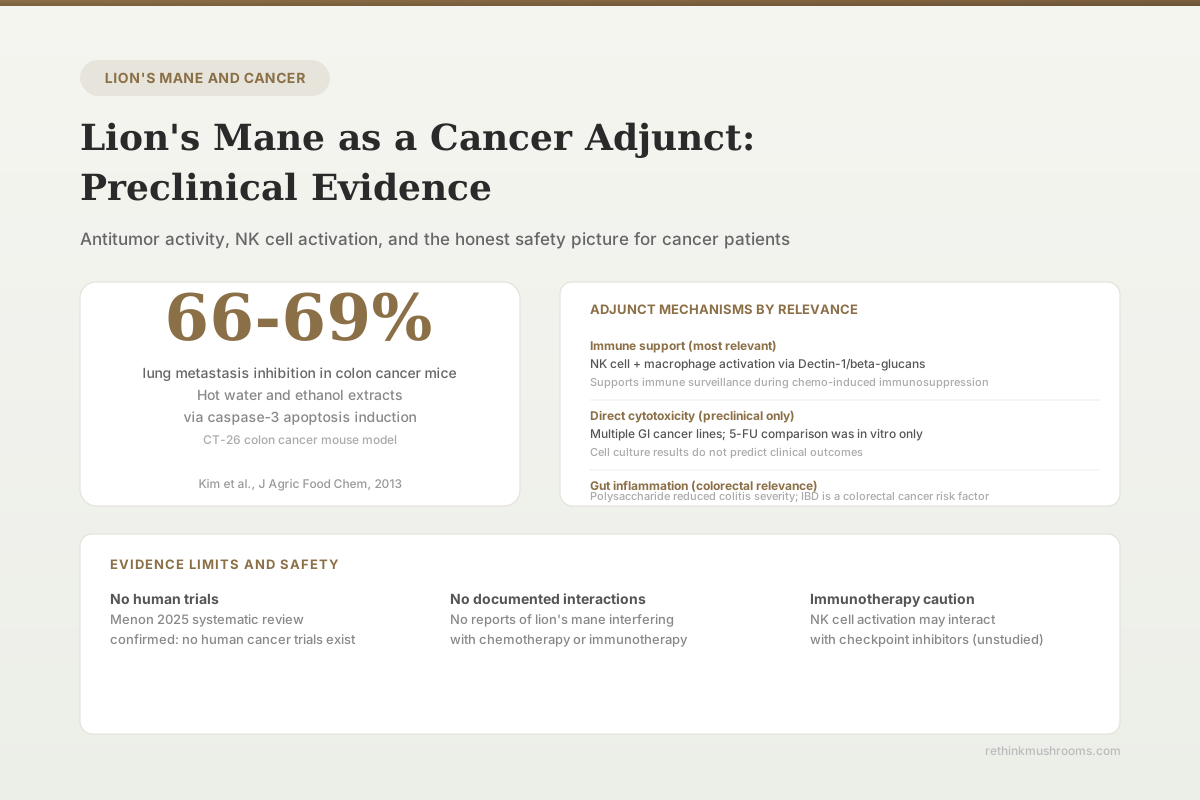
66-69% metastasis inhibition
Lion's mane hot water and ethanol extracts inhibited lung metastasis of colon cancer cells by 66% and 69% respectively in a mouse model, via apoptosis and suppression of MMP-2/MMP-9 invasion enzymes.
Kim et al., J Agric Food Chem, 2013
No human trials
adjunct evidence is entirely preclinical (Menon 2025 systematic review)
NK cell activation
polysaccharides stimulate natural killer cells and macrophages (He 2017)
No known interactions
no reports of lion's mane interfering with chemotherapy agents
Kim et al., J Agric Food Chem, 2013
 View as image ↗
When someone with cancer asks about lion's mane, they are usually not asking whether it cures cancer. They are asking a more specific and more practical question: is it safe to take alongside chemotherapy, and might it help? This is the adjunct question, and it is different from the question of whether lion's mane can treat or prevent cancer.
A cancer adjunct is something used alongside standard medical treatment, not in place of it. Evaluating lion's mane as a cancer adjunct requires looking at three things: what preclinical evidence suggests it might contribute, what mechanisms are most relevant to adjunct use specifically, and what is honestly known about safety during cancer treatment.
The direct answer is that the evidence is entirely preclinical. A 2025 systematic review confirmed anticancer effects in laboratory and animal studies across multiple cancer types, but found no human clinical trials.[1] No human adjunct trial exists. What follows is an honest account of what the preclinical evidence shows, where its limits are, and what a person with cancer should know before drawing conclusions.
For the broader overview of lion's mane research across applications, see What Is Lion's Mane Mushroom? A Science-Based Overview.
Key Takeaways
- No human clinical trials have tested lion's mane alongside any cancer treatment; all evidence is preclinical (Menon et al., 2025 systematic review)
- Lion's mane hot water and microwaved-ethanol extracts inhibited lung metastasis of colon cancer cells by 66% and 69% in mice with CT-26 colon cancer; the extracts triggered apoptosis and suppressed the invasion enzymes MMP-2 and MMP-9 (Kim et al., 2013)
- Li 2014 found Hericium erinaceus extracts showed concentration-dependent cytotoxicity against liver (HepG2, Huh-7), colon (HT-29), and gastric (NCI-87) cancer cell lines; in mouse tumor xenografts the extracts were more effective and less toxic than the chemotherapy drug 5-FU (important context: this was cell-culture and animal data, not a human clinical comparison)
- Lion's mane polysaccharides stimulate natural killer (NK) cells and macrophages, immune cells that kill cancer cells directly; this immune support mechanism is most relevant to adjunct use (He et al., 2017)
- Hericium polysaccharide reduced colitis severity and gut inflammation, relevant for colorectal cancer patients with inflammatory bowel disease as a risk factor (Ren et al., 2018)
- No documented drug interactions between lion's mane and chemotherapy agents exist in published trials, but the absence of documented interactions is not the same as confirmed safety
What "Cancer Adjunct" Means and Why the Question Is Distinct
Adjunct therapy means something used alongside the primary treatment rather than instead of it. In oncology, patients often ask about supplements during treatment because they want to support their body, maintain immune function that chemotherapy suppresses, and reduce treatment side effects. This is a different goal from "treating cancer," and it requires a different kind of evidence.
The most relevant evidence for adjunct use is not necessarily direct cancer cell killing but rather: does the compound support immune function during the period when conventional treatment is suppressing it? Does it reduce inflammation that might accelerate cancer progression? Does it avoid interfering with the mechanism of chemotherapy or immunotherapy?
For lion's mane, the preclinical evidence spans several of these questions, though not definitively for any of them. The 2025 Menon systematic review of Hericium erinaceus as a supplement covered five RCTs, fifteen laboratory studies, three pilot clinical trials, and one cohort study, confirming anticancer effects in vitro and in vivo but finding no human cancer trials.[1]
The Direct Antitumor Evidence and Its Limits
The most compelling preclinical antitumor result for lion's mane is Kim and colleagues' 2013 animal study.[2] Mice were treated with lion's mane hot water extract or a microwaved 50% ethanol extract, with CT-26 colon carcinoma cells used to track migration to the lungs. The hot water extract reduced lung metastasis, the spread of cancer cells from the primary tumor to the lungs, by 66%. The ethanol extract reduced it by 69%. Mechanistically, the extracts triggered cancer cell death through apoptosis (programmed cell death) and reduced the expression and activity of matrix metalloproteinases MMP-2 and MMP-9, enzymes that break down the surrounding tissue matrix to let cancer cells invade and spread. The extracts also dampened the ERK, JNK, and p38 MAPK signaling that drives those invasion enzymes.
This is a striking result. But the important context is what was tested versus what a supplement user would take. The Kim 2013 study used standardized extracts administered under controlled conditions to mice; the dose, route of administration, and exact extract composition are not equivalent to a commercial oral supplement. Animal models of cancer are useful for understanding mechanisms, but they frequently do not predict clinical outcomes in humans.
Li and colleagues in 2014 tested two Hericium erinaceus culture-broth extracts (designated HTJ5 and HTJ5A) against several human gastrointestinal cancer cell lines in culture and in xenograft models, where human cancer cells are implanted in mice.[3] The extracts showed concentration-dependent cytotoxicity against liver cancer cells (HepG2 and Huh-7), colon cancer cells (HT-29), and gastric cancer cells (NCI-87). In the mouse xenograft models, the researchers reported that the extracts were more effective at inhibiting tumor growth, and less toxic to the animals, than 5-fluorouracil (5-FU), a standard chemotherapy drug.
The comparison to 5-FU is frequently cited in popular coverage of lion's mane and cancer, and it deserves careful framing. The comparison was made in mice carrying implanted human tumors, treated with oral extract doses of 500 to 1000 mg/kg/day. Animal xenograft results tell you whether an extract can slow tumor growth in that controlled model. They do not tell you whether an oral supplement at a human-realistic dose will reach cancer tissue in equivalent concentrations in a person, navigate absorption and metabolism, and replicate those effects. The authors themselves framed the synergy with chemotherapy as preliminary and called for further study. Many compounds that outperform chemotherapy drugs in animal models fail in human clinical trials. The Li 2014 result is genuinely interesting preclinical data, but it is not a clinical comparison.
- Cell & mechanistic studiescompleted
Concentration-dependent cytotoxicity against liver, colon, and gastric cancer cell lines (Li 2014); polysaccharide activation of NK cells and macrophages via Dectin-1 (He 2017)
- Animal modelscompleted
66-69% lung metastasis inhibition in CT-26 colon cancer mice (Kim 2013); tumor-growth inhibition in GI cancer xenografts (Li 2014); colitis attenuation in mice (Ren 2018)
- Human pilot / adjunct trialsmissing
No clinical trial has tested lion's mane alongside any cancer treatment for safety or efficacy
- Randomized controlled trial in cancer patientsmissing
None exists
- Meta-analysis of cancer outcomesmissing
Not possible without human trials
The evidence is entirely preclinical and stops at animal models. Mechanistic and animal data are genuinely supportive of biological plausibility, but the entire human evidence base — the part that would tell a cancer patient whether it is safe and helpful during treatment — is empty. The 2025 Menon systematic review confirmed no human cancer trials exist.
Synthesis of references [1]–[6] cited in this article
The Immune Support Pathway: Most Relevant for Adjunct Use
The mechanism that is most directly relevant to adjunct use is not direct cancer cell killing but immune modulation.
He and colleagues' 2017 review of Hericium polysaccharide structures and biological activities identified immune stimulation as a primary mechanism of the polysaccharide fraction.[4] Specifically, Hericium polysaccharides activate two types of immune cells: macrophages and natural killer (NK) cells. Macrophages are large immune cells that engulf and destroy abnormal cells, including cancer cells. NK cells are immune cells that kill tumor cells on direct contact without needing prior exposure or priming by antigens.
This immune stimulation occurs through a receptor called Dectin-1, which sits on the surface of macrophages and NK cells and binds to beta-glucans, the primary polysaccharide type in lion's mane. Beta-glucan stimulation of Dectin-1 activates these immune cells, enhancing their ability to recognize and destroy cancer cells.
The relevance to adjunct use is the immunosuppression problem. Many chemotherapy agents suppress immune function as a side effect, reducing white blood cell counts and impairing NK cell activity. If lion's mane polysaccharides could support NK cell and macrophage function during chemotherapy, they might theoretically help maintain immune surveillance against cancer cells that survive treatment. This is mechanistically plausible but has not been tested in this specific context.
It is worth noting that some immunotherapy drugs for cancer work precisely by activating the immune system to attack cancer cells. Whether lion's mane polysaccharides interact with immunotherapy agents, potentially enhancing or interfering with them, is unknown. For patients on immunotherapy, this is a relevant clinical question that requires discussion with their oncologist.
Gut Inflammation and Colorectal Cancer Risk
Ren and colleagues in 2018 tested Hericium erinaceus polysaccharide in mice with experimentally induced colitis.[5] The polysaccharide reduced colitis severity, attenuated inflammatory signaling through the NF-kB and MAPK pathways, and modified gut microbiota composition toward a healthier bacterial profile.
The relevance to colorectal cancer: inflammatory bowel disease, particularly ulcerative colitis, is a recognized risk factor for colorectal cancer. Chronic gut inflammation creates a pro-carcinogenic environment in the colon. A compound that durably reduces gut inflammation and modifies the microbiota toward a protective composition could theoretically reduce colorectal cancer risk in patients with IBD. This is a prevention argument, not a direct antitumor argument. It is also preclinical only: the Ren 2018 study was in mice, not colorectal cancer patients.
For colorectal cancer patients specifically who have coexisting inflammatory bowel disease, this finding is relevant context. Whether lion's mane would be beneficial or safe alongside colorectal cancer treatment remains outside what the evidence can establish.
Breast Cancer: Cross-Mushroom Evidence
Wong and colleagues' 2020 review covered mushroom extracts and compounds with evidence for breast cancer suppression, including lion's mane, across cultured cancer cells, tumor-bearing animals, and clinical trials.[6] The review identified FIP-Fve, an immunomodulatory protein isolated from lion's mane, and polysaccharide fractions as having preclinical evidence for breast cancer effects. The mechanisms span immune modulation and direct antiproliferative activity.
The breast cancer evidence for lion's mane is less specific than the gastrointestinal cancer evidence. Most of the detailed mechanistic work has been done on colorectal and gastric cancer cell lines, where specific erinacine compounds and polysaccharide fractions have been characterized in multiple studies. For breast cancer, the evidence is at the level of extract effects in cell culture rather than compound-specific mechanistic characterization.
Can Lion's Mane Be Taken with Chemotherapy? The Honest Picture
This is the question most people with cancer are actually asking, and the honest answer has several parts.
Safety
ModerateNo interaction data exists for lion's mane with cancer treatment
Concern
No published trial has tested lion's mane alongside any chemotherapy or immunotherapy agent. Because lion's mane polysaccharides activate immune cells (NK cells and macrophages via Dectin-1), there is a theoretical, unstudied possibility of interaction with checkpoint-inhibitor immunotherapy, which also works by activating immune cells. The absence of documented interactions reflects an absence of studies, not a confirmed safety record.
What the research says
Do not assume safety from the favorable profile seen in healthy supplement users — cancer patients in active treatment have altered physiology, suppressed immunity, and concurrent medications, and that data does not transfer.
Particularly relevant for: Anyone receiving chemotherapy, immunotherapy, radiation, or other active cancer treatment
What to do
Discuss any supplement with your oncologist, who knows your specific protocol, before adding lion's mane. This article is educational and not medical advice.
Menon et al., Frontiers in Nutrition, 2025 (systematic review); He et al., 2017 (immune mechanism)
No interaction studies exist. No published trial has tested lion's mane alongside any specific chemotherapy agent or immunotherapy to assess pharmacokinetic interactions, combined efficacy, or combined toxicity. The absence of documented interactions in the published literature reflects the absence of such studies, not a confirmed safety record.
The general safety profile appears favorable in healthy populations. The Menon 2025 systematic review found a generally favorable safety profile for lion's mane supplementation, with rare GI discomfort as the main reported side effect in trials involving healthy participants.[1] Cancer patients receiving active treatment are a different population with altered physiology, compromised immune systems, and concurrent medication exposure. Safety data from healthy participants cannot be extrapolated to cancer treatment populations.
The immune stimulation question for immunotherapy. Lion's mane polysaccharides activate macrophages and NK cells. Checkpoint inhibitor immunotherapy drugs (PD-1, PD-L1, CTLA-4 inhibitors) also work by activating immune cells against cancer. Whether supplemental immune stimulation from lion's mane would interact with these mechanisms, beneficially or adversely, is genuinely unknown. This is not a documented risk but an unstudied question.
The clearest statement: Lion's mane is not a documented cancer treatment, does not replace standard therapy, and has not been evaluated as an adjunct in any human clinical trial. For anyone receiving cancer treatment, the decision to use any supplement should involve their oncologist, who knows their specific treatment protocol and can assess potential interactions.
For a deeper look at the specific compounds responsible for lion's mane's anticancer mechanisms, see Erinacines: The Compounds That Cross the Blood-Brain Barrier.
What Makes the Adjunct Question Different from the Treatment Question
The treatment question is whether lion's mane can shrink tumors or produce clinical responses in cancer patients. The answer to this is clearly no, based on absence of clinical trials.
The adjunct question is whether, used alongside conventional treatment, lion's mane might support immune function, reduce treatment-related inflammation, or maintain quality of life without interfering with the primary therapy. This is a more nuanced question, and the preclinical evidence provides mechanistic reasons to think some of these effects are possible, particularly through the polysaccharide immune modulation pathway.
The gap between "mechanistic reason to think it might work" and "evidence that it works" in this population is the entire clinical trial space. Until adjunct trials are conducted in cancer patients on standard therapies, the adjunct question remains preclinical.
For the full overview of lion's mane cancer evidence across all cancer types and mechanisms, see Lion's Mane and Cancer: What the Research Shows. For the specific apoptosis mechanisms in greater detail, see Hericium erinaceus and Apoptosis: How It May Fight Cancer Cells.
The Bottom Line
Lion's mane has preclinical evidence for antitumor activity and immune support mechanisms that are conceptually relevant to adjunct cancer use. Animal studies show 66-69% lung metastasis inhibition in colon cancer models; cell studies show cytotoxicity against multiple GI cancer lines; polysaccharides activate NK cells and macrophages relevant to immune surveillance. No human adjunct trial exists, no interaction data with chemotherapy or immunotherapy agents exists, and the 2025 systematic review confirmed no human cancer trials have been conducted. For cancer patients considering lion's mane, the preclinical rationale is mechanistically plausible, and the evidence against its use is also absent, but clinical safety during treatment cannot be confirmed from existing data.
Frequently Asked Questions
Sources & References
- 1RTHM-00943·Menon, Arya et al. (2025). “Benefits, side effects, and uses of Hericium erinaceus as a supplement: a systematic review..” Frontiers in nutrition.Study breakdown →PubMed →↩
- 2RTHM-00532·Kim, Sung Phil et al. (2013). “Hericium erinaceus (Lion's Mane) mushroom extracts inhibit metastasis of cancer cells to the lung in CT-26 colon cancer-tansplanted mice..” Journal of agricultural and food chemistry.Study breakdown →PubMed →↩
- 3RTHM-00614·Li, Guang et al. (2014). “Anticancer potential of Hericium erinaceus extracts against human gastrointestinal cancers..” Journal of ethnopharmacology.Study breakdown →PubMed →↩
- 4RTHM-00472·He, Xirui et al. (2017). “Structures, biological activities, and industrial applications of the polysaccharides from Hericium erinaceus (Lion's Mane) mushroom: A review..” International journal of biological macromolecules.Study breakdown →PubMed →↩
- 5RTHM-00529·Ren, Yilin et al. (2018). “Polysaccharide of Hericium erinaceus attenuates colitis in C57BL/6 mice via regulation of oxidative stress, inflammation-related signaling pathways and modulating the composition of the gut microbiota..” The Journal of nutritional biochemistry.Study breakdown →PubMed →↩
- 6RTHM-00664·Wong, Jack Ho et al. (2020). “Mushroom extracts and compounds with suppressive action on breast cancer: evidence from studies using cultured cancer cells, tumor-bearing animals, and clinical trials..” Applied microbiology and biotechnology.Study breakdown →PubMed →↩