Lion's Mane + Nootropic Stacking
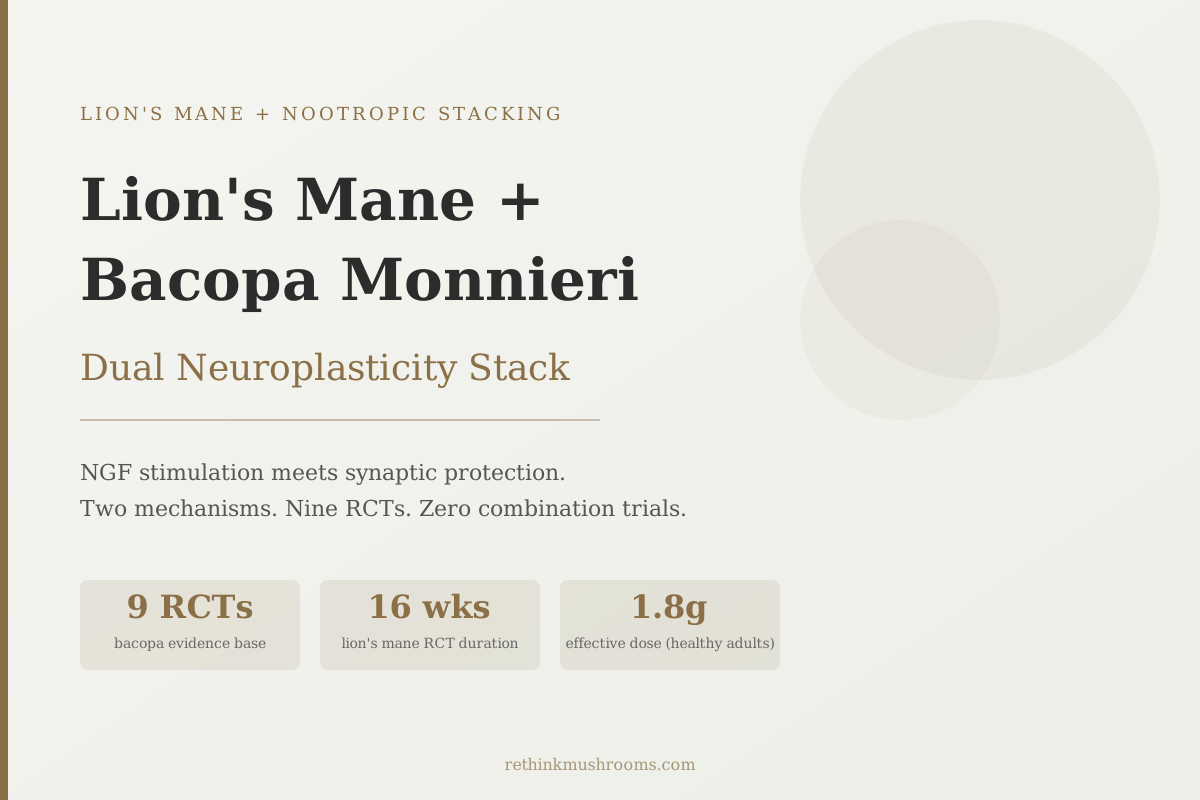
9 RCTs
Nine randomized controlled trials confirm bacopa monnieri improves free recall memory in healthy adults. Zero studies have tested the lion's mane bacopa monnieri stack directly.
Kongkeaw et al., Journal of Ethnopharmacology, 2014
16 weeks
duration of lion's mane RCT showing MCI improvement
1.8g
lion's mane dose with acute cognitive effects in healthy adults
300mg+
daily bacopa dose for consistent memory effects in meta-analysis
Kongkeaw et al., Journal of Ethnopharmacology, 2014
 View as image ↗
In 2014, a meta-analysis counted nine randomized controlled trials on bacopa monnieri and found a consistent result: free recall memory improved at 300mg or more daily in healthy adults.[2] A few years earlier, a 30-person placebo-controlled trial found that lion's mane improved cognitive scores in mild cognitive impairment patients over 16 weeks, with benefits reversing after supplementation stopped.[1] Together, that research forms the foundation of the lion's mane bacopa monnieri stack: two well-studied compounds, two completely different neuroplasticity mechanisms, and zero combination trials.
One compound promotes the growth of new neural connections by upregulating nerve growth factor (NGF). The other protects and optimizes connections you already have through antioxidant activity at the synapse. Supplement brands call this combination "synergistic" without ever defining what that means pharmacologically or acknowledging that no human trial has tested it. This article separates the mechanistic case from the empirical one. For a broader look at how medicinal mushrooms work in stacks, the guide to combining medicinal mushrooms covers the full evidence landscape.
Key Takeaways
- Mori et al. (2009) found 750mg/day lion's mane significantly improved cognitive function scores in MCI patients over 16 weeks; benefits declined after stopping[1]
- Docherty et al. (2023) confirmed acute lion's mane effects in healthy young adults: 1.8g significantly improved Stroop task performance at 60 minutes, with a non-significant trend toward reduced stress over 28 days[4]
- A 2014 meta-analysis of 9 RCTs found bacopa monnieri (300mg+ daily) consistently improved free recall memory via a pathway mechanistically distinct from NGF[2]
- Lion's mane promotes structural neuroplasticity by growing new neural connections; bacopa supports functional neuroplasticity by optimizing existing synaptic signaling
- No randomized controlled trial has tested the lion's mane bacopa monnieri combination; the stacking rationale is mechanistic, not empirical
- Both compounds require 8-12 weeks of consistent daily dosing before effects are reliably measurable
Is Lion's Mane a Nootropic? Yes, But Not How Most Work
Most synthetic nootropics act at the neurotransmitter level. They increase dopamine, block adenosine, or enhance acetylcholine signaling. Effects arrive within an hour. Lion's mane works at the growth factor level instead, which is a fundamentally different approach to cognitive enhancement.
The relevant compounds in the mycelium are a group of diterpenes called erinacines. These stimulate brain cells to produce more NGF, a protein that supports the growth, maintenance, and survival of neurons. NGF is what neurons need to extend new branches (neurites), form new connections, and survive under metabolic stress. In a 2008 in vitro study, Mori and colleagues showed that H. erinaceus extract induced NGF gene expression and protein secretion in human astrocytoma cells (the 1321N1 line), providing the cellular evidence for this mechanism.[3]
Because lion's mane works at the growth factor level, not the neurotransmitter level, its cognitive effects play out over weeks rather than minutes. Mori and colleagues (2009) ran their trial for 16 weeks because that is how long NGF-driven structural changes take to become measurable in clinical outcomes.[1]
That said, Docherty and colleagues (2023) added an important finding: a single dose of 1.8g of lion's mane in 41 healthy young adults improved performance on the Stroop task at 60 minutes post-dose.[4] This is an acute executive function effect that appears before any NGF-driven structural changes would be detectable. It suggests lion's mane has both an immediate signaling component and a slower structural component, operating on different timescales from the same compound.
The NGF Pathway: Why Lion's Mane Takes Weeks, Not Minutes
NGF is a growth factor. When production rises, neurons extend new axons and form new synaptic connections. When it falls, neurons can atrophy. Lion's mane's erinacines trigger the cells that support neurons to ramp up NGF output. This is structural neuroplasticity: the brain literally builds new hardware rather than simply adjusting the chemistry of existing circuits.
The fruiting body of the mushroom contains a different set of bioactives called hericenones. Martínez-Mármol and colleagues (2023) found that compounds isolated from H. erinaceus called hericerin derivatives (such as hericene A) activate a second signaling cascade (via ERK1/2) in hippocampal neurons.[5] This pathway promotes new neurite outgrowth independently of the mycelium-derived erinacine-NGF mechanism. The two pathways are anatomically distinct: mycelium extracts primarily deliver erinacines while fruiting body extracts primarily deliver hericenones. Products made from one or the other may deliver only part of the lion's mane neuroplasticity picture.
A 2026 hypothesis-driven review by Cipriano and colleagues proposed a third layer to the lion's mane mechanism.[6] Beyond NGF, the authors suggest that H. erinaceus bioactives influence neuroplasticity through an epigenetic axis: non-coding RNA networks that regulate which neuroplasticity genes get expressed. This is not clinical trial data. It is a mechanistic hypothesis based on the known bioactive compounds. The erinacine-NGF pathway and the hericenone-ERK1/2 pathway remain the grounded mechanistic foundations; the epigenetic axis represents where the research is heading.
How Bacopa Monnieri Protects and Strengthens Existing Circuits
Bacopa monnieri takes a different approach to neuroplasticity. The primary active compounds are saponins called bacosides. They work through three documented pathways. First, they provide antioxidant protection to synaptic proteins, slowing the oxidative degradation that erodes existing connections over time. Second, they enhance acetylcholine neurotransmission, the main neurotransmitter pathway for learning and memory encoding. Third, they promote dendritic branching in hippocampal neurons: the existing neurons grow more branches and form richer local networks.
Notice what bacosides do not do: they do not stimulate NGF production. They do not trigger neurogenesis in the way lion's mane does through growth factor upregulation. Bacopa's mechanism is about making existing neurons and synapses work better and last longer, not about building new ones.
Kongkeaw and colleagues (2014) systematically reviewed 9 randomized controlled trials on bacopa monnieri's cognitive effects in healthy adults and found consistent improvement in free recall memory at doses of 300mg or more daily. The effect sizes were statistically significant across the pooled data, with higher-dose and longer-duration trials showing stronger signals.[2] This is a well-powered evidence base: nine independent trials in healthy adults testing the same outcome measure with consistent results.
Structural vs. Functional Neuroplasticity: Why This Stack Has a Real Mechanistic Case
Neuroplasticity covers two processes that are often conflated. Structural neuroplasticity is the physical growth of new neurons, new axons, and new synaptic connections. Functional neuroplasticity is the strengthening or weakening of existing connections through changes in synaptic chemistry, receptor density, and signal efficiency.
Lion's mane primarily drives structural neuroplasticity. When NGF production increases, neurons extend new branches and form new connections. The 16-week timeline in the Mori 2009 RCT reflects how long it takes for those physical changes to become detectable in cognitive assessments.[1]
Bacopa primarily drives functional neuroplasticity. The bacosides slow the oxidative damage that degrades existing synapses and enhance the acetylcholine signaling pathway, making existing circuits more efficient and better maintained. The Kongkeaw meta-analysis found the strongest effects on free recall memory, a task that depends on hippocampal synaptic efficiency rather than on neurogenesis.[2]
This is why the combination has theoretical appeal: the two compounds are not doing the same thing in parallel. One builds new neural connections; the other maintains and optimizes existing ones. Whether combining them produces additive benefits in humans has not been tested. But the mechanistic case is more coherent than for most nootropic stacks, where multiple compounds often target the same pathway redundantly.
What the Human Evidence Shows for Each Compound
Lion's Mane in Humans: Three Trials
Mori et al. (2009): Thirty patients with mild cognitive impairment were randomized to 750mg of H. erinaceus tablets daily or placebo for 16 weeks. Cognitive function scale scores (Hasegawa Dementia Scale) improved significantly in the treatment group. When supplementation stopped, scores began declining within four weeks of cessation, indicating that effects were maintained by ongoing use rather than permanent.[1] This is a small trial in an impaired population. It establishes that the mechanism translates to humans, not that every healthy adult will see benefits.
Docherty et al. (2023): Forty-one healthy young adults (ages 18-45) were randomized to 1.8g lion's mane or placebo in a double-blind, parallel-groups pilot design. Acute effect: Stroop task performance improved significantly at 60 minutes post-dose (p = 0.005). Chronic effect: over 28 days, the data showed a trend toward reduced subjective stress that did not reach statistical significance in this pilot.[4] This is an important update for nootropic stackers: lion's mane is not only for MCI patients. It shows a measurable acute effect on executive function in non-impaired healthy adults, with the longer-term signal pointing in a promising direction that a larger trial still needs to confirm.
Saitsu et al. (2019): A separate randomized, double-blind, placebo-controlled trial gave H. erinaceus fruiting body supplements to adults for 12 weeks, assessing cognition with the Mini-Mental State Examination (MMSE), the Benton visual retention test, and a verbal paired-associate learning test. MMSE scores improved significantly in the treatment group.[7] This is a third independent human RCT, from a different research team and using a longer 12-week protocol than Mori 2009 or Docherty 2023.
Bacopa Monnieri in Humans: The Meta-Analysis
Kongkeaw et al. (2014): Nine randomized controlled trials in healthy adults with free recall memory as the primary outcome. Pooled effect sizes were statistically significant with 300mg or more daily. Longer trials (12 weeks) showed stronger effects than shorter ones (4-6 weeks), consistent with bacopa's slow-acting mechanism. The bacoside pathway involves antioxidant protection of synaptic proteins and enhanced acetylcholine signaling, which accumulates over weeks rather than days.[2]
The evidence gap is worth naming: bacopa has the larger pooled base (nine RCTs) compared to lion's mane (three RCTs). This does not mean bacopa is more effective; the compounds target different outcomes in different populations with different dosing protocols. Both have meaningful human evidence. Neither has been tested in combination.
Why Both Compounds Need 8-12 Weeks: The Timeline Problem
The most common failure mode when testing a nootropic stack is giving it three weeks and concluding it does not work.
Bacopa monnieri requires consistent daily dosing for 8-12 weeks before its effects on free recall memory become reliably measurable. The Kongkeaw meta-analysis showed this clearly: shorter-duration trials showed weaker and less consistent effects; 12-week trials showed the strongest signal.[2] The mechanism explains why. Antioxidant protection of synaptic proteins and optimization of acetylcholine signaling are gradual, cumulative processes.
Lion's mane operates on a similar long-term timescale for its structural effects. Mori et al. used 16 weeks because NGF-driven neuroplasticity requires sustained upregulation before the new connections it promotes become functionally significant.[1] Docherty 2023 does show an acute 60-minute effect on the Stroop task, so there is a faster-acting component. But the full structural benefit of NGF upregulation accumulates over months, not days.[4]
For anyone evaluating this stack: if you run both compounds for four weeks and feel unchanged, you have not reached the evaluation window where either compound reliably shows its primary effects. The honest minimum trial duration for the lion's mane bacopa monnieri stack is 8-12 weeks of consistent daily dosing at evidence-backed doses. For broader guidance on how mushroom supplement timing affects outcomes, the best timing guide for mushroom supplements covers the key variables.
The Lion's Mane Bacopa Monnieri Stack: What Honest Protocol Design Looks Like
No combination study exists for lion's mane and bacopa monnieri. The rationale for stacking them is mechanistic: two different neuroplasticity targets that do not compete or interfere. With that caveat made explicit, here is what evidence-backed protocol design looks like.
Dose ranges with research support:
- Lion's mane: 750mg to 1.8g daily. Mori 2009 used 750mg in MCI patients; Docherty 2023 used 1.8g in healthy young adults.[1][4] Fruiting body extracts deliver hericenones; mycelium extracts deliver erinacines. Full-spectrum products covering both forms address both pathways.
- Bacopa monnieri: 300-450mg daily standardized extract. Lower doses showed weaker effects in the Kongkeaw meta-analysis.[2]
Mechanism compatibility: Lion's mane's NGF pathway and bacopa's bacoside-acetylcholine pathway operate independently. Lion's mane does not deplete acetylcholine substrate; bacopa does not interfere with NGF production or signaling. Adding both compounds carries low pharmacological complexity from a known-mechanism perspective.
What this combination does not do: It does not provide acute stimulant effects (neither compound meaningfully raises alertness in the short term beyond Docherty 2023's 60-minute Stroop finding). If you are looking for immediate cognitive lift alongside longer-term neuroplasticity support, mushrooms and caffeine's complementary mechanisms explains how caffeine fits into a stack like this. For cycling considerations on long-term nootropic protocols, the guide to mushroom supplement cycling covers the on/off evidence.
For a broader view of lion's mane nootropic combinations, lion's mane and the best cognitive stacks covers the full range of mechanistic pairing options, including acetylcholine precursors and adaptogens.
The Bottom Line
Lion's mane and bacopa monnieri are among the best-evidenced natural nootropics available, but they work through entirely different neuroplasticity mechanisms: lion's mane via NGF-driven structural growth of new neural connections, and bacopa via bacoside-mediated protection and optimization of existing ones. Three human RCTs confirm lion's mane cognitive effects in both impaired and healthy adults; a 9-trial meta-analysis confirms bacopa's free recall memory improvements. No study has tested the combination directly. The mechanistic case for stacking them is real; the empirical case does not yet exist.
Frequently Asked Questions
Sources & References
- 1RTHM-00165·Mori, Koichiro et al. (2009). “Improving effects of the mushroom Yamabushitake (Hericium erinaceus) on mild cognitive impairment: a double-blind placebo-controlled clinical trial..” Phytotherapy research : PTR.Study breakdown →PubMed →↩
- 2RTHM-00607·Kongkeaw, Chuenjid et al. (2014). “Meta-analysis of randomized controlled trials on cognitive effects of Bacopa monnieri extract..” Journal of ethnopharmacology.Study breakdown →PubMed →↩
- 3RTHM-00268·Mori, Koichiro et al. (2008). “Nerve growth factor-inducing activity of Hericium erinaceus in 1321N1 human astrocytoma cells..” Biological & pharmaceutical bulletin.Study breakdown →PubMed →↩
- 4RTHM-00821·Docherty, Sarah et al. (2023). “The Acute and Chronic Effects of Lion's Mane Mushroom Supplementation on Cognitive Function, Stress and Mood in Young Adults: A Double-Blind, Parallel Groups, Pilot Study..” Nutrients.Study breakdown →PubMed →↩
- 5RTHM-01746·Martínez-Mármol, Ramón et al. (2023). “Hericerin derivatives activates a pan-neurotrophic pathway in central hippocampal neurons converging to ERK1/2 signaling enhancing spatial memory..” Journal of neurochemistry.Study breakdown →PubMed →↩
- 6RTHM-02226·Cipriano, Giovanni Luca et al. (2026). “Beyond Neurotrophins: A Proposed Neurotrophic-Epigenetic Axis Mediated by Non-Coding RNA Networks for Hericium erinaceus Bioactives-A Hypothesis-Driven Review..” International journal of molecular sciences.Study breakdown →PubMed →↩
- 7RTHM-00585·Saitsu, Yuusuke et al. (2019). “Improvement of cognitive functions by oral intake of Hericium erinaceus..” Biomedical research (Tokyo.Study breakdown →PubMed →↩