Lion's Mane + Nootropic Stacking
1.8g LM dose
Docherty et al. (2023) found 1.8g lion's mane improved cognitive performance in 41 healthy adults. Most mushroom coffee products contain roughly 250mg or less, far below what research doses tested.
Docherty et al., Nutrients, 2023
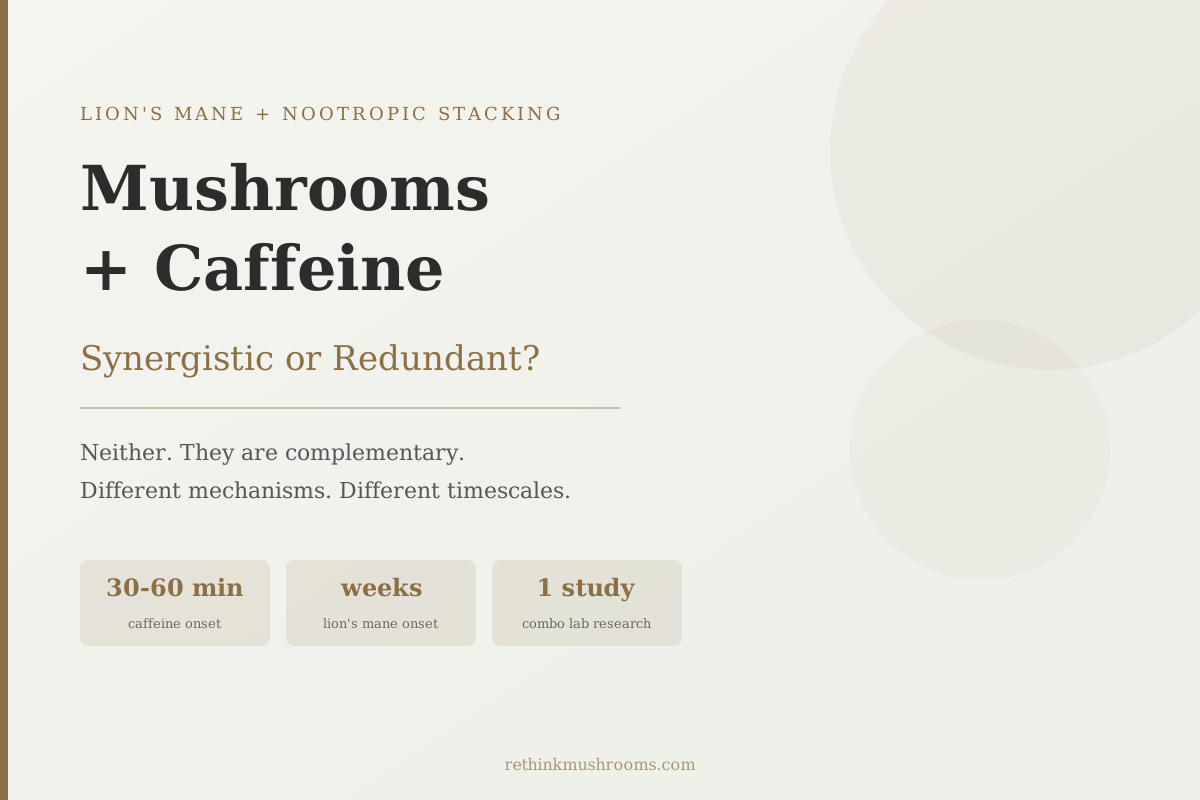
30-60 min
caffeine cognitive onset via adenosine blockade
weeks
lion's mane onset for structural neuroplasticity effects
1 study
lab studies directly testing coffee and mushroom combination
Docherty et al., Nutrients, 2023
 View as image ↗
In 2024, Kała and colleagues put coffee, Cordyceps, and H. erinaceus together in a lab and analyzed what happened to the bioactive compounds. Their finding: hericenones, the key cognitive compounds from lion's mane fruiting body, survive the heat of coffee brewing intact.[1] This is the most direct evidence available on mushroom coffee; it answers the chemistry question, not the cognitive enhancement question. The hericenones survive. Whether the mushrooms and caffeine cognitive effects combine into something greater than either alone is a different question, and nobody has tested it.
The honest answer: mushrooms and caffeine are complementary, not synergistic. Caffeine blocks adenosine receptors for acute alertness within 30-60 minutes. Lion's mane upregulates nerve growth factor (NGF) for structural neuroplasticity effects that accumulate over weeks. Different mechanisms. Different timescales. Neither compound meaningfully interferes with the other's pathway. This article is part of the broader guide to combining medicinal mushrooms.
Key Takeaways
- Caffeine works by blocking adenosine receptors (onset 30-60 min, duration 4-6 hours, tolerance builds with daily use)
- Lion's mane works via NGF upregulation for structural neuroplasticity; effects accumulate over weeks, not hours
- Docherty et al. (2023) found lion's mane improved Stroop task performance at 60 minutes in healthy adults, but this effect targets executive function, not the alertness caffeine provides[2]
- Kała et al. (2024) is the only study directly examining coffee + mushroom combination; it confirmed bioactives survive brewing heat but did not test cognitive performance[1]
- Most mushroom coffee products list 200-500mg mushroom extract per serving; clinical trials showing cognitive effects used 1.8g to 3g daily
- The honest label: mushrooms and caffeine are complementary (different mechanisms, different timescales), not synergistic (same pathway, amplified)
Synergistic, Redundant, or Complementary? A Working Definition
These three terms get used interchangeably in supplement marketing. They mean different things.
Synergistic means two compounds produce a combined effect greater than the sum of either alone, typically because they work on the same pathway at different points. Aspirin and ibuprofen taken together can be synergistic because both inhibit the same enzyme cascade. True pharmacological synergy requires a shared mechanism.
Redundant means two compounds produce similar effects through similar mechanisms. Stacking two adenosine blockers, for example, would be largely redundant: you are adding noise to the same channel.
Complementary means two compounds produce different effects through different mechanisms, covering different cognitive targets at different times. They are additive in the sense of covering more ground, not amplifying each other.
Mushrooms and caffeine fit the complementary category. Caffeine and lion's mane do not share a mechanism. Caffeine blocks adenosine receptors. Lion's mane stimulates NGF production and activates the hericenone-ERK1/2 pathway. These are separate biochemical systems. Combining them does not create synergy in the pharmacological sense. It adds a different type of cognitive support alongside an existing one.
How Caffeine Works: Adenosine Blockade and the 60-Minute Window
Caffeine's cognitive effects come from a single primary mechanism: it occupies adenosine receptors in the brain without activating them. Adenosine normally builds up during waking hours and signals drowsiness. When caffeine blocks those receptors, the drowsiness signal is suppressed and alertness-promoting neurotransmitters (dopamine, norepinephrine, acetylcholine) become more active by default.
The timeline: effects begin within 30-60 minutes of ingestion, peak around 60-90 minutes, and taper over 4-6 hours depending on individual metabolism. The cognitive benefits are well-documented: improved reaction time, sustained attention, reduced perception of fatigue. These are acute effects that directly track caffeine blood levels.
The tolerance problem: daily caffeine use leads to compensatory upregulation of adenosine receptors within days. Regular users often experience baseline adenosine effects (drowsiness, poor focus) without caffeine; the brain adapts to the blockade by making more receptors. This is why chronic daily caffeine use produces diminishing cognitive returns and withdrawal symptoms on cessation.
How Lion's Mane Works as a Cognitive Compound
Lion's mane works through a different mechanism at a different timescale. The mycelium contains erinacines that stimulate nerve growth factor (NGF) production. The fruiting body contains hericenones, which activate a second signaling cascade called ERK1/2. This pathway operates in hippocampal neurons, the brain region most associated with learning and memory. Neither of these pathways intersects with adenosine receptors.
Mori and colleagues (2009) ran the foundational human trial: 3g per day (four 250mg tablets, three times daily) in MCI patients over 16 weeks produced significant cognitive score improvements.[3] The 16-week timeline reflects how slowly NGF-driven structural changes accumulate. New neural branch growth and the formation of new connections take weeks before they produce detectable differences in cognitive scores.
Docherty and colleagues (2023) added an important nuance: 1.8g in healthy young adults (n=41) improved Stroop task performance at 60 minutes post-dose.[2] The Stroop task measures executive function and processing speed, a different cognitive domain from the alertness and reaction time that caffeine improves. This distinction matters for the synergy question. Even at the 60-minute timescale, lion's mane and caffeine are not improving the same thing.
Surendran and colleagues (2025) reinforced the Docherty findings in an independent randomized, double-blind, placebo-controlled crossover trial (n=18), reporting acute cognitive and mood effects from a standardized H. erinaceus fruiting-body extract in healthy younger adults.[4]
The One Lab Study That Tested Coffee and Mushrooms Together
Kała and colleagues (2024) is the only published study directly examining the combination of coffee and medicinal mushrooms. They analyzed coffee combined with Cordyceps militaris and H. erinaceus fruiting body powder to assess what happened to the key bioactive compounds during brewing.[1]
The finding: hericenones from H. erinaceus and cordycepin from Cordyceps militaris both survived the heat of coffee brewing. The compounds remained detectable and presumably bioavailable after mixing with hot coffee. This matters because one common concern about mushroom coffee products is whether heat degrades the active compounds. Kała 2024 suggests the answer is no, at least for hericenones and cordycepin.
What the study did not test: human subjects. Cognitive performance. Blood levels of the compounds after ingestion. Whether hericenone bioavailability from coffee-combined powder is the same as from a standalone extract. Kała 2024 is a chemistry stability study. It tells you the molecules survive in hot liquid. It does not tell you whether drinking mushroom coffee produces a cognitive effect.
This is the gap most mushroom coffee brands exploit. "Coffee + lion's mane = synergistic cognitive enhancement" is a marketing claim. "Hericenones survive coffee brewing temperatures" is what the science actually says.
Mushrooms and Caffeine Cognitive Effects: Two Different Timescales
The most useful framing for mushrooms and caffeine cognitive effects is to separate them by timescale.
At the 60-minute timescale: Caffeine provides alertness via adenosine blockade (onset ~30-60 min). Lion's mane may improve executive function (Stroop task, Docherty 2023) at 60 minutes.[2] These effects are in parallel: one improves alertness, the other may improve processing speed. They operate on different systems at the same time. Additive in scope, not synergistic in mechanism.
At the 4-hour timescale: Caffeine effects are waning. The adenosine blockade tapers. Lion's mane at this timescale is not producing acute neuroplasticity (the structural changes take weeks). No cognitive effect from the mushroom is likely detectable at 4 hours after a single dose.
At the weeks-to-months timescale: Caffeine tolerance is building if used daily. Lion's mane is slowly upregulating NGF and promoting structural neuroplasticity. This is where the complementarity is most real: one provides acute daily support (with diminishing returns over time), while the other accumulates structural benefit over months. They are running on different schedules, covering different windows.
Mechanism & Timescale
Caffeine vs. Lion’s Mane: Different Systems, Different Timescales
Caffeine
Lion’s Mane
Mechanism
Blocks adenosine receptors
Stimulates NGF; hericenone–ERK1/2 pathway
Onset
30–60 min
~60 min (acute executive function)
Peak / accrual
60–90 min
Structural gains accrue over ~16 weeks
Duration
4–6 hours
Weeks to months (cumulative)
Cognitive target
Alertness, reaction time
Executive function (Stroop), memory
Tolerance
Builds with daily use (receptor upregulation)
Not characterised as tolerance-forming
Key human evidence
Established pharmacology
Docherty 2023 (acute, n=41); Mori 2009 (16-wk MCI)
The two effects never share a pathway. Caffeine acts within the hour and fades the same day; lion’s mane’s measurable structural benefit accrues over weeks. That is the definition of complementary, not synergistic — two parallel systems running on different clocks.
Sources: Docherty et al. (2023), Nutrients; Mori et al. (2009), Phytotherapy Research; Kała et al. (2024), Pharmaceuticals. Caffeine pharmacokinetics: established literature.
The Dose Reality Check: Why Most Mushroom Coffee Products Fall Short
Even setting aside the synergy question, there is a more practical problem with most mushroom coffee products: dose.
The clinical trials showing cognitive effects used the following doses:
- Mori et al. (2009): 3g daily in MCI patients[3]
- Docherty et al. (2023): 1.8g daily in healthy young adults[2]
A typical mushroom coffee product on the market lists 200-500mg of mushroom extract per serving. Some contain as little as 50-100mg. Even the most generous mushroom coffee products are typically at the lower end of the range tested in trials, and many are well below it.
This is not evidence that lower doses are inactive. But it does mean the claims mushroom coffee brands make ("nootropic coffee," "brain-boosting coffee") are extrapolated from trials using 4 to 15 times the dose their product contains. The Kała 2024 finding confirms that hericenones survive the heat, but it does not tell you that 250mg of powdered mushroom in a cup of coffee produces the same cognitive effect as 1.8g of a standardized extract in the Docherty 2023 trial.
Readers who want the cognitive effects documented in clinical trials would need to take a standalone lion's mane supplement at 1.8g-3g daily alongside their coffee, not a pre-blended mushroom coffee product. The two are different products at different dose levels.
How Mushrooms and Caffeine Work Together in Practice
Given everything above, here is the honest practical picture:
Caffeine provides reliable acute alertness and focus within 30-60 minutes. This is well-established and consistent. Morning coffee is doing its job via adenosine blockade.
Lion's mane, taken at evidence-backed doses (1.8g-3g), provides a different type of support: possible acute executive function effects (Docherty 2023) and slow-accumulating structural neuroplasticity over weeks and months. These effects are not caffeine's effects. They are complementary to them.
Taking lion's mane with coffee (or in coffee) does not create synergy. It adds a second, parallel benefit pathway alongside an existing one. How you time them relative to each other probably matters less than whether you are hitting effective doses for both. For detailed timing guidance on lion's mane and other mushroom supplements, the optimal timing guide for mushroom supplements covers what the evidence says. For broader lion's mane stacking options beyond caffeine, the full guide to lion's mane nootropic stacks covers the mechanistic pairing options. For the lion's mane and bacopa combination, the dedicated analysis covers the dual neuroplasticity case. For how mushrooms interact with synthetic nootropics, mushrooms and racetams covers the mechanistic differences and the honest limits of those stacks. For an overview of the research-backed brain stack options that includes caffeine context, building the ultimate brain stack covers the full approach.
The Bottom Line
Mushrooms and caffeine are complementary, not synergistic. Caffeine blocks adenosine receptors for acute alertness within 30-60 minutes. Lion's mane stimulates NGF and activates hericenone-ERK1/2 pathways for neuroplasticity effects over weeks. The only lab study testing the combination (Kała 2024) confirmed that bioactives survive coffee brewing heat; it did not confirm cognitive synergy. Most mushroom coffee products contain doses far below what clinical trials used.
Frequently Asked Questions
Sources & References
- 1RTHM-00882·Kała, Katarzyna et al. (2024). “Coffee with Cordyceps militaris and Hericium erinaceus Fruiting Bodies as a Source of Essential Bioactive Substances..” Pharmaceuticals (Basel.Study breakdown →PubMed →↩
- 2RTHM-00821·Docherty, Sarah et al. (2023). “The Acute and Chronic Effects of Lion's Mane Mushroom Supplementation on Cognitive Function, Stress and Mood in Young Adults: A Double-Blind, Parallel Groups, Pilot Study..” Nutrients.Study breakdown →PubMed →↩
- 3RTHM-00165·Mori, Koichiro et al. (2009). “Improving effects of the mushroom Yamabushitake (Hericium erinaceus) on mild cognitive impairment: a double-blind placebo-controlled clinical trial..” Phytotherapy research : PTR.Study breakdown →PubMed →↩
- 4RTHM-00952·Surendran, Geyan et al. (2025). “Acute effects of a standardised extract of Hericium erinaceus (Lion's Mane mushroom) on cognition and mood in healthy younger adults: a double-blind randomised placebo-controlled study..” Frontiers in nutrition.Study breakdown →PubMed →↩