Mushroom Supplement Timing & Dosing
60 minutes
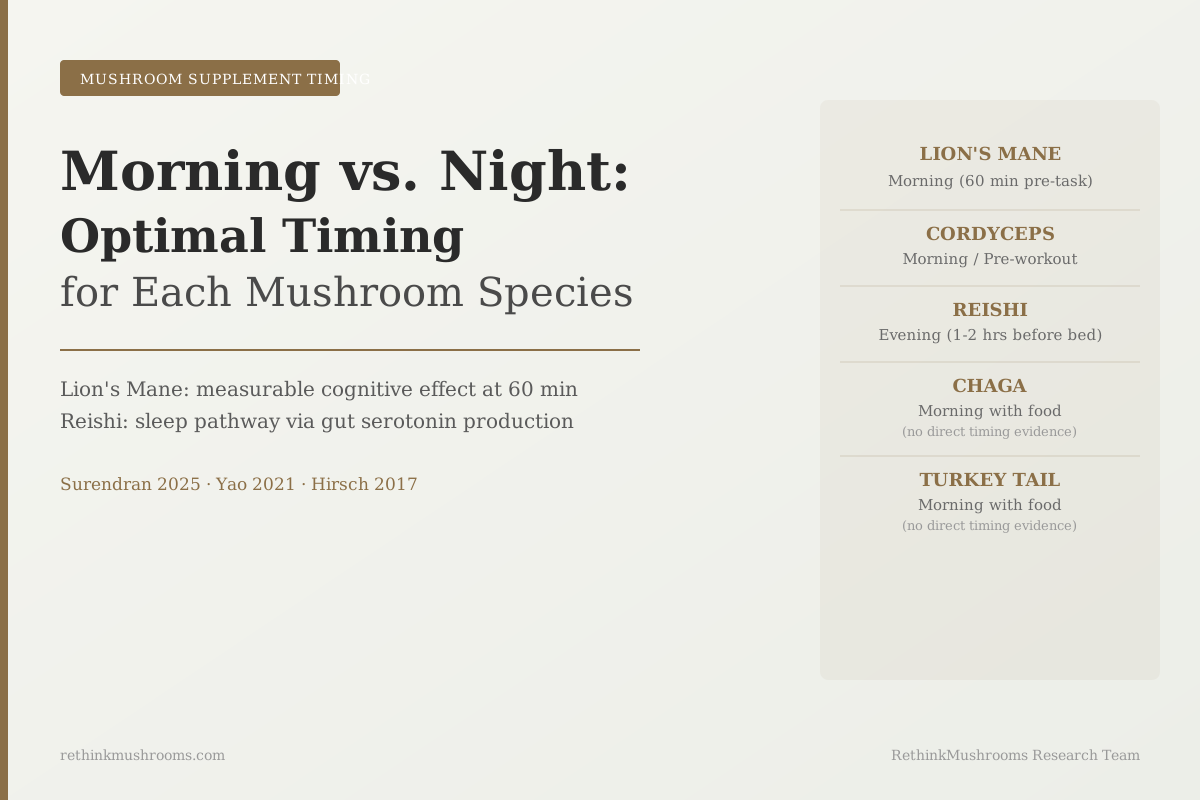
Participants in Surendran's 2025 double-blind RCT showed measurable cognitive improvement on the Stroop test just 60 minutes after a single dose of standardized Lion's Mane extract, making it the clearest trial evidence for mushroom supplement timing to date.
Surendran et al., Frontiers in Nutrition, 2025
Lion's Mane
morning timing supported by direct acute trial data (60 min Stroop effect, Surendran 2025)
Reishi evening
mechanistically supported by gut microbiota serotonin pathway in preclinical research (Yao 2021)
Chaga + TT
no direct timing trial data exists; timing recommendations are bioavailability inference
Surendran et al., Frontiers in Nutrition, 2025
 View as image ↗
Most articles on mushroom supplement timing give you a species-by-species chart and no research to back it up. The recommendations are assembled from general supplement logic, brand messaging, and educated guesses about how adaptogens work.
The actual trial data tells a more specific story. For questions about mushroom supplement timing morning vs night, Lion's Mane has the clearest direct evidence: a 2025 double-blind randomized controlled trial found measurable cognitive improvement at 60 minutes post-dose. Cordyceps data from a 2017 RCT shows both acute (same-session) and chronic exercise benefits, making a pre-workout morning dose the most evidence-consistent choice. Reishi's case for evening use rests on a mechanistic study of its sleep-promoting pathway through gut bacteria and serotonin production. For Chaga and Turkey Tail, there is no direct timing trial data. Saying that clearly is more useful than making up a recommendation.
For the broader context of timing as part of a mushroom stacking strategy, see our complete guide to combining medicinal mushrooms.
Key Takeaways
- Surendran's 2025 double-blind RCT found Lion's Mane improved performance on the Stroop cognitive test at 60 minutes post-dose, directly supporting morning or pre-cognitive-task timing
- Docherty's 2023 double-blind RCT confirmed both acute cognitive benefits and reduced stress after 28 days of Lion's Mane, showing the acute morning window is real and consistently reproducible
- Vigna's 2019 RCT found Lion's Mane improved sleep quality and mood disorders after 8 weeks (77 participants), adding an honest nuance: evening timing may suit some goals for this species
- Hirsch's 2017 RCT showed Cordyceps militaris improved high-intensity exercise tolerance after both a single acute dose AND 3 weeks of chronic use, making pre-workout morning dosing the most evidence-consistent choice
- Yao's 2021 preclinical study (mice) identified the mechanism behind Reishi's sleep effects: enrichment of sleep-promoting gut bacteria and increased serotonin (the melatonin precursor) production, providing the scientific rationale for evening use
- For Chaga and Turkey Tail, no direct timing trial data exists; morning dosing with food follows from general bioavailability research but should be understood as inference, not evidence
The Timing Evidence by Species: A Quick Reference
Before diving into the evidence behind each recommendation, here is a summary. Each row reflects what the research actually supports, with honest notes where the evidence is weak or absent.
| Species | Recommended Timing | Reason | Key Evidence |
|---|---|---|---|
| Lion's Mane | Morning, 60 min before cognitive work | Acute cognitive effect at 60 min post-dose | Surendran 2025, Docherty 2023 |
| Cordyceps | Morning or pre-workout | Acute exercise benefit in single dose, chronic benefit builds | Hirsch 2017 |
| Reishi | 1-2 hours before bed (evening) | Sleep pathway via gut bacteria and serotonin production | Yao 2021, Cheng 2016 |
| Chaga | Morning with food | No direct timing data; general bioavailability logic | Inference |
| Turkey Tail | Morning with food | No direct timing data; general bioavailability logic | Inference |
The two rows marked "Inference" are important: there are no controlled trials that specifically tested Chaga or Turkey Tail timing. Any site that tells you Chaga is best at a specific time is guessing. For those species, consistent daily use matters more than when you take it.
Timing, Graded by Evidence
Not All Timing Advice Is Equally Earned
Each species below has a recommended window — but the confidence behind each one is uneven. Two rest on direct human trials, one on a preclinical mechanism, and two on inference alone. No study has compared morning versus evening head to head for any of them.
Lion's Mane
Morning · 60 min pre-taskTwo double-blind human RCTs show an acute cognitive effect ~60 min after a single dose. An evening case exists for sleep-focused goals but was never timed directly.
Surendran 2025 [1]; Docherty 2023 [2]; Vigna 2019 [3]
Cordyceps
Morning · pre-workoutA single crossover RCT found improved high-intensity exercise tolerance after both an acute dose and three weeks of daily use — the only dual-window human evidence here.
Hirsch 2017 [4]
Reishi
Evening · 1–2 h before bedPreclinical only: mice showed a gut-serotonin sleep pathway; rat pharmacokinetics showed rapid absorption. Plausible mechanism, no human timing trial.
Yao 2021 [5]; Cheng 2016 [6]
Chaga
Morning · with foodNo timing trial exists. Morning-with-food follows from general bioavailability logic and the practical value of a consistent daily routine — not species-specific data.
Weigand-Heller 2012 [7]
Turkey Tail
Morning · with foodSame as Chaga: no controlled timing trial. Any specific-hour claim is an educated guess; consistency matters more than the clock.
Weigand-Heller 2012 [7]
Sources: Surendran et al. (2025) [ref 1]; Docherty et al. (2023) [ref 2]; Vigna et al. (2019) [ref 3]; Hirsch et al. (2017) [ref 4]; Yao et al. (2021) [ref 5]; Cheng et al. (2016) [ref 6]; Weigand-Heller et al. (2012) [ref 7].
Lion's Mane: Morning Has Direct Trial Support
Of all the commonly used functional mushrooms, Lion's Mane has the most direct evidence for morning timing, and the clearest evidence that the timing is more than a theory.
Surendran and colleagues' 2025 double-blind randomized controlled trial tested a standardized Lion's Mane extract against placebo in healthy younger adults.[1] Participants completed the Stroop task, a standard cognitive test that measures processing speed and the ability to suppress competing responses, at multiple time points. The active group showed measurable improvement at 60 minutes post-dose. The 60-minute window is specific and actionable: if you take Lion's Mane an hour before work, a meeting, or a period requiring focused cognitive effort, the trial data suggests you are in the window where acute effects are plausible.
Docherty and colleagues' 2023 double-blind parallel-group RCT in young adults confirmed this acute window and added a 28-day picture.[2] The study found acute cognitive performance improvements after a single dose and reduced subjective stress ratings after 28 days of continuous use. This is the only study to directly measure both time windows in the same trial design. The finding is consistent across both: there is an acute benefit and a cumulative benefit, and both favor continuous morning dosing rather than intermittent use.
Why Some People May Prefer Lion's Mane at Night
The morning recommendation for Lion's Mane has an honest caveat. Vigna and colleagues' 2019 RCT enrolled 77 participants who were overweight or obese and found that eight weeks of Lion's Mane supplementation improved sleep quality and reduced mood disorders compared to placebo.[3]
This finding opens a legitimate question: if Lion's Mane improves sleep, could evening timing amplify that effect?
The evidence does not directly compare morning versus evening timing for sleep outcomes. The Vigna trial used a single daily dose without specifying that it was taken at night. What the study shows is that Lion's Mane produces sleep-related benefits regardless of timing. Whether taking it specifically in the evening enhances those effects is not tested.
The practical takeaway is honest: if your primary goal with Lion's Mane is cognitive performance during the workday, morning timing with a 60-minute head start has the most direct trial support. If sleep quality is your primary goal, the timing question remains genuinely open, and evening dosing is a reasonable experiment without scientific contradiction.
Cordyceps: Pre-Workout Morning Timing Has Both Acute and Chronic Support
Cordyceps is unique among the commonly used functional mushrooms in having direct evidence for both same-session and multi-week timing windows, from the same study.
Hirsch and colleagues' 2017 double-blind crossover RCT tested Cordyceps militaris in healthy adults performing high-intensity exercise.[4] Participants showed improved tolerance to high-intensity exercise after a single acute dose AND after three weeks of chronic supplementation at the same daily dose. Both windows produced measurable improvements over placebo. No other functional mushroom studied to date has this dual-window evidence from a single controlled trial.
What makes this practically useful is the implication for timing decisions. If you are taking Cordyceps for exercise performance or energy, you do not have to choose between building toward a chronic effect or getting an acute effect on the day. You can get both by maintaining consistent morning dosing before workouts. The research protocol in Hirsch's study used a single daily dose taken before exercise sessions.
The case against taking Cordyceps before bed follows from this same evidence: the acute effects on exercise tolerance and energy substrate utilization are the reason to take it, and those effects are most useful before physical effort, not before sleep.
For more on Cordyceps exercise timing specifically, see best time to take Cordyceps: morning, pre-workout, or evening? and Cordyceps and exercise performance: what the clinical trials show.
Reishi: Evening Has the Strongest Mechanistic Case
Reishi's evening timing recommendation has a mechanism behind it, which puts it in a different category from the opinion-based advice you'll find on most supplement blogs.
Yao and colleagues' 2021 study examined how Reishi water extract affects sleep in mice, with a specific focus on the gut-brain pathway.[5] The researchers found that Reishi promoted sleep by enriching sleep-promoting gut bacteria and increasing serotonin production. Serotonin is the precursor to melatonin, the primary sleep hormone. The study also found involvement of the GABA receptor pathway, which is the same system targeted by many pharmaceutical sleep aids.
This is a preclinical study in mice, which means direct translation to human outcomes requires caution. But it identifies a plausible biological mechanism that explains why Reishi has a reputation for improving sleep quality, and it suggests that evening administration (when that serotonin-to-melatonin conversion pathway is most relevant) is mechanistically rational.
Cheng and colleagues' 2016 pharmacokinetic study of ganoderic acids from Reishi adds a note of caution about how far the timing logic can be pushed.[6] Working in rats, the researchers profiled how quickly Reishi's primary bioactives (ganoderic acids, the triterpenoids responsible for many of its studied effects) are absorbed and distributed in plasma after oral dosing. The data showed rapid absorption and distribution, with some ganoderic acids showing secondary reabsorption peaks. Two caveats keep this honest: it is a preclinical (rat) model, and it measured absorption kinetics, not sleep outcomes. It does not, on its own, establish a human sleep-timing window. What it offers is a plausibility check that Reishi's bioactives reach circulation quickly enough that a dose taken 1-2 hours before bed would be present during the sleep-preparation period.
Practical guidance from these two studies, held at the confidence the evidence supports: a Reishi dose taken 1-2 hours before bed is backed by a plausible sleep mechanism (Yao, in mice) and is consistent with the rapid absorption seen in preclinical pharmacokinetic work (Cheng, in rats). Neither study directly compared evening versus morning timing in humans, so this remains a mechanistically rational default rather than a proven schedule.
For readers who want a fuller picture of Reishi's sleep and relaxation evidence, see our article on when is the best time to take mushroom supplements.
Chaga and Turkey Tail: What No Direct Timing Data Means
Chaga and Turkey Tail are two of the most widely used functional mushrooms, but neither has been studied in a controlled trial specifically designed to test morning versus evening timing. This is not a minor gap. Any species-specific timing recommendation for these two fungi is constructed from general principles rather than direct evidence.
The general principles are reasonable. Weigand-Heller and colleagues' 2012 study on ergothioneine bioavailability from mushrooms found that mushroom bioactives are absorbed effectively when consumed as whole food, with no significant impairment from co-ingestion with other foods.[7] For supplement forms (capsules, powders), taking them with a meal or a small amount of fat-containing food is consistent with general bioavailability principles for polysaccharide-based compounds.
Morning is the practical default for Chaga and Turkey Tail for a straightforward reason: it is when people are most likely to remember to take a supplement consistently, and consistency matters more than precise timing when no evidence exists to guide a more specific schedule. Taking them with breakfast fits naturally into a daily routine without any known pharmacological conflict.
The honest framing: if someone tells you Chaga should be taken at a specific time for a specific effect, ask for the evidence. It doesn't exist yet. That is not a criticism of Chaga. It is an invitation for more research.
When You Take Multiple Species at the Same Time
For people who take more than one mushroom supplement, the morning-versus-night question becomes: can you take them all together, or does separating them matter?
No clinical trials have tested what happens when Lion's Mane, Cordyceps, and Reishi are taken simultaneously. The Hisamuddin 2026 RCT tested a specific multi-species mushroom blend in 50 participants and found significant reductions in anxiety (STAI and Hamilton scales), depression (Beck Depression Inventory), and fatigue, along with improved sleep quality, over 12 weeks, with no adverse effects.[8] That suggests combined supplementation can be both well tolerated and effective when formulated together. But that blend was taken as a single daily dose at an unspecified time; it doesn't resolve the morning-versus-evening question for mixed stacks.
Based on the species-level evidence, a practical approach is to split based on intended effect:
- Morning: Lion's Mane and Cordyceps, for the acute cognitive and energy effects that are most useful during the active day
- Evening: Reishi, timed 1-2 hours before sleep to align with its sleep pathway mechanism
- Chaga and Turkey Tail: morning with breakfast, for no pharmacological reason beyond routine consistency
This is a reasonable inference from the available evidence, not a tested protocol. The underlying principle is sound: align each species with the time of day when its studied effects are most relevant.
This article summarizes research on supplement timing and is not medical advice. Functional mushrooms can interact with prescription medications (including immunosuppressants, anticoagulants, and blood-sugar-lowering drugs) and are not a substitute for treatment. Talk to a qualified healthcare provider before starting any supplement, particularly if you are pregnant or nursing, managing a health condition, or taking prescription medication.
For more on combining species in a stack, see our articles on should you cycle mushroom supplements?, mushroom supplement loading phases: do they help?, and how long before you feel mushroom supplement effects?.
The Bottom Line
The timing evidence for functional mushrooms is species-specific and uneven. Lion's Mane has the clearest acute trial support, with measurable cognitive effects at 60 minutes in a 2025 double-blind RCT. Cordyceps shows both acute and chronic exercise benefits, supporting pre-workout morning timing. Reishi's evening use is backed by a preclinical mechanistic study on the gut-serotonin sleep pathway. Chaga and Turkey Tail have no direct timing evidence, and morning dosing with food is inference from general bioavailability principles rather than species-specific data.
Frequently Asked Questions
Sources & References
- 1RTHM-00952·Surendran, Geyan et al. (2025). “Acute effects of a standardised extract of Hericium erinaceus (Lion's Mane mushroom) on cognition and mood in healthy younger adults: a double-blind randomised placebo-controlled study..” Frontiers in nutrition.Study breakdown →PubMed →↩
- 2RTHM-00821·Docherty, Sarah et al. (2023). “The Acute and Chronic Effects of Lion's Mane Mushroom Supplementation on Cognitive Function, Stress and Mood in Young Adults: A Double-Blind, Parallel Groups, Pilot Study..” Nutrients.Study breakdown →PubMed →↩
- 3RTHM-00590·Vigna, Luisella et al. (2019). “Hericium erinaceus Improves Mood and Sleep Disorders in Patients Affected by Overweight or Obesity: Could Circulating Pro-BDNF and BDNF Be Potential Biomarkers?.” Evidence-based complementary and alternative medicine : eCAM.Study breakdown →PubMed →↩
- 4RTHM-00473·Hirsch, Katie R et al. (2017). “Cordyceps militaris Improves Tolerance to High-Intensity Exercise After Acute and Chronic Supplementation..” Journal of dietary supplements.Study breakdown →PubMed →↩
- 5RTHM-00731·Yao, Chunyan et al. (2021). “Ganoderma lucidum promotes sleep through a gut microbiota-dependent and serotonin-involved pathway in mice..” Scientific reports.Study breakdown →PubMed →↩
- 6RTHM-00774·Cheng, Chun-Ru et al. (2016). “Pharmacokinetic Studies of Ganoderic Acids from the Lingzhi or Reishi Medicinal Mushroom, Ganoderma lucidum (Agaricomycetes), by LC-MS/MS..” International journal of medicinal mushrooms.Study breakdown →PubMed →↩
- 7RTHM-00270·Weigand-Heller, AuBrei J et al. (2012). “The bioavailability of ergothioneine from mushrooms (Agaricus bisporus) and the acute effects on antioxidant capacity and biomarkers of inflammation..” Preventive medicine.Study breakdown →PubMed →↩
- 8RTHM-00959·Hisamuddin, Ahmad Safiyyu'd-Din et al. (2026). “Adaptogenic Effects of Mushroom Blend Supplementation on Stress, Fatigue, and Sleep: A Randomised, Double-Blind, and Placebo-Controlled Trial..” Brain and behavior.Study breakdown →PubMed →↩