Mushroom Supplement Timing
0 trials testing a loading phase
Every clinical trial on functional mushrooms uses a fixed daily dose from day one. No research supports a loading phase, and the creatine comparison that drives this question falls apart under closer examination.
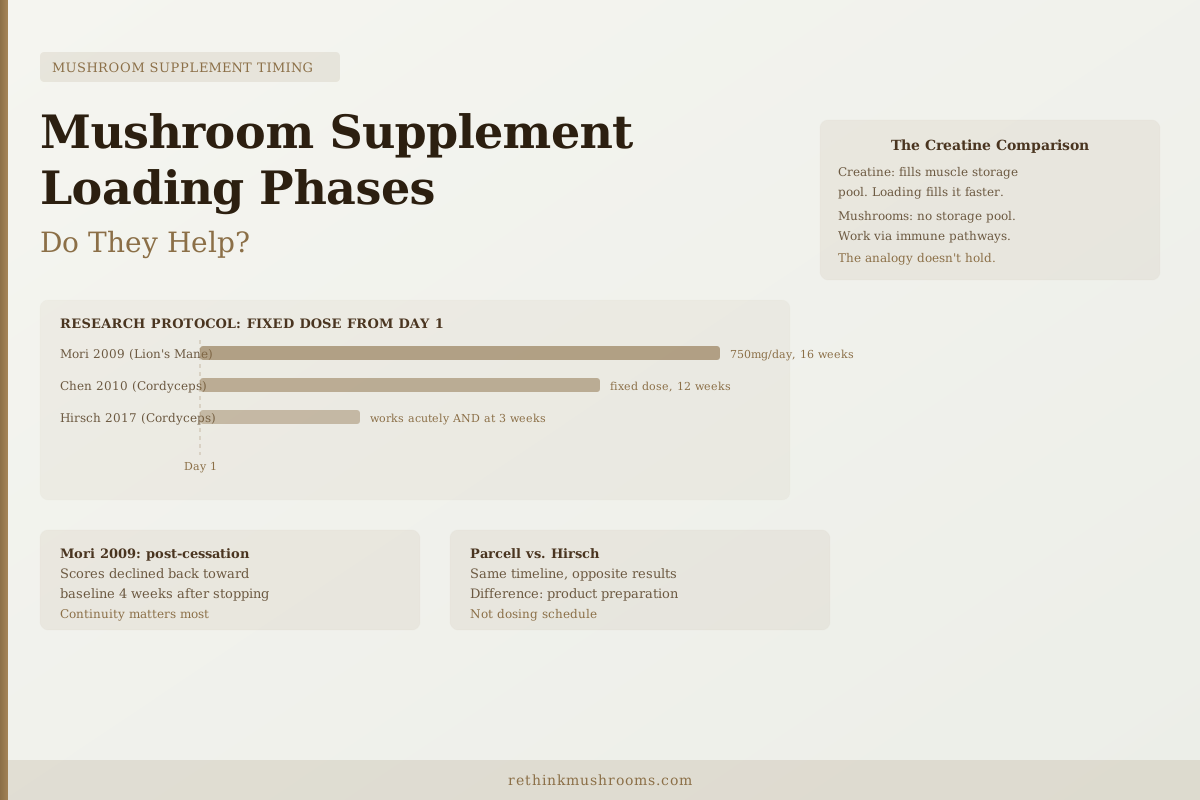
Research protocol analysis: Mori 2009, Chen 2010, Hirsch 2017
Fixed dose
how every mushroom RCT is designed, from day 1
Mori 2009
Lion's Mane at 750mg/day for 16 weeks, no loading
Hirsch 2017
Cordyceps worked acutely AND after 3 weeks, same dose
Research protocol analysis: Mori 2009, Chen 2010, Hirsch 2017
 View as image ↗
The question comes up often: should you start with a higher dose of mushroom supplements and taper down, the way athletes load creatine? It sounds logical. Creatine loading works, mushrooms have cumulative effects, so maybe an initial high dose accelerates the process.
The short answer is: there is no clinical evidence for a mushroom supplement loading phase, and the comparison to creatine breaks down on examination. Every human trial on functional mushrooms has used a fixed daily dose from the first day. Not one has tested whether a loading period produces faster or stronger results.
This article covers what research protocols actually look like, why the creatine analogy doesn't hold up biochemically, and what the trials tell you about how to start. For broader context on stacking and combining mushroom supplements, see our guide to combining medicinal mushrooms.
Key Takeaways
- No clinical trial on any functional mushroom has tested a loading phase protocol; the concept has no direct research basis
- Hirsch and colleagues found Cordyceps militaris improved high-intensity exercise tolerance after a single acute dose AND after 3 weeks of daily supplementation at the same dose, suggesting benefits accumulate without dose escalation[4]
- Mori and colleagues ran Lion's Mane at 750mg per day for 16 weeks and saw improvements build progressively at weeks 8, 12, and 16 without any loading phase; scores declined back toward baseline within 4 weeks of stopping[2]
- The creatine analogy fails because creatine fills a measurable physical storage pool in muscle; mushroom polysaccharides work through immune and adaptogenic pathways that don't have an equivalent tissue storage target
- Parcell found no benefit from Cordyceps Cs-4 supplementation in trained cyclists even after a full supplementation period, while Hirsch found significant effects with Cordyceps militaris at the same timeline; the difference was product preparation, not dosing schedule[1][4]
- Product quality and preparation method predict outcomes more reliably than any dosing schedule variation
What a Loading Phase Is, and Where the Question Comes From
Creatine is the most common frame of reference when people ask about mushroom loading phases. The creatine loading protocol is well-established: take around 20 grams per day for five to seven days to saturate muscle phosphocreatine stores rapidly, then drop to a maintenance dose of three to five grams daily. The loading phase works because creatine fills a physical storage compartment in muscle tissue. Once the muscle is saturated, smaller daily doses maintain the level. The effect is measurable by biopsy.
The protocol makes pharmacological sense for creatine because there is a defined target: muscle phosphocreatine concentration. Loading accelerates the time to saturation. Without loading, the same saturation point is reached in three to four weeks using the lower maintenance dose alone. Loading is a trade-off between a higher short-term dose and a faster timeline to the same end state.
This analogy is what drives the loading phase question for mushroom supplements. The implicit logic: if mushroom supplements have cumulative effects that build over weeks, maybe a higher starting dose gets you there faster.
The problem is that functional mushrooms don't work through a comparable saturation mechanism.
The Creatine Analogy Breaks Down at the Mechanism Level
Creatine's mechanism is direct and physical: the molecule is taken up by muscle cells and stored as phosphocreatine. The storage pool has a ceiling. Loading fills it faster. The math is straightforward.
Mushroom polysaccharides, including beta-glucans and the specific fractions studied in Lion's Mane and Cordyceps trials, work through different pathways. They interact with receptors on immune cells. They modulate the body's response to physiological stress over time. They do not fill a tissue storage compartment the way creatine does.
There is no equivalent of "muscle phosphocreatine saturation" for polysaccharides. The compounds don't accumulate in a pool waiting to be used. They produce effects through repeated signaling, receptor engagement, and downstream physiological changes that develop over the days and weeks of consistent use. There is no ceiling to hit earlier with a higher starting dose.
This is why clinical researchers haven't tested loading phases. They're not missing an obvious protocol. There is no pharmacological rationale for one.
What Research Protocols Actually Look Like
Every major clinical trial on functional mushrooms has used a fixed daily dose from the first day. Looking at the studies directly:
Mori and colleagues ran a 16-week double-blind trial of Lion's Mane in adults with mild cognitive impairment. The dose was 250mg of dried mushroom powder, three times daily, for the entire 16 weeks.[2] That's 750mg total daily, consistent from day one to week sixteen, with no loading phase and no dose adjustment at any point. The cognitive scores improved progressively at weeks 8, 12, and 16, each time point building on the last.
Chen and colleagues tested Cs-4 Cordyceps in healthy older adults (average age 56) over 12 weeks.[3] Fixed daily dose throughout. VO2max, the measure of how much oxygen the body can use during intense exercise and the standard benchmark for aerobic fitness, improved significantly versus placebo by the end of the trial. No loading phase, no dose ramp.
Hirsch and colleagues studied Cordyceps militaris in a mixed acute-and-chronic design, which is the most directly relevant to the loading phase question.[4] Participants took the supplement in a fixed dose and were tested for exercise tolerance both after a single acute dose and after three weeks of daily supplementation at the same dose. Both time points showed improvements versus placebo. The dose that produced acute benefits was the same dose that produced chronic benefits. There was no rationale to escalate the dose for the initial period.
Parcell vs. Hirsch: Why Product Quality Predicts Outcomes Better Than Dosing Schedule
One of the most instructive data points in mushroom supplement research is the contrast between two Cordyceps trials.
Parcell and colleagues tested Cs-4, a standardized Cordyceps sinensis extract, in nine trained cyclists over six weeks.[1] Result: no improvement in VO2max, no improvement in endurance performance. A flat null result versus placebo, in a well-designed RCT.
Hirsch and colleagues tested Cordyceps militaris, a different species and preparation, in fourteen participants over three weeks.[4] Result: significant improvement in high-intensity exercise tolerance, detectable both acutely and after sustained use.
These two trials used similar endpoints and similar populations. They arrived at opposite conclusions. The difference was not the dosing schedule. It was the preparation: Cs-4 (a sinensis extract) versus Cordyceps militaris (a different species with a distinct compound profile, including higher cordycepin content in many preparations).
The lesson is direct: if you are trying to figure out why your mushroom supplement isn't working, the first variable to examine is what's in the product, not whether you should have loaded at the start. For deeper context on how Cordyceps species and preparation affect outcomes, see our article on Cordyceps and exercise performance.
What Actually Builds Over Weeks: Gradual Physiological Adaptation
The progressive benefit pattern seen in mushroom trials does look like something is accumulating. But it's not the supplement itself that's building up in tissue. It's the physiological effects that develop over time.
In Mori's Lion's Mane trial, the cognitive score improvements at week 8 were smaller than at week 12, which were smaller than at week 16. Each time point built on the previous one. The supplement supported a process of neural adaptation, likely involving nerve growth factor (NGF) and the neurotrophic compounds in Lion's Mane, that unfolds gradually through consistent use.
This is fundamentally different from creatine loading. Creatine loading is about reaching a storage ceiling faster. The mushroom progression is about cumulative biological adaptation: the body's stress-response systems, immune signaling pathways, and neural plasticity processes respond to sustained consistent stimulus over time. There is no ceiling to hit early. There is no pool to fill faster.
A higher initial dose would not shorten this timeline in the way loading works for creatine, because the timeline is determined by the speed of biological adaptation, not by compound accumulation.
The Post-Cessation Finding: Why Continuity Matters More Than Starting Dose
Mori's trial included a follow-up assessment four weeks after participants stopped taking Lion's Mane. The cognitive scores, which had built progressively to their highest point at week 16, declined back toward baseline within those four weeks off.[2]
This finding is underreported in almost every piece of mushroom supplement content, and it changes the practical framing substantially. If the goal is sustained cognitive benefit, the critical variable is not the starting dose. It is continuity of use.
Breaking use, whether for a planned cycling break or for any other reason, appears to reduce the accumulated effects. The Mori data point doesn't prove that all benefits disappear for all mushroom species in four weeks. But it does show that the progressive cognitive improvements achieved through 16 weeks of consistent use are not durable across a four-week break.
This argues against any loading protocol that front-loads dose for an initial period and then reduces. If anything, the evidence supports prioritizing consistency over dosing strategy. The same dose every day, maintained continuously, is what the research protocols reflect.
How the Clinical Trials Suggest You Should Start
Based on the four studies directly relevant to this article:
The Mori Lion's Mane trial used 250mg dried powder three times daily, for 750mg total daily across 16 weeks.[2] This remains the most-cited cognitive improvement trial for Lion's Mane.
The Chen Cordyceps trial in older adults used a fixed daily dose of Cs-4 extract for 12 weeks, producing VO2max improvements that were statistically significant by the trial's end.[3]
The Hirsch Cordyceps militaris trial demonstrated that a fixed dose produces benefits within a single session and builds further over three weeks at the same dose, with no dose escalation at any point.[4]
None of these trials used a high starting dose followed by reduction. None reported any benefit to escalation at the beginning. Across all functional mushroom research, the dose used in trials is the starting dose. The most practical interpretation is to begin at a dose consistent with what trials have studied, maintain it daily, and allow the gradual accumulation of physiological effects over weeks.
One honest qualification: individual tolerance at the start of supplementation may occasionally prompt a lower initial dose for the first week or two, particularly for those with GI sensitivity to beta-glucan-rich products. This is a practical accommodation, not a loading strategy. Starting slightly lower to assess tolerance and then moving to the full studied dose is reasonable. Doubling or tripling the dose at the start with the goal of accelerating effects has no research support.
For a detailed look at the timeline of effects by species and outcome, see how long before you feel mushroom supplement effects.
The Bottom Line
No clinical trial on functional mushrooms has tested a loading phase, and the creatine analogy that drives this question doesn't hold up to the mechanism. Creatine loading fills a tissue storage pool; mushroom polysaccharides work through immune and adaptogenic pathways without an equivalent target. The trials that exist all use fixed daily doses from day one. The more instructive comparison is Parcell's null result with Cs-4 versus Hirsch's positive result with Cordyceps militaris: the difference was product preparation, not dosing schedule. Mori's Lion's Mane trial adds the most actionable data point: 16 weeks of fixed-dose daily use built progressively, and scores fell back toward baseline within four weeks of stopping. Consistency over time is the variable that matters.
Frequently Asked Questions
Sources & References
- 1RTHM-00075·Parcell, Allen C et al. (2004). “Cordyceps Sinensis (CordyMax Cs-4) supplementation does not improve endurance exercise performance..” International journal of sport nutrition and exercise metabolism.Study breakdown →PubMed →↩
- 2RTHM-00165·Mori, Koichiro et al. (2009). “Improving effects of the mushroom Yamabushitake (Hericium erinaceus) on mild cognitive impairment: a double-blind placebo-controlled clinical trial..” Phytotherapy research : PTR.Study breakdown →PubMed →↩
- 3RTHM-00176·Chen, Steve et al. (2010). “Effect of Cs-4 (Cordyceps sinensis) on exercise performance in healthy older subjects: a double-blind, placebo-controlled trial..” Journal of alternative and complementary medicine (New York.Study breakdown →PubMed →↩
- 4RTHM-00473·Hirsch, Katie R et al. (2017). “Cordyceps militaris Improves Tolerance to High-Intensity Exercise After Acute and Chronic Supplementation..” Journal of dietary supplements.Study breakdown →PubMed →↩