Mushroom + Nootropic Combinations
4 pathways
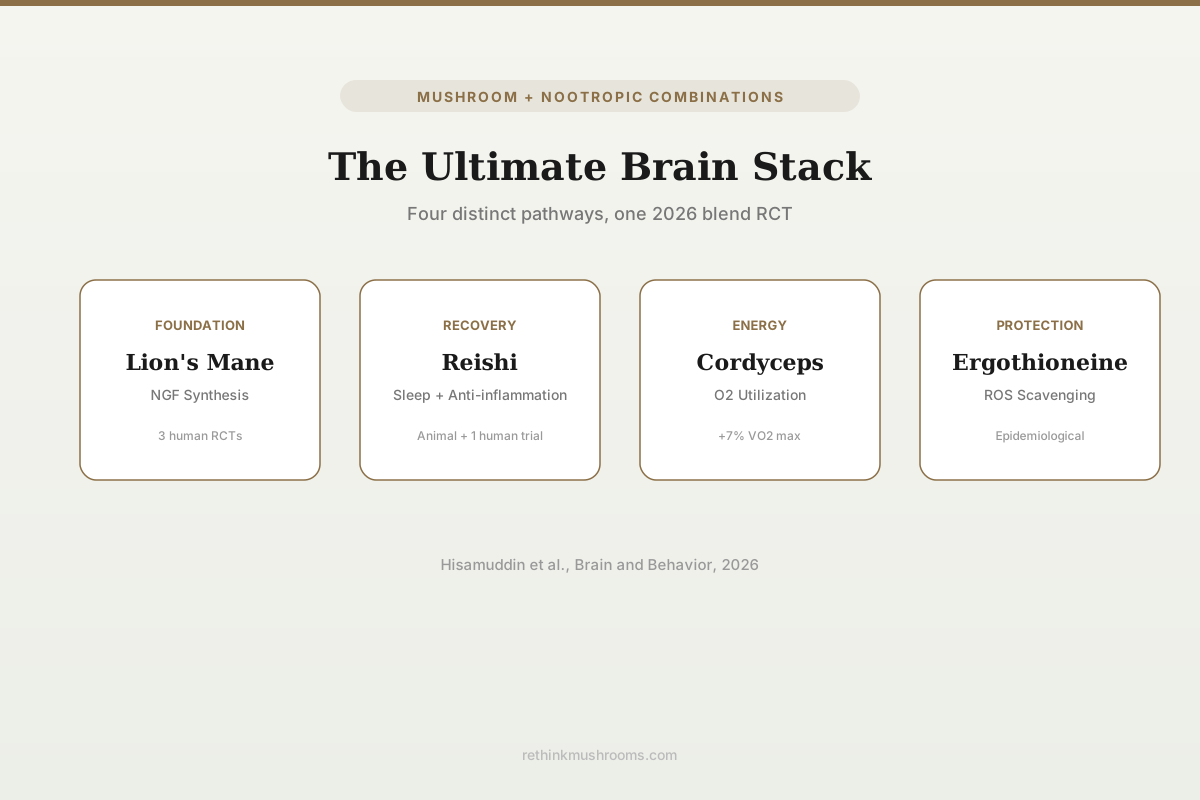
Mushroom nootropics target four distinct brain pathways: NGF synthesis (Lion's Mane), sleep architecture via gut serotonin (Reishi), cellular energy production (Cordyceps), and antioxidant neuroprotection (ergothioneine). One 2026 RCT tested a blend.
Hisamuddin et al., Brain and Behavior, 2026
1 Blend RCT
mushroom combination tested in humans
NGF + Sleep + O2
non-overlapping mechanisms
0
mushroom + synthetic nootropic trials
Hisamuddin et al., Brain and Behavior, 2026
 View as image ↗
The concept of a brain stack, combining multiple compounds that affect cognition through different mechanisms, is central to the nootropic community. Mushrooms occupy a unique position in this space because individual species target genuinely distinct biological pathways rather than variations of the same one. Lion's Mane stimulates nerve growth factor production. Reishi modulates sleep architecture through gut-brain serotonin signaling. Cordyceps enhances oxygen utilization at the mitochondrial level. Ergothioneine selectively protects neuronal tissue from oxidative damage. The question is whether combining these species with each other and with non-mushroom nootropics (bacopa, caffeine, racetams) produces additive benefits or introduces unknown interactions. For a focused look at mushroom-only stacking, see Mushroom nootropic stack: Lion's Mane, Cordyceps, and ergothioneine.
Key Takeaways
- A 2026 randomized double-blind placebo-controlled trial found that a multi-mushroom blend significantly reduced stress, fatigue, and sleep disturbances compared to placebo in healthy adults (Hisamuddin et al., 2026)
- Lion's Mane improved cognitive function in mild cognitive impairment over 16 weeks, with benefits reversing after discontinuation, suggesting ongoing intake is required (Mori et al., 2009)
- Reishi (Ganoderma lucidum) promoted sleep in mice through a gut microbiota-dependent and serotonin-involved pathway, not direct sedation (Yao et al., 2021)
- Ganoderma lucidum polysaccharides attenuated microglia-mediated neuroinflammation and modulated microglial morphology in a TLR4/NF-kB pathway in cell models (Cai et al., 2017)
- Cordyceps Cs-4 raised the ventilatory threshold by 8.5% and the metabolic (lactate) threshold by 10.5% in older adults over 12 weeks, though VO2 max itself was unchanged, supporting an aerobic-efficiency rationale for cognitive stacking (Chen et al., 2010)
- No published study has tested any mushroom species combined with bacopa monnieri, racetams, or other synthetic nootropics
Stack Architecture
Four Non-Overlapping Brain Pathways
Each mushroom layer targets a distinct biological system — and each carries a different weight of human evidence.
Foundation
Lion's Mane
Hericium erinaceus
NGF synthesis / neuroplasticity
Nerve growth factor stimulation supports neuron growth, synaptic connectivity, and myelin integrity.
Recovery
Reishi
Ganoderma lucidum
Gut-serotonin sleep + anti-neuroinflammation
Promotes sleep via a gut microbiota / serotonin pathway (mice) and calms microglial neuroinflammation (cells).
Energy
Cordyceps
Cordyceps sinensis (Cs-4)
Aerobic-threshold efficiency
Raised ventilatory (+8.5%) and metabolic (+10.5%) thresholds over 12 weeks; VO2 max unchanged. Cognitive link is inferred.
Protection
Ergothioneine
from mushroom tissue
Selective antioxidant neuroprotection
Blood levels fall after age 60 and run lower in mild cognitive impairment; protective rather than enhancing.
Sources: Mori 2009; Docherty 2023; Surendran 2025 (Lion’s Mane) · Yao 2021; Cai 2017; Mitra 2024 (Reishi) · Chen 2010 (Cordyceps) · Cheah 2016; Kalaras 2017 (ergothioneine)
The First Mushroom Blend Trial
Hisamuddin et al. (2026) published one of the first randomized, double-blind, placebo-controlled trials testing a multi-mushroom blend supplement (branded Restake) for adaptogenic effects. The 50-participant trial measured psychological stress, fatigue, sleep quality, and stress-hormone biomarkers over 12 weeks in healthy adults.[9]
The mushroom blend group showed significant reductions in perceived stress, fatigue, and sleep disturbances compared to placebo. This is among the first controlled evidence that combining multiple mushroom species produces measurable effects in humans, though the study did not test cognition directly and did not compare the blend to individual species (so it cannot confirm synergy versus additive or even single-species effects).
The study's value for stacking is establishing that a combination product can pass a placebo-controlled test at all. Previous mushroom cognitive claims relied entirely on extrapolation from single-species research. This trial provides a proof-of-concept that multi-mushroom formulations can produce outcomes beyond placebo, even if it does not identify which species or combinations drove the effect.
Lion's Mane: The Neuroplasticity Foundation
Lion's Mane (Hericium erinaceus) remains the strongest candidate for the cognitive core of any mushroom brain stack. Three human trials support its cognitive effects.
Mori et al. (2009) demonstrated improved cognitive scores in 30 adults with mild cognitive impairment over 16 weeks of supplementation at 3,000 mg/day (1 g of Hericium erinaceus dry powder taken three times daily). The key finding for stacking: benefits reversed within four weeks of stopping, indicating Lion's Mane needs to be taken continuously rather than producing lasting structural changes at the studied dose.[1]
Docherty et al. (2023) found both acute effects (detectable at 60 minutes post-dose) and chronic effects (after 28 days) in healthy young adults, including reduced stress and improved cognitive task performance. The dual acute/chronic profile suggests Lion's Mane engages both rapid neurotransmitter-level effects and slower neuroplasticity mechanisms.[2]
Surendran et al. (2025) confirmed acute cognitive effects from a standardized extract, adding to the evidence for rapid-onset activity alongside the better-known chronic benefits.[3]
The rationale for placing Lion's Mane at the center of a brain stack is that NGF stimulation addresses the structural foundation of cognition: neuron growth, synaptic connectivity, and myelin integrity. Other stack components address different layers (energy, protection, sleep), but none replicate the neuroplasticity mechanism.
Reishi: The Sleep and Recovery Layer
Cognitive performance is limited by sleep quality. Poor sleep impairs memory consolidation, executive function, and attentional control more severely than most nutritional deficiencies. Adding a sleep-supportive component to a nootropic stack addresses this bottleneck.
Yao et al. (2021) revealed an unexpected mechanism for Reishi's sleep effects. Rather than acting as a direct sedative, Ganoderma lucidum promoted sleep in mice through a gut microbiota-dependent and serotonin-involved pathway. The mushroom altered gut microbial composition, which increased gut-derived serotonin signaling, which in turn influenced sleep architecture through the gut-brain axis.[4]
This indirect mechanism is relevant to stacking because it means Reishi is unlikely to compete with or interfere with Lion's Mane's direct NGF pathway. The two species target different biological systems (gut-brain serotonin versus neurotrophin signaling), reducing the risk of redundancy or antagonism.
Mitra et al. (2024) tested Ganoderma lucidum supplementation at 500 and 1,000 mg/day in female college students and found improvements in psychological stress and selected fitness parameters. The study provides additional human data supporting Reishi's stress-modulating role in a stack, though it measured psychological stress and physical fitness rather than sleep or cognition directly, so it does not isolate the sleep effect.[5]
Cai et al. (2017) documented a separate neuroprotective mechanism: Ganoderma lucidum polysaccharides attenuated microglia-mediated neuroinflammation through the TLR4/NF-kB pathway. In cell models, the polysaccharides converted microglia from a neurotoxic to a neuroprotective phenotype, reducing the inflammatory mediators that damage neurons.[6]
This gives Reishi two stack-relevant functions: sleep optimization through the gut-serotonin pathway and direct neuroprotection through anti-neuroinflammation. Both operate independently of Lion's Mane's NGF mechanism and Cordyceps' oxygen pathway.
Cordyceps: The Energy Layer
Cordyceps contributes to a brain stack through metabolic enhancement rather than direct neural effects. The brain's baseline energy consumption (approximately 20% of resting metabolic output) makes it sensitive to changes in oxygen delivery and mitochondrial efficiency.
Chen et al. (2010) demonstrated that Cs-4 (Cordyceps sinensis), dosed at 333 mg three times daily for 12 weeks, raised the ventilatory threshold by 8.5% and the metabolic (lactate) threshold by 10.5% in healthy adults aged 50-75. Maximal oxygen consumption (VO2 max) itself did not change; the gains were in the anaerobic thresholds that govern sustainable effort rather than in peak aerobic capacity.[7]
The cognitive relevance is inferred, not measured. Improved metabolic efficiency at submaximal effort plausibly supports sustained mental performance, particularly under cognitive load or fatigue. This mechanism is complementary to Lion's Mane (structural support) and Reishi (sleep/neuroprotection) because it addresses the metabolic substrate rather than neural signaling or inflammatory status. For related evidence on Cordyceps' adaptogenic properties, see Adaptogenic mushrooms for stress: reishi, Cordyceps, and the HPA axis.
Ergothioneine: The Neuroprotective Layer
Ergothioneine adds selective antioxidant protection in brain tissue through the OCTN1 (SLC22A4) transporter. Cheah et al. (2016) showed that whole-blood ergothioneine levels decline significantly after age 60, and that older adults with mild cognitive impairment had significantly lower ergothioneine than age-matched peers, suggesting ergothioneine deficiency may be a risk factor for neurodegeneration.[8]
Kalaras et al. (2017) measured ergothioneine across a range of mushroom species and found it varied widely, from 0.15 to 7.27 mg/g dry weight, with the antioxidant concentrated more in the cap (pileus) than the stem (stipe). Most mushroom supplements provide some ergothioneine incidentally, but the amount varies enormously by species and preparation.[10]
Ergothioneine's role in a stack is protective rather than enhancing. It does not improve cognition directly; it may slow the oxidative damage that degrades cognition over time. This long-horizon mechanism makes it theoretically valuable in a daily stack but essentially impossible to evaluate in short-term trials. For detailed analysis of the mortality and neuroprotection data, see Blood ergothioneine levels and all-cause mortality risk.
Adding Non-Mushroom Nootropics: The Unknowns
The most popular non-mushroom additions to mushroom brain stacks are:
Bacopa monnieri: A plant-derived nootropic with human evidence for memory enhancement over 8-12 weeks. Its mechanism involves bacoside-mediated synaptic strengthening and antioxidant protection. Theoretically complementary to Lion's Mane (NGF synthesis plus synaptic strengthening could be additive), but zero studies test the combination. For a dedicated analysis, see Lion's Mane + Bacopa Monnieri: a nootropic stack with dual neuroplasticity mechanisms.
Caffeine: The most-studied nootropic compound, caffeine enhances alertness and attention through adenosine receptor antagonism. It is mechanistically independent of all mushroom pathways. The practical concern is timing: caffeine's stimulant effects may counteract Reishi's sleep support if both are taken in the same supplement or at the same time of day. For related considerations, see Mushrooms and caffeine: synergistic or redundant?.
Racetams (piracetam, aniracetam): Synthetic compounds that modulate acetylcholine and glutamate signaling. Mechanistically distinct from mushroom compounds, but with significant regulatory and quality-control differences. No interaction data with any mushroom species exists.
The absence of combination data means every mushroom-plus-nootropic stack recommendation is based on theoretical non-overlap of mechanisms. This is a reasonable starting framework, but biological systems regularly produce surprises when compounds are combined. Absorption competition, metabolic interactions, and downstream pathway convergence can all reduce or eliminate expected additive effects. For a detailed comparison of mushroom and synthetic nootropics, see Mushroom nootropics vs. synthetic nootropics: how they compare.
Why Combination Research Is Hard
The absence of mushroom combination trials is not an oversight. Combination studies face regulatory, statistical, and financial barriers that individual-compound studies do not.
Regulatory bodies require safety data for individual ingredients before approving combination studies. Testing a three-species mushroom stack requires establishing the safety and dose range of each species first, tripling the pre-trial investment. Statistical power requirements increase with the number of variables: comparing a three-species blend to placebo requires larger sample sizes than a single-species study to achieve the same confidence, and factorial designs that could identify synergy (testing all possible sub-combinations) require exponentially more participants.
Financial incentives also work against combination research. Mushroom species cannot be patented, so supplement companies funding research have no exclusivity on findings. A company that funds a trial proving Lion's Mane plus Cordyceps produces additive cognitive benefits cannot prevent competitors from using the same combination. This means the return on investment for combination research is systematically lower than for novel proprietary compounds.
The Hisamuddin et al. (2026) blend trial represents an exception, but even that study tested a branded formulation rather than systematically evaluating which species combinations matter. The field needs more studies like this one, and the economic incentives to produce them remain weak.
Practical Framework for Stack Design
Based on the available evidence, a research-informed mushroom brain stack would prioritize:
| Layer | Species/Compound | Function | Evidence Level |
|---|---|---|---|
| Foundation | Lion's Mane | NGF/neuroplasticity | 3 human RCTs |
| Recovery | Reishi | Sleep + anti-neuroinflammation | 1 human trial + animal mechanistic |
| Energy | Cordyceps | Oxygen utilization | 1 human RCT (exercise) |
| Protection | Ergothioneine source | Selective antioxidant | Epidemiological |
| Blend evidence | Multi-mushroom | Stress/fatigue/sleep | 1 human RCT (Hisamuddin 2026) |
The honest assessment: Lion's Mane has the strongest cognitive evidence. Reishi's sleep mechanism is well-characterized in animals. Cordyceps' exercise data is solid but the cognitive extrapolation is unvalidated. Ergothioneine is epidemiologically promising but interventionally untested. The Hisamuddin blend trial confirms that multi-mushroom products can outperform placebo, but does not specify which species or ratios are essential.
This article is educational and is not medical advice. Mushroom and nootropic supplements can interact with medications and are not appropriate for everyone; consult a qualified healthcare provider before starting a stack, particularly if you are pregnant, taking prescription drugs, or managing a health condition.
The Bottom Line
Individual mushroom species target distinct brain pathways: Lion's Mane stimulates NGF, Reishi promotes sleep through gut serotonin, Cordyceps improves oxygen delivery, and ergothioneine provides selective neuroprotection. A 2026 RCT is the first to show a mushroom blend outperforming placebo for stress, fatigue, and sleep. No study has tested mushrooms combined with bacopa, racetams, or other synthetic nootropics. Stack recommendations rest on theoretical mechanism non-overlap, not validated combination data.
Frequently Asked Questions
Sources & References
- 1RTHM-00165·Mori, Koichiro et al. (2009). “Improving effects of the mushroom Yamabushitake (Hericium erinaceus) on mild cognitive impairment: a double-blind placebo-controlled clinical trial..” Phytotherapy research : PTR.Study breakdown →PubMed →↩
- 2RTHM-00821·Docherty, Sarah et al. (2023). “The Acute and Chronic Effects of Lion's Mane Mushroom Supplementation on Cognitive Function, Stress and Mood in Young Adults: A Double-Blind, Parallel Groups, Pilot Study..” Nutrients.Study breakdown →PubMed →↩
- 3RTHM-00952·Surendran, Geyan et al. (2025). “Acute effects of a standardised extract of Hericium erinaceus (Lion's Mane mushroom) on cognition and mood in healthy younger adults: a double-blind randomised placebo-controlled study..” Frontiers in nutrition.Study breakdown →PubMed →↩
- 4RTHM-00731·Yao, Chunyan et al. (2021). “Ganoderma lucidum promotes sleep through a gut microbiota-dependent and serotonin-involved pathway in mice..” Scientific reports.Study breakdown →PubMed →↩
- 5RTHM-00895·Mitra, Sudeep et al. (2024). “Efficacy of Lingzhi or Reishi Medicinal Mushroom Ganoderma lucidum (Agaricomycetes) Supplementation on Psychological Stress and Selective Fitness Profile Parameters in Female College Students in West Bengal, India..” International journal of medicinal mushrooms.Study breakdown →PubMed →↩
- 6RTHM-00462·Cai, Qing et al. (2017). “Polysaccharides from Ganoderma lucidum attenuate microglia-mediated neuroinflammation and modulate microglial phagocytosis and behavioural response..” Journal of neuroinflammation.Study breakdown →PubMed →↩
- 7RTHM-00176·Chen, Steve et al. (2010). “Effect of Cs-4 (Cordyceps sinensis) on exercise performance in healthy older subjects: a double-blind, placebo-controlled trial..” Journal of alternative and complementary medicine (New York.Study breakdown →PubMed →↩
- 8RTHM-00420·Cheah, Irwin K et al. (2016). “Ergothioneine levels in an elderly population decrease with age and incidence of cognitive decline; a risk factor for neurodegeneration?.” Biochemical and biophysical research communications.Study breakdown →PubMed →↩
- 9RTHM-00959·Hisamuddin, Ahmad Safiyyu'd-Din et al. (2026). “Adaptogenic Effects of Mushroom Blend Supplementation on Stress, Fatigue, and Sleep: A Randomised, Double-Blind, and Placebo-Controlled Trial..” Brain and behavior.Study breakdown →PubMed →↩
- 10RTHM-00476·Kalaras, Michael D et al. (2017). “Mushrooms: A rich source of the antioxidants ergothioneine and glutathione..” Food chemistry.Study breakdown →PubMed →↩