Lion's Mane + Nootropic Stacking
41 healthy adults
Docherty et al. (2023), a double-blind pilot RCT, found faster Stroop performance in 41 healthy young adults after a single 1.8g dose of lion's mane. No study has tested any mushroom with any racetam. The combination rationale is entirely mechanistic.
Docherty et al., Nutrients, 2023
NGF
lion's mane primary mechanism (weeks to effect)
ACh
piracetam's primary modulation target (acute effect)
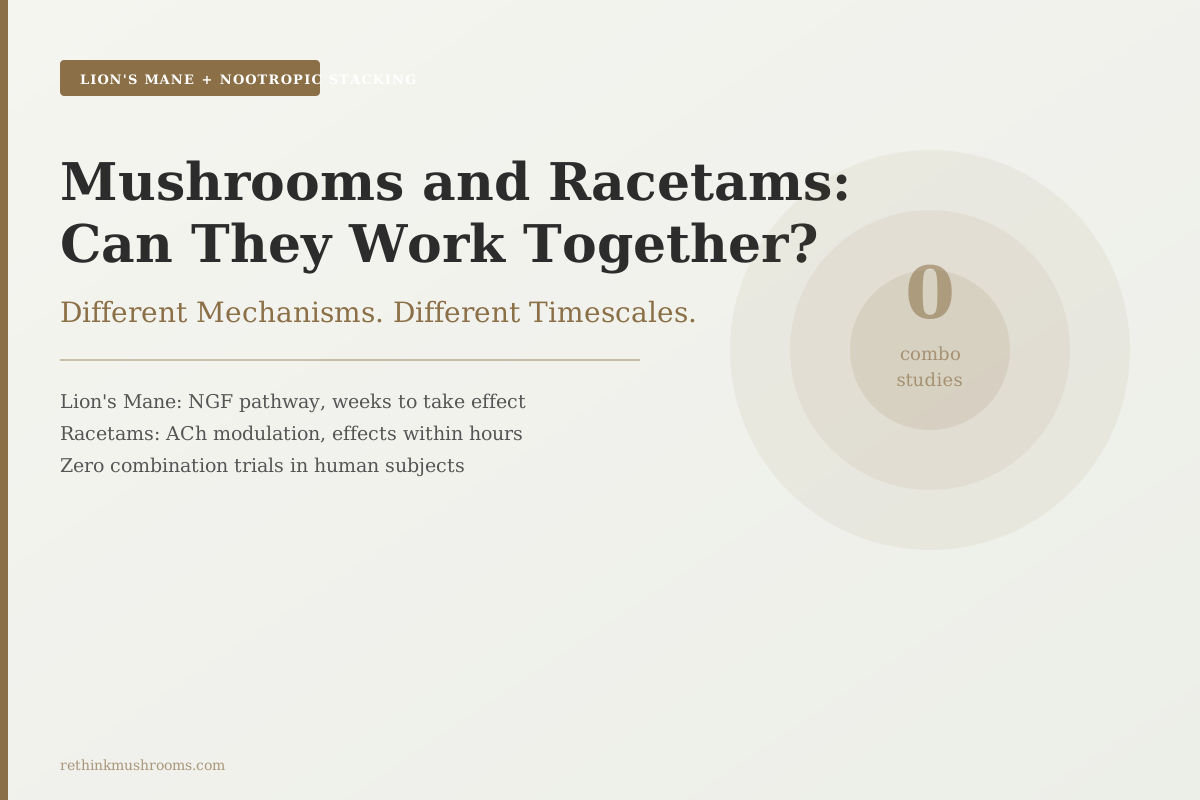
0
combination trials testing any mushroom with any racetam
Docherty et al., Nutrients, 2023
 View as image ↗
The question of whether mushrooms and racetams work together does not have a clinical trial answer. No study has tested lion's mane with piracetam. No study has tested any medicinal mushroom with any racetam compound. This is the honest starting point that every supplement forum and nootropic retailer glosses over.
What does exist: a clear mechanistic picture on both sides. Lion's mane works via nerve growth factor (NGF) upregulation, promoting structural neuroplasticity over weeks. Docherty and colleagues (2023) found an acute cognitive-speed effect in healthy young adults at 1.8g, extending the signal beyond patients with cognitive impairment — though as a pilot study its 28-day outcomes were largely null.[1] Racetams work via acetylcholine receptor modulation and related mechanisms, producing acute cognitive effects. The two approaches operate on different systems at different timescales. That difference is the entire basis for why the combination might make sense — and the ACh substrate issue is why it needs a specific companion supplement that lion's mane cannot provide. This is part of the guide to combining medicinal mushrooms for cognitive effects.
Key Takeaways
- Lion's mane works via NGF upregulation from erinacines (mycelium) and hericerins (fruiting body) — effects accumulate over weeks to months, not hours[3]
- Racetams (piracetam, aniracetam, oxiracetam) modulate acetylcholine signaling and glutamate receptor activity — effects are primarily acute
- Docherty et al. (2023), a double-blind pilot RCT in 41 healthy young adults, found faster Stroop performance 60 min after a single 1.8g dose; its 28-day outcomes were largely null, with only a non-significant trend toward reduced stress[1]
- The combination rationale: different mechanisms = theoretically additive without pharmacological interference
- The honest constraint: racetams deplete acetylcholine substrate, requiring choline supplementation that lion's mane does not provide
- Legal note: piracetam is not FDA-approved in the US (not a food or dietary supplement), though widely prescribed in Europe
Fact Check — the stack
What 'mushrooms and racetams work together' really means
The claim
“Lion's mane and racetams are a proven synergistic stack — combining them multiplies the cognitive benefit.”
Nootropic forums and supplement retailers
What research shows
OverstatedNo published clinical trial has ever tested any mushroom species alongside any racetam in humans. Every claim about this combination — including this article's — is mechanistic inference, not measured synergy.
The two do act on different systems (NGF-driven neuroplasticity over weeks versus acetylcholine and glutamate modulation acutely), so there is a real rationale for additive effects without pharmacological conflict. But 'additive in theory' is not 'synergistic in practice,' and only a combination trial could tell them apart.
No combination trial exists; mechanistic basis from Mori 2009 [ref 2] and Docherty 2023 [ref 1]
Can You Take Lion's Mane With Piracetam? The Short Answer
Yes, in terms of known pharmacology: lion's mane and piracetam do not share a mechanism, compete for the same receptors, or produce known adverse interactions. Lion's mane works by stimulating nerve growth factor (NGF) production — a growth factor process that plays out over weeks. Piracetam works by modulating acetylcholine (ACh) receptor activity and AMPA glutamate receptors — an acute effect detectable within hours.
These are different systems. A 2009 clinical trial found lion's mane (750mg daily) improved cognitive scores in MCI patients over 16 weeks via the NGF pathway.[2] Piracetam was developed in the 1960s as an ACh receptor sensitizer with acute effects. Neither mechanism is doing the same thing in the same place at the same time. The combination rationale is that they cover different aspects of cognitive function without pharmacological conflict.
The important caveat: piracetam increases acetylcholine demand. Lion's mane does not supply choline for ACh synthesis. If you are using piracetam without a choline source, you may deplete ACh substrate and experience cognitive fatigue or headaches regardless of whether you are also taking lion's mane. This is the choline gap that every honest analysis of racetam use needs to address.
How Lion's Mane Works: The NGF and Growth Factor Pathway
Lion's mane (Hericium erinaceus) promotes cognitive function through structural neuroplasticity. The mycelium contains erinacines, which stimulate glial cells to produce more NGF. Mori and colleagues (2008) documented this mechanism in 1321N1 human astrocytoma cells: H. erinaceus extract induced NGF synthesis directly in human brain-derived cells, establishing the cellular basis for later work.[3]
When NGF rises, neurons extend new branches and form new synaptic connections. This is structural neuroplasticity: building new hardware. Mori and colleagues (2009) found that 750mg daily over 16 weeks produced significant cognitive score improvements in MCI patients, with scores declining after stopping supplementation — confirming the benefits are ongoing and dependent on continued use.[2]
The fruiting body adds a second mechanism. Martínez-Mármol and colleagues (2023) found that hericerin derivatives from the mushroom activate a second growth cascade, ERK1/2.[4] This pathway promotes new neural branch growth in cultured hippocampal neurons, separately from the mycelium's erinacine mechanism. In humans, Docherty and colleagues (2023) found a measurable acute effect (faster Stroop performance at 60 minutes) in healthy young adults; the 28-day cognitive and mood outcomes were largely null, with only a non-significant trend toward reduced stress.[1]
The 2025 systematic review by Menon and colleagues pooled the H. erinaceus evidence base — five randomized controlled trials, three pilot clinical trials, and 15 laboratory studies — and summarized cognitive, neuroprotective, and mood-related findings, with commonly studied doses ranging from roughly 500mg to 3g daily and no serious adverse events reported.[5]
Docherty et al. (2023) · Nutrients
- Population
- 41 healthy adults aged 18–45
- Intervention
- 1.8 g/day Hericium erinaceus — a single acute dose, then 28-day supplementation
- Comparator
- Placebo (double-blind, parallel groups)
- Finding
- Participants performed faster on the Stroop task 60 minutes after a single dose (p = 0.005). Over 28 days, results were mostly null, with only a non-significant trend toward reduced subjective stress (p = 0.051).
mixed This is the clearest sign lion's mane does something in healthy (not just impaired) people — but it is a small pilot, the acute win was a processing-speed measure, and the longer-term cognitive and mood outcomes did not reach significance.
Docherty et al., Nutrients, 2023 [ref 1]
- Cell & Lab Studiescompleted
H. erinaceus induces NGF synthesis in 1321N1 human astrocytoma cells (Mori 2008)
- Animal & Neuron Studiescompleted
Hericerin derivatives drive neurite outgrowth and ERK1/2 signaling, enhancing spatial memory in mice (Martínez-Mármol 2023)
- Small Human Trialscurrent
Mori 2009 (16-week RCT in MCI patients) and Docherty 2023 (double-blind pilot in 41 healthy adults)
- Systematic Reviewscurrent
Menon 2025 pooled five RCTs, three pilot trials, and 15 lab studies under PRISMA
- Large Randomized Trialsmissing
No large, multi-center cognitive trials in healthy adults; no dose-optimization trials
- Mushroom + Racetam Combination Trialmissing
No trial has ever tested any mushroom with any racetam
Lion's mane's mechanism is well-characterized in cells and animals and supported by two small human trials plus a systematic review — but the specific mushroom-plus-racetam question sits at the very bottom rung with zero direct evidence.
Mori 2008 [ref 3]; Martínez-Mármol 2023 [ref 4]; Mori 2009 [ref 2]; Docherty 2023 [ref 1]; Menon 2025 [ref 5]
How Racetams Work: Three Compounds, Three Mechanisms
Racetams are a class of synthetic cognitive compounds all sharing a pyrrolidone core structure. They differ meaningfully in their specific mechanisms. Understanding the three most common compounds helps frame why mushrooms and racetams are mechanistically compatible.
Piracetam
Piracetam, the original racetam developed in 1964, works primarily by upregulating acetylcholine receptor sensitivity and modulating AMPA glutamate receptors. This enhances acetylcholine neurotransmission efficiency in existing circuits. It also facilitates long-term potentiation, the synaptic process underlying memory consolidation, through glutamate receptor modulation. Effects are acute: piracetam produces measurable effects on cognitive performance within hours. It does not upregulate NGF or affect structural neuroplasticity in the way lion's mane does.
The key metabolic consequence: piracetam's enhanced ACh receptor activity increases the rate at which neurons cycle through acetylcholine. This depletes choline substrate if dietary or supplemental choline intake is insufficient. The result — headaches, mental fog, fatigue — is a widely reported side effect of piracetam use without adequate choline supplementation.
Aniracetam
Aniracetam primarily enhances AMPA receptor sensitivity, boosting the fast excitatory signaling that supports learning and memory. It also has anxiolytic properties through serotonin pathways, making it somewhat distinct from piracetam in the breadth of its effects. Aniracetam is fat-soluble (unlike piracetam, which is water-soluble), affecting its dosing and absorption profile. The cognitive effects include improved creative thinking and anxiety reduction alongside the working memory and focus effects shared with piracetam.
Oxiracetam
Oxiracetam has the strongest stimulant effect among the common racetams. It targets both AMPA receptors (the same system aniracetam uses) and NMDA receptors, a second glutamate receptor type. This broader receptor coverage produces more pronounced focus and concentration effects compared to piracetam. Like piracetam, it depletes acetylcholine substrate with regular use and should be accompanied by adequate choline supplementation.
Why Different Mechanisms Make Combination Theoretically Rational
Lion's mane and racetams do not share a mechanism, do not compete for the same receptors, and do not interfere with each other's downstream pathways in any documented way. This is the core mechanistic argument for why they can be stacked.
Racetams operate on a timescale of hours: they modulate ACh and glutamate receptor activity acutely, producing faster information processing, better working memory, and improved memory consolidation within a study session. Lion's mane operates on a timescale of weeks: it upregulates NGF and activates hericenone pathways to promote new neural connections over months.
These timescales are additive in a meaningful sense. A racetam user taking lion's mane alongside a long-term protocol is getting acute ACh receptor optimization (from the racetam, within hours) layered on top of slowly accumulating structural neuroplasticity (from the mushroom, over months). The two effects are not amplifying the same signal. They are building and optimizing separate aspects of cognitive infrastructure at different rates.
The honest framing: this is mechanistic reasoning applied to established individual compound data. No combination trial validates it. The absence of known pharmacological interaction is not the same as confirmed additive benefit.
The Acetylcholine Problem: What Lion's Mane Does and Doesn't Cover
This is the most important practical constraint in the mushrooms-and-racetams combination, and it is almost universally absent from competitor content.
Racetams — all three described above — increase acetylcholine activity. Piracetam upregulates ACh receptor sensitivity and increases ACh release. Aniracetam and oxiracetam potentiate AMPA glutamate receptors, increasing the frequency of synaptic firing. This accelerated activity increases acetylcholine turnover, depleting choline substrate if intake is insufficient. This accelerated ACh cycling depletes choline substrate if intake is insufficient.
Lion's mane does not supply choline. The NGF pathway promotes neurite outgrowth and synapse formation, not acetylcholine synthesis. The erinacine-NGF mechanism and the hericenone-ERK1/2 mechanism are both growth factor pathways, not cholinergic ones. Taking lion's mane with piracetam does not protect against the choline depletion that piracetam causes.
What does protect against it: choline precursors. Alpha-GPC (alpha-glycerophosphocholine) and citicoline (CDP-choline) are the two most studied choline sources in nootropic research. Both supply readily bioavailable choline for ACh synthesis, countering the substrate depletion that racetam use accelerates. A complete mushrooms-and-racetams protocol that does not include a choline source is missing a critical piece, and lion's mane is not a substitute for it.
Safety — the choline gap and racetam sourcing
ModerateLion's mane does not cover the acetylcholine cost of a racetam
Concern
Racetams accelerate acetylcholine turnover, and lion's mane supplies no choline for acetylcholine synthesis. Using a racetam without a choline source can cause headaches, mental fog, and fatigue regardless of whether lion's mane is in the stack. Separately, piracetam is not an approved dietary supplement in the US, so products bought from research-chemical vendors sit outside pharmaceutical quality control.
What the research says
If you use a racetam, pair it with a dedicated choline source (Alpha-GPC or citicoline) — lion's mane cannot substitute for it. Treat racetam quality and legal status as a separate question from the mushroom.
Particularly relevant for: Anyone combining a racetam with lion's mane, especially without a choline source
What to do
Consult a physician before starting this combination. This article is educational and is not medical advice.
Mechanistic basis: racetam cholinergic pharmacology; Menon 2025 lion's mane safety review [ref 5]
The Legal Context on Piracetam's Status
This section is absent from virtually every competitor article on mushrooms and racetams, but it matters for reader safety.
In the United States: Piracetam is not FDA-approved as a food, dietary supplement, or drug. It is not on the Generally Recognized as Safe (GRAS) list. The FDA has issued warning letters to companies selling piracetam as a dietary supplement. It exists in a regulatory grey area: technically illegal as a dietary supplement under current FDA interpretation, but not actively banned as a controlled substance. It can be purchased online from research chemical suppliers and through international pharmacies.
In Europe: Piracetam is a prescription medication in most countries (sold as Nootropil). It is prescribed for myoclonus (a neurological disorder), cognitive impairment following stroke, and other conditions. It is not a dietary supplement there — it is a drug with prescription requirements.
The practical implication: Readers in the US who are interested in piracetam are obtaining it through channels that operate outside pharmaceutical regulatory oversight. The compound itself has a long safety record in European clinical use, but the quality and purity of products purchased from unregulated sources cannot be verified in the same way.
Aniracetam and oxiracetam have similar regulatory status in the US: not FDA-approved as dietary supplements, not scheduled as controlled substances, available through research chemical markets. The safety and quality considerations are the same.
Mushrooms and Racetams: What Honest Stacking Looks Like
Taking lion's mane alongside a racetam is mechanistically reasonable given the separate pathways and different timescales. Here is what an honest protocol design looks like based on the available evidence.
Lion's mane doses with human evidence: 750mg daily (Mori 2009, MCI patients) to 1.8g daily (Docherty 2023, healthy young adults). Fruiting body extracts deliver hericerins; mycelium extracts deliver erinacines. Full-spectrum products covering both address both mechanisms.[1][2]
Research vs. Retail
Lion's mane (Hericium erinaceus): Research vs. commercial doses
What research used
750 mg – 1.8 g/day
Oral capsules or extract
Daily · 16 weeks (Mori 2009) to 28 days (Docherty 2023)
750 mg/day improved cognition in MCI patients (Mori 2009); 1.8 g/day sped Stroop performance in healthy adults (Docherty 2023)
What supplements sell
500–3000 mg/day
Oral capsules or powder
Once or twice daily
Fruiting-body extracts, mycelium, or full-spectrum blends; erinacine/hericenone content usually unlabeled
Human evidence clusters at 750 mg–1.8 g/day. Full-spectrum products that cover both fruiting-body (hericenones) and mycelium (erinacines) address both documented mechanisms — but no lion's mane product has been tested alongside a racetam.
- *None of these doses were studied in combination with a racetam.
- *A racetam still requires a separate choline source; lion's mane does not provide one.
- *This is informational only and not a dosing recommendation.
Mori et al. 2009 [ref 2]; Docherty et al. 2023 [ref 1]; Menon et al. 2025 [ref 5]
What lion's mane adds to a racetam protocol: long-term structural neuroplasticity via NGF (accumulated over weeks to months) and possible acute executive function support at the 60-minute timescale. It does not accelerate racetam effects. It does not solve the ACh substrate issue.
What a racetam protocol still requires: a choline source (Alpha-GPC or citicoline) to counter the acetylcholine substrate depletion that piracetam, aniracetam, and oxiracetam accelerate. This is separate from lion's mane and cannot be substituted by it.
What neither can tell you: whether the combination produces additive cognitive benefit beyond what each does alone. That question has not been tested. For cycling considerations on long-term mushroom protocols — relevant for anyone using these over months — the guide to mushroom supplement cycling covers the on/off evidence. For the broader nootropic stacking picture, the lion's mane nootropic stacks guide covers the full range of evidence-based pairing options. For the lion's mane and bacopa combination which has the clearest mechanistic case in this cluster, the dual neuroplasticity stack analysis covers both bodies of evidence.
The Bottom Line
Lion's mane and racetams work through entirely separate mechanisms on different timescales: NGF-driven structural neuroplasticity over weeks versus acetylcholine modulation and glutamate receptor sensitization acutely. Two human trials tested lion's mane cognitive effects directly (Mori 2009 in MCI patients; the Docherty 2023 pilot in healthy young adults), and a 2025 systematic review pooled the wider evidence base. No combination trial exists for any mushroom with any racetam. The combination is mechanistically rational but empirically untested, and it requires a separate choline source that lion's mane cannot provide. Legal status of piracetam in the US is a grey area that competitors consistently fail to mention.
Frequently Asked Questions
Sources & References
- 1RTHM-00821·Docherty, Sarah et al. (2023). “The Acute and Chronic Effects of Lion's Mane Mushroom Supplementation on Cognitive Function, Stress and Mood in Young Adults: A Double-Blind, Parallel Groups, Pilot Study..” Nutrients.Study breakdown →PubMed →↩
- 2RTHM-00165·Mori, Koichiro et al. (2009). “Improving effects of the mushroom Yamabushitake (Hericium erinaceus) on mild cognitive impairment: a double-blind placebo-controlled clinical trial..” Phytotherapy research : PTR.Study breakdown →PubMed →↩
- 3RTHM-00268·Mori, Koichiro et al. (2008). “Nerve growth factor-inducing activity of Hericium erinaceus in 1321N1 human astrocytoma cells..” Biological & pharmaceutical bulletin.Study breakdown →PubMed →↩
- 4RTHM-01746·Martínez-Mármol, Ramón et al. (2023). “Hericerin derivatives activates a pan-neurotrophic pathway in central hippocampal neurons converging to ERK1/2 signaling enhancing spatial memory..” Journal of neurochemistry.Study breakdown →PubMed →↩
- 5RTHM-00943·Menon, Arya et al. (2025). “Benefits, side effects, and uses of Hericium erinaceus as a supplement: a systematic review..” Frontiers in nutrition.Study breakdown →PubMed →↩