Lion's Mane & Myelin Repair
2 independent repair pathways
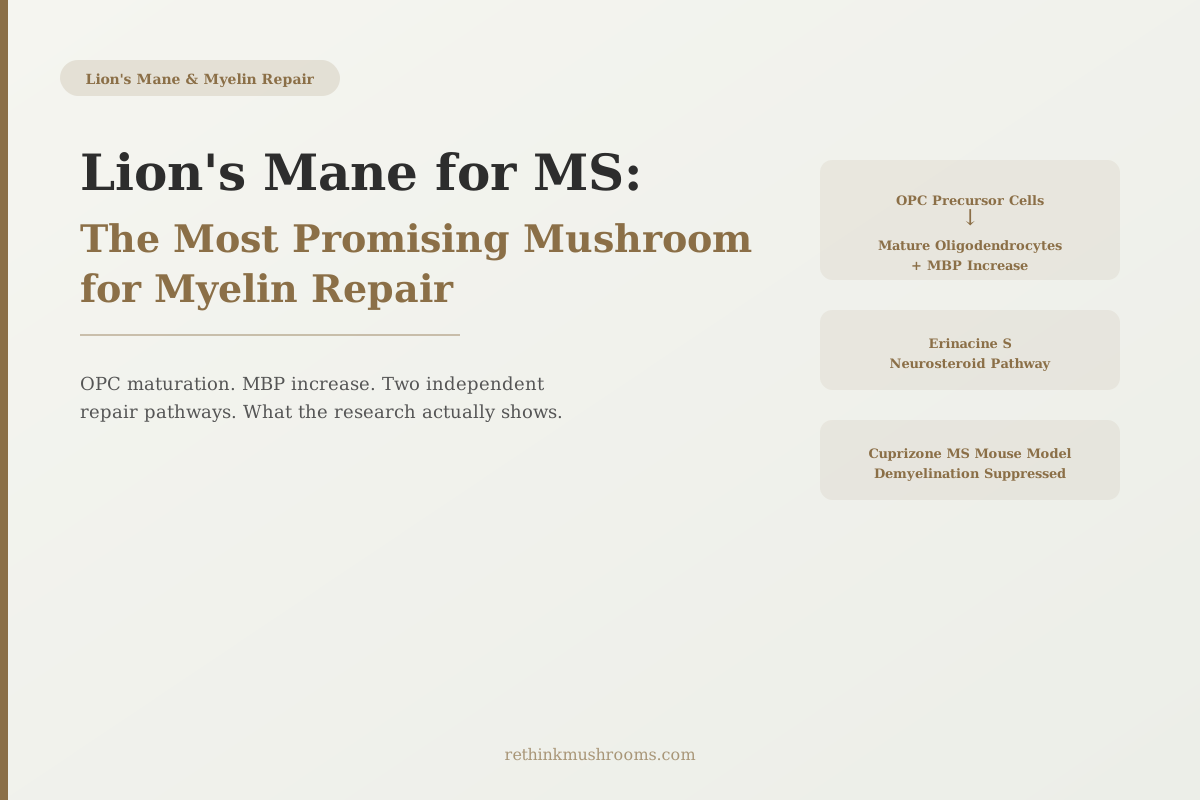
Lion's mane mycelium extracts promote oligodendrocyte maturation and increase myelin basic protein through two distinct biochemical routes — a 2021 breakthrough and a 2023 follow-up discovery.
Huang et al., Scientific Reports, 2021 / Lin et al., J Food Drug Anal, 2023
2003
Year the first in vitro lion's mane myelination study was published
2022
Year an MS mouse model tested mushrooms for demyelination suppression
0
Human clinical trials testing lion's mane in MS patients
Huang et al., Scientific Reports, 2021 / Lin et al., J Food Drug Anal, 2023
 View as image ↗
Multiple sclerosis strips the insulating sheath off nerve fibers. The condition is both demyelinating — damaging the myelin that makes fast, efficient nerve signaling possible — and autoimmune, meaning the damage is caused by the body's own immune system attacking that myelin.
The cells responsible for making and repairing myelin are called oligodendrocytes. In MS, they are damaged or destroyed. Remyelination — the process of rebuilding myelin by generating new oligodendrocytes from precursor cells — is the central target of MS research that aims to reverse damage rather than just slow it.
Of the mushrooms studied for MS-relevant biology, lion's mane (Hericium erinaceus) has the most direct preclinical evidence for the remyelination pathway specifically. This article covers what that evidence is, how strong it is, and where it stops. For a broader overview of mushrooms and brain health, see our pillar on mushrooms and cognitive aging.
Key Takeaways
- Huang (2021) found that lion's mane mycelium extract promoted oligodendrocyte precursor cell (OPC) maturation and measurably increased myelin basic protein (MBP) on neuronal fibers — the most direct remyelination evidence for any mushroom
- Two active compounds in lion's mane mycelium — erinacine A (HeA) and erinacine S (HeS) — were identified as the agents driving OPC maturation; oral administration in neonatal rats also increased corpus callosum MBP
- Lin (2023) identified a second independent repair pathway: erinacine S promotes neuronal regeneration through neurosteroid accumulation — a distinct biochemical route from OPC maturation
- Kolotushkina (2003) showed lion's mane extract accelerated myelination onset in cultured cerebellar cells — the foundational evidence published 20 years before the OPC mechanism was fully understood
- Yamashina (2022) tested medicinal mushroom fruiting bodies in a cuprizone-induced MS mouse model — the gold-standard preclinical MS model — and found demyelination suppression and preserved motor function
- No human clinical trials have tested lion's mane for any MS outcome; all evidence is preclinical
Can Lion's Mane Mushroom Help with Multiple Sclerosis? The Direct Evidence
Preclinical evidence shows lion's mane can support the specific cellular process responsible for myelin production. Huang et al. (2021) found that mycelium extract promoted differentiation of oligodendrocyte precursor cells into mature, myelin-producing oligodendrocytes and increased myelin basic protein on neuronal fibers in laboratory conditions.[1] Whether this translates to myelin repair in MS patients has not been tested in any human trial.
The mechanism is specific to myelin, not just general neuroprotection — which is what distinguishes lion's mane from mushrooms that support neurological health through anti-inflammatory or antioxidant pathways alone.
What Remyelination Actually Means — and Why It Matters for MS
To understand why the lion's mane research matters, it helps to know how remyelination works and why it's considered the frontier of MS therapy.
Myelin is not a passive coating. It is produced and maintained by specialized cells called oligodendrocytes. Each oligodendrocyte extends processes that wrap around nearby nerve axons, creating the myelin sheath that allows signals to travel at high speed. In MS, autoreactive immune cells attack and strip this myelin, and the oligodendrocytes that made it are often damaged or killed in the process.
The brain and spinal cord contain oligodendrocyte precursor cells (OPCs) — a pool of cells that can, under the right conditions, differentiate into new oligodendrocytes and re-myelinate damaged axons. Remyelination — the regeneration of myelin — happens naturally after acute MS episodes but becomes progressively less efficient as the disease progresses.
Current MS disease-modifying therapies are largely immunosuppressive: they reduce how often immune attacks occur. They do not directly promote remyelination. A compound that specifically stimulates OPC maturation into functional oligodendrocytes would address MS biology at the repair level, not just the damage-prevention level. That is why the Huang 2021 finding is considered significant in the research context.
The 2021 Breakthrough: Oligodendrocyte Maturation and Myelin Basic Protein
The most direct evidence connecting lion's mane to the myelin repair process comes from Huang et al.'s 2021 study published in Scientific Reports.[1]
The researchers applied Hericium erinaceus mycelium (HEM) extract to cultures of oligodendrocyte precursor cells. Two outcomes were measured: (1) whether OPCs differentiated into mature oligodendrocytes, and (2) whether myelin basic protein (MBP) — the structural protein that makes up a major component of the myelin sheath — increased on neuronal fibers.
Both happened. OPC maturation into mature oligodendrocytes was promoted by HEM. MBP on neuronal fibers measurably increased.
The researchers then identified which specific compounds in HEM were responsible. Two erinacine compounds — erinacine A (HeA) and erinacine S (HeS) — showed the most potent activity in promoting OPC differentiation. Erinacines are diterpenoid compounds found specifically in lion's mane mycelium (not fruiting body) that are known to cross the blood-brain barrier.
The study extended the findings to a living animal: neonatal rats given oral HEM showed increased MBP expression in the corpus callosum — the white-matter-rich bundle of fibers connecting the brain's two hemispheres, and one of the regions most commonly affected by MS lesions.
This is not a claim that lion's mane reverses MS. It is a finding that the specific cellular machinery responsible for making myelin can be influenced by compounds in lion's mane — in cell culture and in a rat brain.
For the detailed mechanistic picture of how erinacines cross the blood-brain barrier and drive these effects, see erinacines: the compounds that cross the blood-brain barrier.
Before 2021: The 2003 Study That Started the Research Thread
The Huang 2021 study is not the first evidence connecting lion's mane to myelination. Nearly two decades earlier, Kolotushkina et al. (2003) published a study in the Ukrainian physiology journal Fiziolohichnyi zhurnal that demonstrated something similar in a simpler model.[2]
Kolotushkina's team applied H. erinaceus extract to cerebellar cell cultures — a mixed culture containing neurons, glial cells, and the precursors to myelinating cells. They observed two things: the extract accelerated the onset of myelination (nerve fibers became myelinated sooner) and increased the rate at which myelination proceeded. No cytotoxicity was observed — the extract did not harm the cells.
This 2003 finding was not widely incorporated into consumer or clinical awareness of lion's mane for MS. It appeared in a Ukrainian-language physiology journal that is not indexed in the major English-language databases. But it established the basic finding — that lion's mane extracts can promote myelination in laboratory conditions — at a time when the OPC mechanism and the specific erinacine compounds responsible had not yet been identified.
The scientific significance of having both 2003 and 2021 evidence is that the core finding (lion's mane promotes myelination in nerve cells) has been replicated across different cell culture systems and experimental approaches over 18 years, and has now been connected to specific bioactive compounds and specific cellular mechanisms.
NGF and Neurite Outgrowth: A Parallel Mechanism, But Different From Myelin Repair
Lai et al. (2013) published one of the most-cited lion's mane neuroprotection studies: lion's mane extracts combined with low concentrations of nerve growth factor (NGF) produced a 60.6% increase in neurite outgrowth in neurons in culture, and induced extracellular NGF secretion independently.[3]
Neurite outgrowth — the extension of axon-like and dendrite-like processes from neurons — is associated with nerve repair and regeneration. NGF supports neuron survival, regulates synaptic strength, and is deficient in several neurodegenerative conditions.
This is relevant to MS. But it is a different mechanism from the OPC maturation finding.
NGF primarily supports the health of neurons (the nerve cells themselves) and promotes growth of their axonal projections. The OPC → oligodendrocyte → MBP pathway addresses the cells that make the myelin sheath wrapped around those axons.
Both mechanisms are relevant to MS recovery — damaged axons need support as much as stripped myelin needs to be replaced — but they operate at the level of different cell types. When competitors say "lion's mane stimulates NGF which supports myelination," they are conflating two distinct pathways. The NGF pathway supports neuron health; the OPC maturation pathway directly addresses myelin production.
For the complete picture of how NGF stimulation works in lion's mane biology, see hericenones and NGF synthesis: how lion's mane stimulates nerve growth.
Erinacine S: A Second Independent Repair Pathway
Lin et al. (2023) published a follow-up finding that adds a second mechanistically distinct pathway to the lion's mane MS story.[4]
Erinacine S — the same compound identified by Huang 2021 as one of the two key OPC maturation drivers — was found to promote neuronal regeneration through a different route: it induces the accumulation of neurosteroids.
Neurosteroids are steroid compounds synthesized in the brain and nervous system that regulate neuron development, survival, and activity. They play a role in myelin maintenance through their influence on Schwann cells and oligodendrocytes. Erinacine S triggering neurosteroid accumulation is a mechanism independent of the OPC differentiation pathway — it represents a second biochemical route by which the same compound supports nervous system repair.
Having two distinct repair pathways active through overlapping but distinct mechanisms is relevant because they may be additive: a compound that promotes OPC maturation AND increases neurosteroid levels might support remyelination more robustly than a compound working through either pathway alone.
The MS Mouse Model: What Yamashina 2022 Actually Tested
Yamashina et al. (2022) conducted the study that is most directly relevant to MS as a clinical condition — and the one no competitor has cited.[5]
The researchers used the cuprizone model — the most widely used preclinical animal model for MS demyelination. Cuprizone is a copper chelator; when fed to mice, it selectively damages oligodendrocytes, producing demyelination that closely mimics the white matter lesions of MS. After the cuprizone is removed, remyelination begins, allowing researchers to measure both how much demyelination occurred and how well repair proceeds.
Into this model, Yamashina's team introduced fruiting bodies from multiple medicinal mushroom species. The fruiting bodies of the tested mushroom species — a group that included lion's mane — suppressed demyelination markers and preserved motor function in the cuprizone-exposed mice compared to controls.
This is qualitatively different from the cell culture studies. The cuprizone model produces MS-like demyelination through a recognized mechanism, in a living animal, with measurable neurological outcomes. Mushroom fruiting bodies reduced that demyelination.
The specific degree of lion's mane's contribution relative to other species in the study is not independently quantifiable from the brief. But lion's mane was among the mushrooms tested in this MS-mimicking model, and the overall finding — demyelination suppression — was significant.
The Bench-to-Bedside Gap: What Brandalise 2023 Honestly Concludes
Brandalise et al.'s 2023 systematic review in the Journal of Fungi is titled, with notable transparency: "Hericium erinaceus in Neurodegenerative Diseases: From Bench to Bedside and Beyond, How Far from the Shoreline?"[6]
Their conclusion: the preclinical evidence for lion's mane in neurodegenerative conditions, including MS-relevant mechanisms, is strong and mechanistically coherent. Human clinical trials in MS patients specifically are absent. The distance from current evidence to clinical application is not trivial.
This framing matters because the preclinical research is genuinely promising — the findings in cell culture and animal models are specific, reproducible across laboratories, and mechanistically connected to what goes wrong in MS. But many compounds that work in rodents fail in humans. The biology is never identical. The dosing, bioavailability, and timing of interventions that produce effects in cells and mice do not automatically translate to equivalent protocols in humans.
Brandalise's "how far from the shoreline?" framing is the appropriate epistemic position for anyone reading this literature: we can see the direction, we cannot measure the distance. For MS patients wanting to understand where lion's mane research actually stands, this is the honest answer.
Safety for MS Patients: What the Research Does and Doesn't Tell Us
The 2023 systematic review confirmed a favorable safety profile for lion's mane supplementation across the available human studies — no serious adverse effects reported across clinical trials conducted to date.[6]
What the research does not yet provide is safety data for MS patients specifically — particularly those taking disease-modifying therapies. Lion's mane has immunomodulatory properties, and MS medications frequently alter immune function. Whether lion's mane interacts with interferon-beta, natalizumab, ocrelizumab, or other DMTs is unstudied.
The broader safety picture for mushroom supplements in MS — including Reishi and the interactions with immunosuppressant therapies — is covered in the dedicated piece on mushroom supplements and MS: safety considerations. For the broader overview of how multiple mushroom species approach MS biology, see mushrooms and multiple sclerosis: immune modulation and remyelination.
Related topics: mushrooms and remyelination: cross-species research on multiple sclerosis covers how lion's mane compares to other species in the remyelination evidence base. Lion's mane after concussion: can it help recovery? explores the overlapping OPC and neurite outgrowth evidence in the context of traumatic brain injury.
The Bottom Line
Lion's mane has the most direct preclinical evidence for myelin repair among medicinal mushrooms — specifically, Huang 2021's finding that lion's mane mycelium extract promotes oligodendrocyte precursor cell maturation and increases myelin basic protein on neuronal fibers. Two active erinacine compounds (HeA and HeS) were identified as responsible. A 2023 study added a second independent repair pathway via neurosteroid accumulation. A 2022 study using the cuprizone MS mouse model found fruiting bodies from lion's mane suppressed demyelination. No human clinical trials have tested lion's mane in MS patients.
Frequently Asked Questions
Sources & References
- 1RTHM-00692·Huang, Hui-Ting et al. (2021). “Hericium erinaceus mycelium and its small bioactive compounds promote oligodendrocyte maturation with an increase in myelin basic protein..” Scientific reports.Study breakdown →PubMed →↩
- 2RTHM-00058·Kolotushkina, E V et al. (2003). “The influence of Hericium erinaceus extract on myelination process in vitro..” Fiziolohichnyi zhurnal (Kiev.Study breakdown →PubMed →↩
- 3RTHM-00295·Lai, Puei-Lene et al. (2013). “Neurotrophic properties of the Lion's mane medicinal mushroom, Hericium erinaceus (Higher Basidiomycetes) from Malaysia..” International journal of medicinal mushrooms.Study breakdown →PubMed →↩
- 4RTHM-01734·Lin, Chun-Yu et al. (2023). “Erinacine S from Hericium erinaceus mycelium promotes neuronal regeneration by inducing neurosteroids accumulation..” Journal of food and drug analysis.Study breakdown →PubMed →↩
- 5RTHM-01637·Yamashina, Kota et al. (2022). “Suppressive Effect of Fruiting Bodies of Medicinal Mushrooms on Demyelination and Motor Dysfunction in a Cuprizone-Induced Multiple Sclerosis Mouse Model..” International journal of medicinal mushrooms.Study breakdown →PubMed →↩
- 6RTHM-01662·Brandalise, Federico et al. (2023). “Hericium erinaceus in Neurodegenerative Diseases: From Bench to Bedside and Beyond, How Far from the Shoreline?.” Journal of fungi (Basel.Study breakdown →PubMed →↩