Mushrooms & Brain Health
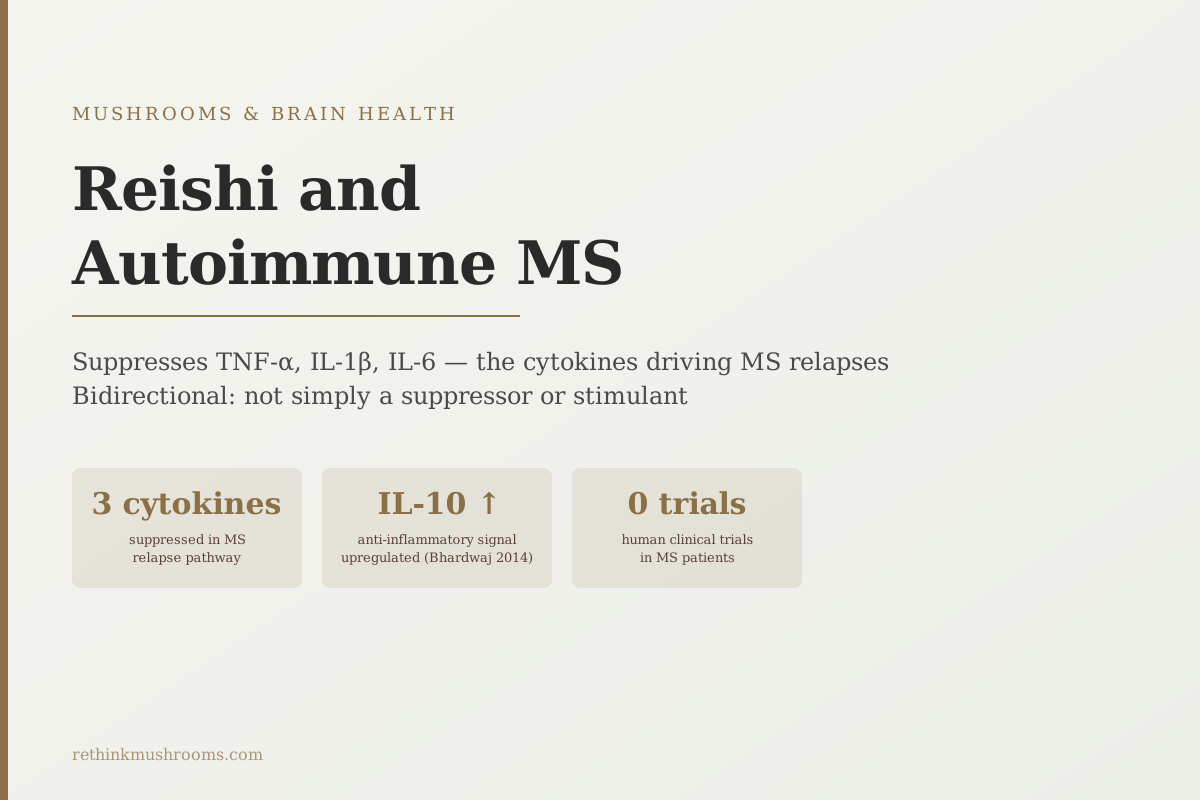
Bidirectional immune modulation
Reishi (Ganoderma lucidum) suppresses the same pro-inflammatory cytokines — TNF-α, IL-1β, and IL-6 — that drive MS relapses, while simultaneously upregulating IL-10, an anti-inflammatory signaling protein. The catch: its immune effects go in multiple directions at once.
Bhardwaj et al., Recent Patents Inflamm Allergy Drug Discov, 2014
3 cytokines
TNF-α, IL-1β, and IL-6 suppressed by Reishi ganoderic acids — the core inflammatory drivers in MS relapse (Bhardwaj 2014)
Dual
profile: Reishi enhances NK cells and dendritic cells while suppressing certain inflammatory T cell subsets (Lin 2005)
0
human clinical trials of Reishi specifically in MS patients — the evidence base is entirely preclinical
Bhardwaj et al., Recent Patents Inflamm Allergy Drug Discov, 2014
 View as image ↗
Multiple sclerosis is not simply an inflammatory disease. It is an autoimmune disease. The distinction matters for understanding how Reishi might be relevant to it.
In MS, the immune system makes a targeting error. Immune cells — specifically T cells — that should recognize and attack foreign pathogens instead learn to recognize myelin as a threat. Myelin is the insulating sheath around nerve fibers that allows fast electrical signal transmission. When these misdirected T cells attack myelin, they damage it. The damage slows or blocks nerve signals, producing the symptoms of MS: muscle weakness, balance problems, vision changes, cognitive difficulties, fatigue.
Standard MS treatments work primarily by suppressing or redirecting the immune system's misdirected attacks. Interferon-beta and glatiramer acetate shift the ratio of inflammatory-to-anti-inflammatory immune activity. More aggressive treatments like natalizumab, ocrelizumab, and cladribine deplete or block specific immune cell populations. They all work on the immune system — which is also what Reishi's compounds do.
That overlap is exactly why both Reishi's potential relevance to MS and its safety complexity in that population begin with the same observation: Ganoderma lucidum modulates immune function in ways that are plausibly connected to MS's underlying pathology.
For the broader overview of mushrooms and MS including the myelin repair angle, see mushrooms and multiple sclerosis: immune modulation and remyelination. For the pillar overview of mushrooms and brain health, see mushrooms and cognitive aging: can they protect your brain?.
Key Takeaways
- MS is caused by autoreactive T cells attacking myelin — Reishi's relevance is through its ability to modulate the type and intensity of immune activity, not just reduce inflammation generically
- Reishi (Ganoderma lucidum) has a dual immune profile: it enhances NK cells, macrophages, and dendritic cells while simultaneously suppressing certain T cell subsets (Lin, J Pharmacol Sci, 2005)
- Ganoderic acids and polysaccharides from Reishi suppress three major pro-inflammatory proteins — TNF-α, IL-1β, and IL-6 — that drive tissue damage during MS relapses, while upregulating anti-inflammatory IL-10 (Bhardwaj et al., 2014)
- The same suppression of the Th1-dominant inflammatory response that may benefit MS also creates complexity for patients on immunomodulatory MS medications — the interactions are unpredictable and unstudied
- No human clinical trials of Reishi specifically in MS patients have been published; all mechanistic evidence is preclinical
- Patients on MS-modifying therapies should discuss Reishi use with their neurologist before starting — the issue is not toxicity but immunological complexity
MS Is an Autoimmune Disease: Why That Shapes What Reishi Research Is Relevant
Most articles about Reishi and MS discuss it as an "immune booster" or an "anti-inflammatory." Both framings miss the specific question that matters most: does Reishi affect the autoreactive T cells responsible for MS?
In a healthy immune system, T cells undergo a selection process that should eliminate cells that recognize the body's own proteins as threats. In MS, this process fails for a subset of T cells that recognize myelin proteins — specifically myelin basic protein and proteolipid protein. These myelin-reactive T cells remain in the immune system and, triggered by infections or unknown factors, cross the blood-brain barrier and attack myelin sheaths.
The resulting inflammation damages myelin (demyelination) and the nerve fibers underneath. Relapses — periods of active symptoms — correspond to waves of this immune attack. Between relapses, some remyelination can occur as the nervous system attempts repair.
Treatments that successfully reduce MS activity generally work by either reducing the number or activity of these autoreactive T cells, or by shifting the balance from inflammatory immune activity toward anti-inflammatory immune activity.
The question for Reishi is not "does it reduce inflammation?" It does. The question is: does it affect the specific type of immune imbalance that MS represents? The published mechanistic data addresses this partially.
Reishi's Dual Immune Profile: Enhancing Some Cells, Suppressing Others
A 2005 review in the Journal of Pharmacological Sciences by Lin documented Ganoderma lucidum's immunomodulatory mechanisms in detail.[1]
The finding was not that Reishi simply stimulates or suppresses the immune system. It does both — in different directions at the same time, depending on which cell type is being affected.
Reishi compounds were found to enhance the activity of several immune cell populations: natural killer cells (NK cells — cells that kill infected and cancerous cells), macrophages (cells that engulf and destroy pathogens), and dendritic cells (messenger cells that present foreign material to T cells and coordinate the immune response). These are primarily cells involved in non-specific immune surveillance and infection defense.
Simultaneously, Ganoderma extracts showed immunosuppressive effects on certain T cell subsets — specifically reducing the activity of pro-inflammatory T cells involved in tissue damage. Lin's review characterized this as "dual modulation": Reishi doesn't simply push the immune system up or down; it types-shifts it.
For MS patients, the mechanistic interest is in that second effect — the suppression of pro-inflammatory T cell activity. Autoreactive T cells in MS are predominantly Th1-type (helper T cells that direct cellular immune attacks rather than antibody production). A shift away from Th1-dominant immune activity is broadly what MS medications aim for.
The Lin 2005 review provides preclinical evidence that Ganoderma extracts produce exactly this type of shift. What it cannot establish is whether this effect would apply specifically to the myelin-reactive T cell population in MS patients, or in what degree.
Ganoderic Acids: Suppressing the Cytokines That Drive MS Relapses
The second mechanistic line of evidence comes from Bhardwaj and colleagues' 2014 review in Recent Patents on Inflammation and Allergy Drug Discovery.[2]
Ganoderic acids are a group of bioactive compounds found in Reishi fruiting bodies — specifically a class of triterpenes unique to Ganoderma lucidum. The Bhardwaj review documented their effect on cytokines — the protein signals that coordinate immune activity.
The key finding: ganoderic acids suppress three major pro-inflammatory cytokines.
- TNF-α (tumor necrosis factor alpha) — a protein that triggers tissue inflammation and is elevated in MS lesions
- IL-1β (interleukin-1 beta) — a cytokine that promotes inflammatory T cell differentiation and neuroinflammation
- IL-6 (interleukin-6) — a cytokine that drives conversion of naive T cells toward Th17 cells, a T cell type strongly implicated in MS relapse activity
All three cytokines are meaningfully elevated during MS relapses. Anti-TNF-α therapies are standard treatment for other autoimmune conditions (rheumatoid arthritis, Crohn's disease). Suppressing IL-6 signaling is one of the mechanisms of some newer MS treatments.
Ganoderic acids in Bhardwaj's review also upregulated IL-10 — an anti-inflammatory cytokine that signals immune cells to stand down and is one of the key outputs of cells that suppress autoimmune activity. IL-10 reduction is one marker of dysregulated immune activity in MS; its upregulation is a target of several experimental MS approaches.
This cytokine suppression profile — TNF-α, IL-1β, and IL-6 down; IL-10 up — is specifically relevant to MS's inflammatory mechanism, not just to inflammation generally. The challenge is that all of this data comes from preclinical models and in vitro studies, not from MS patients.
How These Effects Connect to the Th1/Th17 Imbalance in MS
MS relapses are driven by a specific imbalance in T cell types. In MS, the ratio of inflammatory T cells (Th1 and Th17) to anti-inflammatory regulatory T cells is shifted toward inflammation. Th1 cells promote the cellular immune attacks that damage myelin. Th17 cells, driven by IL-6, are found in high numbers in MS lesions and correlate with relapse severity. Regulatory T cells normally suppress these attacks; in MS, their suppressive function is reduced.
Reishi's mechanistic data addresses each side of this imbalance in preclinical studies:
- Ganoderic acids suppress IL-6 (Bhardwaj 2014) — which would reduce conversion of naive T cells into Th17 cells
- Ganoderma extracts suppress pro-inflammatory T cell subsets (Lin 2005) — consistent with reducing Th1 activity
- Ganoderma extracts upregulate IL-10 (Bhardwaj 2014) — consistent with supporting anti-inflammatory cell activity
The gap is that none of this preclinical data has been tested in MS patients or even in MS animal models specifically. Whether Reishi's effects on these pathways translate to meaningful activity against myelin-reactive T cells in a living system is not established.
A 2015 cross-species review by Phan and colleagues in Critical Reviews in Biotechnology noted that Reishi specifically operates on neuroinflammation suppression pathways among medicinal mushrooms, while other species (notably Lion's Mane) target the nerve regeneration pathway directly.[3] In MS — a condition that involves both active immune damage and impaired repair — these potentially complementary mechanisms from different species are worth distinguishing.
For the Lion's Mane perspective on the repair side of that equation, see Lion's Mane for MS: the most promising mushroom for myelin repair. For the cross-species remyelination research, see mushrooms and remyelination: cross-species research on multiple sclerosis.
The Safety Question: Why 'Immune Modulator' Creates Specific Complexity for MS
The same properties that make Reishi mechanistically interesting for MS create a legitimate safety complexity that most consumer content misses.
MS patients are almost universally on immune-modifying medications. The spectrum runs from relatively mild immune activity reducers (glatiramer acetate, interferon-beta) to potent cell-depleting agents (ocrelizumab, natalizumab, alemtuzumab). These medications work by carefully calibrated immune system modification. Adding a compound that also modifies immune function — in potentially overlapping or antagonistic directions — creates unpredictable pharmacological territory.
This is not a toxicity question in the conventional sense. Reishi has an excellent safety record in the general population, with 40+ years of use and minimal documented serious adverse events. The MS-specific concern is different: it is about immunological complexity and unpredictability, not direct harm from Reishi itself.
Lin 2005's documentation of Reishi's bidirectional immune effects illustrates the issue.[1] Reishi enhances NK cell activity AND suppresses certain T cell subsets AND has anti-inflammatory cytokine effects AND upregulates IL-10. When taken alongside a medication like ocrelizumab (which depletes B cells) or natalizumab (which prevents immune cell trafficking into the CNS), whether Reishi's immune effects reinforce, interfere with, or have no effect on the drug's mechanisms is simply unknown. No studies have examined these interactions.
WebMD and similar sources note that "lion's mane might cause the immune system to become more active, which could increase symptoms of autoimmune diseases like MS." This framing, while cautious, understates the complexity: both Reishi and Lion's Mane affect the TYPE of immune activity rather than simply increasing it. The concern is not straightforward immune stimulation but unpredictable interaction with an already medically-modified immune system.
The Evidence Gap and What It Means for Patients
No human clinical trials have tested Reishi specifically in MS patients. No animal studies have tested Reishi in established MS models (like the EAE or cuprizone models). The entire evidence base for Reishi's relevance to MS is indirect: mechanistic data showing effects on immune pathways that are important in MS, from studies conducted in non-MS contexts.
This does not mean Reishi is not relevant or useful. It means the evidence hierarchy sits at preclinical and mechanistic levels only. The step from "this compound affects cytokines and T cell subsets relevant to MS in laboratory settings" to "this compound benefits MS patients" involves clinical translation that has not been tested.
For a full picture of the safety considerations specific to MS patients considering mushroom supplements — including the interaction question with specific MS medications — see mushroom supplements and MS: safety considerations.
For the broader research on medicinal mushrooms across neurodegenerative conditions including Alzheimer's and Parkinson's, see cross-species mushroom research in Alzheimer's: Lion's Mane, Reishi, and Cordyceps and mushrooms and Parkinson's disease: neuroprotective research.
The Bottom Line
Reishi's mechanistic relevance to multiple sclerosis runs through its bidirectional immune modulation: it suppresses pro-inflammatory cytokines (TNF-α, IL-1β, IL-6) and shifts immune activity away from the Th1/Th17 imbalance associated with MS relapses, while upregulating anti-inflammatory IL-10. The evidence comes entirely from preclinical studies — no human MS trials of Reishi have been published. MS patients on immunomodulatory medications face additional complexity because Reishi affects the same immune pathways those drugs target, creating interaction territory that is unstudied and unpredictable. Any use should involve the patient's neurologist.
Frequently Asked Questions
Sources & References
- 1RTHM-00084·Lin, Zhi-Bin (2005). “Cellular and molecular mechanisms of immuno-modulation by Ganoderma lucidum..” Journal of pharmacological sciences.Study breakdown →PubMed →↩
- 2RTHM-00578·Bhardwaj, Neha et al. (2014). “Suppression of inflammatory and allergic responses by pharmacologically potent fungus Ganoderma lucidum..” Recent patents on inflammation & allergy drug discovery.Study breakdown →PubMed →↩
- 3RTHM-00397·Phan, Chia-Wei et al. (2015). “Therapeutic potential of culinary-medicinal mushrooms for the management of neurodegenerative diseases: diversity, metabolite, and mechanism..” Critical reviews in biotechnology.Study breakdown →PubMed →↩