Antiviral Mushroom Research
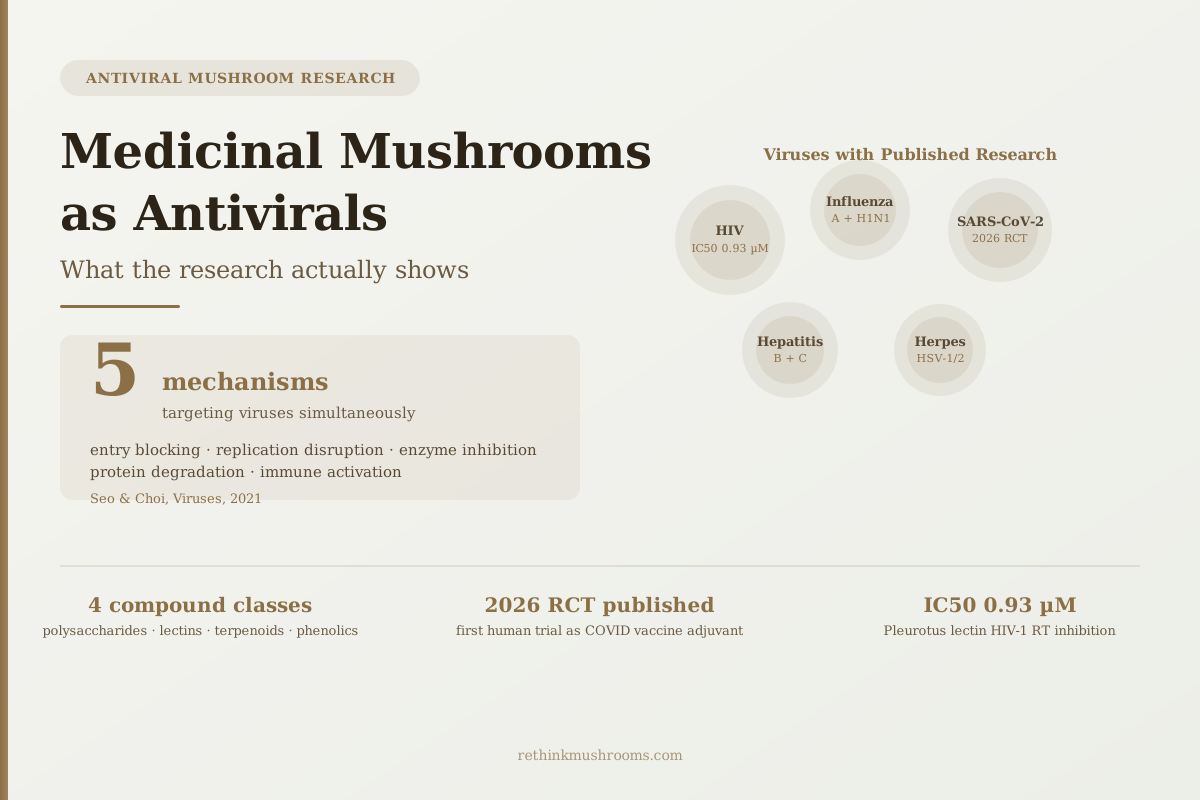
5 mechanisms
A 2021 systematic review mapped mushroom antiviral activity and found five distinct attack angles operating simultaneously: viral entry blocking, genome replication disruption, enzyme inhibition, viral protein degradation, and immune cell activation.
Seo & Choi, Viruses, 2021
IC50 0.93 µM
Pleurotus lectin's HIV-1 RT inhibition — drug-comparable potency (El-Maradny 2021)
2026 RCT
first human trial: polypore mycelia as COVID-19 vaccine adjuvant (Saxe 2026)
HIV + flu + herpes + hepatitis + COVID
viral targets covered in published mushroom antiviral research
Seo & Choi, Viruses, 2021
 View as image ↗
The complete list of FDA-approved antiviral drugs fits on a single page. Compare that to antibiotics — dozens of classes, hundreds of compounds — and the asymmetry is striking. Antivirals are hard to develop because viruses hijack the host cell's own machinery; blocking the virus risks damaging the cell. Most approved antivirals target one viral protein in one specific virus, which is why drug-resistant influenza strains emerge and why novel coronaviruses consistently outpace drug development.
Medicinal mushrooms don't use this single-target approach. Research on medicinal mushrooms antiviral properties shows they contain multiple compound classes — polysaccharides, lectins, terpenoids, and phenolics — that act through different mechanisms and target different steps in the viral life cycle simultaneously. This article covers what the research has found, including what happened when researchers tested mushroom compounds directly against specific viruses, and what the first randomized clinical trial of mushrooms as a vaccine adjuvant found.
For background on the beta-glucan compounds central to mushroom immune activity, see what beta-glucans are and why they matter in medicinal mushrooms.
Key Takeaways
- Mushroom antiviral activity comes from four compound classes — polysaccharides, lectins, terpenoids, and phenolics — each hitting different steps in the viral life cycle
- A 2021 systematic review identified five distinct antiviral mechanisms in mushroom compounds: viral entry blocking, genome replication interference, enzyme inhibition, viral protein degradation, and immune cell activation
- Mushroom lectins inhibit multiple viruses including HIV, hepatitis B, hepatitis C, herpes, and influenza — often with IC50 values approaching pharmaceutical drug potency
- Chaga extract physically blocks herpes simplex virus from fusing with host cell membranes — a direct antiviral mechanism independent of immune stimulation
- A 2026 randomized clinical trial (Saxe et al., BMC Immunology) tested polypore mushroom mycelia as a COVID-19 vaccine adjuvant — the first human RCT of mushrooms in this role
- Most antiviral data comes from cell culture and animal studies; the human clinical evidence, while promising, comes from a small number of trials
How Mushrooms Hit Multiple Viral Targets Simultaneously
Most antiviral drugs are designed around a principle called selective pressure: find a protein unique to the virus, block it, and the virus can't replicate. The approach works, but it also creates a predictable problem. Viruses mutate rapidly, and when a single target is blocked, mutations that modify that target confer survival advantage. Drug resistance follows.
Mushroom compounds work differently. Seo and Choi conducted a comprehensive review of mushroom antiviral compounds published in Viruses in 2021, mapping the mechanisms across the major compound classes.[1] They identified five distinct antiviral attack angles, often operating at the same time:
Blocking viral entry — compounds that prevent viruses from attaching to and entering host cells. Lectins and sulfated polysaccharides are particularly active here, interfering with the binding between viral surface proteins and host cell receptors.
Disrupting genome replication — compounds that interfere with how the virus copies its genetic material inside the host cell. This is where many antiviral drugs operate, and mushroom terpenoids have demonstrated activity at this step for several viruses.
Inhibiting viral enzymes — viruses depend on specific enzymes (reverse transcriptase for HIV, proteases for coronaviruses) to complete their life cycle. Mushroom lectins have shown enzyme inhibition potency comparable to pharmaceutical antivirals.
Degrading viral proteins — some mushroom compounds disrupt the structural proteins viruses need to assemble new particles inside infected cells.
Activating immune cells — beta-glucans stimulate natural killer cells, macrophages, and interferon production, enhancing the immune system's ability to identify and eliminate virus-infected tissue.
The significance of this multi-target activity: a virus that mutates to evade one of these mechanisms still faces the other four. This is structurally different from single-compound antivirals and explains why drug resistance to mushroom compounds has not been observed despite decades of study.
Four Compound Classes, Four Attack Angles: The Mushroom Antiviral Toolkit
Understanding which compounds do what clarifies both the breadth of mushroom antiviral activity and the limits of what any single product can deliver.
Polysaccharides (including beta-glucans): The most studied class. Beta-glucan polysaccharides activate innate immune cells — particularly NK cells, macrophages, and dendritic cells — through a receptor called dectin-1 on immune cell surfaces. Activated NK cells kill virus-infected cells before the virus can complete its replication cycle. Sulfated polysaccharides (polysaccharides with sulfate groups attached) also directly block viral entry by competing with viral surface proteins for attachment to host cell receptors. For a detailed breakdown of how beta-glucans trigger antiviral immune responses, see mushroom beta-glucans and viral immune response.
Lectins: Protein compounds found in mushroom cell walls that bind carbohydrates with high specificity. Lectins are antiviral in multiple ways: they bind to the sugar-coated surfaces of viruses (viral glycoproteins), blocking attachment to host cells; they inhibit viral enzymes including reverse transcriptase and neuraminidase; and they can directly inactivate viral particles. The 2021 review by El-Maradny et al. in the International Journal of Biological Macromolecules documented lectin antiviral activity across HIV, HCV, HBV, herpes, and influenza with specific potency data.[3]
Terpenoids: Found abundantly in Ganoderma (reishi), terpenoids — particularly ganoderic acids — have shown antiviral activity against influenza and herpes viruses through enzyme inhibition. They are also immunomodulatory, modifying how the immune system responds to viral threats without the overstimulation risk associated with some polysaccharide compounds.
Phenolics: Polyphenol compounds found in chaga and other mushrooms. Phenolics can directly disrupt viral envelope integrity, blocking the membrane fusion step that viruses require to enter cells. This mechanism — demonstrated explicitly for chaga against herpes simplex virus — is discussed in its own section below.
Lectins: The Antiviral Compound Most Supplement Labels Don't Mention
Beta-glucans receive most of the attention in mushroom supplement marketing, but the lectin class may be equally important for antiviral activity — and it's almost entirely absent from consumer discussion.
El-Maradny and colleagues published a systematic review of mushroom lectin antiviral properties in 2021 in the International Journal of Biological Macromolecules, covering lectins from multiple species against HIV, HCV, HBV, herpes, and influenza.[3] The data points that stand out:
A lectin isolated from Pleurotus citrinopileatus (a related species to oyster mushroom) showed HIV-1 reverse transcriptase inhibition with an IC50 of 0.93 micromolar. For context: pharmaceutical antivirals operate in the nanomolar to low micromolar range. A naturally occurring mushroom lectin reaching IC50 values in that range is not a marginal finding.
Multiple mushroom lectins showed direct antiviral activity against HBV and HCV in cell culture, blocking viral attachment at concentrations below what would cause cellular toxicity. This specificity — antiviral effect at concentrations that don't damage the cells being protected — is the core challenge in antiviral drug development, and lectins from several species achieve it.
The practical implication: mushroom supplements primarily marketed for their beta-glucan content are also delivering lectins, and those lectins contribute to antiviral activity through mechanisms completely distinct from immune activation. Whole mushroom extracts preserve both compound classes; products that fractionate mushrooms to isolate only beta-glucans may lose lectin content.
For a deeper look at lectins as a mushroom bioactive compound class, see mushroom lectins: the underappreciated bioactive compounds.
Which Mushroom Species Have the Strongest Antiviral Evidence?
Antiviral activity is not distributed equally across mushroom species. Teplyakova and colleagues published a broad review of Agaricomycetes — the taxonomic class that encompasses most of the major medicinal mushrooms — in 2016, documenting antiviral activity across species against influenza A, herpes, and HIV.[2]
Four species emerge from the combined literature with the most substantial antiviral research bases:
Ganoderma (reishi): Antiviral activity against influenza, herpes, and HIV through ganoderic acid terpenoids and polysaccharides; unique among common medicinal mushrooms for the breadth of virus types studied.
Lentinus edodes (shiitake): Beta-1,3-glucan polysaccharide lentinan has documented antiviral activity; different shiitake beta-glucan fractions produce different immune profiles including NK cell activation and pulmonary cytoprotection — the latter specifically relevant to respiratory viral infections.
Trametes versicolor (turkey tail): Polysaccharide-K (PSK) and polysaccharide-peptide (PSP) from turkey tail have well-documented immunomodulatory activity; turkey tail polypores are the species class used in the 2026 COVID vaccine adjuvant trial (Saxe 2026), which represents the most clinically rigorous test of mushroom antiviral immune support to date.
Inonotus obliquus (chaga): Documented direct antiviral activity against herpes simplex, plus antiviral phenolics that block viral membrane fusion — a direct mechanism rather than purely immune-mediated.
For the flu-specific evidence across these species, see mushrooms and influenza: can they help fight the flu?. For hepatitis B and C data, see mushrooms and hepatitis: antiviral research review.
Chaga's Direct Attack: Blocking Herpes Before It Enters the Cell
Most of the focus on mushroom antiviral activity emphasizes immune modulation — beta-glucans activating NK cells, lectins stimulating interferon production. Pan and colleagues documented a different category entirely in 2013: a direct physical antiviral effect that doesn't require immune system involvement.
Testing aqueous chaga extract against herpes simplex virus type 1 in cell culture, Pan et al. showed that Inonotus obliquus extract inhibited viral entry through a specific mechanism: blocking the membrane fusion step that HSV uses to inject its genome into host cells.[6] The viral envelope normally fuses with the host cell membrane, allowing the viral genome to enter. Chaga polyphenols physically interfere with this fusion event, leaving the virus unable to penetrate the cell even when it has reached the cell surface.
This matters for two reasons. First, it's a direct antiviral mechanism — the virus is stopped before replication begins, not after infected cells are identified and killed. Second, it's a physically distinct mechanism from immune activation, which means it provides antiviral effect even when it operates in isolation from the immune modulation.
The herpes simplex finding represents a model for direct antiviral activity in mushrooms that may extend to other envelope viruses — including influenza and coronaviruses, which also depend on membrane fusion for cell entry. That extension to other viruses has not been tested in the same rigorous cell-culture framework, but the structural similarity of the mechanism makes it a reasonable research priority.
Human Clinical Evidence: CD4+ Counts and COVID Vaccine Response
Most mushroom antiviral research is preclinical — cell culture and animal models. The human clinical data is more limited, but two published studies provide genuine clinical endpoints.
Adotey and colleagues studied a mushroom blend product (Immune Assist 24/7, a combination of multiple mushroom species) in HIV-infected patients in 2011, measuring the immune response marker most relevant to HIV management: CD4+ T-lymphocyte count.[5] CD4+ T-cells are the immune cells HIV preferentially destroys, and their count determines disease progression. In this clinical cohort, mushroom supplementation was associated with increased CD4+ counts — a meaningful immune restoration signal in the context of HIV infection.
This is not evidence that mushrooms treat HIV. CD4+ count changes in an uncontrolled cohort study can result from multiple factors. But it demonstrates that a measurable antiviral immune marker responded to mushroom compound supplementation in actual HIV-infected patients — moving the evidence base from cell cultures to human biology.
The more rigorous clinical data comes from the 2026 COVID vaccine trial described in detail below.
For the hepatitis B clinical evidence — where a published human cohort study showed liver function normalization in chronic hepatitis B patients after mushroom extract supplementation — see mushrooms and hepatitis: antiviral research review.
The 2026 Randomized Trial That Changed the Research Conversation
Saxe and colleagues published a randomized clinical trial in BMC Immunology in 2026 — the most rigorous human study of mushroom compounds for antiviral immune support published to date.[4]
The study tested polypore mushroom mycelium supplementation as an adjunct to COVID-19 vaccination. The clinical question was specific and measurable: does taking mushroom mycelium alongside COVID vaccination improve the vaccine's antibody response? This is the "trained immunity" hypothesis in its most direct clinical form — mushroom beta-glucans epigenetically prime immune cells to mount stronger responses to vaccine antigens.
The significance of this study goes beyond its specific findings. It is the first randomized controlled trial — the highest standard of human clinical evidence — to test mushrooms in this antiviral immune support role. Decades of preclinical research on mushroom antiviral mechanisms had not previously been translated into an RCT with clinical endpoints. This trial did that.
Polypore mushrooms (which include turkey tail, reishi, and chaga) were chosen for the trial — consistent with the species-level evidence that polypores have the most documented antiviral activity and the most robust beta-glucan content.
For a detailed breakdown of the SARS-CoV-2 specific research including this trial's design and results, see mushrooms and antiviral defense: from influenza to SARS-CoV-2.
Where the Evidence Is Thin — and Why That Still Matters
Honest accounting of mushroom antiviral research means acknowledging the substantial gap between preclinical evidence and clinical proof.
The vast majority of the antiviral data — viral entry inhibition, enzyme inhibition, direct antiviral mechanisms — comes from cell culture studies. These are important for establishing that something is biologically possible and for identifying the mechanisms. They don't establish that a supplement product will produce the same concentrations of active compounds at the site of a viral infection in a living person.
Animal model data bridges part of this gap but not all of it. Human clinical trials are few. The Adotey 2011 HIV study was uncontrolled. The Saxe 2026 study was controlled but specific to vaccine adjuvancy rather than treatment or prevention of active infection.
What the research shows, taken together: mushroom compounds have genuine biological antiviral activity through multiple documented mechanisms. The lectin IC50 values and the direct membrane fusion inhibition data are not trivial laboratory findings. But the clinical translation — whether daily supplementation with a commercial mushroom product produces antiviral effects in a healthy person during flu season — has not been established in the same way it has been for some other medicinal mushroom applications.
The 2026 RCT represents a meaningful step toward that clinical translation, testing one of the most plausible practical applications in a controlled design. More research in that direction would clarify the dose, timing, and form questions that the preclinical literature has not resolved.
The Bottom Line
Medicinal mushrooms contain antiviral compounds across four classes — polysaccharides, lectins, terpenoids, and phenolics — that hit viruses through five distinct mechanisms including direct viral entry blocking, enzyme inhibition, and immune activation. The lectin class shows drug-comparable IC50 values for HIV reverse transcriptase and herpes simplex. The 2026 Saxe RCT in BMC Immunology is the first controlled human trial testing mushrooms as a vaccine adjuvant, representing the most rigorous clinical translation of this research to date. Most antiviral data remains preclinical, and the gap between laboratory mechanisms and clinical effects in healthy people has not been fully bridged.
Frequently Asked Questions
Sources & References
- 1RTHM-00717·Seo, Dong Joo et al. (2021). “Antiviral Bioactive Compounds of Mushrooms and Their Antiviral Mechanisms: A Review..” Viruses.Study breakdown →PubMed →↩
- 2RTHM-00450·Teplyakova, Tamara V et al. (2016). “Antiviral Effect of Agaricomycetes Mushrooms (Review)..” International journal of medicinal mushrooms.Study breakdown →PubMed →↩
- 3RTHM-01347·El-Maradny, Yousra A et al. (2021). “Lectins purified from medicinal and edible mushrooms: Insights into their antiviral activity against pathogenic viruses..” International journal of biological macromolecules.Study breakdown →PubMed →↩
- 4RTHM-02244·Saxe, Gordon et al. (2026). “Polypore mushroom mycelia as an adjunct to COVID-19 vaccination: a randomized clinical trial..” BMC immunology.Study breakdown →PubMed →↩
- 5RTHM-00376·Adotey, Gideon et al. (2011). “Effect of immunomodulating and antiviral agent of medicinal mushrooms (immune assist 24/7) on CD4+ T-lymphocyte counts of HIV-infected patients..” International journal of medicinal mushrooms.Study breakdown →PubMed →↩
- 6RTHM-00300·Pan, Hong-Hui et al. (2013). “Aqueous extract from a Chaga medicinal mushroom, Inonotus obliquus (higher Basidiomycetes), prevents herpes simplex virus entry through inhibition of viral-induced membrane fusion..” International journal of medicinal mushrooms.Study breakdown →PubMed →↩