Medicinal Mushrooms as Antivirals
4 patients, no control group
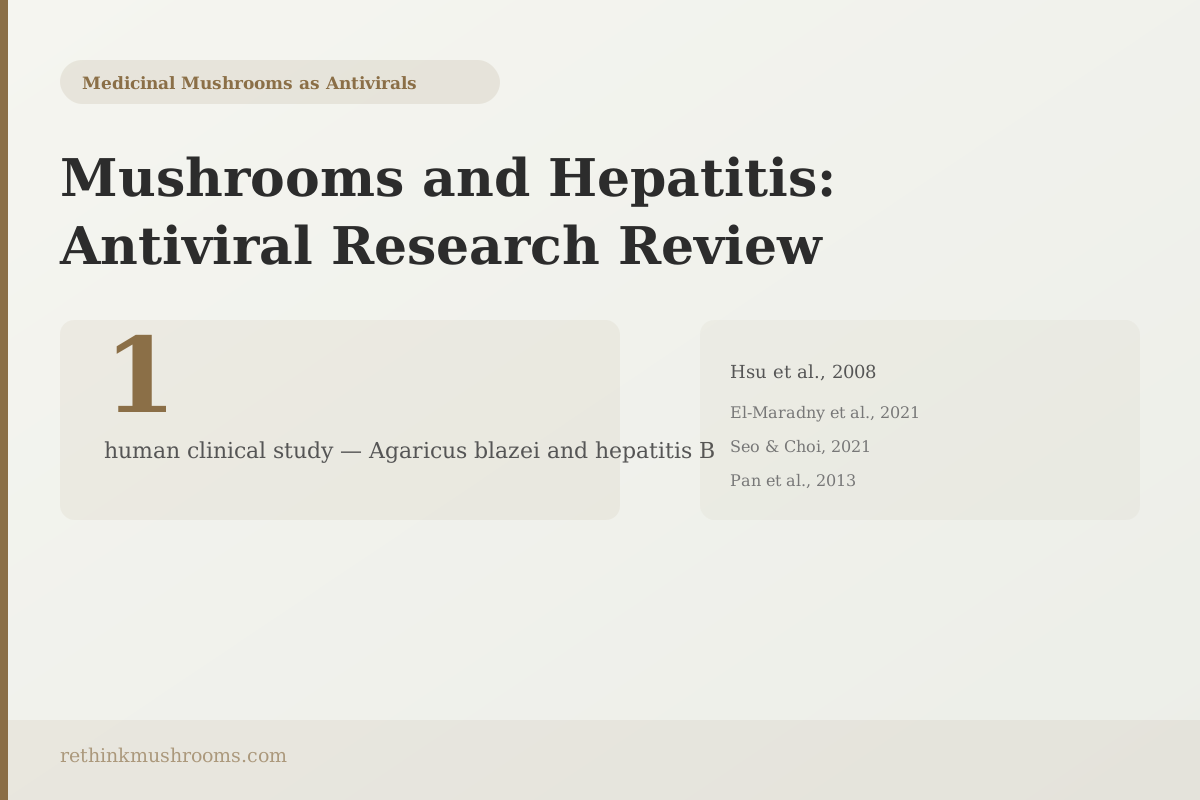
The entire positive human evidence for medicinal mushrooms in viral hepatitis is a single open-label pilot study. Four chronic hepatitis B patients took Agaricus blazei extract for twelve months and their liver enzymes fell. There was no comparison group, and no statistical test was reported.
Hsu et al., Journal of Alternative and Complementary Medicine, 2008
ALT 151 → 46
IU/L across 12 months of 1,500 mg/day Agaricus blazei extract in four patients (Hsu et al., 2008)
4.22 nM
IC50 of an oyster mushroom lectin against HBV polymerase — the strongest direct anti-hepatitis result on record, and it is in cell culture (El-Maradny et al., 2025)
2 deaths
from fulminant hepatitis in cancer patients taking Agaricus blazei extract, including one positive rechallenge (Mukai et al., 2006)
Hsu et al., Journal of Alternative and Complementary Medicine, 2008
 View as image ↗
In 2008, a research group in Taipei published a one-year observation of four people. All four had been chronic hepatitis B carriers for at least three years, all had alanine aminotransferase above 100 IU/L, and none were on lamivudine, interferon, or any other hepatitis drug. Each took 1,500 mg of Agaricus blazei Murill extract daily for twelve months. At the end, mean ALT had fallen from 151 to 46 IU/L and mean AST from 246 to 61 IU/L.[1]
That is the single most positive human result in this entire field. It is also an open-label pilot with four participants and no control group, and its own authors described it as an "initial observation" that should be followed by "controlled studies with larger samples."
Those two sentences are the whole story of mushrooms and hepatitis, and most writing on the subject tells only the first one. This article tells both, plus a third that is almost never mentioned: the same two mushroom species that dominate the benefit literature also dominate the published reports of severe and fatal liver injury.
Hepatitis B and C are worth taking seriously as a target. WHO estimates roughly 240 million people were living with chronic hepatitis B in 2024 and about 47 million with chronic hepatitis C, together causing more than 1.3 million deaths a year, mostly from cirrhosis and liver cancer. Direct-acting antivirals cure most hepatitis C and suppress hepatitis B effectively, but they are expensive and unevenly distributed. That gap is the reason people go looking for something else — and the reason the evidence deserves an honest accounting rather than an encouraging one.
This article is part of the medicinal mushrooms as antivirals overview, which covers the broader antiviral research landscape across multiple virus families.
Key Takeaways
- The positive human evidence is one study: Hsu et al. 2008, an open-label pilot in four chronic hepatitis B patients taking 1,500 mg/day Agaricus blazei extract for 12 months, with no control group and no reported significance test
- A second human study exists and is usually left out — Grinde et al. 2006 gave an Agaricus blazei–based extract to four chronic hepatitis C patients and found viral load was not significantly reduced, and that the beta-glucans presumed responsible for immune activation did not readily enter the blood
- The strongest direct anti-hepatitis data is a 2025 cell-culture study of a purified Pleurotus ostreatus lectin, with IC50 values of 4.22 nM against HBV polymerase and 10.98 nM against the HCV NS3/4A protease
- Ganoderic acid from reishi cut hepatitis B surface antigen to 20% and e antigen to 44% of control in infected liver cells at 8 µg/mL (Li & Wang, 2006), and chaga water extract reduced HCV infectivity roughly 100-fold within 10 minutes (Shibnev et al., 2011)
- Seo and Choi's 2021 mechanism review does not cover hepatitis B as a tested target at all — it covers HCV, HIV, herpes, influenza, and several enteric viruses
- Agaricus blazei and Ganoderma lucidum have published case reports of severe drug-induced liver injury, fulminant hepatitis, and death, including one positive rechallenge — a signal that matters most in exactly the population this article is about
What the 2008 Study Actually Was
Precision matters here, because this one study carries the weight of an entire claim category.
Hsu and colleagues ran a twelve-month, open-label pilot observation.[1] Four patients met the inclusion criteria: aged 20 to 65, Chinese, hepatitis B surface antigen positive for more than three years, ALT above 100 IU/L, and not taking lamivudine, alpha-interferon, or other hepatitis medication. All four received Agaricus blazei Murill extract at 1,500 mg daily for twelve months. ALT was the primary outcome.
The results were a mean AST decline from 246.0 (SD 138.9) to 61.3 (SD 32.6) IU/L, and a mean ALT decline from 151.0 (SD 86.9) to 46.1 (SD 22.5) IU/L.
Now the parts that get dropped in retelling. There was no control group. There was no blinding — everyone knew what they were taking. There was no viral load measurement, so nothing was demonstrated about the virus itself. And with four participants and a single arm, no statistical significance test was reported; the paper presents means and standard deviations, not a p-value against a comparator.
The missing control group is not a technicality in this specific disease. ALT in chronic hepatitis B does not sit at a steady level — it flares and remits spontaneously over months as the immune system periodically attacks infected cells and then backs off. Four patients selected for having ALT above 100 IU/L are, by construction, sampled during a flare. Watching them for a year and observing a decline is exactly what you would expect from regression to the mean, with or without a mushroom. That is precisely the ambiguity a control group exists to resolve, and this study did not have one.
Hsu, Hwang, Chiang & Chou (2008) · Journal of Alternative and Complementary Medicine
- Population
- 4 chronic hepatitis B carriers (HBsAg+ >3 years, ALT >100 IU/L), aged 20–65, not on antiviral medication
- Intervention
- Agaricus blazei Murill extract, 1,500 mg/day for 12 months
- Comparator
- None — single-arm, open-label
- Finding
- Mean ALT fell from 151.0 to 46.1 IU/L and mean AST from 246.0 to 61.3 IU/L over 12 months. No viral load measured; no significance test against a comparator reported.
preliminary The authors themselves describe it as an initial observation requiring controlled studies with larger samples. ALT flares and remits spontaneously in chronic HBV, which an uncontrolled design cannot distinguish from a treatment effect.
Hsu et al., J Altern Complement Med, 2008 (PMID 18370584)
None of this means the result is wrong. It means the result is a hypothesis, not a finding. Eighteen years later, no controlled replication has been published.
For a deeper treatment of this specific mushroom across both hepatitis viruses, see Agaricus blazei for hepatitis B and C.
The Hepatitis C Study That Gets Left Out
A common claim in this space is that no human study has tested medicinal mushrooms against hepatitis C. That is not accurate. One has, and the result is the reason it is rarely cited.
In 2006, Grinde, Hetland and Johnson gave an Agaricus blazei–based extract to four patients with chronic hepatitis C for one week and measured both viral load and genome-wide gene expression in peripheral blood cells.[8] Viral load decreased slightly, but not significantly. More revealing was the mechanistic finding: the cytokine genes that this same extract strongly induced in vitro were not induced in the patients. The authors concluded that the beta-glucans presumed responsible for the immune-activating effect did not readily enter the blood after oral dosing.
That is a small study over a short window, and it cannot exclude a benefit from longer treatment. But it is a direct test of the mechanism most often invoked to explain why mushrooms should help with viral hepatitis, and the mechanism did not show up in humans.
Fact Check
The claim that mushrooms have never been tested against hepatitis C in humans
The claim
“There are no human studies of medicinal mushrooms in hepatitis C — the evidence is all cell culture.”
Repeated across supplement marketing and secondary health writing, usually alongside the more optimistic hepatitis B pilot.
What research shows
MisleadingA human study exists. Grinde et al. (2006) gave an Agaricus blazei–based extract to four chronic hepatitis C patients for one week. Viral load was not significantly reduced.
The study is small and short, so it cannot rule out benefit from longer dosing. But it also showed why: the beta-glucans thought to drive immune activation did not readily enter the bloodstream after oral dosing. The mechanism was measured directly in people, and it was absent.
Grinde et al., Int Immunopharmacol, 2006 (PMID 16782544)
What Mushroom Compounds Do to Hepatitis Viruses in a Dish
The laboratory evidence is genuinely more substantial than the clinical evidence, and it has improved considerably in recent years.
The most direct hepatitis B result is old and still one of the better ones. In 2006, Li and Wang applied ganoderic acid from Ganoderma lucidum to HepG2.2.15 cells — a liver cell line engineered to continuously produce hepatitis B virus. At 8 µg/mL over eight days, hepatitis B surface antigen output fell to 20% of control and e antigen to 44%.[6] Those are the two antigens clinicians actually track in chronic hepatitis B.
The most striking recent result comes from a 2025 characterization of a purified lectin from Pleurotus ostreatus, the common oyster mushroom.[5] Against hepatitis B, the lectin blocked infection with an IC50 of 14.88 nM and inhibited the viral polymerase at 4.22 nM. Against hepatitis C, it neutralized infectivity at 52.13 nM, blocked infection at 68.75 nM, and inhibited the NS3/4A protease at 10.98 nM. It is the first mushroom compound with quantified, mechanistically resolved activity against both hepatitis viruses in the same study.
Chaga (Inonotus obliquus) has direct hepatitis C data too, contrary to a claim that circulates widely. Shibnev and colleagues found that fractions of chaga water extract were virucidal against hepatitis C virus, reducing infectivity roughly 100-fold within ten minutes of contact, with effects present under both preventive and therapeutic dosing schedules in cell culture.[7]
Cordyceps militaris adds a fourth line. Ueda and colleagues screened oral supplements through genotype 1b HCV replicon assay systems and found that the capsule form — but notably not the liquid form of the same supplement — produced moderate anti-HCV activity.[9] Cordycepin, not ergosterol, was the active constituent, and the effect was additive when combined with interferon-alpha or ribavirin. The form-dependence is a useful reminder that "Cordyceps militaris" on a label does not describe what is in the capsule.
Seo and Choi's review adds two more hepatitis C actives with numbers: tyrosinase from Agaricus bisporus, the ordinary button mushroom, with an EC50 of 1.2–2.5 µg/mL against HCV — compared against ribavirin at 10 µg/mL in the same review — and laccase from Pleurotus ostreatus, active at 2.0–2.5 mg/mL as a pre-treatment.[3]
Every published number, one place
What Mushroom Compounds Actually Did to Hepatitis Viruses in a Dish
These are the quantitative results behind the phrase “mushrooms have antiviral activity against hepatitis.” All of them come from cell culture. None come from a person.
Hepatitis B (HBV)
Two compound classes with direct, quantified activity.
Oyster mushroom lectin (POL)
Pleurotus ostreatus
IC50 14.88 nM
Blocking infection in cell culture · El-Maradny 2025
Oyster mushroom lectin (POL)
Pleurotus ostreatus
IC50 4.22 nM
HBV polymerase inhibition · El-Maradny 2025
Ganoderic acid
Ganoderma lucidum (reishi)
8 µg/mL → 20% / 44% of control
HBsAg / HBeAg output, HepG2.2.15, 8 days · Li & Wang 2006
Hepatitis C (HCV)
More compounds tested, wider spread of assay types.
Oyster mushroom lectin (POL)
Pleurotus ostreatus
IC50 10.98 nM
NS3/4A protease inhibition · El-Maradny 2025
Oyster mushroom lectin (POL)
Pleurotus ostreatus
IC50 52.13 nM
Neutralizing infectivity · El-Maradny 2025
Tyrosinase
Agaricus bisporus (button)
EC50 1.2–2.5 µg/mL
EC50 vs HCV (ribavirin 10 µg/mL in same review) · Seo & Choi 2021
Laccase
Pleurotus ostreatus
2.0–2.5 mg/mL
Pre-treatment inhibition of HCV · Seo & Choi 2021
Water extract
Inonotus obliquus (chaga)
~100-fold drop in infectivity
Virucidal, 10-minute exposure · Shibnev 2011
Capsule extract (cordycepin)
Cordyceps militaris
Moderate inhibition; additive with IFN-α / ribavirin
Genotype 1b replicon assay · Ueda 2014
Why you cannot rank this list
The values span nanomolar to milligram-per-millilitre — a spread of roughly a million-fold — but that is not a potency ranking. A purified single protein assayed against an isolated enzyme will always produce a smaller number than a crude water extract assayed against whole virus, regardless of which would work better in a liver. Different assays, different preparations, different endpoints. Comparing the numbers directly would be a category error.
Sources: El-Maradny et al., 2025 (PMID 40739150); Li & Wang, 2006 (PMID 16786250); Seo & Choi, 2021 (PMID 33672228); Shibnev et al., 2011 (PMID 22462058); Ueda et al., 2014 (PMID 24726408)
What the Lectin Data Actually Shows
Lectins are carbohydrate-binding proteins, a different compound class from the beta-glucans that dominate consumer content. El-Maradny and colleagues reviewed mushroom lectins as antiviral agents in 2021, documenting activity against HIV, herpes simplex types 1 and 2, hepatitis C, influenza A and B, Japanese encephalitis virus, and SARS-CoV-2.[2] Hepatitis B was not among the viruses covered in that 2021 review — the HBV lectin data arrived four years later, from the same lead author.[5]
The mechanism is more specific than the "lectins sit on sugar molecules and block the virus" description usually given. In the 2025 study, the oyster mushroom lectin bound cell-surface CD81 with 58.8% binding capacity and inhibited scavenger receptor class B type I with an IC50 of 10.08 nM.[5] CD81 and SR-B1 are two of the four established entry receptors hepatitis C uses to get into a liver cell. The lectin was occupying the host cell's doorway rather than the virus's key — which is why it also blocked infection when applied before the virus arrived.
The limitation is the same one that applies to every compound above: these are cell culture experiments. Lectins are proteins, and proteins are what the digestive system is built to dismantle. Whether an oral dose of oyster mushroom delivers intact lectin to a hepatocyte is not an open question so much as an unaddressed one. For the compound class in general, the mushroom lectins article covers the research across applications.
How Chaga Blocks the Fusion Step
Pan and colleagues tested aqueous chaga extract against herpes simplex virus and identified the specific stage it interferes with.[4] The extract inhibited HSV with an IC50 of 3.82 µg/mL in plaque reduction assay, showed 50% cellular cytotoxicity only above 1 mg/mL, and a selectivity index above 80 — meaning it was disabling the virus at concentrations well below those that harmed the cells. Time-course and fusion-inhibition assays localized the effect to the early stage of infection: the extract prevented virus-induced membrane fusion.
Enveloped viruses — herpes, hepatitis B, and hepatitis C among them — are wrapped in a lipid membrane taken from a previous host cell. To infect a new cell, that membrane has to fuse with the target cell's membrane so the viral contents can be delivered inside. Block fusion and the virus stays outside.
The relevance to hepatitis is partly mechanistic transfer and partly direct: the fusion-blocking work was done in herpes, but the same extract type was independently shown to be virucidal against hepatitis C in the Shibnev study above.[7] Whether the hepatitis C effect runs through the same fusion mechanism has not been established.
For how immune-mediated antiviral protection works separately from direct viral inhibition, the mushroom beta-glucans and viral immune response article covers the immune activation pathway, including the epigenetic trained immunity mechanism behind its persistence. Note that this is the pathway Grinde's hepatitis C patients did not show.
The Mechanisms, Described Accurately
Seo and Choi's 2021 review in Viruses is the standard reference for mushroom antiviral mechanisms, and it is routinely miscited. What it actually covers is herpes simplex 1 and 2, influenza A through D, HIV-1 and HIV-2, hepatitis C, norovirus, enterovirus 71, poliovirus type 1, and coxsackievirus B3.[3] Hepatitis B appears only as a passing example of a reverse-transcribing virus, not as a target any mushroom compound was tested against. Claims that this review documents mushroom activity against hepatitis B are not supported by the paper.
The targets it does enumerate are viral entry, genome replication, viral enzymes, viral proteins, and host cellular proteins, plus immune modulation as a separate influence. Different compound classes hit different points, which is why no single class explains the whole picture.
Where each compound was shown to act
Six Points in the Hepatitis Life Cycle, Six Different Mushroom Compounds
The “multiple mechanisms” claim is real: different compounds hit different stages. Note which stage is the only one that has been tested in people — and how it went.
Attachment to the liver cell
Dish onlyOyster mushroom lectin (POL)
Bound cell-surface CD81 (58.8%); SR-B1 IC50 10.08 nM — both HCV entry receptors
El-Maradny 2025 · cell culture
Membrane fusion / entry
Dish onlyChaga water extract
Blocked virus-induced membrane fusion (HSV, IC50 3.82 µg/mL); virucidal vs HCV, ~100-fold in 10 min
Pan 2013 · Shibnev 2011 · cell culture
Genome replication
Dish onlyCordycepin (Cordyceps militaris)
Moderate inhibition in HCV genotype 1b replicon; additive with IFN-α / ribavirin
Ueda 2014 · cell culture
Viral enzymes
Dish onlyOyster mushroom lectin (POL)
HBV polymerase IC50 4.22 nM; HCV NS3/4A protease IC50 10.98 nM
El-Maradny 2025 · cell culture
Viral protein output
Dish onlyGanoderic acid (reishi)
8 µg/mL cut HBsAg to 20% and HBeAg to 44% of control over 8 days
Li & Wang 2006 · cell culture
Immune activation
Tested in people — failedBeta-glucans (Agaricus blazei extract)
Tested in 4 hepatitis C patients: beta-glucans did not readily enter the blood, viral load not significantly reduced
Grinde 2006 · humans, null result
Five of the six stages have only ever been demonstrated in cell culture. The sixth — immune activation, the mechanism most often invoked in consumer marketing — is the one stage that has been tested in hepatitis patients, and the compounds responsible for it did not reach the bloodstream in usable amounts.
Sources: El-Maradny et al., 2025 (PMID 40739150); Pan et al., 2013 (PMID 23510282); Shibnev et al., 2011 (PMID 22462058); Ueda et al., 2014 (PMID 24726408); Li & Wang, 2006 (PMID 16786250); Grinde et al., 2006 (PMID 16782544)
The mushrooms and antiviral defense overview covers how these mechanisms extend to SARS-CoV-2, including a 2026 randomized clinical trial testing polypore mushroom mycelia alongside COVID-19 vaccination.
The Part Most Articles Skip: These Extracts Can Injure the Liver
An article recommending mushroom extracts to people with damaged livers has an obligation to report that mushroom extracts have damaged livers.
Mukai and colleagues described three advanced-cancer patients who developed severe hepatic damage while taking Agaricus blazei (Himematsutake) extract; two died of fulminant hepatitis.[10] In one patient, liver function recovered after she stopped the extract, then deteriorated again when she restarted it — a positive rechallenge, which is among the strongest causality signals available from case-report evidence.
Hisamochi and colleagues reported two further cases of Agaricus blazei–associated drug-induced liver injury that closely resembled autoimmune hepatitis, one in combination with Ganoderma lucidum extract.[11] Neither patient had told their physician they were taking the supplement.
Ganoderma has its own record. Wanmuang and colleagues reported fatal fulminant hepatitis associated with Ganoderma lucidum (Lingzhi) powder, noting that both this patient and an earlier case had tolerated traditionally boiled Lingzhi for years and developed hepatotoxicity one to two months after switching to the powdered form.[12] More recently, Guedikian and colleagues described acute hepatitis with significant transaminitis in a 47-year-old man after reishi powder and alcohol, resolving fully after treatment.[13]
The other half of the literature
Published Liver Injury From the Same Two Mushrooms
Agaricus blazei and Ganoderma lucidum are the two species with the most hepatitis-adjacent benefit research. They are also the two species with published reports of severe and fatal liver injury.
Mukai et al., 2006
Agaricus blazei extract
Advanced-cancer patients with severe hepatic damage; two died of fulminant hepatitis.
Positive rechallenge
One patient recovered after stopping, then deteriorated again after restarting.
Hisamochi et al., 2013
A. blazei + Ganoderma / fucoidan
Drug-induced liver injury closely resembling autoimmune hepatitis. Neither patient had disclosed the supplement to their physician.
Wanmuang et al., 2007
Ganoderma lucidum powder
Fatal fulminant hepatitis. Both patients had tolerated traditionally boiled Lingzhi, and developed toxicity 1–2 months after switching to powder.
Guedikian et al., 2023
Ganoderma lingzhi (reishi) + alcohol
Acute hepatitis with significant transaminitis; treated with N-acetylcysteine and IV fluids, fully resolved at two weeks.
A positive rechallenge — symptoms resolving on withdrawal and returning on re-exposure — is among the strongest causality signals available in case-report evidence. Case reports cannot establish how often this happens, because there is no denominator: nobody knows how many people take these extracts without incident. What they do establish is that it happens.
Sources: Mukai et al., 2006 (PMID 17105737); Hisamochi et al., 2013 (PMID 26181451); Wanmuang et al., 2007 (PMID 17621752); Guedikian et al., 2023 (PMID 37885515)
There is a mechanistic reason these two lines of research point at the same species. The property being studied as the benefit — potent stimulation of T lymphocytes and natural killer cells — is also the proposed trigger for immune-mediated liver injury. In chronic hepatitis B in particular, the liver damage is largely caused by the immune response to infected cells rather than by the virus directly. A compound that amplifies that response is not obviously safe in that setting, and the Hsu pilot did not have the sample size or the design to detect harm if it occurred.
Safety
CriticalMushroom extracts and existing liver disease
Concern
Agaricus blazei and Ganoderma lucidum extracts — the two species with the most hepatitis-relevant benefit research — both have published case reports of severe drug-induced liver injury, fulminant hepatitis, and death. One Agaricus blazei case had a positive rechallenge. Powdered and extracted forms have been implicated where traditionally boiled preparations were tolerated.
What the research says
Anyone with chronic hepatitis B or C, cirrhosis, or any active liver condition should treat these extracts as a decision requiring a hepatologist's input, not a supplement choice. Baseline and follow-up liver enzyme monitoring is the minimum reasonable precaution if they are used at all, and any unexplained rise in ALT or AST, jaundice, dark urine, or right-upper-quadrant pain warrants stopping and seeking medical attention.
Particularly relevant for: People with chronic hepatitis B or C, existing liver disease, or on hepatically metabolized medication
What to do
Tell your physician about every supplement you take. In both Hisamochi cases, the patients had not disclosed the mushroom extract — which delayed recognition of the cause.
Mukai et al., 2006 (PMID 17105737); Hisamochi et al., 2013 (PMID 26181451); Wanmuang et al., 2007 (PMID 17621752); Guedikian et al., 2023 (PMID 37885515)
One further gap deserves naming rather than boilerplate. For patients taking pharmaceutical antivirals — tenofovir or entecavir for hepatitis B, direct-acting antivirals for hepatitis C — the interaction data for mushroom polysaccharides is limited and for mushroom lectins essentially absent. This is a genuine hole in the literature, and it sits directly under the population most likely to be reading about mushrooms and hepatitis.
Where the Evidence Actually Stands
- Cell culturecompleted
Multiple compounds with quantified activity against HBV and HCV: oyster mushroom lectin, ganoderic acid, chaga extract, cordycepin, tyrosinase, laccase.
- Animal models of viral hepatitismissing
No published animal study of a mushroom compound in an HBV or HCV infection model. Rodent liver work uses chemical injury models (CCl4, diethylnitrosamine), not viral infection.
- Case reportscompleted
Present — but the published case reports describe liver injury from these extracts, not benefit.
- Small human studycurrent
Two, four patients each: Hsu 2008 (HBV, uncontrolled, enzymes improved) and Grinde 2006 (HCV, viral load not significantly reduced).
- Randomized controlled trialmissing
None. No controlled trial of any medicinal mushroom in viral hepatitis has been published.
- Meta-analysismissing
Impossible — there is nothing to pool.
The laboratory evidence is real, recent, and mechanistically detailed. The human evidence is two uncontrolled studies of four patients each, pointing in opposite directions, with no animal infection model bridging the two. The gap between the dish and the clinic here is not narrow, and nothing published since 2008 has narrowed it.
Hsu et al., 2008; Grinde et al., 2006; El-Maradny et al., 2025; Li & Wang, 2006; Shibnev et al., 2011; Ueda et al., 2014
What would change the picture is not more cell-culture work. It is a single randomized, controlled, adequately powered trial in chronic hepatitis B, measuring viral load alongside liver enzymes, running long enough to see past spontaneous ALT fluctuation, with active liver-injury monitoring built in. The compounds now exist with characterized mechanisms and defined potency. The trial does not.
Until it does, the accurate statement is this: mushroom compounds have documented, quantified antiviral activity against hepatitis B and C viruses in cell culture, through mechanisms that are increasingly well described. Whether any of that survives digestion and does anything in a human liver is unknown, the one direct human test of the leading mechanism was negative, and the same extracts carry a documented — if rare and undenominated — risk of serious liver injury. That is not a reason to dismiss the research. It is a reason not to treat it as a therapy.
For a similar evidence pattern in another major viral infection, the mushrooms and influenza article documents the same structure: robust preclinical data, thin human clinical evidence, and a research gap waiting for larger trials.
This article summarizes published research. It is not medical advice, and nothing here should be used to start, stop, or replace treatment for hepatitis. Decisions about supplements in the context of liver disease belong with your hepatologist.
The Bottom Line
The human evidence for medicinal mushrooms in viral hepatitis is two studies of four patients each. Hsu et al. (2008) gave Agaricus blazei extract to four chronic hepatitis B patients for twelve months and saw ALT fall from 151 to 46 IU/L — in an open-label design with no control group, no viral load measurement, and no significance test, in a disease where liver enzymes flare and remit on their own. Grinde et al. (2006) gave a related extract to four chronic hepatitis C patients and found viral load was not significantly reduced, with the beta-glucans presumed responsible for immune activation failing to enter the blood. The cell-culture evidence is stronger and more recent: a purified Pleurotus ostreatus lectin inhibited HBV polymerase at 4.22 nM and the HCV NS3/4A protease at 10.98 nM by binding host entry receptors, ganoderic acid cut hepatitis B antigen output to 20–44% of control, and chaga extract reduced HCV infectivity roughly 100-fold in ten minutes. What is missing is any bridge between the two: no animal infection model, no controlled trial, and no meta-analysis. What is present but usually omitted is the harm signal — Agaricus blazei and Ganoderma lucidum both have published cases of severe and fatal liver injury, including one positive rechallenge.
Frequently Asked Questions
Sources & References
- 1RTHM-00137·Hsu, Chung-Hua et al. (2008). “The mushroom Agaricus blazei Murill extract normalizes liver function in patients with chronic hepatitis B..” Journal of alternative and complementary medicine (New York.Study breakdown →PubMed →↩
- 2RTHM-01347·El-Maradny, Yousra A et al. (2021). “Lectins purified from medicinal and edible mushrooms: Insights into their antiviral activity against pathogenic viruses..” International journal of biological macromolecules.Study breakdown →PubMed →↩
- 3RTHM-00717·Seo, Dong Joo et al. (2021). “Antiviral Bioactive Compounds of Mushrooms and Their Antiviral Mechanisms: A Review..” Viruses.Study breakdown →PubMed →↩
- 4RTHM-00300·Pan, Hong-Hui et al. (2013). “Aqueous extract from a Chaga medicinal mushroom, Inonotus obliquus (higher Basidiomycetes), prevents herpes simplex virus entry through inhibition of viral-induced membrane fusion..” International journal of medicinal mushrooms.Study breakdown →PubMed →↩
- 5RTHM-02079·El-Maradny, Yousra A et al. (2025). “Biochemical characterization of a novel purified lectin extracted from Pleurotus ostreatus mushroom for its antiviral activity..” Scientific reports.Study breakdown →PubMed →↩
- 6RTHM-00194·Li, Yan-Qun et al. (2006). “Anti-hepatitis B activities of ganoderic acid from Ganoderma lucidum..” Biotechnology letters.Study breakdown →PubMed →↩
- 7RTHM-00233·Shibnev, V A et al. (2011). “Antiviral activity of Inonotus obliquus fungus extract towards infection caused by hepatitis C virus in cell cultures..” Bulletin of experimental biology and medicine.Study breakdown →PubMed →↩
- 8RTHM-00097·Grinde, B et al. (2006). “Effects on gene expression and viral load of a medicinal extract from Agaricus blazei in patients with chronic hepatitis C infection..” International immunopharmacology.Study breakdown →PubMed →↩
- 9RTHM-00354·Ueda, Youki et al. (2014). “Anti-HCV activity of the Chinese medicinal fungus Cordyceps militaris..” Biochemical and biophysical research communications.Study breakdown →PubMed →↩
- 10RTHM-00105·Mukai, Hirofumi et al. (2006). “An alternative medicine, Agaricus blazei, may have induced severe hepatic dysfunction in cancer patients..” Japanese journal of clinical oncology.Study breakdown →PubMed →↩
- 11RTHM-00287·Hisamochi, Akiko et al. (2013). “Drug-induced liver injury associated with Agaricus blazei Murill which is very similar to autoimmune hepatitis..” Clinical journal of gastroenterology.Study breakdown →PubMed →↩
- 12RTHM-00122·Wanmuang, Harirak et al. (2007). “Fatal fulminant hepatitis associated with Ganoderma lucidum (Lingzhi) mushroom powder..” Journal of the Medical Association of Thailand = Chotmaihet thangphaet.Study breakdown →PubMed →↩
- 13RTHM-00826·Guedikian, Roupen et al. (2023). “Ganoderma lingzhi (Reishi Mushroom)-Induced Acute Liver Injury in the Setting of Alcohol Use: A Case Report and Review of the Literature..” Cureus.Study breakdown →PubMed →↩