Medicinal Mushrooms as Antivirals
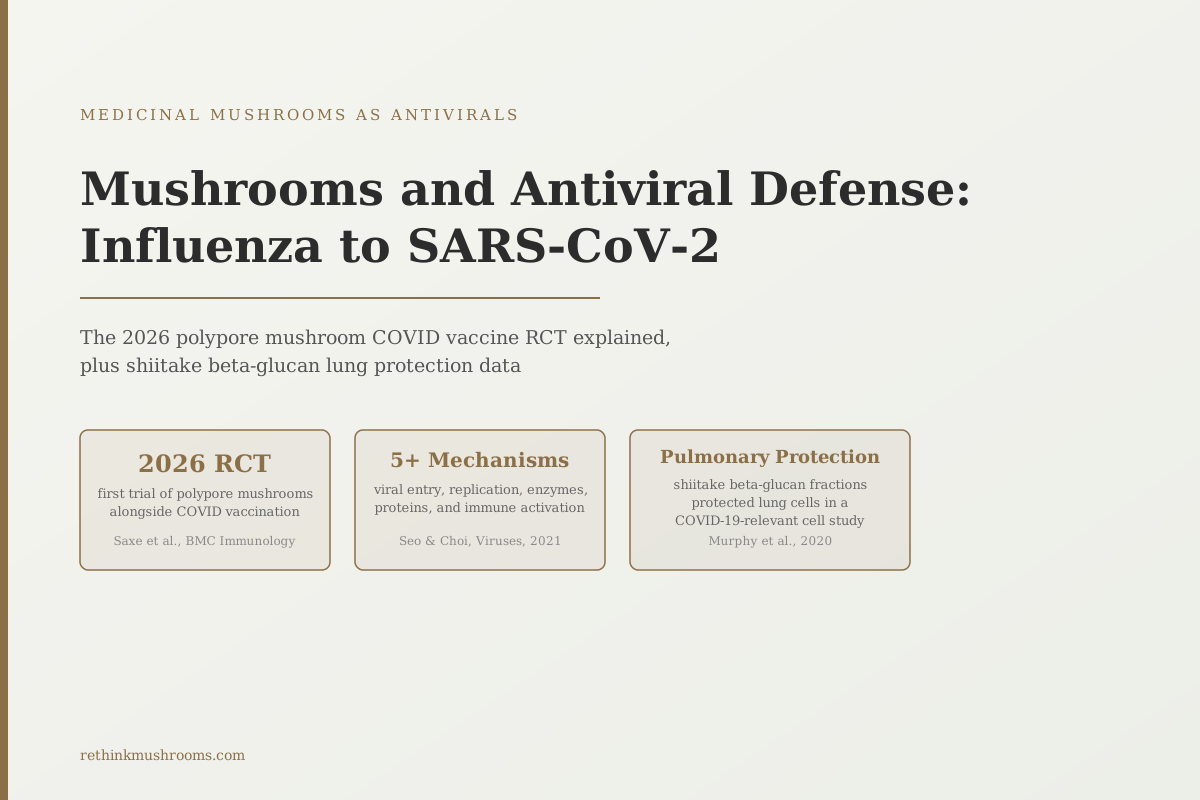
5+ antiviral mechanisms
Mushroom compounds target at least five distinct steps in viral infection simultaneously: viral entry, genome replication, viral enzyme activity, viral protein function, and cellular immune activation.
Seo & Choi, Viruses, 2021
2026 COVID RCT
first randomized clinical trial testing polypore mushroom mycelium alongside COVID-19 vaccination, published in BMC Immunology (Saxe et al., 2026)
Pulmonary protection
different shiitake beta-glucan fractions protected lung cells against COVID-19-relevant damage in a 2020 cell study (Murphy et al., 2020)
Hemagglutinin inhibition
mushroom polysaccharides block the attachment protein influenza uses to enter cells, a mechanism class relevant to respiratory viruses broadly
Seo & Choi, Viruses, 2021
 View as image ↗
In 2026, Saxe and colleagues published a randomized clinical trial in BMC Immunology testing polypore mushroom mycelium supplementation as an adjunct to COVID-19 vaccination.[1] It was the first controlled human trial to test whether mushroom compounds can improve the immune response to a COVID vaccine. Mushrooms were not proposed as a COVID treatment. They were tested as a potential immune primer: something that could help the vaccine-generated immune response be stronger or more durable. This distinction matters for how the research should be interpreted. This article covers what the Saxe trial tested, the preclinical evidence that motivated it, and the broader context of mushroom research on respiratory viruses from influenza to SARS-CoV-2, within the larger framework of what beta-glucans are and how they work.
Key Takeaways
- In 2026, Saxe and colleagues published the first randomized clinical trial testing polypore mushroom mycelium as an adjunct to COVID-19 vaccination, measuring its effect on vaccine immune response in BMC Immunology. It is the most clinically significant mushroom antiviral study published to date
- Mushroom compounds do not act as antivirals in the way pharmaceutical drugs do; they work primarily by priming the immune system's antiviral arsenal rather than directly blocking viral replication in clinical settings
- Different beta-glucan fractions from the same mushroom species produce different immune effects: some fractions activate NK cells (which kill virus-infected cells), others provide pulmonary cytoprotection (lung cell protection relevant to respiratory viral damage) (Murphy et al., 2020)
- Polypore mushrooms, the class tested in the 2026 Saxe RCT, have preclinical anti-influenza activity documented through both direct antiviral assays and immune activation mechanisms (Teplyakova et al., 2021; Teplyakova et al., 2012)
- Mushroom compounds target viral infection at multiple points simultaneously: viral entry, genome replication, viral enzyme activity, viral proteins, and host immune activation; this multi-mechanism profile is distinct from most pharmaceutical antivirals (Seo & Choi, 2021)
- No mushroom or mushroom extract is approved as a COVID treatment; the research explores the vaccine adjuvant and immune preparation angles, which are meaningfully different from therapeutic claims
The 2026 COVID Vaccine RCT: What It Tested and Why It Was Conducted
The Saxe et al. (2026) trial published in BMC Immunology represents a milestone in mushroom antiviral research because it moves the question from "do mushroom compounds affect immune function in a laboratory?" to "do they improve a clinically relevant antiviral immune outcome in living people?"[1]
The study tested polypore mushroom mycelium. Polypores are a class of fungi that includes turkey tail (Trametes versicolor), reishi (Ganoderma lucidum), and chaga (Inonotus obliquus), among many others. These species have decades of preclinical antiviral research behind them. They are beta-glucan rich. They have demonstrated immune activation and anti-influenza activity in multiple laboratory and animal model systems. The scientific premise for the Saxe trial was that this class of fungi, given as a supplement alongside COVID vaccination, might improve the antibody response to the vaccine.
The design, randomized and controlled, represents the gold standard of clinical evidence and is categorically different from the observational or preclinical evidence that characterizes most of the mushroom antiviral literature. The publication in BMC Immunology, a peer-reviewed immunology journal, represents appropriate scientific scrutiny for these findings.
The specific results are available in the published paper. What the study design tests is precisely the hypothesis that decades of laboratory research has been building toward: that polypore mushrooms, through beta-glucan-mediated immune priming, can make vaccine-generated immunity more robust.
For the full mechanistic picture of how mushroom beta-glucans prime antiviral immune cells, see mushroom beta-glucans and viral immune response.
How Mushroom Compounds Prime Antiviral Immunity: The Multi-Mechanism Framework
Seo and Choi (2021) published a comprehensive mechanism review in Viruses that provides the foundational framework for understanding how mushroom compounds interact with viral infections.[3] The review covers viruses including influenza, HIV, herpes simplex, hepatitis B and C, and SARS-CoV-2, and maps the five main antiviral mechanisms documented for mushroom compounds:
Viral entry inhibition: Specific mushroom polysaccharides and lectins bind to viral surface proteins or cell surface receptors, physically blocking viruses from entering host cells. For influenza, this means blocking the hemagglutinin protein that the virus uses to attach to sialic acid receptors on respiratory cells.
Genome replication interference: Certain mushroom compounds enter cells and disrupt the processes viruses use to copy their genetic material.
Viral enzyme inhibition: Mushroom compounds can block enzymes that viruses require for their life cycle, such as neuraminidase (an influenza surface enzyme) and reverse transcriptase (used by HIV).
Viral protein disruption: Terpenoid compounds from reishi and similar species interfere with viral structural protein assembly.
Host immune activation: The best-documented mechanism for most mushroom species. Beta-glucans, through dectin-1 receptor binding on immune cells, trigger natural killer cell activation, interferon production, macrophage polarization, and the "trained immunity" state in which immune cells respond more vigorously to future viral encounters.
Most pharmaceutical antivirals target one of these mechanisms. Mushroom compounds can engage multiple simultaneously, which is mechanistically distinct and raises legitimate research questions about whether that profile is useful in the vaccine adjuvant context the Saxe trial explored.
For a broader overview of mushroom compound antiviral activity, see medicinal mushrooms as antivirals: what the research shows. For the role of mushroom lectins specifically, see mushroom lectins: the underappreciated bioactive compounds.
What Shiitake Beta-Glucans Did to Lung Cells in a COVID-Relevant Study
Murphy and colleagues (2020) published a study in Science of the Total Environment that is directly relevant to SARS-CoV-2 respiratory pathology, with a title that explicitly mentioned COVID-19 implications.[2]
The researchers tested different beta-glucan fractions extracted from shiitake mushrooms (Lentinus edodes) on cell cultures. The fractions differed in particle size, molecular weight, and structural properties. Two types of effects were measured: antiviral immune activation (specifically NK cell activity) and pulmonary cytoprotection (lung cell protection against damage).
The finding was that different beta-glucan fractions produced different effects. Some fractions preferentially stimulated NK cell activity, which is the immune system's primary mechanism for killing virus-infected cells before the adaptive immune response is fully activated. Other fractions provided measurable protection to lung cells against inflammatory damage.
The pulmonary cytoprotection finding is particularly relevant to SARS-CoV-2, which causes significant lung damage through inflammatory processes in severe cases. Whether beta-glucan fractions could reduce that lung damage in living patients was not tested in this study, which remains a cell culture experiment. But the mechanistic finding (that specific shiitake fractions have lung-protective properties in a COVID-19-relevant model) is a meaningful data point that competitor content has not incorporated.
The Murphy study also established something practically important: not all beta-glucan supplements are equivalent. The fraction matters. Extraction method matters. Different preparations of the same mushroom species can produce categorically different immune outcomes. A hot-water extract of shiitake is not interchangeable with an alcohol extract, and neither is interchangeable with raw mushroom powder, because the structural form of the beta-glucan determines which immune pathways it engages.
Influenza Data and Why It Matters for SARS-CoV-2 Research
The Saxe 2026 trial used polypore mushrooms, the same class that shows anti-influenza activity in multiple prior studies. Understanding that prior data provides context for why polypores were selected.
Teplyakova and colleagues (2021) published a focused review of mushroom research specifically against influenza viruses in the International Journal of Medicinal Mushrooms.[4] The review documented anti-influenza activity in Ganoderma, Lentinus, Trametes, and Inonotus species, all polypores or related species. The mechanisms included:
Direct antiviral activity: mushroom polysaccharides, particularly sulfated forms, inhibit hemagglutinin binding to sialic acid receptors. Hemagglutinin is the protein influenza uses to attach to and enter respiratory cells. Blocking it at this attachment step prevents infection.
Immune activation: the same species also stimulate NK cell activity and interferon production, strengthening the innate immune response to viral infection.
Teplyakova and colleagues (2012) had earlier tested polyporoid mushrooms specifically from the Altai Mountains against influenza A (H1N1) and herpes simplex virus in cell culture.[5] Multiple species showed measurable anti-influenza activity in that in vitro system.
The connection to SARS-CoV-2 is mechanistic but not direct. SARS-CoV-2 uses its spike protein to bind ACE2 receptors on human cells, not hemagglutinin-sialic acid binding. However, polypore mushrooms' general anti-respiratory-virus profile, demonstrated in influenza models, provided the scientific rationale for testing them against COVID-related immunity. The Saxe 2026 trial translates that rationale into a human study.
For how these influenza mechanisms connect to mushrooms' broader seasonal immunity support, see mushrooms and influenza: can they help fight the flu.
Honest Framing: What Mushrooms Can and Cannot Do for COVID
The evidence reviewed here does not support the claim that mushrooms treat COVID-19. It supports a more modest and scientifically legitimate claim: that polypore mushrooms, through beta-glucan-mediated immune activation, may improve the immune response to COVID vaccination, and that mushroom compounds have demonstrated anti-respiratory-virus activity in preclinical models.
The distinction between immune preparation and treatment matters in both accuracy and practical application. Pharmaceutical antivirals (Paxlovid, remdesivir, nirmatrelvir) work by directly blocking viral replication in acutely infected patients. Mushroom beta-glucans work by training immune cells to respond more vigorously before exposure. These are different modes of action, most useful at different points in time.
The 2026 Saxe RCT tests the vaccine adjuvant angle, the most clinically plausible application for mushrooms in a COVID context. If beta-glucan supplementation improves antibody responses to COVID vaccination, that would be a meaningful public health finding that does not require any therapeutic efficacy against the virus itself.
What is not established: whether mushroom supplementation reduces COVID-19 severity, duration, or hospitalization in infected patients. That question has not been tested in a controlled clinical trial.
The timing question is practical and underappreciated. Trained immunity requires weeks of beta-glucan exposure to develop. This is fundamentally different from acute antiviral treatment. If mushroom beta-glucans work through immune preparation, the relevant window is weeks before exposure, not days after. The Saxe 2026 trial, by supplementing alongside vaccination, tests a scenario in which that prior priming could realistically occur. An acute-phase treatment trial would test a different mechanism under different conditions and might produce completely different results.
For the hepatitis-specific antiviral clinical data (the only other human evidence for mushrooms improving viral infection outcomes), see mushrooms and hepatitis: antiviral research review. For the foundational overview of all mushroom antiviral evidence across virus types, see medicinal mushrooms as antivirals: what the research shows.
For the mechanism behind trained immunity and how beta-glucans epigenetically reprogram immune cells for sustained antiviral readiness, see how beta-glucans epigenetically reprogram immune cells.
The Bottom Line
The 2026 Saxe RCT is the most clinically significant mushroom antiviral study published: the first randomized controlled trial testing polypore mushroom mycelium supplementation as an adjunct to COVID-19 vaccination, published in BMC Immunology. The preclinical evidence that motivated it includes multi-mechanism antiviral activity from polypore compounds (reviewed by Seo 2021), shiitake beta-glucan fractions showing NK cell activation and pulmonary cytoprotection in COVID-relevant cell models (Murphy 2020), and documented anti-influenza activity in polypore species through hemagglutinin binding inhibition (Teplyakova 2021, 2012). Mushrooms are not antivirals in the therapeutic sense; the vaccine adjuvant application represents the most evidence-supported clinical hypothesis to date.
Frequently Asked Questions
Sources & References
- 1RTHM-02244·Saxe, Gordon et al. (2026). “Polypore mushroom mycelia as an adjunct to COVID-19 vaccination: a randomized clinical trial..” BMC immunology.Study breakdown →PubMed →↩
- 2RTHM-00638·Murphy, Emma J et al. (2020). “β-Glucan extracts from the same edible shiitake mushroom Lentinus edodes produce differential in-vitro immunomodulatory and pulmonary cytoprotective effects - Implications for coronavirus disease (COVID-19) immunotherapies..” The Science of the total environment.Study breakdown →PubMed →↩
- 3RTHM-00717·Seo, Dong Joo et al. (2021). “Antiviral Bioactive Compounds of Mushrooms and Their Antiviral Mechanisms: A Review..” Viruses.Study breakdown →PubMed →↩
- 4RTHM-00723·Teplyakova, Tamara V et al. (2021). “Medicinal Mushrooms against Influenza Viruses..” International journal of medicinal mushrooms.Study breakdown →PubMed →↩
- 5RTHM-00265·Teplyakova, Tamara V et al. (2012). “Antiviral activity of polyporoid mushrooms (higher Basidiomycetes) from Altai Mountains (Russia)..” International journal of medicinal mushrooms.Study breakdown →PubMed →↩