Meshima (Phellinus linteus)
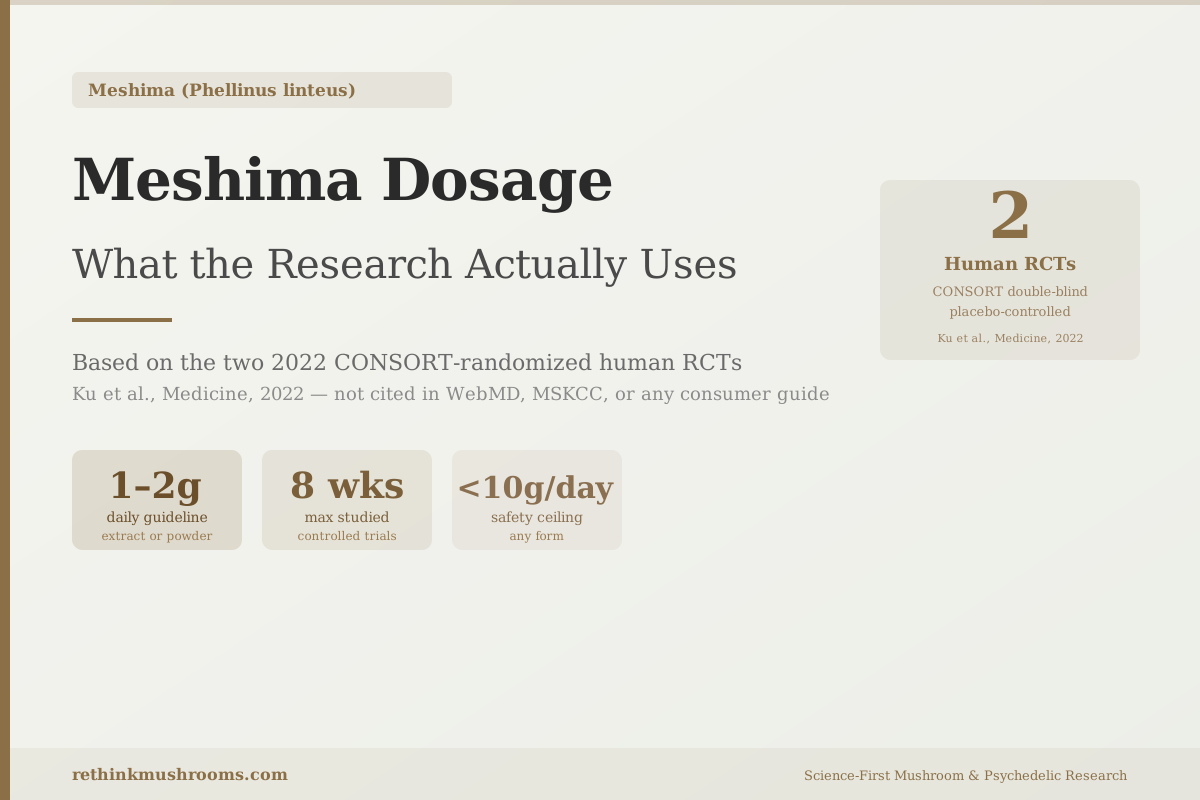
2 RCTs
The number of CONSORT-randomized double-blind human trials providing clinical dosage data for Phellinus linteus extract; neither is cited in any major consumer health resource.
Ku et al., Medicine, 2022
1–2g
daily dose in established safety guidelines
8 wks
maximum studied duration in human trials
< 10g
daily ceiling based on safety data
Ku et al., Medicine, 2022
 View as image ↗
Phellinus linteus has been used as medicine for over a thousand years in East Asian practice. Two formal human clinical trials exist for its extract. Both were published in 2022. Neither appears in WebMD's dosage guidance, MSKCC's integrative medicine profile, or any supplement review that comes up when someone searches for meshima mushroom dosage. Every number circulating in consumer resources comes from generic herbal safety guidelines compiled before those trials existed.
This article is a companion to the broader overview of meshima mushroom: what it is, how it grows, and what the evidence base covers. Here, the focus is specifically on dosage: what human clinical trials have tested, how the safety guidelines compare, and why the form of meshima product you take changes how dose should be calculated.
The short answer: no human dose-finding (Phase I) trial has been published specifically for meshima. The strongest available evidence comes from two CONSORT-randomized double-blind placebo-controlled trials published by Ku et al. in 2022 that tested fruiting body extract for immune enhancement in adults. Established safety guidelines place daily intake at 1 to 2 grams for durations up to 8 weeks, with an upper threshold below 10 grams per day.
Key Takeaways
- The two highest-quality human dosage references are CONSORT-randomized double-blind trials by Ku et al. (2022), both in Medicine, and neither is cited in any major consumer health resource[1][2]
- Established safety guidelines recommend 1 to 2 grams daily for up to 8 weeks, with a ceiling below 10 grams per day
- No published dose-finding trial has identified the minimum effective dose or the optimal dose for any clinical endpoint
- Extract dose and whole mushroom powder dose are not interchangeable; concentrated extracts deliver higher active compound density per gram than raw powder
- All human RCT evidence is for fruiting body extract; mycelium-based products have preclinical evidence of biological activity but have not been tested in human controlled trials[4][5]
- Lee et al. (2019) documented 41 pancreatic cancer patients taking meshima alongside chemotherapy with no significant adverse interactions, providing real-world context for use beyond the 8-week trial window[3]
The Two Clinical Trials No Consumer Resource Cites
Ku YH and colleagues published two CONSORT-randomized, double-blind, placebo-controlled trials testing Phellinus linteus fruiting body extract supplementation for immune enhancement in humans. Both appeared in Medicine in 2022. Together they are the only published controlled human trials examining Phellinus linteus extract supplementation in a wellness context, and they represent the highest level of clinical trial rigor available for this mushroom.
The CONSORT standard requires trials to be pre-registered, with randomization, blinding, allocation concealment, and full reporting of participant flow and adverse events. A CONSORT-compliant trial is not a small case series or an observational study. Both Ku 2022 trials meet this standard.
Ku et al. (2022a) tested Phellinus linteus extract on immune markers in adults in a double-blind placebo-controlled pilot trial and documented immunological outcomes and safety data across the intervention period.[1] Ku et al. (2022b) followed as a confirmatory trial, also CONSORT-compliant, double-blind, and placebo-controlled, examining immune outcomes with fruiting body extract in the same format.[2] Both trials used fruiting body extract, not raw mushroom powder and not mycelium culture. The key dosage and safety data from these trials, including what extract doses were administered and what adverse events were observed, are reported in the published papers.
The competitive landscape in consumer media is stark: WebMD cites generic safety guidelines. MSKCC's integrative medicine profile was not updated to include these trials. Healing-mushrooms.net and similar supplement education sites work from summaries that predate 2022 entirely. For anyone wanting dosage guidance grounded in the highest-quality human evidence, the 2022 Ku trials are the starting point, not the 1-2g guideline that floats unattributed across dozens of websites.
The Safety Baseline: 1–2g Daily, 8 Weeks Maximum
Outside the clinical trial literature, the most consistently cited safety guideline for Phellinus linteus supplementation is 1 to 2 grams per day for up to 8 weeks. This range was compiled from available human data and appears in safety-oriented consumer resources including WebMD.
A second threshold appears in safety assessments based on the cumulative research record: chronic daily intake should remain below 10 grams. This ceiling is not derived from a dose-escalation trial (none exists for meshima) but from safety evaluations of the literature overall.
The table below maps the available dosage reference points by source and evidence type:
| Source | Form | Daily Dose | Duration |
|---|---|---|---|
| Safety guideline | Fruiting body extract or powder | 1–2 g | Up to 8 weeks |
| Clinical trials (Ku et al., 2022) | Fruiting body extract | Per trial protocol | ~8 weeks |
| Safety ceiling | Any form | Below 10 g | Not defined |
| Common commercial product | Standardized extract | ~600 mg–1.2 g | Varies |
What the table shows: the safety guideline and the clinical trial window align. Commercial products in the 600 mg per serving range fall within the lower portion of the established safety range for a standard one-to-two capsule daily dose. The RCT protocols are the most precisely documented reference point; those details are in the published Ku et al. papers.
One thing the table clarifies: the safety guideline's 1–2 g refers to extract, which is concentrated. The same gram amount of raw whole mushroom powder is not the equivalent.
Extract vs. Powder: Why the Same Gram Count Delivers Different Active Compounds
Meshima's biological activity comes primarily from two classes of compounds: polysaccharides (including beta-glucans and other immunomodulatory carbohydrates) and phenolics such as hispolon. An extract concentrates these compounds by removing the indigestible fiber matrix and inert material. Whole mushroom powder contains the full mushroom matrix, including all active compounds, at lower concentration per gram. The detailed breakdown of what each compound class does and how extraction methods affect compound ratios is covered in the guide to Phellinus linteus bioactive compounds.
This means that a 600 mg dose of a standardized fruiting body extract is not the same as 600 mg of whole mushroom powder. An extract labeled "10:1" theoretically concentrates material from 10 parts raw mushroom into 1 part extract, delivering a higher dose of active compounds per gram. The ratio varies by manufacturer and extraction method.
The clinical trials used fruiting body extract, not raw powder.[1][2] This means the dosage data from those trials applies to extract products, not to raw mushroom powder products. Someone using raw whole mushroom powder at 1 gram daily is delivering less active compound than someone using 1 gram of a concentrated extract.
The full comparison of meshima extract vs. whole powder, covering hot water vs. alcohol extraction, polysaccharide molecular weight, and the dual extraction advantage, is covered in the companion article. For the purposes of dosage, the takeaway is: match your dose reference to your product type. The safety guidelines and RCT data apply to extract. If your product is raw powder, the active compound delivery per gram is lower.
Sourcing and what to look for when buying meshima is a separate practical question; it connects directly to dosage because product quality determines how much active compound is actually present at any given gram amount.
Duration: 8 Weeks of Human Evidence and What We Know Beyond It
The 8-week window comes from both the safety guidelines and the approximate duration of the Ku et al. clinical trials. This is the maximum studied duration in controlled human research for a wellness context. It does not mean use beyond 8 weeks is harmful; it means no controlled data exists for longer periods.
The one exception in the literature is Lee et al. (2019), a propensity score-matched observational analysis of 41 pancreatic ductal adenocarcinoma patients who took Phellinus linteus alongside adjuvant chemotherapy after curative resection.[3] The researchers found that the meshima group showed better adherence to adjuvant treatment and no significant adverse interactions between meshima and the chemotherapy regimen were documented.
Several things are worth noting about the Lee 2019 data: it was observational, not randomized, so confounding is possible; the population was cancer patients on chemotherapy, not a general wellness population; and "no documented adverse interactions" is a real-world observation, not a controlled safety assessment. Still, it provides the only extended-use context in a human population, and the picture it offers is relatively reassuring for a population where the stakes of using an insufficiently studied supplement are highest.
For general use, the 8-week window with a pause before restarting is the evidence-based default until longer-term controlled data exists. For cancer patients or anyone taking CYP450-cleared medications, the safety considerations go beyond duration. The full safety profile for meshima, including the CYP450 drug interactions and the autoimmune contraindication, is covered in the companion safety article.
Mycelial Products: Biologically Active in Animals, Not Tested in Human RCTs
Meshima supplements come in two basic substrate forms: fruiting body-derived and mycelium-derived. The distinction matters for interpreting dosage because all human clinical trial evidence is for fruiting body extract.
Shin et al. (2021) demonstrated that Phellinus linteus mycelium produces immunomodulatory and anti-inflammatory effects in preclinical models.[4] Huang et al. (2011) showed that oral administration of mycelial culture demonstrated antitumor activity in hepatoma-bearing mice.[5] Mycelium is not inert. The preclinical evidence supports that mycelium-based preparations are biologically active.
But preclinical evidence is not human trial evidence. Both of the Ku 2022 CONSORT trials used fruiting body extract. There is no CONSORT-randomized human trial testing Phellinus linteus mycelium. The dose-to-effect data from the human literature cannot be applied to mycelium products without assuming the two substrate types are pharmacologically equivalent, which has not been established.
For buyers of mycelium-based meshima products, the honest assessment is: the product may be biologically active, but the dosage data from the human clinical literature does not apply directly. What dose of mycelium produces an effect equivalent to what dose of fruiting body extract is an open question.
What Sliva's 2010 Review Established: The Gap the 2022 Trials Filled
Sliva (2010) published a comprehensive review of Phellinus linteus as an alternative cancer therapy in Experimental and Therapeutic Medicine, examining the evidence up to that date for anti-tumor, anti-angiogenic, and immunomodulatory mechanisms.[6] The review identified the biological rationale for therapeutic use and noted, accurately for that time, that most of the evidence was preclinical.
The 2010 review captured the state of meshima science before human trials existed. It is still the most-cited reference for mechanistic background in consumer media. Its conclusion, that human trials were needed, identified exactly the gap that the 2022 Ku trials began to fill.
What Sliva's review could not provide was human dosage data. No dose-finding trial, no Phase I safety escalation, no dose-response relationship in humans had been published by 2010. That gap is still only partially filled in 2026. The two 2022 Ku trials provided the first CONSORT-quality human evidence for fruiting body extract supplementation in a wellness context. But they are two trials. A minimum effective dose has not been identified. A dose-response curve does not exist. The optimal dose for any specific indication remains unknown.
What Remains Unknown: The Dose-Finding Gap
Every dosage guide on the internet answers the question "how much meshima should I take?" with a number. What most of those guides don't say is that no published clinical study has tried to identify the minimum effective dose, the optimal dose, or the dose at which effects plateau for any specific outcome.
The two 2022 Ku trials established that Phellinus linteus extract can affect immune markers in humans over an 8-week period at the doses tested. What they did not establish is whether a lower dose would produce the same effect, whether a higher dose would produce a larger effect, or how the dose-response curve is shaped. These are the questions a dose-finding or Phase I trial would address. No such trial has been published.
This is not a unique limitation of meshima research. Most functional mushroom dosage guidance is built on safety thresholds derived from animal studies and general use patterns, with isolated human trials testing fixed doses without dose-ranging. The honest position is that the current dosage guidance is based on safety assessments and a small number of trials, not on a systematic mapping of dose to effect.
The sourcing quality issues in the meshima market add another layer: species identity inconsistencies mean that two products labeled as "Phellinus linteus" at the same gram dose may contain different amounts of different species with somewhat different bioactive profiles. Dose in milligrams of a named product and dose in milligrams of active compounds reaching the body are two different numbers.
The Bottom Line
The strongest human dosage data for meshima (Phellinus linteus) comes from two CONSORT-randomized double-blind placebo-controlled trials by Ku et al. published in Medicine in 2022, the only controlled human trials in a wellness context, neither of which is referenced in major consumer health resources. Established safety guidelines place daily intake at 1 to 2 grams for up to 8 weeks, with a ceiling below 10 grams per day. No dose-finding trial exists, so the minimum effective dose and optimal dose remain unknown. All human RCT evidence is for fruiting body extract; dosage data from the trials does not translate directly to mycelium-based products or raw whole mushroom powder without adjustment for concentration.
Frequently Asked Questions
Sources & References
- 1. Source details for this reference are not yet available.
- 2. Source details for this reference are not yet available.
- 3. Source details for this reference are not yet available.
- 4. Source details for this reference are not yet available.
- 5. Source details for this reference are not yet available.
- 6. Source details for this reference are not yet available.