Meshima Sourcing
Dual extraction = both compound classes
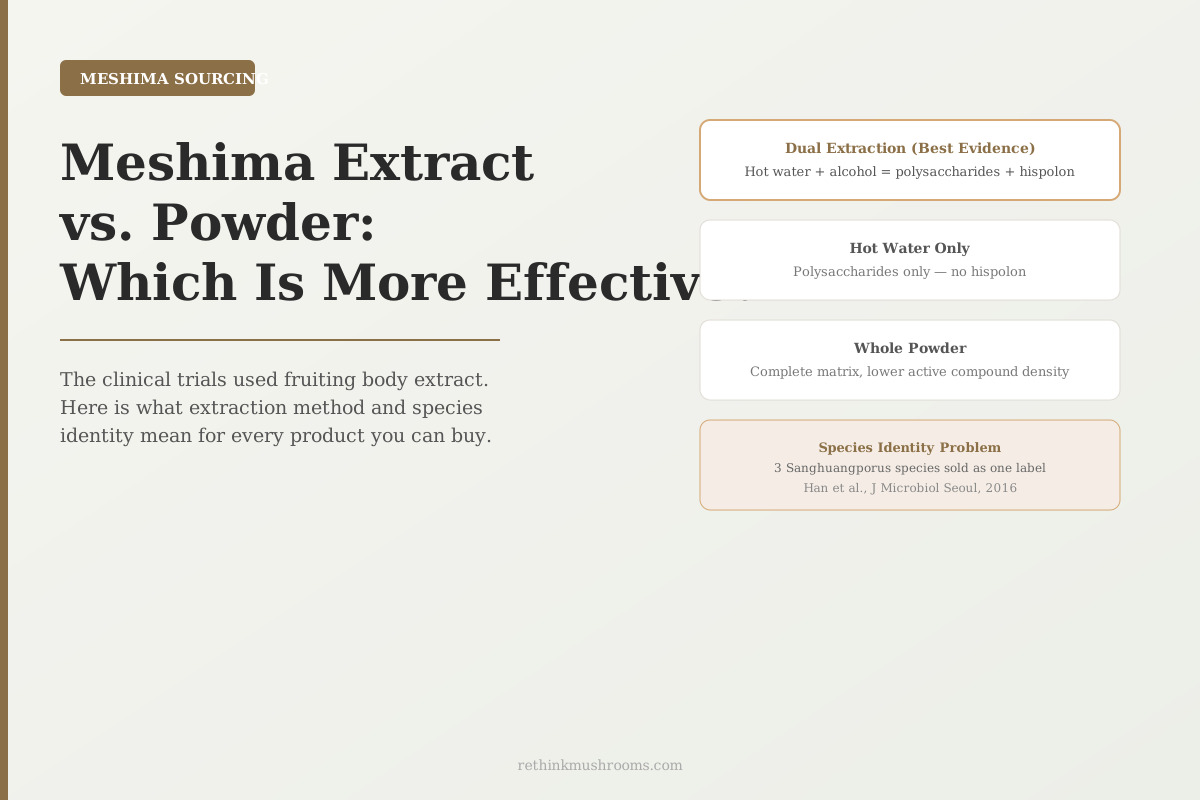
Hot water extraction captures immune-activating polysaccharides. Alcohol extraction captures hispolon and antitumor phenolics. Only dual extraction captures both. Most products use only one method.
Qin et al., Int J Biol Macromol, 2023
2 RCTs
both used fruiting body extract, not whole mushroom powder (Ku et al., 2022)
3 species
sold as Phellinus linteus in Korean markets with different bioactive profiles (Han et al., 2016)
MW matters
polysaccharide molecular weight affects immunomodulatory potency (Kou et al., 2024)
Qin et al., Int J Biol Macromol, 2023
 View as image ↗
Most people comparing mushroom supplements focus on the product label. Meshima extract vs. powder comes down to a more fundamental question: which active compounds are you trying to get, and which form actually delivers them? The answer depends on the extraction method, which part of the mushroom was used (fruiting body or mycelium), and whether you're getting the species that the research actually studied. A 2023 systematic review of Phellinus linteus extraction methods found that hot water and alcohol extraction yield entirely different compound classes with different biological activities.[1]
This matters because both compound classes in Meshima have research backing, and most products only capture one of them.
For the full picture of what Meshima is and why it has been studied as a medicinal mushroom, see what is Meshima. For the specific immune mechanisms that make Meshima compounds biologically active, see Phellinus linteus bioactive compounds.
Key Takeaways
- Hot water extraction yields polysaccharides (the immune-activating compound class); alcohol extraction yields hispolon and other phenolics (the antitumor compound class); dual extraction yields both (Qin et al., Int J Biol Macromol, 2023)
- The only published human clinical trials (two 2022 Korean CONSORT-randomized RCTs) used fruiting body extract specifically, making it the best-evidenced form for human use (Ku et al., Medicine, 2022)
- Polysaccharide molecular weight is a more precise potency marker than beta-glucan percentage: different extraction conditions produce different molecular weight polysaccharides with different immunomodulatory activity (Kou et al., Int J Biol Macromol, 2024)
- Mycelium-based products show bioactivity in preclinical models (Shin et al., 2021; Suh et al., 2022), but all human clinical evidence is from fruiting body extract
- Products labeled "Phellinus linteus" may contain up to three different Sanghuangporus species (S. baumii, S. vaninii, S. sanghuang) with different compound ratios; species identity is a quality variable independent of extraction method (Han et al., 2016)
- Whole mushroom powder retains the complete food matrix but delivers lower active compound concentrations per gram than standardized extracts
What Gets Lost (and What Gets Concentrated): How Extraction Works
Mushroom powder is exactly what it sounds like: dried mushroom material ground into a fine powder. All the fiber, inert structural material, and bioactive compounds stay in the powder, but at the same concentrations found in the original mushroom. Nothing is removed; nothing is concentrated.
Extraction changes this. The process uses a solvent (water, alcohol, or both) to pull specific compounds out of the mushroom material. The resulting liquid is then dried into a concentrated powder. The goal is to increase the density of biologically active compounds relative to the inert material.
The critical word is "specific." Different solvents pull different compounds from mushroom tissue, and different compounds are responsible for different biological effects. For Meshima, this means two compound classes are in play, and they require different extraction methods.
A 2023 systematic review in the International Journal of Biological Macromolecules, covering Phellinus linteus extraction methods, purification techniques, and structure-activity relationships, documented this clearly.[1]
Two Compound Classes, Two Extraction Methods: Why One Process Isn't Enough
The first active compound class in Meshima is polysaccharides, which are large sugar-chain molecules found in the mushroom's cell walls and internal structures. These are the compounds responsible for most of the immune-stimulating activity studied in the research literature. They activate macrophages (immune cells that identify and attack pathogens and cancer cells), stimulate cytokine production (immune signaling molecules), and have been the subject of most clinical research.
Polysaccharides are water-soluble. Hot water extraction pulls them efficiently from mushroom tissue. A well-executed hot water extraction produces a polysaccharide-rich concentrate, often standardized by beta-glucan percentage (since beta-glucans are the most studied subtype of mushroom polysaccharides).
The second active compound class is hispolon and related phenolic compounds. Hispolon is a polyphenol unique to Phellinus/Sanghuangporus species. Research has linked it to antitumor, antioxidant, and anti-inflammatory activity. Cell culture studies have shown hispolon induces apoptosis (programmed cell death) in cancer cells and sensitizes them to immune-mediated death signals.
Hispolon is not water-soluble. It requires alcohol (typically ethanol) to extract effectively. A product made only with hot water extraction contains polysaccharides but will have little to no hispolon.
Dual extraction uses both water and alcohol sequentially, capturing both compound classes. The 2023 review confirmed that dual extraction provides the broadest bioactive compound profile of any single method.[1]
What this means for buying decisions: a product labeled "Phellinus linteus extract" without specifying the extraction method may be hot water only. Products that specify "dual extraction" or list both polysaccharide content and hispolon content have processed for both compound classes.
Molecular Weight: Why Beta-Glucan Percentage Doesn't Tell the Full Story
Beta-glucan percentage is the standard quality marker on mushroom supplement labels. A product stating "30% beta-glucan" is telling you what fraction of the powder, by weight, consists of beta-glucan polysaccharides. This is a useful baseline. It is not, however, the most precise measure of immunomodulatory potency.
A 2024 review of Phellinus linteus polysaccharides covering preparation methods and structure-activity relationships introduced an important refinement.[2]
Polysaccharides are not a uniform compound class. They vary in molecular weight (how long the sugar chain is) and in the degree of branching (how many side chains extend from the main backbone). These structural features affect how the immune system responds to them. High molecular weight polysaccharides with more branching tend to activate immune cells more strongly than low molecular weight, less branched versions. The same total beta-glucan percentage can correspond to very different immunomodulatory potency depending on the size and structure of the molecules.
Extraction conditions determine which molecular weights you end up with. Higher extraction temperatures and longer extraction times tend to break polysaccharide chains into smaller fragments. Products extracted under controlled, documented conditions are more likely to preserve the higher molecular weight structures associated with stronger immune activity.
The practical takeaway: when comparing products, beta-glucan percentage is better than no standardization at all. But manufacturers who publish extraction parameters (temperature, time, solvent ratios) or provide assay data on polysaccharide molecular weight are providing more useful information.
Fruiting Body vs. Mycelium: What the Clinical Evidence Actually Used
Mushroom supplements can be made from the fruiting body (the visible part of the fungus, the "mushroom cap and stem"), the mycelium (the root-like network of fungal threads that grows underground or through a substrate), or the whole mushroom (both parts together). For Meshima, this distinction affects which product form has the most relevant human evidence.
The two highest-quality human studies for Phellinus linteus are the 2022 CONSORT-randomized, double-blind, placebo-controlled trials by Ku and colleagues, published in the journal Medicine.[6] Both trials used fruiting body extract. The clinical evidence anchors specifically to that form.
Mycelium-based products have their own evidence base, but it is preclinical. Shin and colleagues (2021) demonstrated that Phellinus linteus mycelium had immunomodulatory and anti-inflammatory effects in preclinical models.[3] Suh and colleagues (2022) showed that postbiotics (fermentation-derived compounds) from Phellinus linteus mycelial submerged culture activated immune cells in mice.[4] Huang and colleagues (2011) used orally administered mycelial culture in a hepatoma mouse model and found antitumor effects.[5]
So mycelium products are not without bioactivity evidence. The honest answer is that the fruiting body evidence is deeper for Meshima specifically, and the only human trial data is for fruiting body extract.
One practical note: mycelium is easier and cheaper to produce commercially than fruiting bodies, which require longer growth cycles. This economic pressure means some products labeled as mushroom supplements use mycelium grown on grain substrate, which can dilute active compound content with starchy filler material. Products that specify fruiting body as the source, or that publish beta-glucan or polysaccharide content from assay testing, avoid this ambiguity.
For context on how beta-glucans from mushrooms activate specific immune cell pathways, see how mushroom beta-glucans modulate insulin signaling. For the broader Meshima immune mechanism research, see Meshima and the immune system.
What Extract Ratios Mean and Why They Are Often Misleading
Many mushroom products state an "extract ratio" on the label: 10:1, 5:1, or similar. These numbers claim a concentration multiple: a 10:1 extract supposedly concentrated 10 grams of mushroom material down to 1 gram of extract.
Extract ratios are claims about the process, not the product. A 10:1 ratio describes how much starting material was used per gram of finished extract. It says nothing about:
- Whether the extraction actually pulled out the active compounds
- What percentage of the final product is beta-glucan or other bioactives
- Whether the extraction was hot water, alcohol, or dual
A poorly executed 10:1 extraction of low-quality starting material can result in a product with less active compound than a well-executed 4:1 extraction of high-quality fruiting bodies. The ratio is process information, not potency information.
Beta-glucan percentage, combined with the extraction method and source material specification, gives a more meaningful picture than ratio alone. The 2024 review's emphasis on polysaccharide molecular weight and branching is the next layer of precision beyond that, though it remains an emerging quality standard rather than an established label norm.[2]
The Species Problem That Affects Every Form
Extraction method and fruiting body vs. mycelium are processing decisions made after harvest. But the species of mushroom harvested matters before any processing begins, and this is where the Meshima market has a documented authenticity problem.
A 2016 study in the Journal of Microbiology (Seoul) investigated the species identity of commercial sanghuang products sold in Korea and found that "Phellinus linteus" was not consistently being applied to a single species.[7] Products sold under the sanghuang or Phellinus linteus name were confirmed to include multiple species that have since been reclassified into the genus Sanghuangporus: primarily Sanghuangporus baumii, Sanghuangporus vaninii, and Sanghuangporus sanghuang.
These three species have overlapping but not identical bioactive compound profiles. The ratio of polysaccharides to hispolon varies across species. The specific immunological and antitumor effects associated with each compound class may therefore vary between products, even if both are labeled identically.
This is not a theoretical concern. It is a documented finding from a peer-reviewed species identity study, in the primary market where Meshima is commercially produced. A dual-extraction fruiting body product with high beta-glucan content is meaningfully better than a generic powder on most quality dimensions. But if the species inside is not the most-researched one, even a well-extracted product delivers a different compound profile than the research studied.
For a full examination of the species confusion problem and how to evaluate authenticity when buying, see sourcing authentic Meshima. For practical buying guidance including what certifications and labels to check, see where to find Meshima supplements. For dosage context from the clinical trials, see Meshima dosage guide.
Which Form Has the Strongest Research Backing
Ranked by strength of evidence:
Evidence Ladder
Four Meshima Forms, Ranked by Human Evidence
Dual-extraction fruiting body extract
StrongestPolysaccharides (immune)
CapturedHispolon (antitumor)
CapturedHot water + alcohol captures both compound classes; closest to the clinical-trial form.
Hot-water fruiting body extract
Human RCTPolysaccharides (immune)
CapturedHispolon (antitumor)
Not capturedMatches the RCT form and immune-mechanism evidence; misses hispolon/phenolic activity.
Hot-water mycelium extract
PreclinicalPolysaccharides (immune)
Low / variableHispolon (antitumor)
Not capturedBioactive in animal and cell studies only; watch for grain-substrate filler.
Whole mushroom powder
Food matrixPolysaccharides (immune)
Low / variableHispolon (antitumor)
Low / variableRetains the full food matrix but delivers the lowest active-compound density per gram.
Evidence rank reflects human trial data, not marketing claims: the only published human RCTs used fruiting body extract (Ku et al., 2022). Mycelium bioactivity is documented in preclinical models only (Shin 2021; Suh 2022; Huang 2011). Species identity is a separate quality variable that shifts the compound ratio in every form (Han et al., 2016).
Dual extraction fruiting body extract (hot water plus alcohol, sourced from fruiting body): captures both polysaccharide and hispolon compound classes; the form closest to what the human clinical trials studied; strongest overall research backing.
Hot water extraction fruiting body extract (polysaccharides only): aligns with the immune mechanism evidence and the RCT form; misses hispolon/phenolic activity. The trade-off is a narrower compound profile but cleaner documentation of what you're getting.
Hot water extraction mycelium extract: bioactive in preclinical studies; lower human evidence base; potential grain-filler issue with some commercial products; check for fruiting-body-verified sourcing.
Whole mushroom powder (fruiting body): retains the complete food matrix and may have synergistic effects from minor compounds not captured by extraction; delivers lower concentrations of active compounds per dose; less useful when a specific compound class (polysaccharides or hispolon) is the therapeutic target.
The clinical trial data supports fruiting body extract. The extraction method science supports dual extraction when compound breadth matters. Both quality dimensions are independent: the best available product combines fruiting body sourcing with dual extraction and publishes assay data for both polysaccharide content and extraction method.
The Bottom Line
Meshima extract concentrates active compounds that whole mushroom powder delivers at lower density. The two relevant compound classes, polysaccharides (immune activation) and hispolon/phenolics (antitumor), require different extraction methods: hot water for polysaccharides, alcohol for hispolon, dual for both. The only human clinical trial evidence is for fruiting body extract. Mycelium products are biologically active in preclinical models but lack human trial data. Species identity is a separate quality variable that affects every form.
Frequently Asked Questions
Sources & References
- 1. Source details for this reference are not yet available.
- 2. Source details for this reference are not yet available.
- 3. Source details for this reference are not yet available.
- 4. Source details for this reference are not yet available.
- 5. Source details for this reference are not yet available.
- 6. Source details for this reference are not yet available.
- 7. Source details for this reference are not yet available.