Mushrooms & Gut Health
9 studies
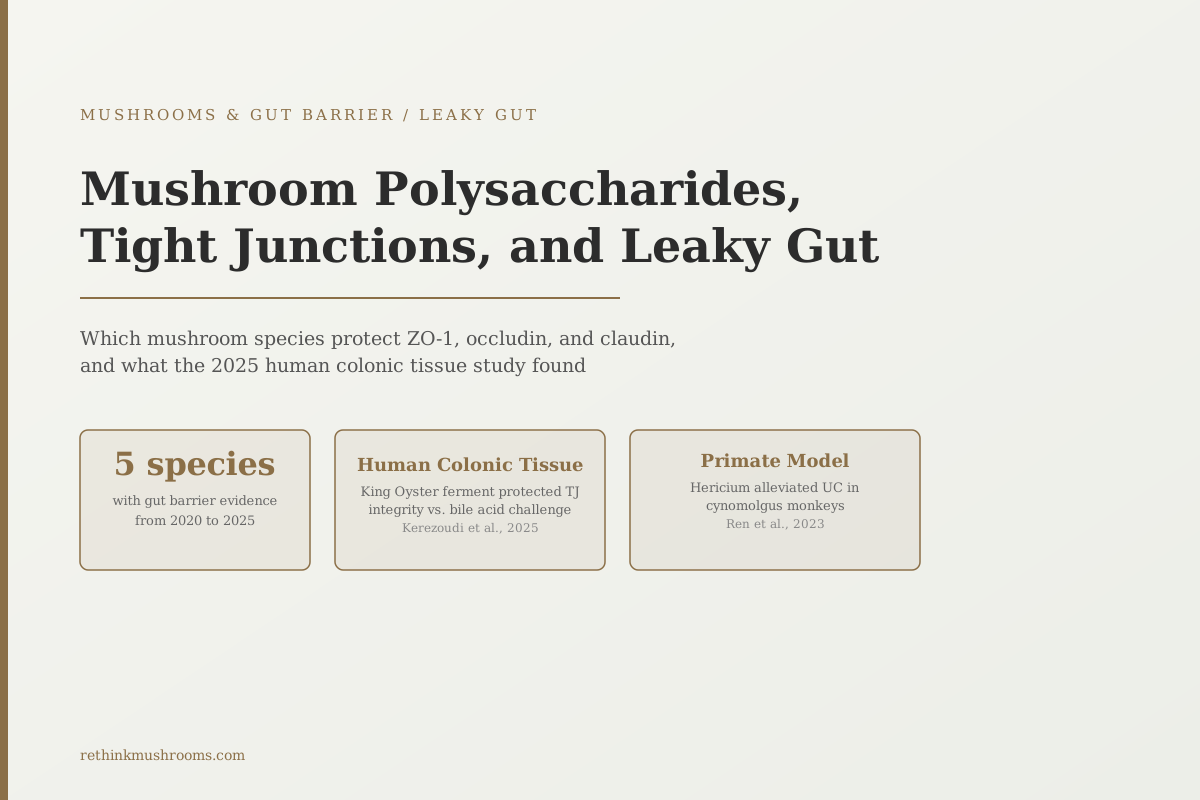
In 2025, King Oyster mushroom fermented with human gut bacteria preserved tight junction integrity in human colonic tissue against bile acid disruption. The most mechanistically direct evidence in this field yet.
Kerezoudi et al., Nutrients, 2025
5 species
with preclinical gut barrier evidence
2025
year of first human colonic tissue data
Zero
human RCTs for mushrooms and leaky gut
Kerezoudi et al., Nutrients, 2025
 View as image ↗
Multiple mushroom species produce polysaccharides, the long-chain fiber molecules that make up most of their cell walls, that appear to protect the gut lining in preclinical research. The most direct evidence came in 2025, when Kerezoudi and colleagues fermented King Oyster mushrooms with human gut bacteria and exposed human colonic tissue to a bile acid that degrades the gut barrier under normal physiological stress. The tight junction proteins that seal gut cells together were preserved.[1]
That experiment is the closest this field has come to human evidence. The rest of the data on mushroom polysaccharides, tight junction proteins, and leaky gut comes from animal models and cell studies. No randomized clinical trial has tested any mushroom extract specifically for intestinal permeability or leaky gut in humans. What the evidence does show is consistent: multiple species, multiple research teams, and a 2023 systematic review all point to the same two mechanisms, one direct and one running through the gut bacteria that mushroom fiber feeds.[2]
This article maps the preclinical evidence across five species and nine studies. For the broader picture of how mushrooms interact with gut bacteria, this cluster builds on how mushrooms feed your gut bacteria.
Key Takeaways
- Kerezoudi et al. (Nutrients, 2025) found King Oyster mushroom fermented with human gut bacteria preserved tight junction integrity in human colonic tissue against bile acid disruption, making it the most mechanistically direct evidence in this evidence base.
- Lion's Mane (Hericium erinaceus) has two preclinical gut barrier studies: a 2023 cynomolgus monkey study (stronger translational evidence than rodent data) and a study showing Hericium restored tight junction proteins in immunocompromised mice after chemotherapy drug exposure.
- Poria cocos polysaccharide protected the gut barrier in both an antibiotic-associated diarrhea model and a DSS-induced colitis model, making it relevant to drug-related gut barrier disruption contexts.
- Auricularia (wood ear mushroom) and Phellinus linteus each have animal colitis studies showing gut barrier protection through gut microbiota modulation.
- Van Den Broeke et al. (International Journal of Molecular Sciences, 2025) found a mushroom blend restored butyrate production in IBS patient microbiomes, providing the human-microbiome-context link between the prebiotic effect and tight junction function.
- No human clinical trial has tested mushroom polysaccharides for leaky gut, and no established dose or duration has been identified for any species.
What Tight Junctions Are and How Mushroom Polysaccharides Reach Them
The gut lining is a single layer of cells stretched across the inner surface of the intestine. These cells do not simply sit next to each other. They are locked together at their edges by protein structures called tight junctions, a set of molecular seals that determine what crosses the gut barrier and what does not.
Three proteins do most of the sealing work. Occludin and claudin are proteins that physically span the gap between adjacent cells and form the seal itself. ZO-1, or zonula occludens-1, is a scaffold protein that anchors the junction to the cell's internal skeleton and holds the whole complex together. When these proteins are intact, the gut behaves like a selective filter: nutrients and water pass through, but bacteria, bacterial fragments, and large undigested particles are blocked.
When tight junctions degrade, that selectivity breaks down. Fragments of bacterial cell walls called lipopolysaccharide (LPS) can slip through the gaps and enter the bloodstream. The immune system treats LPS as a foreign threat and mounts an inflammatory response. This state, where the gut is no longer an effective barrier, is what researchers call increased intestinal permeability. The popular term is leaky gut. The underlying problem is the same in both framings: the molecular seals between gut cells have weakened.
Several things weaken them. Overactivation of NF-κB and MAPK signaling, two inflammation pathways that directly degrade junction proteins, is one route. Bile acid overload is another. Oxidative stress, disrupted gut bacteria composition, and certain drugs including chemotherapy agents and antibiotics all compromise the barrier through related mechanisms.
Mushroom polysaccharides appear to work against several of these mechanisms at once. A 2023 systematic review by Zhao and colleagues catalogued the pathways: mushroom polysaccharides promote beneficial gut bacteria, increase short-chain fatty acid production, reduce inflammatory signaling, and directly improve the mucosal barrier structure.[2]
For a deeper look at which specific proteins each mushroom species is shown to affect, see mushroom compounds and tight junction protein expression.
Five Species, Nine Studies: The Full Evidence Map
The evidence base for mushroom polysaccharides and gut barrier function spans five species and nine studies. The table below maps them by species, model type, and key finding. No competitor article has organized the evidence this way or explained what each model type can and cannot tell us.
| Mushroom | Study | Model | Key Barrier Finding |
|---|---|---|---|
| Lion's Mane (Hericium erinaceus) | Ren et al., Mol Nutr Food Res, 2023 | Cynomolgus monkeys, UC | Alleviated colitis; modulated gut microbiota |
| Lion's Mane | Tian et al., Food & Function, 2023 | Mice, cyclophosphamide-induced | Restored tight junction proteins; improved mucosal architecture |
| King Oyster (Pleurotus eryngii) | Kerezoudi et al., Nutrients, 2025 | Human colonic tissue, bile acid | Preserved tight junction integrity; modulated immune signaling |
| Poria cocos | Xu et al., IJMS, 2023 | Mice, antibiotic-associated diarrhea | Restored mucosal barrier; normalized gut microbiota |
| Poria cocos | Wan et al., IJBM, 2024 | Mice, DSS-induced UC | Reduced inflammation; corrected microbial dysbiosis |
| Wood Ear (Auricularia auricular-judae) | Zhao et al., J Food Sci, 2020 | Mice, DSS-induced colitis | Prevented colitis; modulated microbiota composition |
| Phellinus linteus | Hu et al., IJBM, 2024 | Mice, DSS-induced UC | Ameliorated ulcerative colitis |
| Mushroom blend | Van Den Broeke et al., IJMS, 2025 | Ex vivo, IBS patient microbiomes | Restored butyrate; promoted barrier integrity |
| (All above) | Zhao et al., Biology, 2023 | Systematic review | Catalogued microbiota, SCFA, signaling, and barrier mechanisms |
Three things stand out from this map. First, Lion's Mane has evidence in two model types, with the more significant being the cynomolgus monkey study, which provides stronger translational evidence than standard rodent data. Second, King Oyster stands alone as the only species tested in human tissue rather than a living animal. Third, most models involve chemically induced gut damage, which is a useful starting point for research but a different scenario from the gradual gut barrier stress most people experience.
Lion's Mane: Two Studies and the Only Primate Data in This Field
Of the five mushroom species with gut barrier evidence, Lion's Mane (Hericium erinaceus) has the most persuasive research.
Tian and colleagues, writing in Food & Function in 2023, examined a context that most consumer gut health content ignores: chemotherapy-related gut damage. They used cyclophosphamide, a chemotherapy agent that compromises the gut barrier as a side effect, to induce immunosuppression in mice. Hericium erinaceus polysaccharides restored tight junction protein expression and improved the gut mucosal architecture in these animals.[4] The relevance to people undergoing chemotherapy or long-term immunosuppressive drug therapy is a gap almost no consumer health content discusses.
The 2023 primate study from Ren and colleagues, published in Molecular Nutrition & Food Research, is the more striking result. They tested Hericium erinaceus mycelium polysaccharide in cynomolgus monkeys with experimentally induced ulcerative colitis. Cynomolgus monkeys are a non-human primate species whose gut structure and microbiome composition are significantly closer to humans than rodents are, in immune system anatomy, gut cell architecture, and the bacteria that inhabit their intestines.[3] The polysaccharide alleviated colitis and modulated gut microbiota in this model. It is the strongest translational animal evidence in the mushroom gut barrier literature for any species.
Neither study is a human clinical trial. But two studies from different research groups, using different model types: one showing restored tight junction proteins after drug-induced barrier damage, one showing gut barrier protection in a primate model. Together they represent the most coherent preclinical case for any single species in this evidence base.
King Oyster Protected Human Gut Tissue Directly in 2025
The Kerezoudi 2025 study works differently from every other study in this evidence base, and the difference matters for interpretation.
Animal models test a polysaccharide extract in a living creature. Cell models test it on isolated cells in a dish. Kerezoudi and colleagues did something more specific: they first fermented Pleurotus eryngii (King Oyster mushroom) with actual human fecal microbiota. What they then tested on colonic tissue was not raw mushroom polysaccharide, but the fermentation products that a real human gut microbiome would produce from those mushrooms.[1]
The tissue was challenged with deoxycholic acid. Deoxycholic acid is a bile acid present in the gut under normal conditions, but disruptive to tight junctions at elevated concentrations. It is used as a physiologically relevant challenge in gut barrier experiments because it replicates a mechanism that actually occurs in human guts. In the presence of the mushroom ferment, tight junction integrity was maintained and immune signaling pathways were modulated.
Two aspects of this study design are more informative than a standard cell experiment. First, the mushroom went through actual human microbial digestion before testing, so the extract that reached the tissue reflected what would arrive after passing through a living human gut rather than a raw, unmodified extract. Second, the test tissue was human colonic tissue, not an animal model translated through species differences.
This is still not the same as a clinical trial. Excised human tissue in a controlled setting does not capture how a living person's immune system, gut microbiome, and whole-body physiology would respond to months of dietary mushroom exposure. But it tests the mechanism in a human biological context that animal studies cannot. This is why King Oyster holds a distinctive place in this evidence map despite having fewer studies than Lion's Mane.
Poria, Auricularia, and Phellinus: Three Supporting Species With Colitis Model Data
Beyond Lion's Mane and King Oyster, three other mushroom species have gut barrier evidence in animal models. Each has one or two studies.
Poria cocos
Poria cocos has two relevant gut barrier studies. Xu and colleagues, writing in the International Journal of Molecular Sciences in 2023, tested Poria cocos polysaccharide in a model of antibiotic-associated diarrhea. In this model, antibiotic treatment wipes out the gut microbiome, collapses mucosal barrier function, and produces intestinal inflammation, a sequence that reflects what often happens clinically when people take antibiotics. The polysaccharide restored mucosal barrier integrity and normalized gut microbiota homeostasis in the treated mice.[5]
Wan and colleagues added a second study in 2024, published in the International Journal of Biological Macromolecules, testing Poria cocos polysaccharide in a DSS-induced colitis model. The polysaccharide reduced intestinal inflammation and corrected the gut bacteria imbalance that colitis produces.[6]
Having two studies in different model types, antibiotic-associated diarrhea and chemical colitis, gives Poria cocos a slightly broader evidence base than the other supporting species.
Auricularia auricular-judae (Wood Ear Mushroom)
Wood ear mushroom is common in East Asian cuisine and rarely mentioned in Western gut health content. It has one relevant study. Zhao and colleagues, in the Journal of Food Science in 2020, found that Auricularia polysaccharide prevented DSS-induced colitis in mice by modulating gut microbiota composition.[7] The effect was primarily through the indirect route: shifting the microbiome toward species that protect the gut lining rather than through direct anti-inflammatory signaling on gut cells.
Phellinus linteus
Phellinus linteus is a bracket fungus used in traditional Korean and Chinese medicine that rarely appears in consumer gut health discussions. Hu and colleagues, in a 2024 study in the International Journal of Biological Macromolecules, found that an acidic polysaccharide fraction from Phellinus linteus ameliorated DSS-induced ulcerative colitis in mice.[8] The study expands the gut barrier evidence beyond the most-discussed mushroom species.
All three species show consistent effects in DSS colitis models. For the mechanistic overlap between mushroom polysaccharides and gut inflammatory pathways, see mushroom beta-glucans and gut inflammation.
How Butyrate Connects Mushroom Fiber to Tight Junction Proteins
Most of the studies above describe a direct effect: mushroom polysaccharides interfering with the signaling pathways that break down tight junctions. But there is a second route connecting mushroom fiber to gut barrier health, and it runs through gut bacteria and a molecule called butyrate.
Butyrate is a short-chain fatty acid that gut bacteria produce when they ferment dietary fiber. It matters for the gut barrier for a specific reason: it is the primary fuel source for colonocytes, the cells that line the colon. When colonocytes have adequate butyrate, they maintain the expression of tight junction proteins including occludin and claudin-1. A gut that produces sufficient butyrate maintains the barrier better than one that is deficient.
Mushroom polysaccharides act as prebiotic fiber, a fermentation substrate that selectively feeds certain gut bacteria. The 2023 systematic review by Zhao and colleagues described the chain of events: mushroom polysaccharides enter the colon undigested, feed bacteria such as Bifidobacterium, Lactobacillus, and Akkermansia, which produce butyrate and other short-chain fatty acids, which then signal colonocytes to maintain the gut barrier.[2]
The animal studies leave a gap: they show the endpoint (gut barrier protection) but not always whether the protective effect ran through butyrate specifically. Van Den Broeke and colleagues closed part of that gap in 2025. They collected microbiome samples from IBS patients, people whose gut bacteria under-produce butyrate compared to healthy individuals, and tested a mushroom blend with those microbiomes in a controlled lab setting. The mushroom blend restored butyrate production and promoted barrier integrity in those IBS patient microbiomes.[9]
This is an ex vivo experiment, not a clinical trial. It shows what mushroom polysaccharides do to human gut bacteria under controlled conditions, not what happens when a person with IBS eats mushrooms over weeks. But it is the closest thing in this evidence base to demonstrating the butyrate mechanism in a human gut microbial context.
For the IBS-specific angle in more depth, see mushrooms for IBS: can they help or hurt?. For how mushrooms shift the gut microbiome more broadly, see how mushrooms change your gut microbiome. The full two-pathway mechanistic picture is covered in the gut barrier and mushroom polysaccharides: mechanisms.
What the Research Can't Tell You: No Doses, No Human Trials, No Timelines
The preclinical evidence for mushroom polysaccharides and tight junction function is consistent and mechanistically coherent. It does not answer the three questions that matter most for someone trying to understand the practical implications.
What dose produces an effect in humans? All animal studies used purified polysaccharide fractions administered under controlled conditions. Those quantities and specific fractions do not map directly to what is present in food mushrooms or consumer supplements, which vary widely by species, extraction method, and processing. No study has identified a dose of any mushroom product that produces measurable changes in tight junction protein expression in healthy humans.
How long does it take? The animal gut damage models typically ran one to four weeks under conditions of acute, chemically induced gut injury. The time course of any gut barrier effect from mushrooms consumed as food or supplements under normal daily conditions is unknown.
Which species is most effective in humans? Based on preclinical evidence, Lion's Mane has two animal studies including the only primate study in this field. King Oyster has the only human colonic tissue data. Both have stronger evidence than the other three species in this review. But a preclinical ranking does not reliably predict which species performs best in human clinical trials, because those trials have not been done.
The honest summary: mushroom polysaccharides have a consistent, mechanistically plausible preclinical signal for gut barrier protection across multiple species and research groups. Human clinical evidence does not yet exist in trial form. No established clinical dose or duration has been identified for any species.
For a comparative look at all the preclinical models used across the mushroom gut barrier literature, see mushrooms for intestinal permeability: preclinical evidence. For the full picture of leaky gut and what mushrooms might offer, see mushrooms and leaky gut: can they restore intestinal barrier?.
The Bottom Line
Nine studies across five mushroom species show consistent preclinical support for gut barrier function through direct anti-inflammatory signaling and an indirect route via butyrate-producing gut bacteria. Hericium erinaceus has the deepest evidence base, including the only non-human primate study in this field. Pleurotus eryngii has the only human colonic tissue data, from a 2025 experiment using mushroom fermented with actual human gut bacteria. No human clinical trial has tested any mushroom polysaccharide for leaky gut or intestinal permeability, and no established dose or treatment duration has been identified for any species.
Frequently Asked Questions
Sources & References
- 1RTHM-02104·Kerezoudi, Evangelia N et al. (2025). “Pleurotus eryngii Mushrooms Fermented with Human Fecal Microbiota Protect Intestinal Barrier Integrity: Immune Modulation and Signalling Pathways Counter Deoxycholic Acid-Induced Disruption in Healthy Colonic Tissue..” Nutrients.Study breakdown →PubMed →↩
- 2RTHM-01835·Zhao, Jiahui et al. (2023). “The Interaction between Mushroom Polysaccharides and Gut Microbiota and Their Effect on Human Health: A Review..” Biology.Study breakdown →PubMed →↩
- 3RTHM-01776·Ren, Zhengyu et al. (2023). “Hericium erinaceus mycelium-Derived Polysaccharide Alleviates Ulcerative Colitis and Modulates Gut Microbiota in Cynomolgus Monkeys..” Molecular nutrition & food research.Study breakdown →PubMed →↩
- 4RTHM-01803·Tian, Baoming et al. (2023). “Ameliorating effects of Hericium erinaceus polysaccharides on intestinal barrier injury in immunocompromised mice induced by cyclophosphamide..” Food & function.Study breakdown →PubMed →↩
- 5RTHM-01825·Xu, Huachong et al. (2023). “Poria cocos Polysaccharide Ameliorated Antibiotic-Associated Diarrhea in Mice via Regulating the Homeostasis of the Gut Microbiota and Intestinal Mucosal Barrier..” International journal of molecular sciences.Study breakdown →PubMed →↩
- 6RTHM-02011·Wan, Jin et al. (2024). “Poria cocos polysaccharide alleviates dextran sulphate sodium-induced ulcerative colitis in mice by modulating intestinal inflammatory responses and microbial dysbiosis..” International journal of biological macromolecules.Study breakdown →PubMed →↩
- 7RTHM-00667·Zhao, Di et al. (2020). “Polysaccharide isolated from Auricularia auricular-judae (Bull.) prevents dextran sulfate sodium-induced colitis in mice through modulating the composition of the gut microbiota..” Journal of food science.Study breakdown →PubMed →↩
- 8RTHM-01903·Hu, Jutuan et al. (2024). “Ameliorative effect of an acidic polysaccharide from Phellinus linteus on ulcerative colitis in a DSS-induced mouse model..” International journal of biological macromolecules.Study breakdown →PubMed →↩
- 9RTHM-02197·Van den Abbeele, Pieter et al. (2025). “Triacetin and a Mushroom Blend Restore Butyrate Production by IBS Microbiomes Ex Vivo, Thus Promoting Barrier Integrity..” International journal of molecular sciences.Study breakdown →PubMed →↩