Mushrooms & Gut Barrier / Leaky Gut
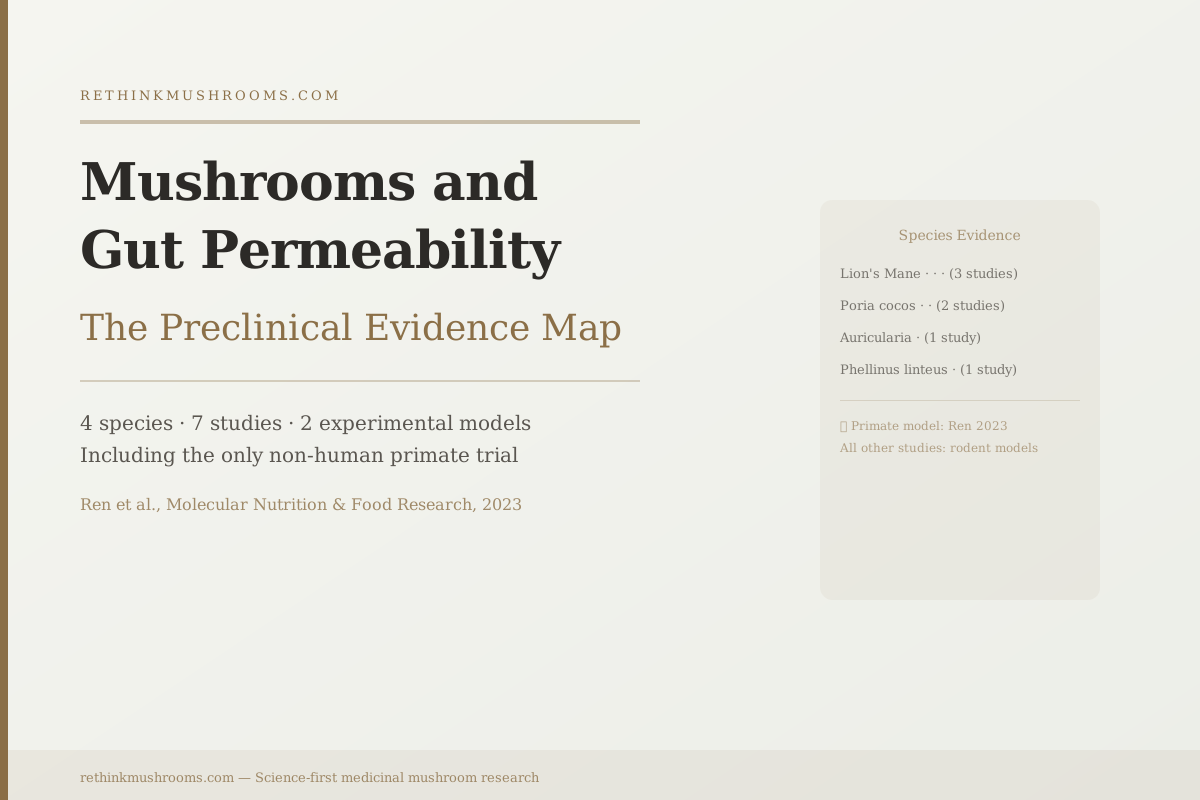
4 species studied
Four mushroom species have preclinical evidence for reducing intestinal permeability. Hericium erinaceus leads with the only non-human primate trial in mushroom gut barrier research — the highest level of translational evidence available in this field.
Ren et al., Molecular Nutrition & Food Research, 2023
1 primate study
Hericium erinaceus polysaccharide in cynomolgus monkeys — stronger translational evidence than rodent models for human gut barrier claims
2 models
DSS-induced colitis and antibiotic-associated diarrhea — the two preclinical test systems used across the seven studies in this review
Tian 2023
found Hericium restored gut barrier in immunocompromised mice — uniquely relevant to people whose gut is disrupted by chemotherapy
Ren et al., Molecular Nutrition & Food Research, 2023
 View as image ↗
Intestinal permeability describes how easily substances pass through the gut wall. A healthy gut lining is selectively permeable: nutrients pass through, while bacteria, bacterial toxins, and undigested particles are blocked. When the proteins that form the seals between gut cells weaken, gaps form, and material that should stay in the gut can enter the bloodstream. This is what is commonly called "leaky gut," and it is clinically measured as intestinal hyperpermeability.
Multiple mushroom species have been studied for their effects on this barrier in preclinical models. The evidence is entirely animal-based or cell-based — no human clinical trial has used intestinal permeability as a primary endpoint for any mushroom intervention. But the preclinical landscape is broader than most coverage suggests, spanning four species, seven studies, and two distinct experimental models.
This article maps that landscape by species and model type. For the mechanistic explanation of how mushroom polysaccharides support the gut barrier, see the gut barrier and mushroom polysaccharides: mechanisms. For the human-tissue evidence on tight junction proteins specifically, see mushroom compounds and tight junction protein expression. For the broader picture of what mushrooms do for gut health overall, see the mushrooms as prebiotics guide.
Key Takeaways
- Seven preclinical studies across four mushroom species show reduced intestinal permeability or gut barrier protection: lion's mane (3 studies), Poria cocos (2 studies), wood ear mushroom (1 study), and Phellinus linteus (1 study)
- Hericium erinaceus (lion's mane) has the most extensive evidence, including the only non-human primate study in mushroom gut barrier research — Ren et al. (2023) in cynomolgus monkeys, which carries stronger translational weight than rodent data[1]
- The Hericium immunocompromised mouse study (Tian et al., 2023) is uniquely relevant to people whose gut barrier is disrupted by chemotherapy or immunosuppressive drugs: polysaccharides restored tight junction proteins and mucosal architecture in cyclophosphamide-treated mice[3]
- Poria cocos has evidence in two clinically distinct contexts: antibiotic-associated diarrhea (Xu et al., 2023) and DSS-induced ulcerative colitis (Wan et al., 2024), both resulting in gut barrier restoration[5],[6]
- Auricularia (wood ear mushroom) and Phellinus linteus both showed protective effects in DSS-induced colitis mouse models, extending gut barrier evidence well beyond the standard lion's mane narrative[4],[7]
- No human clinical trial has measured intestinal permeability as a primary endpoint for any mushroom intervention — the evidence base is entirely preclinical, with the translational strength varying significantly between rodent and primate models
What the Animal Models Actually Measure — and Why It Matters for Human Claims
Understanding the evidence requires understanding the models. Most gut barrier research uses one of two standard experimental setups, and the choice of model affects how seriously the results can be taken as relevant to humans.
DSS-induced colitis is the most widely used gut permeability model. Mice drink water containing dextran sulfate sodium, a chemical that damages the intestinal lining and produces inflammation closely resembling ulcerative colitis, one of the two main forms of inflammatory bowel disease. The model is reproducible, well-characterized, and produces measurable gut barrier disruption including loss of tight junction proteins and mucosal damage. It is not identical to human leaky gut in healthy people; it is an injury model that tests whether a compound can prevent or repair chemically induced gut barrier damage. Results from this model suggest barrier-protective potential but do not establish that the same effect occurs in humans with the subclinical intestinal hyperpermeability that leaky gut discussions typically concern.
Antibiotic-associated diarrhea is the second model used in this literature. Broad-spectrum antibiotics disrupt the gut microbiota, which in turn weakens the gut barrier. This model is clinically relevant to a large population: antibiotic courses are common, and antibiotic-associated gut disruption is a real clinical problem. Mouse studies using this model test whether a compound can restore gut barrier function after microbiota disruption.
A third model type appears once in the evidence reviewed here: chemotherapy-induced immunosuppression. Cyclophosphamide, a chemotherapy drug, suppresses the immune system and damages the gut lining. This model is specifically relevant to cancer patients whose gut barrier is compromised during treatment.
The model hierarchy for translational value runs: non-human primate > rodent immunosuppression/chemotherapy model > DSS colitis > antibiotic-associated diarrhea model (on the basis that all models have limitations, but primate physiology is closest to human). This hierarchy matters when evaluating which mushroom species has the most credible evidence.
Lion's Mane (Hericium erinaceus): Three Studies, Including a Primate Trial
Hericium erinaceus is the most-studied mushroom for gut barrier protection, with three distinct studies across three different models and two species of test animal.
Ren and colleagues (2018) established the foundation with a mouse DSS colitis study.[2] Hericium erinaceus polysaccharide reduced the severity of DSS-induced colitis in mice through multiple mechanisms operating in parallel. Oxidative stress fell significantly in treated animals. Two cellular signaling systems involved in inflammatory gut damage (the NF-κB system and the MAPK system, both of which, when overactivated, degrade the proteins sealing gut cells together) showed reduced activity. Gut microbiota composition shifted favorably. The multi-mechanism character of the effect was notable: rather than targeting one pathway, the polysaccharide appeared to work across several simultaneously.
Ren and colleagues (2023) then ran what is, by far, the strongest translational study in the mushroom gut barrier literature: a Hericium erinaceus mycelium-derived polysaccharide study in cynomolgus monkeys, a non-human primate species with a gastrointestinal system substantially closer to humans than mice.[1] Critically, the ulcerative colitis in these monkeys occurred spontaneously rather than being chemically induced — the study first validated naturally-occurring UC in the primates using postmortem bowel evaluation, inflammatory markers, and fecal occult blood testing, then showed that the polysaccharide alleviated the colitis and modulated gut microbiota composition. Spontaneous primate disease recapitulates human ulcerative colitis far more faithfully than the chemical injury models used in rodents, which is exactly why this study carries more translational weight than any of the rodent work here. It is also completely unreported by any consumer health source.
Tian and colleagues (2023) addressed a distinct clinical scenario: gut barrier disruption caused by chemotherapy.[3] Cyclophosphamide, used in cancer treatment, suppresses the immune system and damages the intestinal lining in the process. Hericium erinaceus polysaccharides restored intestinal barrier integrity in these immunocompromised mice, improving tight junction protein levels and mucosal architecture. This study is particularly relevant to cancer patients experiencing gut problems during chemotherapy — a common and clinically significant problem for which existing interventions are limited.
For the species-specific deep dive on lion's mane gut effects, including the IBD and gastroprotective data, see lion's mane for IBD: gastroprotective evidence.
Auricularia, Poria cocos, and Phellinus linteus: Three More Species With Evidence
The gut barrier evidence extends well beyond lion's mane, though with fewer studies per species and no primate trials.
Zhao and colleagues (2020) found that a polysaccharide from Auricularia (the wood ear mushroom, widely used in East Asian cooking) prevented DSS-induced colitis in mice by modulating gut microbiota composition.[4] Auricularia is not commonly mentioned in mushroom gut health discussions, which focus heavily on lion's mane and turkey tail. The 2020 study places it on the map for intestinal barrier research, though with a single study rather than the multi-study base that Hericium has accumulated.
Poria cocos, a medicinal mushroom used in traditional Chinese medicine, has evidence in two different models, which makes it more clinically interesting than single-model evidence.
Xu and colleagues (2023) tested Poria cocos polysaccharide in the antibiotic-associated diarrhea model and found that it restored intestinal mucosal barrier function by normalizing gut microbiota composition after antibiotic disruption.[5] This is clinically relevant: many people take antibiotics and experience gut disruption ranging from mild diarrhea to significant gut barrier dysfunction. The study suggests Poria cocos polysaccharides could help restore the barrier after that disruption.
Wan and colleagues (2024) separately found that Poria cocos polysaccharide reduced DSS-induced ulcerative colitis in mice by modulating intestinal inflammation and correcting gut microbiota dysbiosis.[6] Having consistent results in two different models (antibiotic disruption and chemically induced colitis) strengthens the case for Poria cocos as a gut barrier species, though both studies are rodent-based.
Hu and colleagues (2024) added Phellinus linteus to the list with a DSS colitis mouse study showing that an acidic polysaccharide from this species ameliorated gut damage and protected barrier function.[7] Phellinus linteus (also known as Inonotus obliquus or related species in some classification schemes) is rarely mentioned in gut health discussions. The 2024 study expands the species picture and contributes the most recent animal evidence in this literature.
For how gut microbiota modulation connects to gut barrier function across these species, see how mushrooms change your gut microbiome: research review.
The Evidence Map: Four Species, Seven Studies, Two Models
| Species | Study | Model | Key Outcome |
|---|---|---|---|
| Lion's mane (Hericium erinaceus) | Ren et al., 2018 | Mouse DSS colitis | Reduced colitis via oxidative stress, NF-κB/MAPK, microbiota shifts |
| Lion's mane (Hericium erinaceus) | Ren et al., 2023 | Cynomolgus monkey, spontaneous UC | Alleviated colitis, modulated gut microbiota (primate model) |
| Lion's mane (Hericium erinaceus) | Tian et al., 2023 | Immunocompromised mice (cyclophosphamide) | Restored tight junction proteins and mucosal architecture |
| Wood ear (Auricularia auricular-judae) | Zhao et al., 2020 | Mouse DSS colitis | Prevented colitis via gut microbiota modulation |
| Poria cocos | Xu et al., 2023 | Mouse antibiotic-associated diarrhea | Restored mucosal barrier by normalizing gut microbiota |
| Poria cocos | Wan et al., 2024 | Mouse DSS ulcerative colitis | Reduced inflammation, corrected microbiota dysbiosis |
| Phellinus linteus | Hu et al., 2024 | Mouse DSS ulcerative colitis | Ameliorated gut damage and barrier disruption |
The table above lists the studies, but it treats them as equals. They are not. The single most important thing to understand about this evidence base is that the studies occupy very different rungs of translational value — and the difference between a spontaneously-diseased primate and a chemically-injured mouse is the difference between evidence that points toward humans and evidence that merely points toward a plausible mechanism. The map below re-orders the same seven studies by how human-relevant the underlying model is.
Study · Model · Translational Tier
Seven Studies, Ranked by How Human-Relevant the Model Is
The evidence is not equally strong. A flat list of “four species, seven studies” hides the fact that one study sits in a spontaneously-diseased primate while the rest are chemically injured rodents. This orders every study by translational tier — the closer to the top, the closer the model is to a human gut.
- 1
Lion's mane
Hericium erinaceus
Ren et al., 2023Primate — highest translational valueRef 1Cynomolgus monkey, spontaneous ulcerative colitis
Mycelium-derived polysaccharide alleviated naturally-occurring colitis and modulated gut microbiota in a non-human primate — the only such study in this literature.
- 2
Lion's mane
Hericium erinaceus
Tian et al., 2023Rodent — chemo immunosuppressionRef 3Cyclophosphamide-immunocompromised mice
Polysaccharides restored intestinal barrier integrity, tight junction proteins, and mucosal architecture — relevant to chemotherapy-related gut disruption.
- 3
Lion's mane
Hericium erinaceus
Ren et al., 2018Rodent — DSS colitis injury modelRef 2Mouse DSS colitis
Attenuated colitis through parallel mechanisms: lower oxidative stress, reduced NF-κB / MAPK activity, and favorable microbiota shifts.
- 3
Wood ear
Auricularia auricula-judae
Zhao et al., 2020Rodent — DSS colitis injury modelRef 4Mouse DSS colitis
Polysaccharide prevented DSS-induced colitis by modulating gut microbiota composition — first barrier-research evidence for this culinary species.
- 3
Poria cocos
Wolfiporia cocos
Wan et al., 2024Rodent — DSS colitis injury modelRef 6Mouse DSS ulcerative colitis
Polysaccharide reduced inflammation and corrected microbiota dysbiosis — one of two clinically distinct models supporting this species.
- 3
Phellinus linteus
Phellinus linteus
Hu et al., 2024Rodent — DSS colitis injury modelRef 7Mouse DSS ulcerative colitis
Acidic polysaccharide ameliorated gut damage and protected barrier function — the most recent animal evidence in this literature.
- 4
Poria cocos
Wolfiporia cocos
Xu et al., 2023Rodent — antibiotic-associated diarrheaRef 5Mouse antibiotic-associated diarrhea
Polysaccharide restored the intestinal mucosal barrier by normalizing microbiota after antibiotic disruption — a clinically common scenario.
None of these are human trials. Tier 1 is the highest translational value available in mushroom gut-barrier research today — a spontaneously-diseased primate — not proof of a human effect.
Source: Ren et al. (2023); Tian et al. (2023); Ren et al. (2018); Zhao et al. (2020); Wan et al. (2024); Hu et al. (2024); Xu et al. (2023)
For the full picture of how polysaccharides from these species affect tight junction protein expression specifically, see mushroom polysaccharides and tight junction protein expression.
What Preclinical Evidence Can — and Cannot — Establish
The seven studies above form a consistent picture: multiple mushroom species, across multiple models, show reduced intestinal barrier damage in animal experiments. The consistency across species and models adds credibility. It is unlikely that a single mechanism or artifact explains results in four different species and two different experimental setups.
But there are real limits to what preclinical evidence establishes.
DSS-induced colitis is an injury model. It produces damage comparable to inflammatory bowel disease, which is more severe than the subclinical intestinal hyperpermeability that most leaky gut discussions concern. Whether the barrier-protective effects seen in damaged colons apply to mildly elevated gut permeability in healthy adults is unknown.
Rodent studies do not automatically translate to humans. The primate study (Ren 2023) narrows this gap for lion's mane, but it remains an animal study in a controlled experimental setting. No species has human clinical trial evidence for intestinal permeability as a primary outcome.
Effect size is not established for any dose. The animal studies use polysaccharide doses that are difficult to translate directly to human equivalent doses. How much lion's mane or Poria cocos a person would need to consume to achieve a comparable gut barrier effect is not known.
The mechanistic picture — how polysaccharides support barrier function through both prebiotic (butyrate-producing bacteria) and direct (signaling pathway) routes — is covered in the gut barrier and mushroom polysaccharides: mechanisms. The question of whether mushrooms can help restore an impaired gut barrier in human leaky gut contexts is addressed, with honest acknowledgment of evidence limits, in mushrooms and leaky gut: can they restore intestinal barrier?.
The evidence currently says: animal models support the direction, with lion's mane having the strongest and most consistent case. Human clinical confirmation is the next step — and it has not happened yet.
- Cell / mechanistic studiescompleted
Polysaccharides act on tight junction proteins and inflammatory signaling (NF-κB, MAPK) in vitro.
- Animal models (rodent + one primate)current
Seven studies across four species; strongest is Ren 2023 in cynomolgus monkeys with spontaneous UC.
- Human pilot / early trialsmissing
No human trial has used intestinal permeability as a primary endpoint for any mushroom.
- Randomized controlled trialsmissing
No dosing, effect size, or clinical benefit established in humans.
- Meta-analysismissing
Not possible without human trials to pool.
The field has consistent preclinical signal and one uniquely human-relevant primate study, but the entire human-evidence tier is empty. The direction is supported; the clinical effect is unproven.
Ren et al. (2018, 2023); Tian et al. (2023); Zhao et al. (2020); Xu et al. (2023); Wan et al. (2024); Hu et al. (2024)
Reader Guidance
ModerateThis is preclinical research, not a treatment protocol
Concern
No mushroom has been shown to reduce intestinal permeability in a human clinical trial. Translating animal results into a self-directed regimen for 'leaky gut,' IBD, or chemotherapy-related gut damage risks substituting an unproven supplement for evaluated medical care.
What the research says
Treat these findings as a research map, not a dosing guide. The animal doses do not convert to a known human equivalent, and gut-barrier symptoms can signal conditions — inflammatory bowel disease, infection, treatment side effects — that need medical evaluation.
Particularly relevant for: People with diagnosed IBD, active gastrointestinal symptoms, or a compromised gut barrier from chemotherapy or immunosuppression should be especially cautious.
What to do
Discuss any mushroom supplement with a physician before use, particularly if you are undergoing cancer treatment, are immunosuppressed, or take medications that affect the gut or immune system.
Evidence base is entirely preclinical (see references); this is general educational information and not medical advice.
The Bottom Line
Seven preclinical studies across four mushroom species — lion's mane, wood ear mushroom, Poria cocos, and Phellinus linteus — show gut barrier protection in animal models of colitis and antibiotic-associated diarrhea. Hericium erinaceus has the most extensive evidence, including the only non-human primate trial in mushroom gut barrier research. No human clinical trial exists for intestinal permeability as a primary endpoint for any mushroom species. The preclinical evidence is consistent in direction but cannot establish clinical effect sizes or translate directly to specific consumption recommendations.
Frequently Asked Questions
Sources & References
- 1RTHM-01776·Ren, Zhengyu et al. (2023). “Hericium erinaceus mycelium-Derived Polysaccharide Alleviates Ulcerative Colitis and Modulates Gut Microbiota in Cynomolgus Monkeys..” Molecular nutrition & food research.Study breakdown →PubMed →↩
- 2RTHM-00529·Ren, Yilin et al. (2018). “Polysaccharide of Hericium erinaceus attenuates colitis in C57BL/6 mice via regulation of oxidative stress, inflammation-related signaling pathways and modulating the composition of the gut microbiota..” The Journal of nutritional biochemistry.Study breakdown →PubMed →↩
- 3RTHM-01803·Tian, Baoming et al. (2023). “Ameliorating effects of Hericium erinaceus polysaccharides on intestinal barrier injury in immunocompromised mice induced by cyclophosphamide..” Food & function.Study breakdown →PubMed →↩
- 4RTHM-00667·Zhao, Di et al. (2020). “Polysaccharide isolated from Auricularia auricular-judae (Bull.) prevents dextran sulfate sodium-induced colitis in mice through modulating the composition of the gut microbiota..” Journal of food science.Study breakdown →PubMed →↩
- 5RTHM-01825·Xu, Huachong et al. (2023). “Poria cocos Polysaccharide Ameliorated Antibiotic-Associated Diarrhea in Mice via Regulating the Homeostasis of the Gut Microbiota and Intestinal Mucosal Barrier..” International journal of molecular sciences.Study breakdown →PubMed →↩
- 6RTHM-02011·Wan, Jin et al. (2024). “Poria cocos polysaccharide alleviates dextran sulphate sodium-induced ulcerative colitis in mice by modulating intestinal inflammatory responses and microbial dysbiosis..” International journal of biological macromolecules.Study breakdown →PubMed →↩
- 7RTHM-01903·Hu, Jutuan et al. (2024). “Ameliorative effect of an acidic polysaccharide from Phellinus linteus on ulcerative colitis in a DSS-induced mouse model..” International journal of biological macromolecules.Study breakdown →PubMed →↩