Mushroom Skincare
2023 dermatology journal review
Tremella fuciformis earned a peer-reviewed review in a dermatology journal, making it the best-evidenced mushroom in the skincare market and the clearest benchmark for what the science actually supports.
Mineroff & Jagdeo, Archives of Dermatological Research, 2023
Tremella
strongest topical evidence of any functional mushroom species
Chaga
potent antioxidant chemistry, limited topical-specific data
2025
year a study confirmed Tremella's structural similarity to hyaluronic acid
Mineroff & Jagdeo, Archives of Dermatological Research, 2023
 View as image ↗
The mushroom skincare aisle has expanded faster than the research behind it. Tremella serums, chaga creams, reishi toners, and lion's mane face masks now fill beauty shelves from drugstores to luxury boutiques. Most of them describe their mushroom ingredient as an "adaptogen," a "superfood for skin," or a "natural hyaluronic acid," without citing where those claims come from.
Some of those claims are grounded in real studies. Others aren't. The distinction matters, and it tracks closely to species: mushroom skincare products are not all the same, and the evidence behind each species varies dramatically.
This guide covers what the research actually shows about mushroom skincare products, species by species. For a broader look at functional mushroom formats and product categories, see our overview of functional mushroom products.
Key Takeaways
- Tremella fuciformis has the strongest topical evidence base of any functional mushroom species; a 2023 dermatologist-authored review in a peer-reviewed dermatology journal covered its hydration, UV protection, and wound-healing mechanisms[1]
- A 2025 analytical study found that Tremella-derived polysaccharides have a chemical structure comparable to hyaluronic acid, making Tremella a potential vegan source of HA-like moisturizing compounds[2]
- Chaga contains a distinct profile of antioxidant compounds including novel polyphenols not widely found elsewhere[5], but most of this evidence comes from cell studies rather than human topical trials
- Very few human clinical trials exist specifically for topical mushroom skincare; most evidence is from laboratory cell cultures or animal models
- Product format matters: Tremella's active compounds are water-soluble and work in water-based serum delivery; Chaga's triterpenoids are fat-soluble and need different formulation to be delivered effectively
- The concentration of active compounds in commercial mushroom skincare products is rarely disclosed; ingredient list position and extract ratio labeling are the best available indicators
Why Tremella Leads the Pack: A Dermatologist Review Changes the Conversation
Most functional mushroom ingredients lack peer-reviewed coverage in dermatology journals. That changed for Tremella in 2023 when Mineroff and Jagdeo published a review article specifically covering its cutaneous, or skin-related, benefits in the Archives of Dermatological Research.[1]
The review surveyed the available evidence across four categories: hydration, UV protection, anti-inflammatory activity, and wound healing. That the review exists at all is significant. Dermatologists don't typically publish review articles on cosmetic ingredients unless the evidence base justifies the attention. Tremella earned that review.
Why Tremella? The structural answer lies in its polysaccharides. These are large chain-sugar molecules that form the main active fraction of the mushroom. A comprehensive review by Wu and colleagues catalogued Tremella polysaccharides' strong water-holding capacity, the property that has driven their use as a plant-based alternative to hyaluronic acid, the moisture-binding molecule that commands premium pricing in the serum market.[4] Tremella polysaccharides are water-soluble; they dissolve in water-based formulations, which is why they translate well to serum products rather than requiring specialized fat-based delivery systems.
The anti-inflammatory and wound-healing properties noted in the Mineroff review draw on a larger body of Tremella research. Multiple mechanisms have been studied: polysaccharide fractions from Tremella show activity against the inflammatory pathways associated with sensitive and reactive skin, including the Th1/Th2 immune balance relevant to conditions like eczema and atopic dermatitis. The UV protection mechanisms got their own study, covered in the next section.
The commercial implication: when you see Tremella fuciformis polysaccharides or snow mushroom extract on a serum label, the ingredient has more scientific grounding than most mushroom ingredients on the market.
The Hyaluronic Acid Comparison: What the Evidence Actually Shows
The claim that Tremella is "better than hyaluronic acid" circulates widely in mushroom skincare marketing. Some brands cite a "15% higher hydration" comparison figure without naming the study. The claim is specific enough to be compelling and vague enough to be unverifiable.
What the 2025 Galla study actually shows is more nuanced and more interesting than that marketing claim.[2] The Galla team conducted an analytical-chemistry comparison of Tremella-derived polysaccharides against standard hyaluronic acid. Their finding: the structural chemistry is comparable. Tremella polysaccharides have molecular features similar to the HA molecule, making Tremella a scientifically plausible non-animal source of HA-like moisture-binding compounds.
This is not the same as a clinical trial showing Tremella outperforms HA in a human hydration comparison. But it is stronger than vague "super-hydrator" marketing: a 2025 peer-reviewed study confirmed the structural basis for why Tremella and HA behave similarly as skincare ingredients. The comparison stands on solid chemistry.
The UV protection angle adds another dimension to Tremella's case. A 2021 study exposed human dermal fibroblasts, the collagen-producing cells in the middle layer of skin, to UVA radiation and measured the effects with and without Tremella polysaccharides.[3] Fibroblasts pretreated with Tremella polysaccharides showed significantly less UVA-induced oxidative damage. Specifically, the polysaccharides lowered the reactive oxygen species and lipid-peroxidation byproducts (malondialdehyde) that UVA generates inside the cells, and raised the activity of the cells' own antioxidant enzymes — superoxide dismutase, catalase, and glutathione peroxidase — by activating the Nrf2/Keap1 pathway, the master switch for a cell's antioxidant defenses. Because that UVA-driven oxidative stress is itself a primary driver of collagen breakdown and photoaging, blunting it is the mechanism by which Tremella polysaccharides slowed photodamage in the cell culture model.
The limitation worth naming: this is an in vitro study using isolated cells, not a clinical trial of humans applying Tremella serum and measuring wrinkle reduction over time. The mechanistic pathway is credible. The human clinical evidence for topical Tremella as a specific UV-protective product is not yet available. Competitors who market Tremella as "UV protection" are extrapolating from cell culture to consumer product in ways the evidence doesn't fully support.
Chaga in Skincare: Real Antioxidant Chemistry, Less Topical-Specific Evidence
Chaga has a compelling chemistry story. The mushroom grows as a dense mass on birch trees and accumulates compounds from both the mushroom and its host tree, producing an unusual concentration of antioxidant polyphenols. In 2007, Lee and colleagues isolated novel antioxidant polyphenols from Chaga — including three previously unknown compounds — that are not widely found in other sources, and documented strong free-radical-scavenging activity in antioxidant assays.[5]
This antioxidant activity is real. The question for skincare applications is how it translates when Chaga is formulated into a cream or serum applied to the skin's surface.
Antioxidant compounds protect against oxidative stress, which is a significant driver of skin aging: UV radiation, pollution, and metabolic processes generate reactive molecules that damage collagen, elastin, and DNA in skin cells. Chaga's antioxidant profile, which spans these polyphenols along with melanin pigments and triterpenoids such as inotodiol, makes it a plausible antioxidant ingredient in this context.
The evidence gap: the Lee study used analytical chemistry and radical-scavenging assays to identify and characterize Chaga's antioxidant compounds. This is essential foundational work. It does not confirm that a cream containing Chaga extract delivers those compounds to skin cells effectively, at the right concentration, in a form that remains stable through the product's shelf life.
Human topical trials specifically examining Chaga as a skincare ingredient are currently rare. The antioxidant chemistry supports the theoretical case. Chaga creams and serums may well provide oxidative stress protection, but the clinical evidence to confirm this at the level that Tremella hydration evidence exists is not yet there.
What Chaga does better than Tremella in the skincare context is potentially the antioxidant-protective angle. Tremella is better characterized for hydration and UV protection via collagen preservation. Chaga may be better suited for formulations targeting environmental damage and antioxidant defense, but with the honest caveat that this rests more on chemistry than on completed human trials.
Reishi, Shiitake, and Others: Compounds of Interest, Less Topical Data
Reishi appears in a growing number of skincare products, typically highlighted for its triterpenoid content. Triterpenoids, including the ganoderic acids that give reishi its bitter taste, have shown anti-inflammatory properties in laboratory settings. The specific skincare evidence for reishi is less developed than for Tremella, and the concentration problem is particularly acute: reishi's triterpenoids are fat-soluble, requiring oil-based or specialized delivery formulations to deliver them past the skin's surface.
Shiitake is increasingly appearing in premium formulations for a different reason: ergothioneine. This is an antioxidant compound that fungi, including shiitake, synthesize in unusually high amounts compared to most organisms. Ergothioneine has been studied for antioxidant and cell-protective properties, and some dermatologists have noted its potential as a stable antioxidant ingredient. It appears in a handful of high-end serums. The human topical evidence remains limited.
For most other mushroom species appearing on skincare labels, the evidence follows a similar pattern: interesting chemistry at the compound level, credible antioxidant or anti-inflammatory mechanisms in cell studies, and very few completed human trials testing topical application specifically.
Evidence by Species: A Quick Reference for Shoppers
| Mushroom | Key Compounds | Main Skin Benefit | Topical Evidence Level |
|---|---|---|---|
| Tremella (Snow Mushroom) | Polysaccharides (HA-comparable) | Hydration, UV oxidative protection | Strongest: dermatology journal review |
| Chaga | Polyphenols, melanins, inotodiol | Antioxidant protection | Moderate chemistry, limited human topical trials |
| Reishi | Triterpenoids (ganoderic acids) | Anti-inflammatory | Laboratory data; needs fat-soluble delivery |
| Shiitake | Ergothioneine, lentinan | Antioxidant, brightening (kojic acid) | Limited; ergothioneine shows promise |
Tremella is the only species with both a peer-reviewed dermatology journal review[1] and a 2025 structural chemistry comparison to hyaluronic acid.[2] Chaga has credible antioxidant chemistry but less topical-specific research. Reishi and Shiitake have interesting compound profiles; the topical clinical evidence is thin.
Topical Evidence by Species
How Far the Skincare Evidence Actually Goes, Species by Species
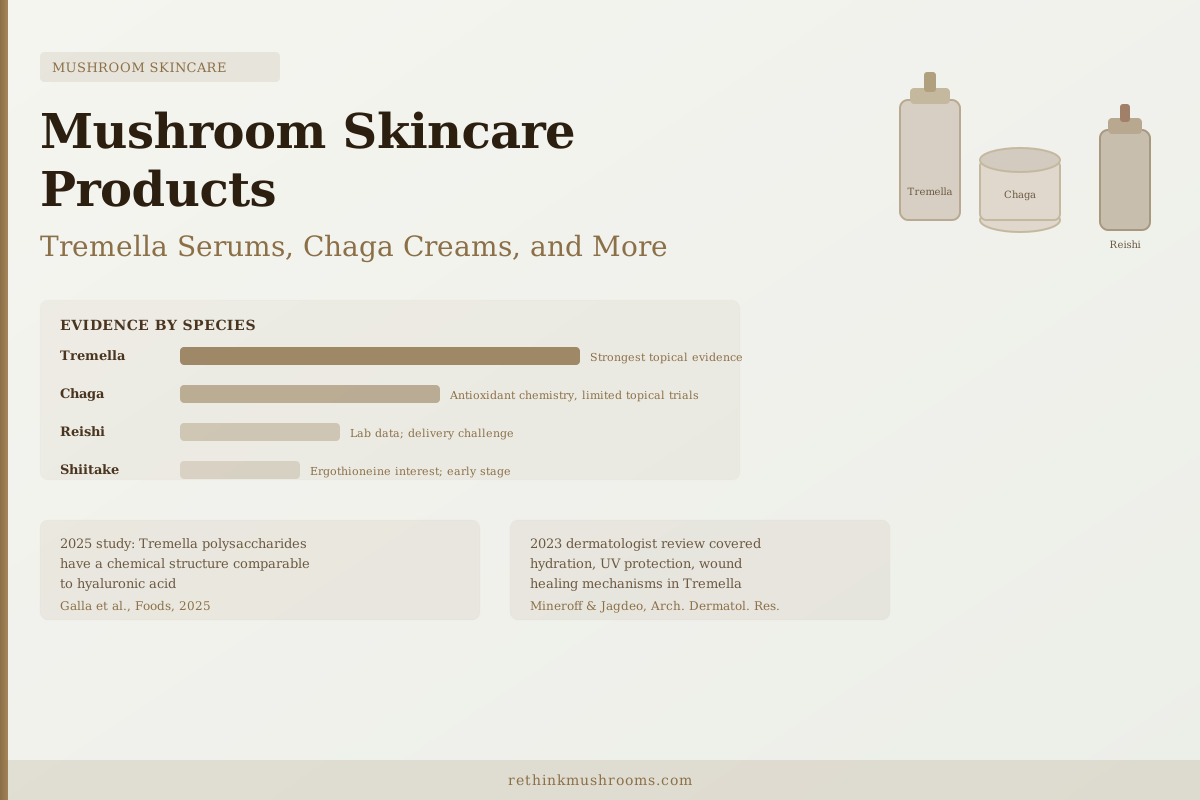
The quality of the topical-skincare evidence tracks the species. Tremella sits far ahead — a dermatology-journal review plus chemistry and cell studies — while Chaga rests on established antioxidant chemistry and Reishi and Shiitake remain at the laboratory or emerging-interest stage. Bar width reflects the depth of species-specific topical evidence, not the size of any measured effect.
Tremella (Snow Mushroom)
StrongestMineroff 2023 · Galla 2025 · Fu 2021 · Wu 2019
The only species with a peer-reviewed dermatology-journal review, an analytical study confirming a hyaluronic-acid-comparable structure, and a cell study showing its polysaccharides blunt UVA-induced oxidative stress in human dermal fibroblasts via the Nrf2/Keap1 pathway
Chaga
Moderate chemistry, limited topical trialsLee 2007
Distinctive antioxidant polyphenols were isolated and characterized in radical-scavenging assays — real, foundational chemistry — but human trials testing topical Chaga products specifically have not been completed
Reishi
Thin: laboratory-stageLaboratory data only
Triterpenoids such as ganoderic acids show anti-inflammatory activity in laboratory settings, but the compounds are fat-soluble and need specialized delivery, and no completed human topical trial anchors the case
Shiitake & others
Thin: emerging interestLimited topical evidence
Ergothioneine and related compounds are of genuine antioxidant interest and appear in premium serums, but human evidence for topical application remains limited
How to read it: a full bar means the species has direct, species-specific topical evidence; a dashed outline means the case still rests on general chemistry or laboratory work rather than completed human topical trials. Only Tremella clears the bar on multiple independent lines of evidence — which is why it, not the mushroom with the most marketing, has the strongest claim on a skincare label.
Sources: Mineroff 2023 [1]; Galla 2025 [2]; Fu 2021 [3]; Wu 2019 [4]; Lee 2007 [5]. Reishi and Shiitake rungs reflect the absence of a completed topical human trial in this article's cited literature. Bar widths are illustrative of evidence depth per species, not quantitative effect sizes.
Serums, Creams, and Masks: What the Format Tells You
The same mushroom species performs differently depending on how it's formulated. This matters because the active compounds in different mushrooms are chemically different.
Serums are water-based and deliver ingredients in their most concentrated, fast-absorbing form. For Tremella, this is the optimal format: Tremella polysaccharides are water-soluble and disperse readily in an aqueous serum base. When you apply a Tremella serum, the polysaccharides reach the skin's surface in a bioavailable form. Serums are also better for layering under moisturizers.
Creams and moisturizers have an emollient base that slows water loss and provides a barrier function. For Chaga and Reishi, which contain fat-soluble active compounds, a cream formulation makes more chemical sense than a water serum: the fat-soluble triterpenoids and polyphenols can distribute more effectively in an oil-containing emollient base. A Chaga serum relies on the product formulator having solved the delivery problem; a Chaga cream formulated with lipid carriers is structurally more logical.
Masks provide extended contact time with the skin's surface, typically 10 to 20 minutes. The longer dwell time allows more compound penetration than a rinse-off formula. Tremella masks benefit from this: the polysaccharides form a temporary film on the skin surface during the mask's contact time, which may enhance the hydration effect relative to a quick-application serum.
The concentration problem applies across all formats. Most mushroom skincare products list their mushroom ingredient without disclosing the concentration or extract ratio. A product containing 0.1% Tremella extract and a product containing 5% Tremella extract both list "Tremella fuciformis extract" on the label. Without a concentration disclosure, which most brands don't provide, there's no way to know whether the dose used in the product is remotely comparable to the concentrations used in research studies.
For context on how extraction methods determine which compounds are actually present in a mushroom-derived ingredient, see our article on dual extraction and full-spectrum mushroom products.
What to Actually Look for on a Mushroom Skincare Label
Ingredient lists on skincare products are written in INCI (International Nomenclature of Cosmetic Ingredients) format, with ingredients listed from highest to lowest concentration. A mushroom ingredient positioned near the end of a long ingredient list, after the preservatives and fragrance, is present in trace amounts that are unlikely to have any measurable effect.
Practical things to look for:
The Latin name, not a common name. "Mushroom extract" tells you nothing about species. "Tremella fuciformis extract" or "Inonotus obliquus extract" (Chaga) is specific. Products using Latin names are at least telling you which species the extract is from.
The position in the ingredient list. For a mushroom extract to be present at a meaningful concentration, it should appear in the first half of the ingredient list, ideally before the preservatives (typically sodium benzoate, phenoxyethanol, or parabens near the end of the list).
Extract ratio labeling, when present. A "10:1 extract" means 10 grams of dried mushroom material were processed to produce 1 gram of extract, a 10-fold concentration. This information is rarely disclosed but signals a more serious formulation approach when present.
Fruiting body vs. mycelium. The research evidence behind Tremella and Chaga is primarily based on fruiting body tissue (the actual mushroom structure) rather than mycelium (the root-like growth stage). Tremella fuciformis polysaccharides as characterized in the dermatology literature come from the fruiting body. A product using mycelium-derived Tremella extract is using less-characterized material. For more on this distinction, see our article on fruiting body vs. mycelium in mushroom supplements.
No specific product or brand recommendations are made here. This article covers the ingredient science. Product quality varies by formulation, not by brand name.
The Bottom Line
Mushroom skincare products vary significantly in their evidence base by species. Tremella fuciformis has the strongest topical case: a 2023 dermatologist-authored review covered its hydration and UV protection mechanisms, a 2025 study confirmed structural similarity to hyaluronic acid, and cell studies document a protective mechanism against UVA-induced oxidative damage. Chaga has credible antioxidant chemistry but less evidence specifically for topical application. For both species, the gap between laboratory evidence and clinical human trials remains significant. The practical takeaway is that Tremella in a water-based serum from a brand that discloses its extract concentration has the most science behind it; everything else requires scrutiny of the ingredient label and honest uncertainty about whether the evidence transfers from the lab bench to the bathroom shelf.
Frequently Asked Questions
Sources & References
- 1RTHM-01754·Mineroff, Jessica et al. (2023). “The potential cutaneous benefits of Tremella fuciformis..” Archives of dermatological research.Study breakdown →PubMed →↩
- 2RTHM-02086·Galla, Rebecca et al. (2025). “Non-Animal Hyaluronic Acid from Tremella fuciformis: A New Source with a Structure and Chemical Profile Comparable to Hyaluronic Acid..” Foods (Basel.Study breakdown →PubMed →↩
- 3RTHM-01353·Fu, Hao et al. (2021). “Tremella fuciformis polysaccharides inhibit UVA-induced photodamage of human dermal fibroblast cells by activating up-regulating Nrf2/Keap1 pathways..” Journal of cosmetic dermatology.Study breakdown →PubMed →↩
- 4RTHM-01140·Wu, Yu-Ji et al. (2019). “Structure, bioactivities and applications of the polysaccharides from Tremella fuciformis mushroom: A review..” International journal of biological macromolecules.Study breakdown →PubMed →↩
- 5RTHM-00118·Lee, In-Kyoung et al. (2007). “New antioxidant polyphenols from the medicinal mushroom Inonotus obliquus..” Bioorganic & medicinal chemistry letters.Study breakdown →PubMed →↩