Mushroom Skincare & Cosmeceuticals
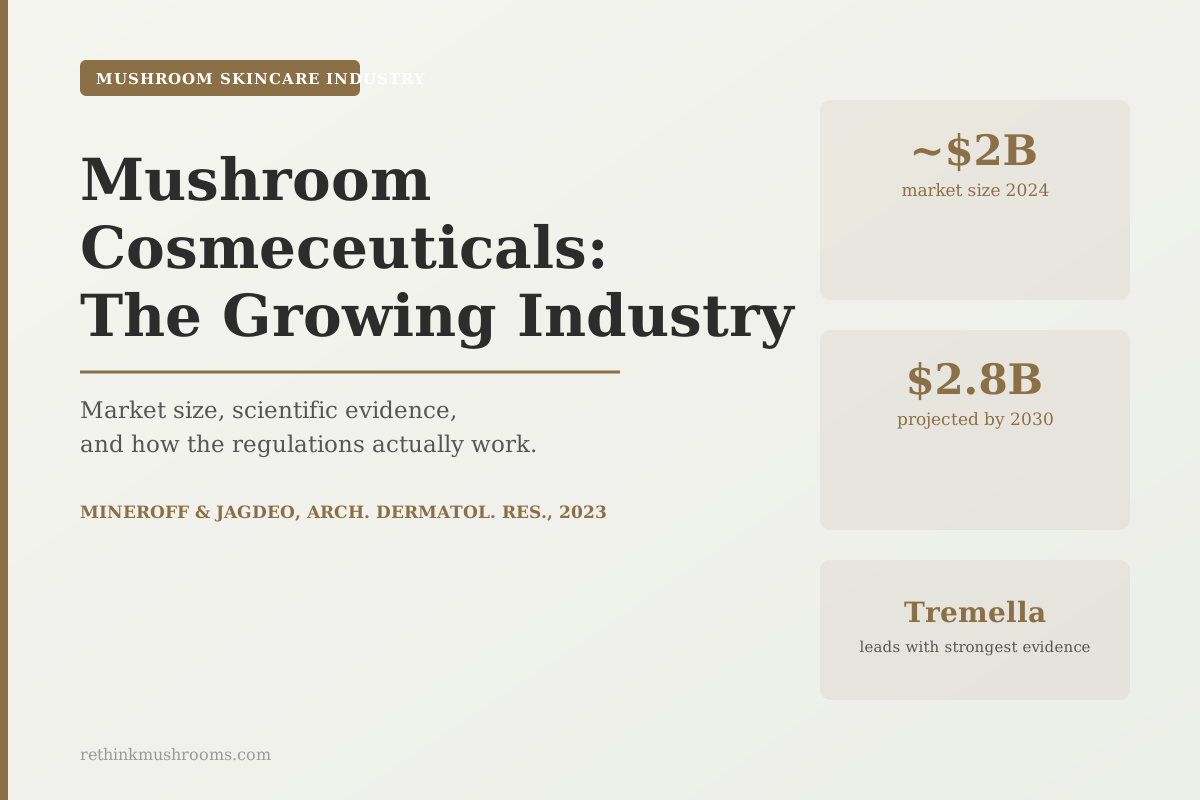
~$2 billion mushroom cosmeceuticals market in 2024
A category that barely existed a decade ago has reached approximately $2 billion, led by Tremella polysaccharides, which a dermatologist-authored 2023 review in a peer-reviewed journal called a credible skin hydration and UV-protective ingredient.
Mineroff & Jagdeo, Archives of Dermatological Research, 2023
$2.8B
projected mushroom cosmeceuticals market by 2030 at roughly 5% annual growth
2025
Galla study confirmed Tremella polysaccharides structurally comparable to hyaluronic acid
0
FDA-recognized product categories called 'cosmeceutical'; the term has no legal standing in US law
Mineroff & Jagdeo, Archives of Dermatological Research, 2023
 View as image ↗
The mushroom cosmeceuticals category is growing fast, and it sits in a genuinely unusual position in the consumer goods landscape. The science underpinning some of these products is real: Tremella fuciformis polysaccharides have peer-reviewed evidence for skin hydration, UV protection, and anti-inflammatory action. A 2025 study confirmed their structural similarity to hyaluronic acid, the dominant active ingredient in premium hydration skincare.[2] At the same time, the regulatory framework governing these products is permissive in ways that allow claims to outpace evidence, and many products in this market contain mushroom extracts at concentrations that haven't been independently validated. Understanding how the industry actually works, what the science supports, and what the regulations do and don't require is how to evaluate mushroom cosmeceuticals honestly. This article is part of a broader look at functional mushroom products across different forms.
Key Takeaways
- The mushroom cosmeceuticals market was valued at approximately $1.98–2.00 billion in 2024 and is projected to reach $2.80 billion by 2030 at a 5.0–5.3% annual growth rate (Polaris Market Research, Grand View Research, 2024)
- "Cosmeceutical" is not a legal product category under US law; the FDA recognizes only cosmetics and drugs, and claims that cross from cosmetic to drug territory require clinical evidence and regulatory approval
- A 2023 dermatologist-authored review in Archives of Dermatological Research found Tremella fuciformis has the strongest topical evidence among mushroom species for skin hydration and UV protection (Mineroff & Jagdeo, 2023)
- A 2025 study found Tremella-derived polysaccharides are structurally comparable to hyaluronic acid, providing a scientific basis for the vegan HA alternative positioning (Galla et al., 2025)
- Tremella polysaccharides are water-soluble and well-characterized; Chaga's active triterpenoids require alcohol extraction and have limited topical-specific evidence compared to their antioxidant chemistry evidence
- Most mushroom cosmeceutical products don't disclose extract concentration or beta-glucan content, making it impossible to compare product potency from label information alone
What "Cosmeceutical" Actually Means (and What the FDA Says It Doesn't)
The word "cosmeceutical" was coined in 1984 by dermatologist Albert Kligman to describe products that sit between cosmetics and pharmaceuticals: they are applied topically like cosmetics, but they claim to affect the biological processes of skin like drugs. Retinoids, vitamin C serums, and alpha-hydroxy acids are classic examples. Mushroom-based skincare products now routinely use the same framing.
The critical regulatory clarification: the FDA does not recognize "cosmeceutical" as a legal product category. Under US law, a product is either a cosmetic or a drug, and the distinction is made by its intended use and the claims made about it. A cosmetic is defined as something applied to the human body to clean, beautify, or alter appearance. A drug is something intended to affect the structure or function of the body, or to diagnose, cure, treat, or prevent disease.
The practical consequence is straightforward. A skin moisturizer is a cosmetic. A product marketed to "rebuild collagen," "reverse skin aging," or "stimulate cellular repair" is making drug-like claims that technically require clinical substantiation and FDA approval. Cosmetics, however, don't require pre-market approval or clinical efficacy trials.
Most mushroom skincare products navigate this by using language that implies transformation ("supports skin renewal") while stopping short of explicit drug claims. This is legal, widespread across premium skincare categories, and leaves consumers without a regulatory mechanism to verify that a product does what it implies. The "cosmeceutical" label, then, signals a positioning aspiration rather than a verified performance category. Mushroom cosmeceuticals are regulated as cosmetics unless they make drug claims, in which case the FDA can take action.
The $2 Billion Market: What Is Actually Driving Growth
Industry market data, based on estimates from Polaris Market Research and Grand View Research, places the mushroom cosmeceuticals market at approximately $1.98 to $2.00 billion globally in 2024, with projections reaching $2.80 billion by 2030 at a compound annual growth rate of 5.0 to 5.3%. These are market research firm estimates rather than peer-reviewed data, but the direction of growth aligns with visible category trends.
Three converging forces appear to be driving the expansion.
The first is the clean beauty movement's search for natural actives with credible mechanism stories. Consumers increasingly want to understand what they are putting on their skin and why it should work. Mushroom species, especially Tremella, provide a narrative that appeals to this consumer segment: a traditional East Asian beauty ingredient, now backed by peer-reviewed research, with a mechanism (hydration-retaining polysaccharides) that maps to an established skincare concept.
The second is the demand for vegan alternatives to animal-derived ingredients. Hyaluronic acid, the dominant hydration active in premium skincare globally, has traditionally been produced from rooster combs or through bacterial fermentation. A 2025 study by Galla and colleagues found that Tremella-derived polysaccharides have a chemical structure comparable to standard hyaluronic acid, making them a scientifically plausible non-animal HA alternative.[2] For brands positioning in the vegan and cruelty-free segment, this is a meaningful ingredient story.
The third driver is the broader functional mushroom wellness trend flowing into adjacent categories. Consumers who adopted lion's mane coffee and reishi supplements are carrying their established comfort with mushroom-derived products into skincare. Brand extension from supplement to cosmeceutical is a natural commercial move.
The Science Behind the Category: Evidence Varies Significantly by Species
The phrase "mushroom skincare" groups a diverse set of species under one label, and the evidence base varies substantially across them. What's true for Tremella is not automatically true for Chaga, and neither is necessarily true for reishi or shiitake.
Tremella fuciformis has the deepest and most topically-specific evidence base of any mushroom species in skincare. A comprehensive review published in the International Journal of Biological Macromolecules catalogued Tremella polysaccharides' documented bioactivities, including moisture retention comparable to hyaluronic acid, wound healing promotion, anti-inflammatory action, and anti-aging effects.[3] In 2023, a dermatologist-authored review in Archives of Dermatological Research specifically examined Tremella's potential cutaneous benefits, concluding that the evidence for hydration, UV protection, and anti-inflammatory properties is credible and warrants clinical investigation.[1] This is the closest thing to a mainstream dermatology endorsement of a mushroom skincare ingredient.
Chaga (Inonotus obliquus) contributes a different set of compounds. Its key bioactives are polyphenols and triterpenoids, including betulinic acid and inotodiol. These have potent antioxidant properties well-documented in chemical assays. The relevance to topical skincare is the anti-aging mechanism of protecting cells from oxidative damage. However, most of the evidence for Chaga's effects is from antioxidant chemistry studies and internal consumption research, not from topical application to human skin specifically. Chaga is legitimately interesting as an antioxidant ingredient, but its topical evidence base is less specifically developed than Tremella's.
Reishi (Ganoderma lucidum) has extensive immune research, primarily for internal use. Its triterpenoids and beta-glucans have documented anti-inflammatory properties. Topical reishi products exist, but the evidence base for topical application lags behind Tremella significantly. Shiitake is notable for ergothioneine content, the same compound discussed in motor neuron disease research for its antioxidant and cellular protection properties, but topical shiitake skincare remains a small segment.
The Tremella vs. Hyaluronic Acid Question: What the Chemistry Actually Shows
The most repeated marketing claim in mushroom skincare is that Tremella is more effective than hyaluronic acid at skin hydration. Versions of this claim appear on dozens of brand websites, sometimes with specific numbers ("2.6 times more hydrating," "15% more effective than HA").
These specific figures are difficult to trace to primary sources. What the 2025 Galla study actually showed is structural comparability, not superiority.[2] The researchers found that Tremella-derived polysaccharides share a chemical profile comparable to standard hyaluronic acid, including similar molecular weights in some preparations and comparable water-binding properties. This supports Tremella as a scientifically plausible alternative to HA, particularly for consumers seeking a non-animal-derived source. It does not establish superiority in controlled human clinical trials.
The distinction matters because the marketing claim and the scientific finding are not the same thing. "Structurally comparable to HA" and "more hydrating than HA" are different claims with different evidence requirements. The former has peer-reviewed support. The latter, in specific percentage form, does not appear to have been tested in a rigorous head-to-head human trial.
For readers interested in the full skincare evidence comparison, how topical mushroom products compare by species and evidence tier evaluates each species' evidence base in depth.
What the Regulatory Gap Means in Practice
The absence of a "cosmeceutical" legal category, combined with cosmetics' pre-market approval exemption, creates a practical consequence for consumers: there is no external verification requirement for the claims mushroom skincare products make.
A brand can launch a Tremella serum, describe it as "inspired by traditional East Asian beauty rituals" and "clinically proven to hydrate," and the FDA will not review that claim before the product ships unless it crosses the explicit drug claim threshold. Post-market enforcement exists but is reactive, not preventive. The "clinically proven" language, if supported by any internal testing, meets the legal minimum even if that testing was conducted by the brand with no independent replication.
This doesn't mean all mushroom skincare products are ineffective. It means that the label on a mushroom serum tells you very little about whether the concentration of active compound is sufficient to do anything. Tremella polysaccharides at 0.5% of the formula may behave differently from the same polysaccharides at 3% or 10%, and most product labels don't disclose this figure. The same extract quality issues that affect mushroom supplements (species authenticity, extraction method, active compound concentration) apply in skincare, with even less analytical infrastructure for consumers to evaluate.
For comparison, how to evaluate mushroom supplement quality from a label covers the supplement-side equivalent of these questions.
Where the Industry Is Heading: Credibility as a Competitive Differentiator
The mushroom cosmeceuticals market is at an inflection point that parallels where mushroom supplements were a decade ago. Early growth was driven by novelty and trend momentum. The next phase will likely be driven by brands willing to differentiate on evidence: disclosing extract concentrations, commissioning independent efficacy trials, and citing primary research rather than aggregated marketing claims.
Dermatology's increasing attention to the category is a marker of this trajectory. The Mineroff and Jagdeo review appearing in Archives of Dermatological Research is the kind of academic engagement that signals a transition from trend ingredient to mainstream clinical interest.[1] Similar transitions happened with retinoids, niacinamide, and peptides. Each was initially associated with marketing claims that outpaced science, then gradually refined as clinical evidence accumulated.
Tremella is the species best positioned for that transition: it has the strongest evidence base, a clear mechanism story (water-retaining polysaccharides comparable to HA), a vegan sourcing advantage, and increasing dermatological research attention. Chaga and reishi have compelling antioxidant chemistry but need more targeted topical application research to make claims that hold up to scrutiny.
For readers interested in where mushroom supplement sales fit in the broader industry picture, mushroom supplement sales in the US market covers the supplement market segment that overlaps with cosmeceuticals. For the practical consumer question of which specific mushroom skincare products to look for, mushroom skincare products by species and evidence provides the product-facing guide. And for a direct comparison of Tremella and Chaga for topical application specifically, Tremella and Chaga in skincare: what the evidence shows covers each species in depth.
The Bottom Line
The mushroom cosmeceuticals market is approaching $2 billion and growing, driven by Tremella's scientifically-grounded story as a vegan alternative to hyaluronic acid, clean beauty trends, and the wellness industry's expansion into skincare. The regulatory category "cosmeceutical" does not exist in US law, which means claims can outpace evidence without legal consequence. Tremella has the strongest and most topically-specific scientific evidence of any mushroom species in this category; Chaga has strong antioxidant chemistry but weaker topical application evidence. The market's next phase will likely be defined by brands that can back their claims with disclosed concentrations and independent testing.
Frequently Asked Questions
Sources & References
- 1. Source details for this reference are not yet available.
- 2. Source details for this reference are not yet available.
- 3. Source details for this reference are not yet available.