Mushrooms & Immune Health
90-Person RCT
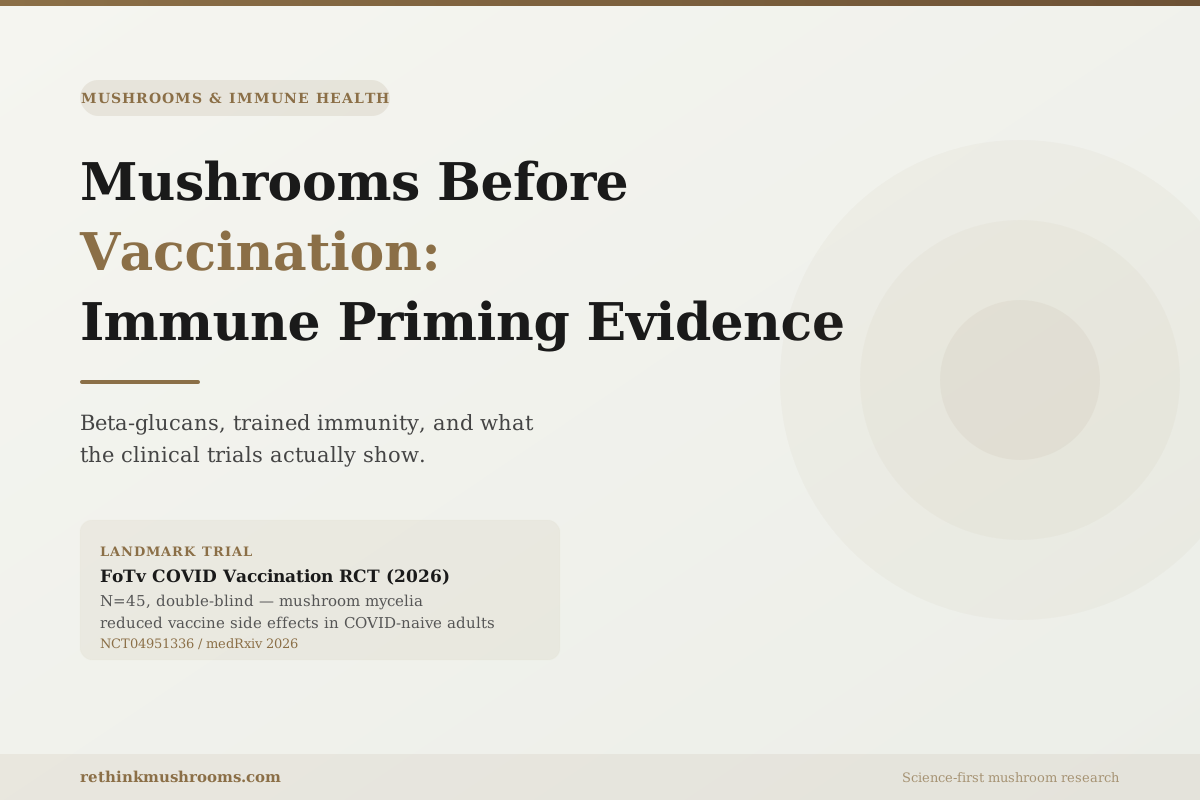
A 2026 double-blind randomized trial found that polypore mushroom mycelia as an adjunct to COVID-19 vaccination reduced vaccine side effects in COVID-naive individuals, the most rigorous controlled mushroom pre-vaccination trial published.
2026, BMC Immunology / NCT04951336
Double-blind RCT
the 2026 FoTv mushroom trial used placebo controls and masked allocation, the gold standard for clinical evidence
Trained immunity
beta-glucan exposure epigenetically reprograms innate immune cells into a heightened, longer-lasting alert state
Dectin-1 pathway
mushrooms work through innate immune cell reprogramming via Dectin-1 receptors, not by directly activating T cells
2026, BMC Immunology / NCT04951336
 View as image ↗
Most strategies for making vaccines work better focus on what happens at the moment of injection: the adjuvants added to the vaccine itself, the site of injection, or the health of the person receiving it. A different approach is starting weeks earlier, taking compounds that shift the immune system into a primed, heightened-readiness state before the vaccine arrives. Mushroom supplements before vaccination and the concept of immune priming through beta-glucans is where some of the most interesting recent immunology research sits.
The compounds responsible are beta-glucans, long-chain carbohydrates found in the cell walls of medicinal mushroom species including turkey tail, reishi, and shiitake. Beta-glucans are recognized by specific receptors on innate immune cells, the first-responder cells of the immune system, and this recognition triggers a molecular cascade that leaves those cells more reactive for weeks or months afterward. A 2026 double-blind randomized clinical trial, the first to test polypore mushroom mycelia as an adjunct to COVID-19 vaccination, found these compounds were safe and reduced vaccine side effects in participants with no prior COVID infection.[1] For the broader picture of how beta-glucans interact with immune function, the mushroom beta-glucan and immunity guide covers the full range of mechanisms.
Key Takeaways
- Beta-glucans in medicinal mushrooms (turkey tail, reishi, shiitake) activate innate immune cells through Dectin-1 receptors, creating an epigenetically-altered state called trained immunity that can amplify subsequent immune responses, including those generated by vaccines
- The 2026 FoTv polypore mushroom COVID vaccination RCT (N=90, double-blind) demonstrated safety and significantly reduced vaccine side effects in COVID-naive individuals, with anti-SARS-CoV-2 antibody levels preserved (and possibly increased) through six months, per BMC Immunology / NCT04951336
- A Phase 2 RCT published in JAMA Oncology (2023, N=107) found that oral beta-glucan during the vaccine priming phase raised anti-tumor (anti-GD2 IgG1) antibody titers versus no beta-glucan (P=.08 against a pre-specified 0.10 significance threshold), an effect concentrated in dectin-1 genetic responders, though seroconversion rates were unchanged
- Mushrooms work through innate immune cells (macrophages, dendritic cells), not by directly stimulating T cells, per Wilbers et al. (Frontiers in Immunology, 2016); this distinction is why the weeks-before-vaccination timing matters
- Animal and human studies reviewed by Vetvicka et al. (2020) showed beta-glucan consistently enhanced both antibody levels and cellular immune responses across hepatitis B, influenza, aspergillosis, and other vaccine models
- Most pre-vaccination evidence still involves small trials or preclinical models; the mechanism is established, but large confirmatory human RCTs are still needed
What Immune Priming Means (And Why Innate Immunity Is the Target)
Immune priming with mushrooms involves taking beta-glucan-rich species such as turkey tail, reishi, and shiitake in the weeks before vaccination. Beta-glucans activate macrophages and other innate immune cells through Dectin-1 receptors, creating an epigenetically-altered state called trained immunity that can amplify subsequent immune responses, including those generated by vaccines.
That definition captures the mechanism, but it requires unpacking. The immune system operates in two broad divisions. The innate immune system is the ancient, fast-responding branch: it detects threats within hours using pattern-recognition receptors that recognize broad molecular patterns, like the beta-glucan structure on fungal cell walls, rather than specific pathogens. The adaptive immune system is the learned, slower branch: it makes specific antibodies and T cells tailored to exact threats, and this is primarily what vaccines train. Vaccines work by introducing a harmless version of a pathogen so the adaptive immune system can build lasting specific memory against it.
What beta-glucans target is the innate side. Specifically, beta-glucans act on the macrophages, dendritic cells, and monocytes that function as the immune system's first responders. These cells are also the ones that process incoming vaccine antigens and signal to adaptive immune cells about the threat level. When innate immune cells are in a primed, heightened state at the moment a vaccine arrives, they can amplify the signal sent to the adaptive immune system, potentially generating faster and stronger antibody production.
This innate priming is distinct from the adaptive memory that vaccines themselves create. It is a support mechanism, not a replacement for vaccination. Understanding this distinction is critical for evaluating the research honestly.
How Beta-Glucans Reprogram Immune Cells Before Any Vaccine Arrives
The specific molecular event at the center of mushroom immune priming is beta-glucan binding to a receptor called Dectin-1. This receptor sits on the surface of macrophages and other innate immune cells and was originally identified as the primary pattern-recognition sensor for fungal infections. When beta-glucans from mushrooms bind to Dectin-1, they trigger a signaling cascade inside the cell.
What happens inside that cascade is the key: the signaling leads to epigenetic changes, meaning changes in which of the cell's genes are switched on or off, without altering the DNA sequence itself. These changes affect the genes responsible for inflammatory signaling, oxidative burst (the cell's ability to kill pathogens), and antigen presentation (the process by which immune cells show fragments of invaders to T cells). The net effect is that the macrophage or monocyte becomes more reactive. It responds more quickly and more intensely to the next threat it encounters.
This state is called trained immunity. A 2020 study in Cell Reports (Moorlag et al.) demonstrated that beta-glucan exposure induces trained immunity that protects against Mycobacterium tuberculosis infection, with the epigenetic reprogramming occurring in bone marrow precursor cells and providing long-lasting protection.[2] The key mediator identified was interleukin-1, an inflammatory signaling molecule involved in immune cell activation. The implications for vaccination are direct: if those same trained innate cells are present and reactive when a vaccine is injected, the signal they send to adaptive immune cells is louder.
A 2016 study by Wilbers and colleagues in Frontiers in Immunology added an important mechanistic nuance using Agaricus subrufescens mushroom extracts.[3] They found that the mushroom's effects on dendritic cells, the specialized innate cells that process antigens and present them to T cells, did not require direct physical contact between the dendritic cells and T cells. The mushroom worked on the innate cell first, altering how that cell behaved, and the downstream effects on adaptive immune activation followed from the changed innate cell state. This is consistent with the trained immunity model: beta-glucans program the innate cells, which then do their work more effectively when the vaccine arrives.
For the molecular detail on how this epigenetic reprogramming works at the histone level, the how beta-glucans epigenetically reprogram immune cells article covers that mechanism in depth. The broader trained immunity framework is in mushrooms and trained immunity.
The 2026 Randomized Trial: Polypore Mushrooms and COVID-19 Vaccination
The most rigorous controlled evidence for mushroom supplementation as a pre-vaccination intervention comes from a 2026 randomized clinical trial registered as NCT04951336. The trial tested a combination of two polypore mushroom mycelia, Fomitopsis officinalis and Trametes versicolor, abbreviated as FoTv, against placebo as an adjunct to COVID-19 vaccination.[1]
The design was double-blind: participants and investigators were both masked to which group received the mushroom combination and which received placebo. Ninety participants were randomized (52 to FoTv, 38 to placebo) and all completed the trial. They were classified after the fact, by their baseline antibodies, as either COVID-naive (no prior SARS-CoV-2 exposure) or COVID-exposed. The side-effect benefit emerged specifically in the COVID-naive group, where vaccination effects are clearest because there is no pre-existing immunity to confound the results.
The key finding: FoTv significantly reduced vaccine side effects compared to placebo in COVID-naive participants, specifically on days 3 and 5 after vaccination. Safety profiles were similar between groups, with no adverse events, establishing that polypore mushroom mycelium was well-tolerated alongside a COVID-19 vaccine. On the antibody side, the trial tracked anti-SARS-CoV-2 levels out to six months: in the COVID-naive FoTv group, antibody responses were preserved, and possibly increased, across that window, an effect not seen in the other groups. In other words, the reduction in side effects did not come at the cost of a weaker antibody response.
Trametes versicolor, one of the two species used in this trial, is turkey tail. It carries the most extensive beta-glucan immune function evidence base of any medicinal mushroom and is the species with the clearest mechanistic support for innate immune priming. Fomitopsis officinalis is a polypore fungus with historical use in European and Asian traditional medicine. Both are non-psilocybin species; the entire mechanism operates through beta-glucan cell wall compounds and the Dectin-1 trained immunity pathway.
Cancer Vaccine and Flu Shot Research: The Human Evidence Most Sites Miss
The 2026 COVID vaccination trial is the most recent, but the human evidence trail for beta-glucan enhancement of vaccine responses goes further back.
A Phase 2 randomized trial published in JAMA Oncology in 2023 (Cheung et al., PMID 36547975) tested oral beta-glucan supplementation in 107 high-risk neuroblastoma patients receiving a GD2/GD3 ganglioside cancer vaccine.[4] The vaccine targeted gangliosides displayed on the surface of neuroblastoma cells; the goal was to generate antibodies against them. Adding oral beta-glucan during the first five weeks of vaccine priming elicited a higher anti-GD2 IgG1 antibody response than no beta-glucan, a difference that met the trial's pre-specified significance threshold (P = .08 against a planned type I error of 0.10) and was concentrated in patients carrying the responder variant of the dectin-1 receptor gene. Seroconversion rates, however, did not differ between the groups. It remains the most direct human randomized evidence that oral beta-glucan can raise a vaccine-generated antibody titer, though the effect was modest and genotype-dependent, and the authors noted that additional adjuvants may be needed to move seroconversion.
The context matters for calibration: these were cancer patients receiving active treatment, not healthy adults getting a routine vaccine. The immune environment in cancer patients can differ from that in healthy vaccine recipients. The finding nonetheless establishes that the beta-glucan mechanism for amplifying vaccine-generated antibodies is real and detectable in a controlled human trial. For the broader question of how mushroom compounds influence antibody production, the how mushrooms enhance antibody production article covers that mechanism in full.
The review by Vetvicka et al. published in the Scandinavian Journal of Immunology in 2020 (PMID 31544248) synthesized beta-glucan adjuvant data across hepatitis B, influenza, aspergillosis, and coccidioidomycosis vaccine models in animals and humans.[5] The consistent finding: beta-glucan enhanced both antibody titers and cellular immune responses, and it worked synergistically with conventional adjuvants already added to those vaccines. As a narrative review rather than a single controlled trial, it establishes the breadth of the signal rather than one effect size, and much of the underlying data is preclinical.
For flu shot-specific clinical evidence, the most direct data comes from a 2025 double-blind pilot trial (Moreno et al., Journal of Dietary Supplements) testing 500 mg/day of yeast beta-glucan against placebo during influenza vaccination in 90 adults averaging 70.7 years of age. In the first of two vaccination seasons, the post-vaccination antibody titer response to the H3N2 influenza A strain favored the beta-glucan group over placebo (p = 0.037); the second season could not be interpreted because that season's vaccine antigen was poorly detected by the assay. The authors concluded that a larger trial is needed to confirm the effect. The specific population, dosing, and full evidence for that trial are covered in the companion article on mushrooms and flu shot response.
Human Evidence, At a Glance
What Each Vaccination Study Actually Moved — and What It Did Not
Study
What improved
Caveat / unchanged
FoTv + COVID vaccine[1]
Saxe 2026 · RCT, N=90, double-blind
Fewer vaccine side effects in COVID-naive (days 3 & 5); antibodies preserved (possibly higher) to 6 mo
Benefit confined to the COVID-naive subgroup; side-effect endpoint, not a clean antibody boost
Neuroblastoma vaccine[4]
Cheung 2023 · Phase 2 RCT, N=107
Higher anti-GD2 IgG1 titer during priming (P=.08 vs a pre-set 0.10 threshold)
Only in dectin-1 genetic responders; seroconversion rates unchanged
Influenza vaccine
Moreno 2025 · pilot RCT, N=90, age 70.7
Greater H3N2 antibody titer response vs placebo (p=0.037), season 1
Season 2 uninterpretable; symptoms and IFN-γ no different
Multi-vaccine review[5]
Vetvicka 2020 · narrative review
Antibody titers + cellular responses enhanced across vaccine models; adjuvant synergy
Review, not one controlled trial; much of the data is preclinical
The human signal is real but early: reduced reactogenicity, a modest and genotype-dependent antibody bump, and a single-season flu result. It reads as a supporting pre-vaccination strategy under study — not a proven way to make any vaccine stronger, and never a substitute for the vaccine itself.
Sources: Saxe et al. (2026) [ref 1]; Cheung et al. (2023) [ref 4]; Moreno et al. (2025); Vetvicka et al. (2020) [ref 5].
Which Mushrooms and How Long Before Vaccination?
The trained immunity research, particularly the 2020 Cell Reports trained immunity study, provides a framework for timing.[2] Epigenetic reprogramming of bone marrow precursor cells takes time to propagate into circulating monocytes and tissue macrophages. Most experimental protocols use two to four weeks of beta-glucan exposure before the immune challenge. This suggests that starting supplementation at least two weeks before a planned vaccination, and ideally four weeks, aligns with the mechanism's timescale.
For species, the relevant characteristic is beta-glucan content and structure. The beta-glucans that bind most effectively to Dectin-1 are 1,3/1,6 linked beta-glucans, the form predominant in fungal cell walls. Species with documented high content of these structures include the following.
Turkey tail (Trametes versicolor) is one of the most studied medicinal mushrooms for immune function and was used in the FoTv COVID vaccination trial. Its PSK (polysaccharide-K) and PSP (polysaccharide-peptide) compounds are among the most characterized in the clinical immunology literature.
Reishi (Ganoderma lucidum) has documented beta-glucan content alongside a suite of triterpene compounds and has been used in multiple human immune function trials.
Shiitake (Lentinus edodes) produces lentinan, a specific beta-1,3-glucan that has been studied in clinical oncology for decades.
Agaricus subrufescens was tested specifically for its dendritic cell effects in the Wilbers study, demonstrating that its extracts alter innate immune cell behavior through the model this article describes.[3]
Yeast beta-glucan (from Saccharomyces cerevisiae) is a non-mushroom source with 1,3/1,6 structure similar to medicinal mushrooms and was the form tested in the 2025 flu vaccination pilot.
The Limitation Nobody Mentions: What Priming Innate Cells Cannot Do
The trained immunity mechanism for mushroom beta-glucans is well-established in preclinical models, and there are now multiple human trials showing effects on vaccine-related outcomes. Calibrating what those effects actually mean requires care.
Trained immunity primes innate immune cells. It does not directly generate vaccine-specific antibodies. Vaccines work by training adaptive immune cells, specifically the antibody-producing B cells and pathogen-killing T cells, to recognize specific pathogens. This is a fundamentally different biological process from innate immune cell priming. The two processes interact: primed innate cells provide stronger activation signals to adaptive immune cells. But they are not the same thing, and a primed innate system does not replace the need for vaccination.
The 2026 COVID vaccination trial's primary finding was side-effect reduction, not antibody enhancement in the primary analysis. Reduced vaccine reactogenicity (the discomfort and systemic symptoms that accompany vaccination) is a clinically useful finding, particularly for populations who avoid vaccination because of those symptoms. But it is not the same finding as "mushrooms make your antibodies stronger."
The most direct antibody-enhancement evidence, the Cheung 2023 JAMA Oncology cancer vaccine trial, produced only a modest, genotype-dependent signal (P = .08) in cancer patients using a specialized immunotherapy target. Whether a comparable effect would appear in healthy adults receiving influenza or COVID vaccines has not been confirmed in a large trial.
The honest position: the mechanism is established. Multiple small trials show relevant effects. The effect on antibody titers to conventional vaccines in healthy adults is suggested by the 2025 flu shot pilot, a small single-season signal, and by the broader beta-glucan adjuvant review literature, but a large confirmatory trial in healthy adults has not been completed. None of this is medical advice, and mushroom supplementation is not a substitute for vaccination; anyone considering it, especially people who are immunocompromised, pregnant, or taking immunosuppressive medication, should talk with their clinician first.
For the natural killer cell activation side of the trained immunity picture, the mushrooms and natural killer cell activity article covers the parallel evidence base. And for what happens when influenza is contracted regardless of vaccination, mushrooms and influenza covers the direct antiviral evidence.
The Bottom Line
Beta-glucans in medicinal mushrooms prime innate immune cells through the Dectin-1 trained immunity pathway, creating a more reactive state that may support stronger vaccine-generated responses. A 2026 double-blind RCT (N=90) found polypore mushroom mycelia were safe alongside COVID-19 vaccination and reduced side effects in COVID-naive participants without weakening antibody levels. A 2023 JAMA Oncology Phase 2 trial found oral beta-glucan raised cancer-vaccine anti-GD2 antibody titers during priming (P=.08 versus a pre-specified 0.10 threshold), mainly in dectin-1 genetic responders. The mechanism is well-established; large confirmatory trials for conventional vaccine enhancement in healthy adults are still needed.
Frequently Asked Questions
Sources & References
- 1RTHM-02244·Saxe, Gordon et al. (2026). “Polypore mushroom mycelia as an adjunct to COVID-19 vaccination: a randomized clinical trial..” BMC immunology.Study breakdown →PubMed →↩
- 2RTHM-01255·Moorlag, Simone J C F M et al. (2020). “β-Glucan Induces Protective Trained Immunity against Mycobacterium tuberculosis Infection: A Key Role for IL-1..” Cell reports.Study breakdown →PubMed →↩
- 3RTHM-00839·Wilbers, Ruud H P et al. (2016). “Physical Interaction of T Cells with Dendritic Cells Is Not Required for the Immunomodulatory Effects of the Edible Mushroom Agaricus subrufescens..” Frontiers in immunology.Study breakdown →PubMed →↩
- 4RTHM-01675·Cheung, Irene Y et al. (2023). “Effect of Oral β-Glucan on Antibody Response to Ganglioside Vaccine in Patients With High-Risk Neuroblastoma: A Phase 2 Randomized Clinical Trial..” JAMA oncology.Study breakdown →PubMed →↩
- 5RTHM-01297·Vetvicka, Vaclav et al. (2020). “β-glucan as a new tool in vaccine development..” Scandinavian journal of immunology.Study breakdown →PubMed →↩