Mushrooms & Adaptive Immunity
2 RCTs confirm IgA increases
Two separate randomized controlled trials in healthy human volunteers found statistically significant increases in serum IgA levels: one using a reishi beta-glucan supplement (Chiu 2023) and one using daily shiitake mushrooms as food (Dai 2015).
Chiu et al., Foods, 2023; Dai et al., J Am Coll Nutr, 2015
52 adults
healthy participants in the Dai 2015 shiitake RCT showing IgA, γδ T cell, and NK cell increases over 4 weeks
IgA
the mucosal antibody most consistently elevated in mushroom studies, protecting gut and respiratory mucous membranes
97% reduction
in IL-1β levels in human volunteers taking Agaricus blazei extract (Johnson 2015), showing cytokine modulation alongside antibody effects
Chiu et al., Foods, 2023; Dai et al., J Am Coll Nutr, 2015
 View as image ↗
When researchers test whether mushroom supplements affect the immune system, they typically measure immune cell activity: NK cell killing, T cell proliferation, macrophage activation. Fewer studies go one step further and measure the actual proteins those cells produce: the antibodies that circulate in the blood and line the surfaces of the gut and respiratory tract. Two randomized controlled trials have now done exactly that, and both found the same result: statistically significant increases in IgA, the primary antibody of mucosal surfaces, in healthy human volunteers.
This article explains what those findings mean, how mushroom compounds drive the pathway from initial immune contact to antibody secretion, and what the evidence shows about which antibody classes are most consistently affected.
For the broader landscape of how mushrooms interact with the adaptive immune system, see Mushroom Beta-Glucans and Immunity: The Complete Research Guide. For the dendritic cell mechanism that bridges mushroom compounds to T and B cell responses, see Mushrooms and Dendritic Cell Maturation: Bridging Immune Responses.
Key Takeaways
- A 2023 RCT using Ganoderma lucidum (reishi) beta-glucan found statistically significant IgA increases in healthy volunteers versus placebo (Chiu et al., Foods, 2023)
- The Dai 2015 RCT with dietary shiitake consumption (5-10g dried daily, 4 weeks, n=52) found increased serum IgA alongside γδ T cell proliferation and NK cell activity
- IgA (immunoglobulin A) is the antibody class that protects mucosal surfaces including the gut lining, respiratory tract, and salivary glands; it is the primary defense against inhaled and ingested pathogens
- The pathway from mushroom beta-glucan to antibody production runs through dendritic cells that express the Dectin-1 receptor, which recognizes beta-glucans and initiates the cascade leading to T helper cell activation and B cell antibody secretion
- Mushroom compounds including fungal immunomodulatory proteins (FIPs) found in reishi can directly modulate B cell activity without requiring the full T cell intermediate pathway
- The clinical evidence base across systematic reviews and RCTs shows more consistent support for IgA increases than for IgG, suggesting mushrooms preferentially support mucosal immunity
What Antibodies Are and Why IgA Matters Most Here
Antibodies are Y-shaped proteins produced by white blood cells called B cells. Each antibody binds to a specific target, called an antigen, which is typically a piece of a pathogen (virus, bacterium, fungus) or a foreign molecule the immune system has flagged. When an antibody binds its target, it either neutralizes the pathogen directly or marks it for destruction by other immune cells.
The immune system produces several classes of antibodies, designated IgA, IgG, IgM, IgD, and IgE. Each class has distinct structural features that determine where in the body it circulates and what it does:
IgG is the most abundant antibody in blood serum. It provides the majority of systemic antibody-based immunity and is the antibody class most people think of when they hear "antibody." Vaccines typically aim to generate IgG responses.
IgA comes in two forms: serum IgA (in the bloodstream) and secretory IgA (at mucosal surfaces). Secretory IgA is the dominant antibody in the saliva, tears, breast milk, gut lining, and the mucous membranes of the respiratory tract. It is the primary defense against pathogens that enter through these surfaces, which is to say most pathogens. Respiratory viruses, gut bacteria, and food-borne pathogens all enter through mucous membranes where IgA is the first antibody they encounter.
Both the 2023 reishi RCT and the 2015 shiitake RCT found increases in serum IgA. The consistency across different mushroom species, different populations, and different study designs in showing IgA specifically (rather than IgG) points toward a particular pattern in how mushrooms interact with the immune system.
The 2023 Reishi RCT: Direct IgA Evidence
Chiu and colleagues published a randomized controlled trial in 2023 specifically designed to test immune modulation by a well-characterized reishi beta-glucan preparation.[1] The compound tested was β-1,3;1,6 D-glucan from Ganoderma lucidum, one of the most studied beta-glucan structural forms from medicinal mushrooms.
In healthy adult volunteers randomized to receive either the beta-glucan preparation or placebo, the beta-glucan group showed a statistically significant increase in serum IgA concentration compared to placebo. This is the most recent direct RCT evidence that mushroom-derived beta-glucan produces measurable antibody changes in healthy humans.
The study is notable for two reasons: it isolates the beta-glucan fraction (rather than testing whole mushroom extract), and it tests in healthy volunteers rather than in patients with existing immune system compromise. The effect appearing in healthy adults with presumably normal baseline immunity strengthens the case that this is a specific pharmacological effect of the compound rather than a correction of a deficiency.
The 2015 Shiitake RCT: Dietary Evidence
The earlier clinical benchmark comes from Dai and colleagues, who enrolled 52 healthy young adults in a dietary intervention trial rather than a supplement study.[2] Participants ate 5-10g of dried shiitake mushrooms daily for 4 weeks.
The results covered several immune parameters. γδ T cells (a specialized T cell type that bridges innate and adaptive immunity, discussed more fully at Mushrooms and Adaptive Immunity: T-Cell and B-Cell Research) showed increased proliferation. NK cell activity increased. C-reactive protein (CRP), a marker of systemic inflammation, decreased.
And serum IgA increased.
The Dai 2015 finding is important beyond its antibody result because it demonstrates that dietary-level mushroom consumption, not pharmacological-dose supplementation, can produce these effects. The 5-10g of dried shiitake per day is equivalent to roughly 75-150g of fresh mushrooms, achievable through regular cooking rather than supplementation.
How the Pathway Works: From Mushroom to Antibody
The pathway from eating a mushroom to producing more IgA involves several linked steps, each supported by separate research.
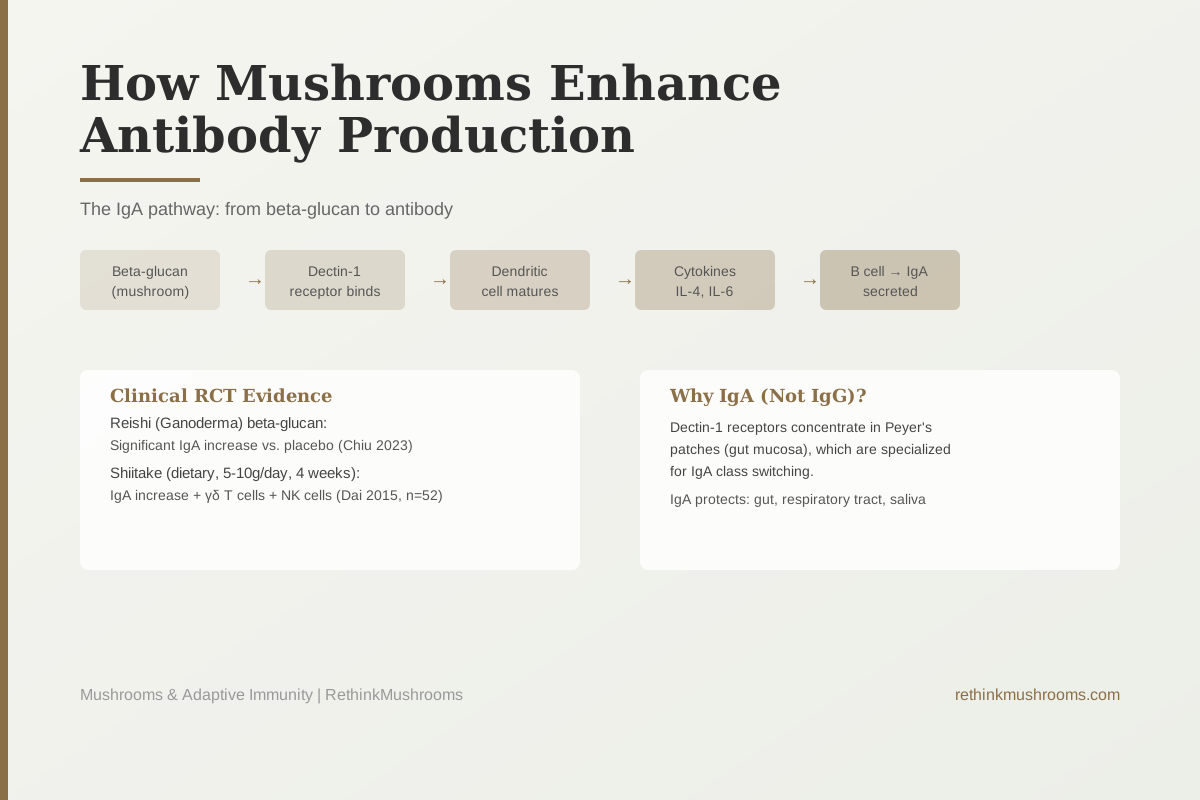
Step 1: Beta-glucan binds Dectin-1. Beta-glucans in mushrooms bind to a receptor called Dectin-1 (a pattern recognition receptor) on the surface of dendritic cells and macrophages in the gut wall. A large population of Dectin-1-expressing cells lines the gut mucosa, particularly in clusters called Peyer's patches. This explains why oral mushroom consumption, specifically through the digestive tract, is effective at initiating immune responses.
Step 2: Dendritic cells mature and signal. When Dectin-1 is engaged by beta-glucan, the dendritic cell activates, matures, and begins producing signaling molecules called cytokines. The specific cytokines produced influence what happens next in the immune cascade.
Step 3: Cytokines direct B cell class switching. B cells in the vicinity of activated dendritic cells receive cytokine signals that influence which antibody class they will produce. IL-4, IL-5, and IL-6 (cytokines released during this process) are particularly important for driving B cells toward IgA production in mucosal tissue. This is the molecular explanation for why IgA, the mucosal antibody, is the class most consistently elevated in mushroom studies.
Step 4: Plasma cells secrete IgA. B cells that receive the appropriate signals differentiate into plasma cells, which are essentially dedicated antibody-secreting factories. Plasma cells in mucosal tissue secrete IgA into the mucous layer where it performs its protective function.
A 2021 comprehensive review of mushroom bioactive molecules as immunotherapeutic agents documented this pathway and identified an additional mechanism: fungal immunomodulatory proteins (FIPs), found particularly in Ganoderma species (reishi), can directly modulate B cell activity through lectin binding without requiring the full dendritic cell intermediate step.[3] FIPs are a structurally distinct compound class from beta-glucans, meaning reishi contains at least two different compound classes with B cell-relevant mechanisms.
The Cytokine Context: What Happens to Inflammation While Antibodies Increase
Antibody production does not occur in isolation from the broader immune environment. The same mushroom compounds that enhance antibody production also modulate the cytokines (chemical messengers) that regulate inflammation.
Johnson and colleagues published findings from a study of Agaricus blazei extract in human volunteers that captured some of the most striking cytokine data in the mushroom literature.[5] After administration of an Agaricus blazei-based preparation, volunteers showed significant reductions in pro-inflammatory cytokines: IL-1β (interleukin-1 beta, a driver of acute inflammation) decreased by 97%, TNF-α (tumor necrosis factor alpha, a central inflammatory signaling molecule) decreased by 84%, IL-17 decreased by 50%, and IL-2 decreased by 46%.
These reductions do not contradict the IgA increases found in other studies. They point to a more nuanced immune effect: mushroom compounds can simultaneously support specific antibody production while reducing the chronic low-grade inflammatory cytokine load that contributes to tissue damage and immune dysregulation. The overall picture is of immune modulation (tuning the system toward appropriate response) rather than simple immune stimulation (turning everything up indiscriminately).
The 2021 Wasser review, one of the most comprehensive recent syntheses of mushrooms and immunity, characterizes this pattern as bidirectional immunomodulation: the ability to upregulate some immune functions while downregulating others depending on the immunological context of the host.[4]
What the Systematic Evidence Shows
Beyond individual studies, the systematic review literature provides a broader view of what the combined evidence shows about mushrooms and antibody levels.
A systematic review of randomized controlled trials on fungal beta-glucans by Islam and colleagues, published in Food & Function in 2021, examined immune outcomes across multiple trials.[6] The review documented effects on lymphocyte counts, cytokine profiles, NK cell activity, and antibody levels across multiple beta-glucan preparations. IgA appeared as a more consistent endpoint than IgG across the included trials.
Twardowska and colleagues reviewed 39 clinical studies on medicinal mushroom supplements in cancer care in 2023, representing the broadest recent review of human clinical outcomes.[7] Immune outcomes including lymphocyte counts and cytokine profiles were among the endpoints tracked, with quality of life improvements in 14 of the 39 studies and adverse events that were mostly low-grade.
The weight of this systematic evidence supports the conclusion that mushroom beta-glucans and related compounds produce genuine, measurable effects on adaptive immune parameters in humans, with IgA being the most consistently documented antibody response.
IgA vs. IgG: What the Pattern Suggests
The consistent finding of IgA elevation rather than IgG elevation has a mechanistic explanation. The gut-associated lymphoid tissue (the portion of the immune system that lines the digestive tract and is the primary site where Dectin-1 binds dietary beta-glucans) is specialized for IgA production. Peyer's patches (lymphoid aggregates in the gut wall) contain B cells that are primed toward IgA class switching specifically. When mushroom beta-glucans are consumed orally and interact with Dectin-1 in this environment, the B cell responses that follow preferentially produce IgA rather than IgG.
IgG is more strongly induced by systemic antigen exposure (vaccination, bloodstream infection) rather than by gut mucosal stimulation. A mushroom consumed as food or a supplement swallowed as a capsule primarily encounters gut-associated immune tissue first, which biases the antibody response toward IgA.
The practical implication is that mushrooms appear most likely to enhance the first line of antibody defense against pathogens that enter through mucous membranes: respiratory viruses, gut pathogens, and food-borne bacteria. This is consistent with traditional and clinical uses of medicinal mushrooms for immune support against respiratory infections and gastrointestinal conditions.
For the companion article on how mushrooms affect vaccine-related antibody responses, see Mushroom Supplements Before Vaccination: Immune Priming Evidence. For the full spectrum of how mushroom compounds interact with adaptive immune cells, see Mushrooms and Adaptive Immunity: T-Cell and B-Cell Research and Medicinal Mushrooms and Cytokine Balance.
For the related question of how beta-glucan recognition works at the cellular level, see The Dectin-1 Receptor: How Your Body Recognizes Mushroom Beta-Glucans.
The Bottom Line
Two independent randomized controlled trials in healthy humans have found that mushroom compounds increase serum IgA levels: the 2023 Chiu reishi beta-glucan RCT and the 2015 Dai shiitake dietary RCT. IgA is the antibody that protects mucosal surfaces including the respiratory tract and gut lining, and it is the antibody class most consistently elevated in mushroom clinical trials. The pathway runs from beta-glucan binding Dectin-1 in gut-associated immune tissue, through dendritic cell activation and cytokine signaling, to B cell differentiation and IgA secretion. Fungal immunomodulatory proteins in reishi provide an additional direct B cell mechanism. Simultaneously, mushroom compounds modulate pro-inflammatory cytokines, producing an overall pattern of immune tuning rather than nonspecific stimulation.
Frequently Asked Questions
Sources & References
- 1. Source details for this reference are not yet available.
- 2RTHM-00368·Dai, Xiaoshuang et al. (2015). “Consuming Lentinula edodes (Shiitake) Mushrooms Daily Improves Human Immunity: A Randomized Dietary Intervention in Healthy Young Adults..” Journal of the American College of Nutrition.Study breakdown →PubMed →↩
- 3RTHM-01416·Patel, Dinesh K et al. (2021). “Mushroom-Derived Bioactive Molecules as Immunotherapeutic Agents: A Review..” Molecules (Basel.Study breakdown →PubMed →↩
- 4. Source details for this reference are not yet available.
- 5. Source details for this reference are not yet available.
- 6. Source details for this reference are not yet available.
- 7. Source details for this reference are not yet available.