Mushrooms & Adaptive Immunity
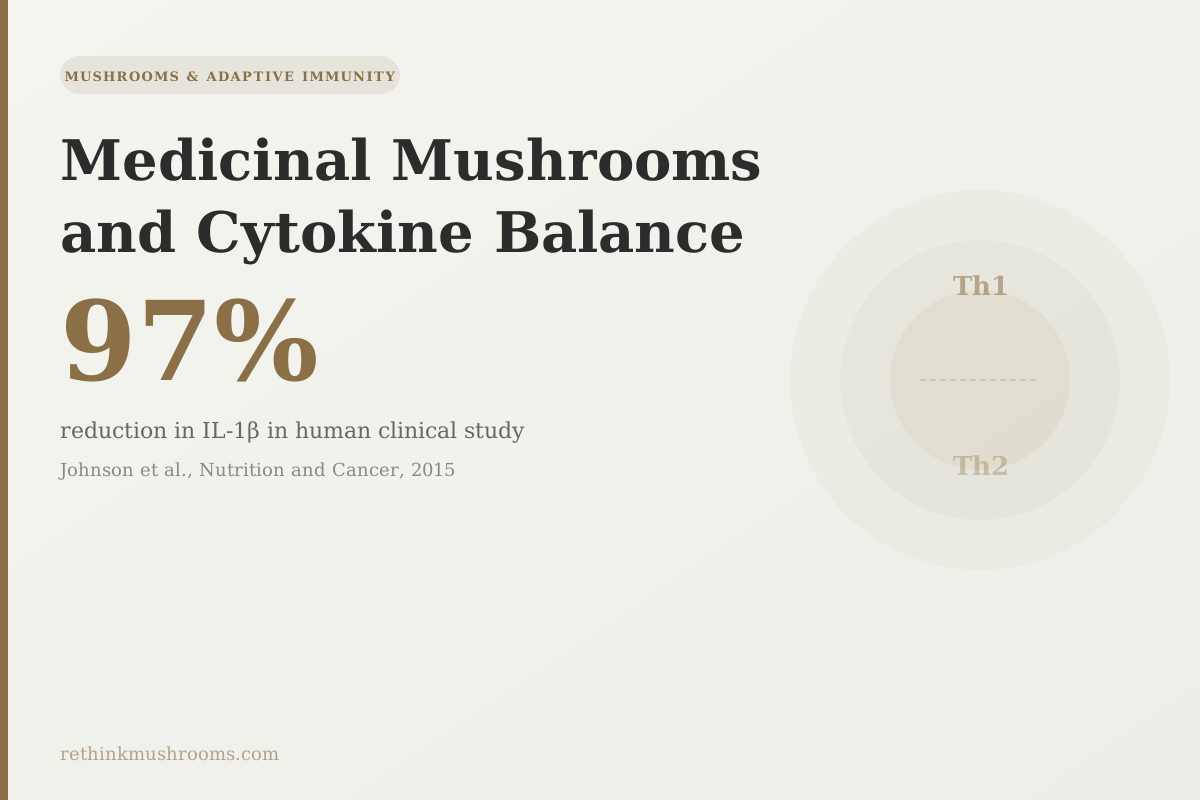
97% reduction in IL-1β
Human volunteers taking an Agaricus blazei mushroom extract showed a 97% drop in the inflammatory signaling protein IL-1β, one of the most striking cytokine measurements in the clinical mushroom literature.
Johnson et al., Nutrition and Cancer, 2015
84% drop
TNF-α reduction in the same human study
Th1/Th2
the immune balance axis most mushrooms shift toward Th1
Species-specific
Phellinus linteus shifts cytokines in the opposite direction
Johnson et al., Nutrition and Cancer, 2015
 View as image ↗
When a peer-reviewed study reports that a mushroom extract reduced an inflammatory signaling protein by 97%, the natural response is disbelief. Numbers like that appear in marketing copy, not clinical data. But Johnson and colleagues published exactly that result in Nutrition and Cancer in 2015: volunteers taking an Agaricus blazei-based extract showed a 97% reduction in IL-1β and an 84% reduction in TNF-α, two of the key proteins that drive chronic inflammation.[1] The cytokine balance effects of medicinal mushrooms are real, measurable in human studies, and more species-specific than most mushroom content acknowledges.
This is a cluster article focused on cytokine mechanisms. For the broader clinical picture of how mushroom compounds activate T cells and B cells, the mushrooms and adaptive immunity overview covers those findings. The complete beta-glucan and immunity guide places this research in the full context of how mushroom compounds interact with the immune system.
Key Takeaways
- Human volunteers taking Agaricus blazei extract (AndoSan) showed a 97% reduction in IL-1β and 84% reduction in TNF-α in a published human clinical study (Johnson et al., 2015)
- Most medicinal mushroom species drive immune responses toward Th1 dominance through dendritic cell IL-12 secretion, improving cellular immunity against pathogens and abnormal cells
- Phellinus linteus is an exception: it decreases the IFN-γ/IL-4 ratio and shifts toward Th2 rather than Th1, demonstrating that mushroom cytokine effects are species-specific, not universal
- Ex vivo cytokine results (cells exposed to mushroom compounds in a lab) consistently overestimate the effects seen in clinical studies; Hetland and colleagues documented this discrepancy directly in a 2009 Agaricus blazei study
- Three systematic reviews (Islam 2021, Shetty 2021, Twardowska 2023) confirm measurable cytokine effects across multiple human trials, with the strongest evidence in cancer and inflammatory disease populations
- For most people without autoimmune conditions, the predominant direction of effect (Th1 upregulation and reduced pro-inflammatory cytokine activity in inflamed tissues) aligns with the goals of improved immune surveillance and infection resistance
What Cytokines Are (and Why Balance Matters More Than Stimulation)
Cytokines are signaling proteins that immune cells use to communicate with each other. When one immune cell detects a threat, it releases cytokines to recruit and instruct nearby cells. Some cytokines escalate inflammation. Others tell the immune system to slow down. A few serve both purposes depending on concentration, timing, and which cells receive the signal.
The immune system organizes its responses around two general modes, named Th1 and Th2 after the T-helper cells that direct each branch.
Th1 handles cellular defense. It specializes in identifying and destroying cells that have been invaded by viruses or bacteria, and in recognizing and killing abnormal cells before they can establish themselves. Its primary signaling molecules are IFN-γ (interferon-gamma), IL-2, and IL-12. When Th1 is active and well-directed, the immune system is effective at fighting infections that hide inside cells and at early cancer surveillance.
Th2 handles the antibody response and extracellular threats. It coordinates the production of antibodies (immunoglobulins) like IgE and IgG, and it plays a central role in allergic reactions. Its primary cytokines are IL-4, IL-5, and IL-13. A healthy Th2 response is essential for immune memory and parasitic defense. An overactive Th2 response drives allergy and asthma.
In a well-functioning immune system, Th1 and Th2 stay in proportion to each other. When one branch is chronically elevated, problems follow. Th1 dominance can drive autoimmune reactions, where the immune system attacks normal tissue. Th2 dominance can leave viral and tumor surveillance inadequate.
This is why the phrase "immune stimulant" applied to mushrooms is too imprecise to be useful. The 2024 Shang systematic review in Biomedicine & Pharmacotherapy frames the effect more accurately: mushroom-derived polysaccharides regulate the balance between Th1 and Th2 cells and their cytokine profiles, improving the immune environment rather than simply amplifying immune activity indiscriminately.[2] The direction of that regulation depends on species, compound, and baseline immune state.
The 97% Data Point: What Agaricus blazei Did to Inflammatory Cytokines in Human Volunteers
Johnson and colleagues measured cytokine levels in volunteers with inflammatory bowel disease before and after they took AndoSan, an Agaricus blazei-based extract, over a defined treatment period.[1] The reductions were striking:
- IL-1β (interleukin-1 beta, a pro-inflammatory protein that drives fever and tissue damage): down 97%
- TNF-α (tumor necrosis factor-alpha, a key inflammation coordinator): down 84%
- IL-17 (involved in mucosal and autoimmune inflammation): down 50%
- IL-2 (a T cell growth factor that can escalate inflammatory cascades when dysregulated): down 46%
Some context on what these molecules do. IL-1β is the cytokine produced in large quantities during infections and inflammatory flares. It drives fever, tissue swelling, and the acute symptoms of illness. TNF-α coordinates inflammatory signaling across multiple tissues. It is the target of several major rheumatoid arthritis drugs, specifically etanercept and adalimumab, which work by blocking this single cytokine. Pharmaceutical companies have built large product lines around inhibiting it. IL-17 is a central driver of psoriasis, Crohn's disease, and autoimmune inflammation; several approved biologics specifically target the IL-17 pathway.
To see all four of those markers fall simultaneously in human volunteers from a dietary preparation is unusual enough to require careful examination of what this study actually shows.
The population matters. These were IBD patients whose inflammatory cytokine levels were elevated above healthy baseline. Reductions of this magnitude are far more plausible in the context of active inflammation than they would be in healthy adults with normal cytokine levels. The study was also a non-randomized cohort design, not a placebo-controlled trial, which limits the certainty of attribution. These changes cannot be definitively credited to the mushroom extract alone.
What the study establishes is that measurable and substantial cytokine shifts occur in humans consuming Agaricus blazei preparations, and the direction is anti-inflammatory across multiple markers simultaneously. That is a meaningful finding, even with the design caveats. For the B-cell and antibody side of this immune picture, see the research on how mushrooms enhance antibody production.
How Most Mushroom Species Push the Th1/Th2 Seesaw Toward Defense
For most studied medicinal mushroom species, the cytokine effect points consistently toward Th1 dominance. Hetland and colleagues documented this in a 2011 review of Agaricus blazei Murill: the mushroom shifts immune balance toward Th1 through NK cell activation and macrophage stimulation, increasing the signature Th1 cytokines IFN-γ and IL-2 while reducing allergic Th2-associated responses.[3]
The mechanism runs through dendritic cells (DCs), which are the specialized immune cells that bridge initial threat detection and coordinated adaptive immune response. When beta-glucans from mushrooms bind to a receptor called Dectin-1 on the surface of DCs, those DCs mature and begin secreting IL-12. IL-12 then acts as an instruction signal to naive T cells, directing them to differentiate into Th1 cells. The Shang 2024 review synthesizes this pathway across multiple polysaccharide types: DC-mediated IL-12 secretion is the central mechanism by which mushroom polysaccharides achieve Th1 polarization.[2]
What makes this pathway relevant to oral supplementation is that dendritic cells do not need to be physically adjacent to T cells to deliver IL-12 signals. The cytokines they secrete travel through blood and lymph to reach T cells in distant tissues. This explains how mushroom compounds absorbed in the gut can influence T cell populations and cytokine profiles throughout the body. The article on dendritic cell maturation and mushrooms covers the specific research behind this remote signaling mechanism in detail.
Chan and colleagues added another layer of specificity in 2007 with their study of human dendritic cells exposed to mushroom-derived versus barley-derived beta-glucans.[4] The DCs responded differently depending on the source. Mushroom-derived polysaccharides triggered distinct profiles of IL-12, IL-10, and TNF-α compared to barley beta-glucans, even though both belong to the same broad structural category. The three-dimensional architecture of the polysaccharide molecule determines which receptors engage and what cytokine cascade follows. Two beta-glucans can look similar on a product label and behave very differently in the immune system.
This is why species identity matters for cytokine outcomes. "Mushrooms" is not a single category with a single cytokine signature.
The Counterexample: Phellinus linteus Goes the Opposite Direction
Here is where the research complicates the simple story in a useful way.
Kim and colleagues published a 2015 study examining how Phellinus linteus, a mushroom used in Korean traditional medicine, modulates T cell responses.[5] The finding was that Phellinus linteus polysaccharides decreased the IFN-γ/IL-4 ratio. IFN-γ is a Th1 cytokine; IL-4 is a Th2 cytokine. A lower ratio means the immune balance tips toward Th2, the opposite direction from what Agaricus blazei and most studied mushroom species produce.
This is an in vitro finding, and direct translation to clinical outcomes in living humans involves additional variables. But the preclinical data is consistent enough to take seriously: Phellinus linteus appears to modulate cytokines in a Th2-supportive direction rather than a Th1-supportive one.
Whether that is beneficial or counterproductive depends entirely on context. The point here is that species identity changes the direction of the effect, not just the magnitude. A summary claim that "mushrooms balance cytokines" is accurate as far as it goes, but it collapses meaningful differences between species into a single phrase that does not help anyone make an informed judgment.
The mushroom polysaccharides and T-cell differentiation article covers how different polysaccharide structures interact with the DC-T cell axis and why this species specificity exists at the molecular level.
When Lab Results Don't Travel: The Ex Vivo vs In Vivo Gap
One of the most candid pieces of data in the mushroom cytokine literature comes from Hetland and colleagues' 2009 study of Agaricus blazei extract.[6]
The researchers measured cytokine responses in two conditions: ex vivo (blood cells taken from participants and exposed to the extract in a lab dish) and in vivo (the same participants consuming the extract orally, with blood drawn afterward). The ex vivo results were dramatic. Blood cells exposed directly to the extract produced significant increases in pro-inflammatory cytokines including IL-1β, IL-6, and TNF-α, plus leukocyte growth factors G-CSF and GM-CSF. The in vivo results, measured after oral consumption, were more modest. The cytokine changes after oral intake were considerably smaller than what the ex vivo data suggested.
This discrepancy is not a flaw in either methodology. It reflects a real pharmacological challenge: the gastrointestinal tract digests some polysaccharides before they reach the bloodstream, reducing the concentration and structural integrity of the active compounds. The material that enters the body orally is different, in both form and quantity, from the concentrated preparation added directly to cells in a laboratory environment.
The practical implication for interpreting mushroom cytokine research: in vitro and ex vivo studies tell you a compound is immunologically active. They cannot tell you how much of that activity survives digestion, absorption, and distribution through a living body. Clinical trials with actual humans consuming actual preparations are required for that. This is why the systematic review data carries more weight than individual cell culture studies, however striking those studies may look.
What Clinical Trials Show About Medicinal Mushrooms and Cytokine Balance
Three substantial systematic reviews now synthesize what clinical human trials actually show for beta-glucan-containing mushrooms and cytokine outcomes.
Islam and colleagues published a 2021 systematic review of randomized controlled trials using fungal beta-glucans, covering immune outcomes including cytokine profiles, lymphocyte counts, NK cell activity, and antibody levels across multiple human trials.[7] The review confirms that fungal beta-glucans produce measurable cytokine changes in clinical settings, with the direction depending on species and the health status of the population.
Shetty and colleagues' 2021 systematic review focused on clinical trials using fungal beta-glucans as cancer treatment adjuvants, covering evidence accumulated since the 1980s.[8] In cancer populations where Th1 immunity is often suppressed, mushroom beta-glucans produced documented changes in T cell subsets, NK cell activity, and cytokine profiles across multiple trials. Turkey tail's PSK (polysaccharide-K) has the deepest clinical track record in this category, studied extensively in Japanese cancer trials for over four decades. The cytokine direction in these trials is consistently Th1-supportive.
Twardowska and colleagues reviewed 39 clinical studies on mushroom supplements in cancer in 2023, documenting outcomes including lymphocyte counts, NK cell activity, cytokine profiles, and quality of life measures.[9] The review confirms measurable immune effects while also reflecting the broader evidence quality problem across this field: many studies are small, use varied preparations and dosing, and lack standardized biomarker assessment that would allow direct comparison across trials.
Borchers and colleagues' comprehensive 2008 review of mushroom immunobiology, still among the most-cited synthesis in this literature, documented T cell activation, NK cell stimulation, macrophage activation, and cytokine effects across multiple species.[10] The foundational picture that emerged from that review, that medicinal mushrooms affect cytokine profiles through both innate and adaptive immune compartments, has held up through subsequent decades of additional research.
The clinical picture that emerges from these reviews is consistent but not simple. Mushroom beta-glucans produce measurable cytokine effects in human studies. The direction is generally Th1-supportive across most studied species. The effects are largest in populations with pre-existing immune suppression or active inflammation. Healthy adults with normal baseline immunity show smaller and less consistent effect sizes.
For the autoimmune context, where Th1 activity can already be pathologically elevated and further Th1 upregulation is a different kind of risk, the mushrooms and autoimmune disease article addresses the specific safety considerations.
A Species-by-Species Cytokine Reference
The literature shows distinct cytokine signatures by species that no consumer-facing mushroom content currently brings together in one place. The table below synthesizes the clinical and preclinical findings from this article's studies:
| Mushroom | Primary Cytokine Effect | Direction | Source |
|---|---|---|---|
| Agaricus blazei (AndoSan extract) | IL-1β, TNF-α, IL-17, IL-2 | Decrease (97%, 84%, 50%, 46%) in IBD patients | Johnson et al., 2015 |
| Agaricus blazei | IFN-γ, IL-2 | Increase, Th1-dominant | Hetland et al., 2011 |
| Multiple species (beta-glucan polysaccharides) | IL-12 via dendritic cell activation | Increase, driving Th1 polarization | Shang et al., 2024 |
| Phellinus linteus | IFN-γ/IL-4 ratio | Decrease, Th2 direction | Kim et al., 2015 |
| Turkey tail (PSK) and multiple species | T cell subsets, NK activity, cytokines | Th1-supportive across cancer trials | Shetty et al., 2021 |
| Fungal beta-glucans across RCTs | Variable cytokine profiles | Mixed; Th1-dominant in cancer and inflammatory populations | Islam et al., 2021 |
The Agaricus blazei data in the table looks contradictory at first glance: pro-inflammatory cytokines going down in one study and Th1 cytokines going up in another. These are not actually contradictory. They are different things being measured in different contexts. Reducing IL-1β and TNF-α in an IBD patient with elevated baseline inflammation reflects anti-inflammatory modulation in an inflammatory disease. Increasing IFN-γ in a Th1 upregulation context reflects immune surveillance enhancement. A cytokine like IL-2 serves multiple roles: at normal concentrations it supports T cell growth and function; in an overactivated inflammatory cascade it can drive escalation. What "reducing IL-2 by 46%" means depends entirely on where it started.
The Phellinus linteus data is not contradictory with the general pattern. It is a genuine exception. Some mushroom polysaccharides engage different receptor pathways than the Dectin-1/IL-12/Th1 cascade that characterizes most studied beta-glucan species. The research on mushrooms and trained immunity covers how different receptor engagements produce different long-term immune programming outcomes and why starting at the receptor level reveals more about a mushroom's immune effects than knowing its species name alone.
The Bottom Line
Medicinal mushrooms produce measurable cytokine shifts in human studies, with most species driving Th1-dominant immune responses through dendritic cell IL-12 secretion. The strongest single clinical data point involves Agaricus blazei, which produced 97% and 84% reductions in IL-1β and TNF-α in IBD patients. Species-specific effects are real and go in different directions: Phellinus linteus shifts cytokines toward Th2 rather than Th1. Ex vivo laboratory results consistently exceed clinical effect sizes after oral intake. Systematic reviews of human trials confirm the cytokine effects are real, with the strongest and most consistent evidence in cancer and inflammatory disease populations.
Frequently Asked Questions
Sources & References
- 1. Source details for this reference are not yet available.
- 2RTHM-01985·Shang, Qihang et al. (2024). “Polysaccharides regulate Th1/Th2 balance: A new strategy for tumor immunotherapy..” Biomedicine & pharmacotherapy = Biomedecine & pharmacotherapie.Study breakdown →PubMed →↩
- 3RTHM-00215·Hetland, Geir et al. (2011). “The Mushroom Agaricus blazei Murill Elicits Medicinal Effects on Tumor, Infection, Allergy, and Inflammation through Its Modulation of Innate Immunity and Amelioration of Th1/Th2 Imbalance and Inflammation..” Advances in pharmacological sciences.Study breakdown →PubMed →↩
- 4RTHM-00208·Chan, Wing Keung et al. (2007). “Response of human dendritic cells to different immunomodulatory polysaccharides derived from mushroom and barley..” International immunology.Study breakdown →PubMed →↩
- 5. Source details for this reference are not yet available.
- 6. Source details for this reference are not yet available.
- 7. Source details for this reference are not yet available.
- 8. Source details for this reference are not yet available.
- 9. Source details for this reference are not yet available.
- 10RTHM-00242·Borchers, Andrea T et al. (2008). “The immunobiology of mushrooms..” Experimental biology and medicine (Maywood.Study breakdown →PubMed →↩