Mushrooms & Adaptive Immunity
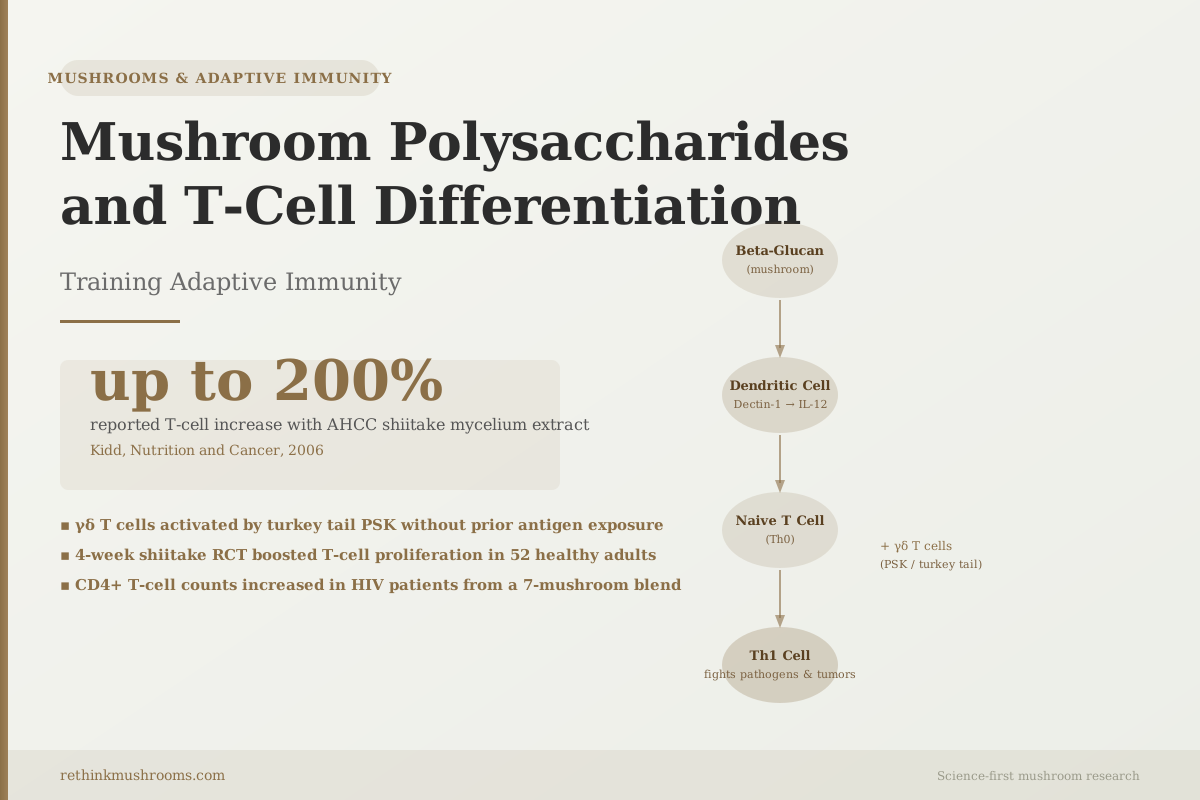
up to 200% reported T-cell increase
AHCC, a shiitake mycelium extract, was reported to increase T-cell numbers by up to 200% in Japanese human studies compiled by Kidd in a 2006 review.
Kidd, Nutrition and Cancer, 2006
γδ T cells
a rare T-cell type that kills tumors without prior antigen exposure, specifically activated by turkey tail PSK (Torkelson et al., 2013)
4 weeks
was all it took for daily shiitake consumption to measurably boost T-cell proliferation in 52 healthy adults (Dai et al., 2015)
CD4+ counts increased
in HIV patients supplementing with a 7-mushroom blend, as measured in a clinical study by Adotey et al., 2011
Kidd, Nutrition and Cancer, 2006
 View as image ↗
Every T cell starts life as a blank slate. It circulates through blood and lymph nodes, uncommitted, waiting for instruction. These waiting cells are called naive T cells, and the process that transforms them into a specific type of immune weapon is called T-cell differentiation. What type they become determines what kind of immune defense your body can mount. Mushroom polysaccharides appear to influence this differentiation process in adaptive immunity, steering naive T cells toward specific roles. They do this not by acting on T cells directly, but through an intermediary. That pathway is what this article examines. For the broader picture of how mushrooms affect immune health, see the complete guide to mushrooms, beta-glucans, and immunity.
Key Takeaways
- Mushroom polysaccharides don't directly reach T cells: they first activate dendritic cells, which release instructional cytokines (chemical messengers) that direct T-cell differentiation into specific types (Wilbers et al., Frontiers in Immunology, 2016)
- Most mushroom polysaccharides push T-cell differentiation toward Th1, the type associated with fighting viruses, bacteria inside cells, and tumors, via dendritic cell-secreted IL-12 (Shang et al., Biomedicine & Pharmacotherapy, 2024)
- Turkey tail's PSK (polysaccharide K) specifically activates gamma-delta T cells, a rare subtype that can kill tumor cells without prior antigen exposure (Torkelson et al., Journal of Functional Foods, 2013)
- AHCC, a shiitake mycelium extract, was reported to increase T-cell numbers by up to 200% in Japanese human studies; the direction is consistent with other clinical data even if the magnitude needs replication (Kidd, Nutrition and Cancer, 2006)
- HIV patients supplementing with a 7-mushroom blend showed measurable increases in CD4+ T-lymphocyte counts over the study period, one of the few direct clinical measures of T-cell subtype changes from mushroom supplementation (Adotey et al., 2011)
- Phellinus linteus is an exception: its polysaccharides shift T cells in the opposite direction from most mushrooms, demonstrating that species-specific data matters and "medicinal mushroom" is not one uniform category (Kim et al., Phytotherapy Research, 2015)
What T-Cell Differentiation Is (The Missing Explanation Behind "Immune Boosting")
When you hear "immune boosting," the implied image is of an immune system turning up in volume: more white cells, stronger responses, better defense all around. T-cell differentiation doesn't work that way.
Every T cell starts as a naive cell. It hasn't encountered any pathogen yet and hasn't been assigned a role. This uncommitted state is sometimes labeled Th0, but the more useful way to think about it is a conscript who has been enlisted but not yet told what unit they're joining. What follows, the assignment to a specific type, is differentiation, and it's driven by chemical signals from other immune cells.
The main outcomes of T-cell differentiation are four types, each with a distinct job:
Th1 cells specialize in fighting threats that hide inside cells. Viruses replicate inside your cells, some bacteria do the same, and tumor cells carry abnormal internal proteins. Th1 cells coordinate the response that identifies and destroys those infected or abnormal cells. They produce IFN-gamma (a signaling molecule that amplifies the activity of killer immune cells) and IL-2 (which drives T-cell multiplication).
Th2 cells specialize in coordinating antibody production and defending against parasites. They also drive allergic responses when overactivated. Th2 cytokines suppress the Th1 response, which is partly why strong allergic disease and strong antiviral immunity don't typically coexist in the same person.
Th17 cells specialize in mucosal defense, protecting surfaces like the gut lining and lungs from bacteria and fungi that try to breach those barriers.
Regulatory T cells (Tregs) suppress immune activity. They prevent the immune system from attacking the body's own tissue and limit responses once a threat has been cleared. They are the brake on immune activity, not the gas.
The direction of differentiation matters far more than the raw T-cell count. A skew toward Th2 can produce allergic disease. A skew toward Th1 supports antiviral and antitumor defense. Balanced Treg activity keeps autoimmune tissue damage from developing. The goal is not "more immune." It is "the right type of immune response for the situation at hand."
Mushroom polysaccharides appear to influence which direction naive T cells go. But they never talk to T cells directly.
The Pathway from Mushroom to T Cell: It Goes Through Dendritic Cells
T cells don't encounter mushroom polysaccharides on their own. Before any T cell changes, a different immune cell has to react first.
Dendritic cells are the scouts of the immune system. They patrol tissues, capture foreign material, and carry information back to lymph nodes where they present it to T cells. They are the bridge between the innate immune system (which detects a threat) and the adaptive immune system (which mounts a targeted response to it). The full story of what happens to dendritic cells when they encounter mushroom compounds is covered in mushrooms and dendritic cell maturation. The relevant point here is what those activated dendritic cells do to T cells.
The critical insight came from a 2016 study by Wilbers and colleagues, testing the mushroom Agaricus subrufescens. The finding was counterintuitive: dendritic cells do not need to be in direct physical contact with T cells to change their behavior.[3] Soluble factors, specifically cytokines, the chemical messengers that dendritic cells release into surrounding fluid, carry the instruction signal to T cells that may be far away.
This finding explains something that otherwise seems puzzling about oral mushroom supplementation. When you eat mushrooms or take a mushroom extract, the polysaccharides interact with immune cells in the gut lining. Those gut-resident dendritic cells release cytokines. Those cytokines travel through the bloodstream. T cells in lymph nodes, the spleen, and circulation encounter those instructions without any mushroom compound ever reaching them. The gut is the entry point, but the effect is systemic.
What signals do those cytokines carry? Chan and colleagues documented in 2007 that human dendritic cells respond differently to mushroom-derived beta-glucan polysaccharides than to barley beta-glucans, even though both are structurally similar carbohydrates.[4] Mushroom polysaccharides triggered distinct immune signaling patterns, including differences in IL-12, IL-10, and TNF-alpha (three key messenger molecules the immune system uses to coordinate responses), while barley beta-glucans did not produce the same profile. This specificity is the first clue that mushroom polysaccharides aren't doing generic activation. They trigger a particular cascade that starts with dendritic cell recognition and ends with specific T-cell instructions.
IL-12 is the most consequential of those signals. It is the cytokine that tells a naive T cell to become a Th1 cell. It is the instruction that launches the cellular immunity branch of the adaptive response. And it comes from dendritic cells, prompted by the mushroom polysaccharide signal they received at the gut wall.
The receptor that dendritic cells use to recognize beta-glucans is called Dectin-1. The full story of how that recognition works is explored in the article on the Dectin-1 receptor.
Th1 Dominance: Why Most Mushroom Polysaccharides Push T Cells Toward Fighting Mode
A 2024 systematic review by Shang and colleagues examined how polysaccharides, including mushroom-derived compounds, regulate the balance between Th1 and Th2 immune responses.[2] The mechanism synthesis was the clearest available: mushroom polysaccharides bind Dectin-1 on dendritic cells, those cells secrete IL-12, and IL-12 drives naive T cells toward Th1 differentiation. The resulting Th1 cells produce IFN-gamma and IL-2. Those Th1 cytokines amplify cytotoxic T cell activity: the immune cells that identify and kill infected or abnormal cells.
Shang's review focused on tumor immunotherapy, which is why the Th1/Th2 balance matters in cancer research. Many solid tumors survive by shifting the immune environment in their vicinity toward Th2, suppressing the Th1 activity that would otherwise target them. Restoring Th1 dominance through the DC-IL-12 pathway is one mechanism by which mushroom polysaccharides may support antitumor immune function.
A 2011 review by Hetland and colleagues documented this Th1 shift for Agaricus blazei Murill specifically.[10] Agaricus blazei extracts shifted the Th1/Th2 balance toward Th1 through NK cell activation and macrophage stimulation. IFN-gamma and IL-2, the defining Th1 cytokines, increased. Signaling molecules associated with allergic Th2 responses decreased relative to Th1 markers. The mechanism aligned with what Shang's later, more comprehensive review also described.
What Th1 dominance means practically: the immune system becomes better at identifying and clearing virally infected cells and cells carrying abnormal surface proteins. This is the immune state already characteristic of people without significant immune compromise. What the mushroom data suggests is that polysaccharides can shift this balance further in the same direction and potentially restore it in people whose Th1 response has been suppressed by illness or treatment.
For the full breakdown of which cytokines change with specific mushroom species, including quantified data from human clinical studies, see medicinal mushrooms and cytokine balance.
Turkey Tail's PSK Activates a T-Cell Type That Kills Without Prior Training
Most T cells require a specific education before they can act on a threat. A conventional cytotoxic T cell, the type that directly kills infected or cancerous cells, must first encounter its target displayed by a dendritic cell, receive activation signals, and then multiply into a clone army specific to that one target. That process takes days, and it means the response is always narrowly targeted at whatever specific antigen was presented.
Gamma-delta T cells (abbreviated γδ T cells) are different. They sit at the intersection of innate and adaptive immunity. They can recognize and kill abnormal cells without prior sensitization and without needing a specific antigen presented to them. They patrol mucosal tissues, including the gut, lungs, and skin, acting as fast-response surveillance cells. In cancer immunology, they draw attention specifically because they can react to tumor cells they have never previously encountered.
In 2013, Torkelson and colleagues documented that PSK, polysaccharide K, the main active compound in turkey tail mushroom (Trametes versicolor), specifically activates gamma-delta T cells, and that these activated cells contribute to anti-cancer immune responses.[5] This was laboratory work, not a clinical trial. But it provided a mechanistic rationale for findings the same research group had reported in a clinical setting the year before.
In 2012, Torkelson and colleagues published a Phase I clinical trial of turkey tail in women with breast cancer.[6] At doses up to 9 grams per day, both NK cell activity and lymphocyte counts improved in patients whose immune systems had been suppressed by conventional cancer treatment. Gamma-delta T cells are included in the lymphocyte count. The 2013 mechanism paper clarifies one reason this improvement appeared even in immunocompromised patients: the activation signal for gamma-delta T cells from PSK does not depend on the patient's existing immune memory or prior antigen exposure.
The broader concept, that beta-glucan exposure creates lasting shifts in how immune cells respond, connects to the research on trained immunity and mushrooms.
Human Clinical Evidence: AHCC, Shiitake, and CD4+ T-Cell Data
Mechanism and preclinical data point in a consistent direction. The question is what actually changes in people who take mushroom compounds.
The most widely cited T-cell data from human subjects comes from AHCC research. AHCC is an extract derived from the root-like mycelium of shiitake mushrooms, developed in Japan in the 1980s. A 2006 review by Kidd compiled findings from Japanese human studies and reported that AHCC increased T-cell numbers by up to 200%, increased NK cell activity, and enhanced the activity of T-helper cells.[1] A 200% increase in T cells would represent an extraordinary shift by any immunological standard. The data comes largely from Japanese clinical contexts, many with industry involvement, and the extreme magnitude should be read with that context in mind. But the direction, measurable T-cell increases from a shiitake-derived compound, is consistent with what other clinical data shows.
A more controlled data point comes from Adotey and colleagues, who in 2011 measured CD4+ T lymphocyte counts in HIV-positive patients taking a 7-mushroom blend supplement.[7] CD4+ cells are the T-helper cells that HIV selectively destroys: losing them is the defining feature of AIDS progression, and any intervention that increases their count in this population has clinical significance. Adotey's patients showed measurable increases in CD4+ T-lymphocyte counts over the study period. This is one of the few direct clinical measures of a specific T-cell subtype responding to mushroom supplementation in a population with confirmed immune deficiency.
A 2015 randomized controlled trial by Dai and colleagues enrolled 52 healthy adults and assigned them to eat 5 to 10 grams of dried shiitake mushrooms daily for four weeks.[8] The results showed significant increases in gamma-delta T-cell proliferation and NK cell activity. Serum IgA, an antibody type that protects mucosal surfaces like the gut and lungs, also increased, and CRP, a general marker of inflammation, decreased. The Dai 2015 trial is notable for three reasons: it used whole food rather than an extract, it studied healthy adults rather than patients, and the randomized design controls for confounding better than most mushroom supplementation research. The magnitude was smaller than AHCC reports, which is expected given the difference between a whole-food dietary intervention and a concentrated extract. The direction was the same.
The 2021 systematic review by Shetty and colleagues covered clinical trials using fungal beta-glucans alongside cancer treatment since the 1980s.[9] Across those trials, they documented consistent effects on lymphocyte counts, T-cell subsets, NK cell activity, and cytokine profiles. The pattern across decades of cancer research is coherent: fungal beta-glucans reliably shift measurable adaptive immune cell populations in human clinical settings, even in patients with heavily compromised baseline immune function.
How this T-helper activity translates into downstream antibody production, the B-cell half of adaptive immunity, is covered in how mushrooms enhance antibody production.
The Exception: One Mushroom That Pulls T Cells the Other Direction
The picture built so far describes a consistent effect: mushroom polysaccharides generally steer T-cell differentiation toward Th1. But that generalization holds only for the mushrooms most studied: turkey tail, shiitake, reishi, and Agaricus blazei. The picture changes when you look at less-common species.
Phellinus linteus, a medicinal mushroom used in East Asian traditional medicine, provides the clearest counterpoint. In a 2015 study by Kim and colleagues, Phellinus linteus polysaccharides modulated T-cell responses by decreasing the ratio of IFN-gamma to IL-4.[11] IFN-gamma is the defining signaling molecule of Th1 cells; IL-4 is the defining signaling molecule of Th2 cells. A decrease in the IFN-gamma/IL-4 ratio means the balance shifted toward Th2, the opposite direction from what Agaricus blazei, turkey tail, shiitake, and reishi consistently produce.
This finding matters on two levels.
First, it disproves any notion that all medicinal mushrooms produce the same T-cell effect. The specific structural features of mushroom polysaccharides, their branching patterns, molecular weights, and solubility, vary enough between species to produce qualitatively different immune outcomes, not just different magnitudes of the same outcome. Different mushrooms are not interchangeable.
Second, it opens a question with real clinical relevance. In conditions where Th1 activity is excessive (certain autoimmune diseases involve Th1-mediated attacks on self-tissue), a mushroom that shifts the balance the other way might theoretically be more appropriate than one that amplifies an already-overactive Th1 response. That specific hypothesis has not been tested in clinical trials on those populations, and the Kim 2015 data is preclinical. But the mechanistic divergence is real and it points toward the importance of species-specific data in any serious assessment of mushroom immune effects.
The broader picture of how different polysaccharide structures create different cellular outcomes connects to the research on how beta-glucans epigenetically reprogram immune cells.
For the full comparison of T-cell and B-cell effects across mushroom species, including the overview of the adaptive immunity pathway from beginning to end, see mushrooms and adaptive immunity.
The Bottom Line
Mushroom polysaccharides influence T-cell differentiation through a relay: beta-glucans activate dendritic cells via the Dectin-1 receptor, those cells release IL-12, and IL-12 instructs naive T cells to become Th1 cells, the type specialized for fighting viral, bacterial, and tumor threats. Clinical data from healthy adults, breast cancer patients, and HIV patients consistently shows that mushroom compounds produce measurable shifts in T-cell populations, including gamma-delta T-cell activation from turkey tail PSK and CD4+ T-cell increases from multi-mushroom supplementation. The picture is largely consistent across the best-studied species, but Phellinus linteus pushes in the opposite direction, demonstrating that species-specific evidence matters and that "medicinal mushroom" is not a single immunological category.
Frequently Asked Questions
Sources & References
- 1. Source details for this reference are not yet available.
- 2RTHM-01985·Shang, Qihang et al. (2024). “Polysaccharides regulate Th1/Th2 balance: A new strategy for tumor immunotherapy..” Biomedicine & pharmacotherapy = Biomedecine & pharmacotherapie.Study breakdown →PubMed →↩
- 3RTHM-00839·Wilbers, Ruud H P et al. (2016). “Physical Interaction of T Cells with Dendritic Cells Is Not Required for the Immunomodulatory Effects of the Edible Mushroom Agaricus subrufescens..” Frontiers in immunology.Study breakdown →PubMed →↩
- 4RTHM-00208·Chan, Wing Keung et al. (2007). “Response of human dendritic cells to different immunomodulatory polysaccharides derived from mushroom and barley..” International immunology.Study breakdown →PubMed →↩
- 5. Source details for this reference are not yet available.
- 6RTHM-00267·Torkelson, Carolyn J et al. (2012). “Phase 1 Clinical Trial of Trametes versicolor in Women with Breast Cancer..” ISRN oncology.Study breakdown →PubMed →↩
- 7RTHM-00376·Adotey, Gideon et al. (2011). “Effect of immunomodulating and antiviral agent of medicinal mushrooms (immune assist 24/7) on CD4+ T-lymphocyte counts of HIV-infected patients..” International journal of medicinal mushrooms.Study breakdown →PubMed →↩
- 8RTHM-00368·Dai, Xiaoshuang et al. (2015). “Consuming Lentinula edodes (Shiitake) Mushrooms Daily Improves Human Immunity: A Randomized Dietary Intervention in Healthy Young Adults..” Journal of the American College of Nutrition.Study breakdown →PubMed →↩
- 9. Source details for this reference are not yet available.
- 10RTHM-00215·Hetland, Geir et al. (2011). “The Mushroom Agaricus blazei Murill Elicits Medicinal Effects on Tumor, Infection, Allergy, and Inflammation through Its Modulation of Innate Immunity and Amelioration of Th1/Th2 Imbalance and Inflammation..” Advances in pharmacological sciences.Study breakdown →PubMed →↩
- 11. Source details for this reference are not yet available.