Mushrooms & Adaptive Immunity
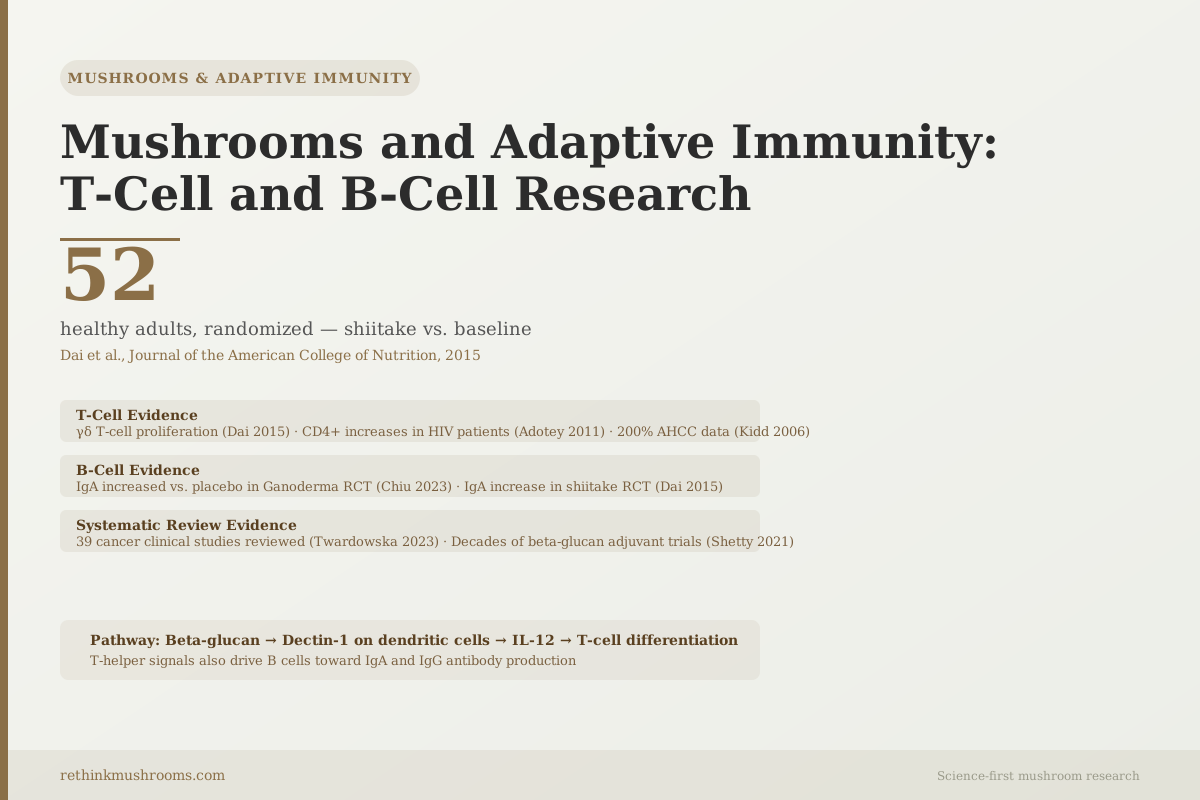
52 healthy adults, randomized
A 4-week randomized controlled trial found that healthy adults eating 5–10g of dried shiitake daily showed measurable increases in T-cell proliferation, NK cell activity, and serum IgA, alongside reductions in CRP.
Dai et al., Journal of the American College of Nutrition, 2015
CD4+ T cells increased
in HIV patients supplementing with a 7-mushroom blend (Adotey et al., International Journal of Medicinal Mushrooms, 2011)
up to 200%
T-cell number increase reported with AHCC shiitake mycelium extract in Japanese human studies (Kidd, Nutrition and Cancer, 2006)
IgA increased significantly
versus placebo in a randomized controlled trial of Ganoderma lucidum beta-glucan in healthy volunteers (Chiu et al., Foods, 2023)
Dai et al., Journal of the American College of Nutrition, 2015
 View as image ↗
A 2015 randomized controlled trial enrolled 52 healthy adults, fed them dried shiitake mushrooms for four weeks, and then measured their adaptive immune cells. What changed: T-cell proliferation increased, NK cell activity improved, and B-cell-produced IgA, an antibody type that protects mucosal surfaces, rose significantly. Medicinal mushrooms measurably shifted adaptive immunity in healthy people eating ordinary food, not a concentrated extract. That trial, conducted by Dai and colleagues and published in the Journal of the American College of Nutrition, remains one of the most carefully designed clinical studies of how mushrooms affect T cells and B cells in a non-patient population.[1] This article covers the full adaptive immunity research record, from mechanism to human clinical data. For the complete framework of how mushroom beta-glucans interact with the immune system, see mushroom beta-glucans and immunity: the complete guide.
Key Takeaways
- A 4-week randomized controlled trial of dried shiitake in 52 healthy adults showed significant increases in gamma-delta T-cell proliferation, NK cell activity, and serum IgA, alongside reduced CRP (Dai et al., 2015)
- HIV patients supplementing with a 7-mushroom blend showed measurable increases in CD4+ T-lymphocyte counts, one of the few direct clinical measures of T-cell subtype changes from mushroom supplementation (Adotey et al., 2011)
- AHCC, a shiitake mycelium extract, was reported to increase T-cell numbers by up to 200% in Japanese human studies; the magnitude needs replication but the direction is consistent with other data (Kidd, 2006)
- Turkey tail (Trametes versicolor) in a Phase I clinical trial showed improved NK cell activity and lymphocyte counts at doses up to 9g/day in breast cancer patients (Torkelson et al., 2012)
- A 2023 RCT found that Ganoderma lucidum beta-glucan produced a statistically significant increase in serum IgA versus placebo in healthy volunteers (Chiu et al., Foods, 2023)
- Systematic reviews of clinical trials using fungal beta-glucans as cancer adjuvants document consistent effects on lymphocyte counts, T-cell subsets, NK cell activity, and cytokine profiles across multiple decades of research (Shetty et al., 2021; Twardowska et al., 2023)
What Adaptive Immunity Is and Why Mushroom Research Focuses on It
The immune system has two broad operating modes. The innate system reacts immediately and non-specifically to any perceived threat. The adaptive system takes longer to respond but is highly specific, remembers past threats, and is capable of targeted attacks against particular pathogens or abnormal cells.
Adaptive immunity runs on two cell types: T cells and B cells, both of which originate in bone marrow but mature differently and take on distinct roles.
T cells are the system's cellular operators. After maturing in the thymus (hence the name), they specialize into several functional types. Helper T cells (CD4+) coordinate other immune cells. Cytotoxic T cells (CD8+) kill infected cells and tumor cells directly. Gamma-delta T cells patrol mucosal surfaces and respond to broad signals from damaged or infected tissue without needing prior sensitization. These functions collectively constitute cellular immunity.
B cells produce antibodies. After being activated by T-helper cell signals, B cells mature into plasma cells and begin manufacturing immunoglobulins: IgA, IgG, IgM, IgE, and IgD. Each class serves a different purpose. IgA is secreted at mucosal surfaces (gut lining, respiratory tract) and is the primary antibody defense at the points where pathogens first enter the body. IgG is the most abundant antibody in blood and the primary antibody of systemic immune memory. This function is called humoral immunity.
Mushroom research has measured effects on both branches. The Borchers 2008 foundational immunobiology review documented T-cell activation, NK cell stimulation, macrophage activation, and cytokine modulation across multiple mushroom species and confirmed that both cellular and humoral immunity arms showed responses in animal and human studies.[2] A 2005 landmark review by Lull and colleagues on fungal metabolites established that polysaccharides, proteins, and lipid compounds from mushrooms could modulate lymphocytes (the category encompassing both T and B cells) as well as macrophages.[3]
The Shiitake RCT: The Cleanest Clinical Evidence in Healthy People
Most of the adaptive immunity research on mushrooms comes from two contexts: laboratory work (cell culture and animal models) and cancer patient clinical trials. The Dai 2015 trial is notable precisely because it belongs to neither category.
Dai and colleagues enrolled 52 healthy adults between 21 and 41 years old and randomly assigned them to eat either 5 or 10 grams of dried shiitake mushrooms daily for four consecutive weeks.[1] No supplements, no extracts. The shiitake came from a single commercial source and was standardized for beta-glucan content. Blood draws and ex vivo immune cell testing were done before and after the intervention period.
Results at four weeks:
- Gamma-delta T-cell proliferation increased significantly
- NK cell activity increased significantly
- Serum IgA, the mucosal antibody class, increased significantly
- CRP, a systemic inflammation marker, decreased
The significance of this trial is its design: randomized, controlled (both dose groups were compared to baseline), using whole food at dietary-plausible amounts, in healthy people with normal baseline immune function. The effects appeared across both T cells and B cells in the same intervention, making it the broadest single-study evidence base for mushroom effects on adaptive immunity in non-clinical populations.
The IgA finding in particular matters because serum IgA reflects the health of the mucosal immune layer, the body's first-contact defense against respiratory and gastrointestinal pathogens. An increase in serum IgA from dietary mushroom consumption, measured in a randomized trial, is a clinically meaningful finding.
The gamma-delta T-cell increase connects to the turkey tail research: Torkelson and colleagues documented in 2013 that turkey tail PSK (polysaccharide K) specifically activates this T-cell type in vitro, and that these cells can kill tumor cells without prior antigen sensitization.[5] The Dai 2015 data suggests that shiitake consumption through dietary intake reaches the same T-cell population.
T-Cell Changes in Human Clinical Populations
Beyond healthy volunteers, several clinical studies have measured direct T-cell count changes from mushroom supplementation in populations with confirmed immune challenges.
The most compelling is Adotey and colleagues' 2011 study measuring CD4+ T-lymphocyte counts in HIV-positive patients taking "Immune Assist 24/7," a 7-mushroom blend supplement.[7] CD4+ cells, also called T-helper cells, are the specific immune cell population that HIV selectively targets. Their count decline defines the progression from HIV infection to AIDS. Adotey's patients showed measurable increases in CD4+ T-lymphocyte counts over the study period. In a population where CD4+ preservation is a primary clinical goal, this finding stands out as the most direct clinical evidence that mushroom supplementation can alter T-cell subtype counts in a clinically relevant population.
The AHCC data provides a different angle. AHCC is an extract of shiitake mycelium developed in Japan. Kidd's 2006 review of Japanese human studies reported AHCC increased T-cell numbers by up to 200%, increased NK cell activity, and enhanced T-helper cell function.[8] These numbers are striking, and the review notes they come largely from Japanese clinical settings with industry involvement. The magnitude should be treated cautiously, but the directional consistency with other data supports the general finding.
Turkey tail provides clinical evidence in cancer patients. Torkelson and colleagues' 2012 Phase I clinical trial enrolled women with breast cancer and dosed them up to 9 grams of Trametes versicolor mushroom per day.[6] NK cell activity and lymphocyte counts improved across dose escalation. The participants had received conventional cancer treatment and had suppressed immune function at baseline. The fact that lymphocyte counts improved in this context supports the relevance of the T-cell effects observed in healthier populations.
A 2021 systematic review by Shetty and colleagues covered clinical trials using fungal beta-glucans as adjuncts to cancer treatment since the 1980s and documented consistent effects on lymphocyte counts, T-cell subsets, NK cell activity, and cytokine profiles across the literature.[10] The consistency across decades, multiple species, and varied patient populations points toward a reliable effect rather than an artifact of any single study or population.
For the detailed mechanistic explanation of how T-cell differentiation works at the molecular level, including the Th1/Th2 balance and the role of dendritic cell-secreted IL-12, see mushroom polysaccharides and T-cell differentiation.
B-Cell Changes: The Antibody Production Evidence
The B-cell half of adaptive immunity has received less attention in the mushroom literature than T cells, partly because measuring antibody production requires more specific assays. But the evidence exists, and it is clinically meaningful.
The most direct B-cell evidence comes from a 2023 randomized controlled trial by Chiu and colleagues testing Ganoderma lucidum (reishi) beta-glucan against placebo in healthy adult volunteers.[9] The intervention was a specific beta-1,3;1,6 D-glucan fraction, not a crude extract. The primary outcome was serum immunoglobulin levels. The result: serum IgA concentration increased statistically significantly in the Ganoderma beta-glucan group versus placebo. This is the most direct, recent, and specific RCT evidence for mushroom compounds influencing B-cell-mediated antibody production.
The mechanism pathway connecting mushroom compounds to B-cell activity runs through T-helper cells: B cells generally require T-helper cell signals to differentiate into antibody-producing plasma cells. The beta-glucan-driven T-helper cell activation documented in the T-cell section above is the same upstream process that ultimately drives B cells toward antibody secretion. The Dai 2015 shiitake RCT showed both effects simultaneously, which is consistent with this pathway explanation.
The distinction between IgA and IgG matters in practical terms. IgA is secreted at mucosal surfaces and provides first-line defense at the gut, lungs, and nasal passages, where most pathogens initially attempt entry. An increase in serum IgA reflects the body's readiness to defend these surfaces. IgG is the systemic antibody of long-term immune memory, produced in abundance after conventional vaccination and natural infection. The mushroom data shows consistent IgA effects in multiple studies; IgG data is less robust. A full exploration of the antibody production evidence is in how mushrooms enhance antibody production.
What Systematic Reviews Show Across Decades of Clinical Research
The cancer adjuvant research provides the largest consolidated evidence base for mushroom effects on adaptive immunity, because oncology trials have been running immune outcome measurements on fungal beta-glucan interventions since the 1980s.
Twardowska and colleagues' 2023 systematic review covered 39 clinical studies on mushroom supplements in cancer patients, including immune outcomes: lymphocyte counts, NK cell activity, cytokine profiles, and quality of life measures.[11] The review provides the most contemporary synthesis of what the clinical evidence in oncology settings actually shows, with realistic appraisal of study quality.
The cytokine data deserves attention here. Johnson and colleagues' 2015 clinical study documented that AndoSan, an Agaricus blazei-based extract, significantly reduced IL-1beta (by 97%), TNF-alpha (by 84%), IL-17 (by 50%), and IL-2 (by 46%) in human volunteers.[12] These cytokine reductions in humans are extraordinary by supplement standards. The numbers have been validated by Hetland and colleagues' 2009 ex vivo human blood study, which also found cytokine stimulation with the same extract type, though noting important differences between ex vivo and in vivo responses, a reminder that laboratory findings don't always cleanly predict clinical outcomes.[13]
The Full Picture: What Comprehensive Reviews Conclude
Wasser's 2021 comprehensive review of mushrooms and immunity, one of the most recent broad-scope academic syntheses, covered adaptive and innate immune effects, clinical trial evidence, and mechanistic pathways across multiple mushroom species.[14] The conclusion is consistent with the individual study evidence: medicinal mushrooms produce measurable shifts in adaptive immune markers including T-cell subsets, B-cell-produced antibodies, and cytokine profiles, with the strongest evidence concentrated in turkey tail (PSK), shiitake (AHCC and whole food), and reishi (Ganoderma polysaccharides).
Patel and Goyal's 2021 review of mushroom bioactive molecules as immunotherapeutic agents covered the full chemical landscape beyond beta-glucans, including lectins and fungal immunomodulatory proteins (FIPs), and their mechanisms on T cells, B cells, and cytokine production.[4] FIPs, a class of proteins found in several mushroom species, bind directly to immunoglobulin receptors on immune cells and modulate B-cell function through a separate molecular route from polysaccharide compounds.
A 2018 randomized clinical trial evaluating immune modulation from a mushroom preparation in the International Journal of Medicinal Mushrooms provided additional human clinical trial data on immune cell changes.[15]
The honest summary: the evidence is real but almost entirely preclinical or from small clinical trials in specific populations. The mechanistic logic is well-supported. The clinical translation into healthy populations at realistic supplement doses is less well-characterized outside the Dai 2015 shiitake RCT. Larger, well-powered randomized trials in healthy populations across a range of mushroom species and doses remain the gap that the research literature acknowledges.
For the dendritic cell mechanisms that bridge innate recognition to adaptive T-cell response, see mushrooms and dendritic cell maturation. For the cytokine balance data in detail, see medicinal mushrooms and cytokine balance.
The Bottom Line
The clinical evidence for mushroom effects on adaptive immunity spans multiple decades, species, and patient populations. The most rigorous single study is Dai 2015, a randomized controlled trial showing shiitake consumption increased T-cell proliferation, NK activity, and IgA in 52 healthy adults. HIV patients, breast cancer patients, and AHCC research collectively add to the T-cell evidence base with consistent directional findings. A 2023 reishi RCT provides the most specific antibody production data. Systematic reviews of cancer adjuvant trials document consistent effects on lymphocyte counts and T-cell subsets. The evidence is substantial but primarily from small or preclinical studies; larger healthy-population trials across species and doses remain the research gap.
Frequently Asked Questions
Sources & References
- 1RTHM-00368·Dai, Xiaoshuang et al. (2015). “Consuming Lentinula edodes (Shiitake) Mushrooms Daily Improves Human Immunity: A Randomized Dietary Intervention in Healthy Young Adults..” Journal of the American College of Nutrition.Study breakdown →PubMed →↩
- 2RTHM-00242·Borchers, Andrea T et al. (2008). “The immunobiology of mushrooms..” Experimental biology and medicine (Maywood.Study breakdown →PubMed →↩
- 3RTHM-00166·Lull, Cristina et al. (2005). “Antiinflammatory and immunomodulating properties of fungal metabolites..” Mediators of inflammation.Study breakdown →PubMed →↩
- 4RTHM-01416·Patel, Dinesh K et al. (2021). “Mushroom-Derived Bioactive Molecules as Immunotherapeutic Agents: A Review..” Molecules (Basel.Study breakdown →PubMed →↩
- 5. Source details for this reference are not yet available.
- 6RTHM-00267·Torkelson, Carolyn J et al. (2012). “Phase 1 Clinical Trial of Trametes versicolor in Women with Breast Cancer..” ISRN oncology.Study breakdown →PubMed →↩
- 7RTHM-00376·Adotey, Gideon et al. (2011). “Effect of immunomodulating and antiviral agent of medicinal mushrooms (immune assist 24/7) on CD4+ T-lymphocyte counts of HIV-infected patients..” International journal of medicinal mushrooms.Study breakdown →PubMed →↩
- 8. Source details for this reference are not yet available.
- 9. Source details for this reference are not yet available.
- 10. Source details for this reference are not yet available.
- 11. Source details for this reference are not yet available.
- 12. Source details for this reference are not yet available.
- 13. Source details for this reference are not yet available.
- 14. Source details for this reference are not yet available.
- 15. Source details for this reference are not yet available.