Mushrooms & Immune Health
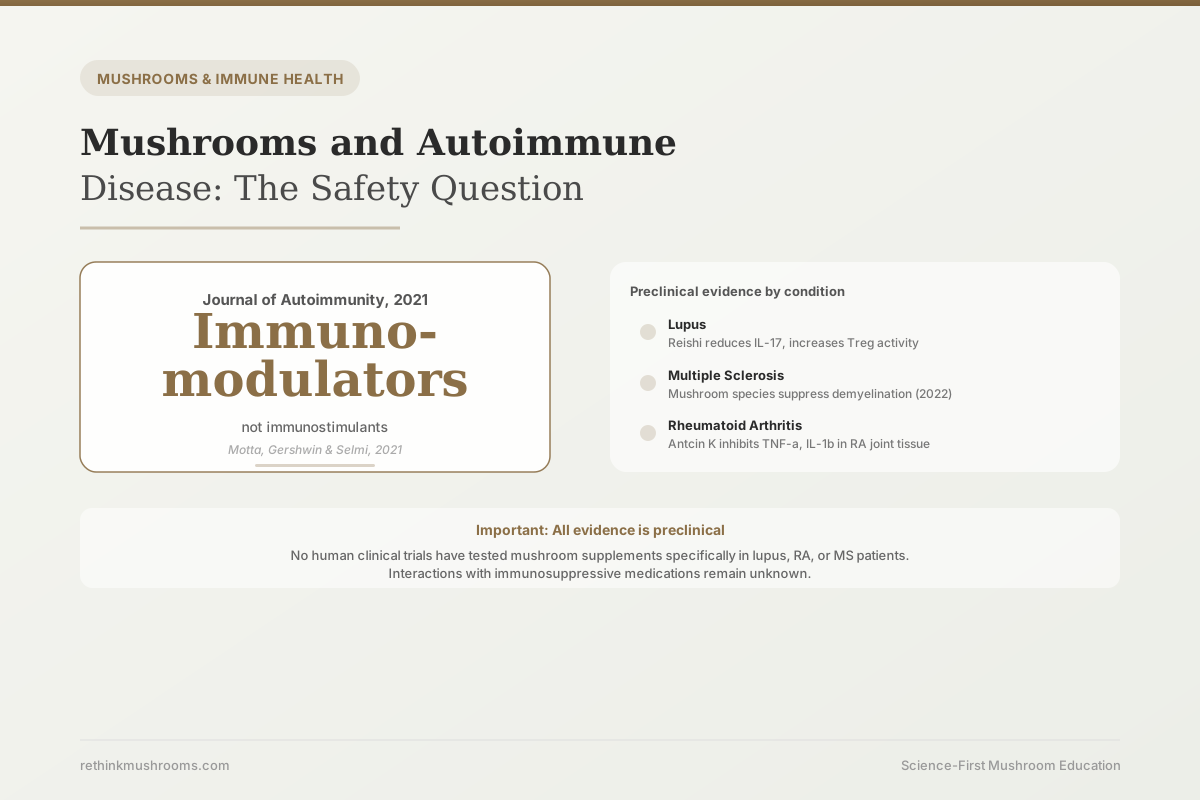
2021 Journal of Autoimmunity
A review published in the Journal of Autoimmunity, the primary scientific authority on autoimmune conditions, classified medicinal mushrooms as immunomodulators, meaning they adjust immune responses bidirectionally rather than simply amplifying them.
Motta, Gershwin & Selmi, Journal of Autoimmunity, 2021
IL-17 decreased
reishi (Ganoderma) reduced this key Th17 pro-inflammatory cytokine in lupus mouse models (Bhardwaj et al., 2014)
Demyelination suppressed
multiple medicinal mushroom species reduced demyelination in an MS mouse model (Yamashina et al., 2022)
No human trials
all autoimmune-condition-specific mushroom data is preclinical; no RCTs in lupus, RA, or MS patients exist
Motta, Gershwin & Selmi, Journal of Autoimmunity, 2021
 View as image ↗
People with autoimmune conditions are regularly told to avoid immune-stimulating supplements. The concern is logical: if your immune system is already attacking your own tissue, adding something that turns immune activity up seems like it would make things worse.
The problem is that this framing may not fit medicinal mushrooms. In 2021, a review published in the Journal of Autoimmunity, the primary scientific journal for autoimmune research, categorized medicinal mushrooms as immunomodulators, not immunostimulants.[3] The distinction matters. Immunostimulants increase immune activity uniformly. Immunomodulators adjust immune responses depending on context, including reducing certain pro-inflammatory signals that are specifically overactive in autoimmune disease.
Mushrooms and autoimmune disease is a genuine research topic with emerging preclinical evidence. It is also a topic where the data is still primarily in animal and cell models, not human trials. Both of those things are true simultaneously. This article covers what the research actually shows without overstating it.
For the broader framework on mushrooms and immune health, see Mushroom Beta-Glucans and Immunity: The Complete Research Guide.
Key Takeaways
- A 2021 review in the Journal of Autoimmunity categorized medicinal mushrooms as immunomodulators with bidirectional immune effects, not simple immune stimulants that would uniformly worsen autoimmune conditions (Motta, Gershwin & Selmi, 2021)
- Reishi (Ganoderma lucidum) decreased IL-17 and IL-18 in autoimmune-relevant models and shifted the Treg/Th17 ratio toward regulatory T-cell dominance, which is the immune direction autoimmune patients need (Bhardwaj et al., Recent Pat Inflamm Allergy Drug Discov, 2014)
- Multiple medicinal mushroom fruiting body extracts suppressed demyelination and motor dysfunction in a cuprizone-induced MS mouse model (Yamashina et al., Int J Med Mushrooms, 2022)
- A 2025 review identified multiple mechanistic pathways by which medicinal mushrooms may manage MS, including neuroprotective and anti-inflammatory effects (Pourmohammadi & Moghimi, Fitoterapia, 2025)
- The foundational framework for mushroom immune effects, established by Lull et al. (2005), shows fungal metabolites produce both anti-inflammatory AND immunomodulatory effects through the same compounds depending on the existing immune context
- No human clinical trials have tested any mushroom supplement specifically in lupus, rheumatoid arthritis, or multiple sclerosis patients; all condition-specific evidence is preclinical
The Category Error Behind the Safety Concern
The concern that autoimmune patients should avoid mushrooms typically follows this logic: mushrooms "boost immunity," boosted immunity means more immune activity, more immune activity in autoimmunity means worse disease. This chain only holds if the first premise is correct.
Lull et al. (2005) published what became a foundational review of how fungal metabolites actually interact with the immune system.[1] The central finding: fungal compounds produce both anti-inflammatory and immunomodulatory effects, and those effects are context-dependent rather than directionally fixed. The same compound class can activate immune cells against infection and suppress excessive inflammation in a different context. The review covered multiple mechanisms, including polysaccharide-mediated immune activation and triterpenoid-mediated NF-κB inhibition (NF-κB is a master switch for inflammation), demonstrating that the immune effects of fungal metabolites are bidirectional, not unilateral.
This is the mechanistic foundation for why "mushrooms boost immunity" misrepresents how they work. A compound that activates macrophages via Dectin-1 receptor binding in one context also depends on what those macrophages were doing before the compound arrived. A compound that inhibits NF-κB can calm inflammatory signaling that is running too high regardless of what triggered it.
This does not mean mushrooms are automatically safe for autoimmune patients. It means the category "immune booster to avoid" may not correctly describe what mushrooms do.
What the Journal of Autoimmunity Said in 2021
Motta, Gershwin, and Selmi published a review titled "Mushrooms and immunity" in the Journal of Autoimmunity in 2021.[3] The significance of the journal is worth noting: the Journal of Autoimmunity is the primary peer-reviewed authority on autoimmune disease research. A review of mushroom immune effects appearing there was reviewed and accepted by specialists in autoimmunity, not just mycology.
The review established the conceptual framework that mushrooms are immunomodulators with context-dependent immune effects. It covered the mechanisms by which beta-glucan receptor binding (Dectin-1 and TLR2) generates cytokine responses, the Treg induction evidence from several mushroom species, and the anti-inflammatory evidence from triterpenoid compounds. The review specifically examined implications for autoimmune conditions, acknowledging both potential benefits and the absence of human clinical trial data.
The framing Motta et al. used is precise: medicinal mushrooms can both activate underactive immune responses (relevant for infection or cancer surveillance) and suppress overactive ones (relevant for autoimmunity and inflammation). The mechanism that makes the second possible is largely the triterpenoid class, particularly compounds that inhibit NF-κB and suppress pro-inflammatory cytokine production, rather than the beta-glucan class, which is more strongly associated with immune activation.
Reishi and Lupus: What the Cytokine Data Shows
Bhardwaj et al. (2014) reviewed Ganoderma lucidum's effects on inflammatory and allergic responses with particular attention to autoimmune-relevant outcomes.[2]
The most relevant finding for lupus: reishi decreased IL-17 in lupus mouse models. IL-17 is a pro-inflammatory cytokine produced by a subset of immune cells called Th17 cells. In autoimmune conditions including lupus, systemic lupus erythematosus (SLE), and rheumatoid arthritis, the Th17/Treg balance is skewed toward Th17 dominance. More IL-17 correlates with more autoimmune tissue damage. Less IL-17, with a corresponding increase in regulatory T-cells (Tregs), correlates with disease control.
Reishi treatment in the lupus mouse models shifted this balance. IL-17 decreased. IL-18 (another inflammation amplifier relevant to lupus) also decreased. Regulatory T-cell activity increased. The immune effect was in the direction of calming autoimmune activity, not amplifying it.
Reishi also decreased IL-18 in rheumatoid arthritis patients in one cited study, demonstrating that at least some of this immune-calming activity translates to human tissue in an RA context, though this was not a formal clinical trial with defined endpoints.
These findings are in cell and mouse models, and lupus mouse models are imperfect proxies for human lupus. But the directionality of the immune effects from reishi compounds in lupus-relevant biological contexts is consistently anti-inflammatory and Treg-supporting, not Th17-promoting.
For a closer look at how mushroom polysaccharides influence T-cell differentiation broadly, see Mushroom Polysaccharides and T-Cell Differentiation: Training Adaptive Immunity.
Mushrooms and Multiple Sclerosis: The Demyelination Evidence
Multiple sclerosis involves immune-mediated destruction of myelin, the protective sheath around nerve fibers. The autoimmune component drives inflammatory attacks on oligodendrocytes (the cells that produce myelin) and on myelin itself. Protecting myelin while modulating the inflammatory attack is the goal of current MS therapies.
Yamashina et al. (2022) tested multiple medicinal mushroom fruiting body extracts in a cuprizone-induced MS mouse model.[4] The cuprizone model uses a toxic compound to destroy oligodendrocytes, producing demyelination and motor dysfunction similar to MS pathology. Multiple mushroom species (the paper covered several) suppressed demyelination and preserved motor function compared to untreated animals. This is direct evidence that mushroom compounds can interfere with the demyelination process in a controlled biological model.
Pourmohammadi and Moghimi (2025) published the most current synthesis of mushroom-MS evidence, reviewing the neuroprotective, anti-inflammatory, and immunomodulatory mechanisms by which multiple medicinal mushrooms may be relevant to MS management.[5] Their framing as a "new approach" reflects the emerging status of this research area: the evidence base is building but remains preclinical.
The honest state of the evidence: mushrooms suppress demyelination in a mouse model and the mechanisms by which they do so (anti-inflammatory, neuroprotective) are consistent with what is known about MS pathology. No human clinical trial has tested mushrooms as a treatment or adjunct for MS patients.
Where the Research Is Still Too Early to Conclude
The preclinical signals in this cluster are consistently in the direction of immune-balancing rather than immune-stimulating effects. That is a meaningful pattern across several models and compound classes. It is not sufficient to make safety or efficacy claims for human autoimmune patients.
Several important knowledge gaps remain:
No human clinical trial has tested any mushroom supplement specifically in patients with lupus, rheumatoid arthritis, or multiple sclerosis. Every finding in this article comes from animal models, cell culture experiments, or reviews of that preclinical evidence. Translating mouse immune biology to human autoimmune disease is a well-documented challenge; many compounds that show promise in animal models fail in human trials.
The interaction between mushroom supplements and immunosuppressive medications (methotrexate, hydroxychloroquine, biologics like TNF inhibitors or anti-CD20 agents) is unknown. These are the standard-of-care treatments for severe autoimmune conditions. Whether mushroom compounds affect drug metabolism, compete with drug mechanisms, or interact in other ways has not been studied.
Lupus in particular warrants caution because of the condition's heterogeneity and the severity of lupus nephritis (kidney involvement). The preclinical reishi data is promising, but the clinical stakes for lupus patients are high enough that extrapolating from mouse data to self-prescribing is a qualitatively different risk calculation.
Chaga specifically may warrant more caution than reishi or Antrodia in autoimmune contexts. Chaga has potent immune activation properties and has not been studied in autoimmune condition models in the same way reishi has. The absence of evidence of harm is not evidence of safety.
For the condition-specific research across lupus, RA, and MS, see Mushrooms for Lupus, RA, and MS: Research Across Conditions. For a cytokine-level mechanistic view of how mushrooms affect the inflammation signals central to autoimmune disease, see Medicinal Mushrooms and Cytokine Balance. For the detailed conceptual framework distinguishing immunomodulation from immunostimulation, see Immunomodulation vs. Immunostimulation: Why It Matters for Autoimmunity.
The Bottom Line
Medicinal mushrooms are classified as immunomodulators in peer-reviewed autoimmune research, producing context-dependent immune effects that in several preclinical models decrease pro-inflammatory cytokines like IL-17 rather than amplifying them. A 2021 review in the Journal of Autoimmunity established this framework, and animal studies on reishi (lupus mouse models), Antrodia (lupus nephritis), and multiple mushroom species (MS demyelination model) provide specific mechanistic and outcome data. All evidence is preclinical. No human clinical trial has tested mushroom supplements specifically in patients with lupus, RA, or MS, and interactions with immunosuppressive medications remain unknown. The direction of the evidence is cautiously encouraging, but the evidence base is not yet sufficient to guide clinical decisions in autoimmune patients without physician oversight.
Frequently Asked Questions
Sources & References
- 1RTHM-00166·Lull, Cristina et al. (2005). “Antiinflammatory and immunomodulating properties of fungal metabolites..” Mediators of inflammation.Study breakdown →PubMed →↩
- 2RTHM-00578·Bhardwaj, Neha et al. (2014). “Suppression of inflammatory and allergic responses by pharmacologically potent fungus Ganoderma lucidum..” Recent patents on inflammation & allergy drug discovery.Study breakdown →PubMed →↩
- 3RTHM-00709·Motta, Francesca et al. (2021). “Mushrooms and immunity..” Journal of autoimmunity.Study breakdown →PubMed →↩
- 4RTHM-01637·Yamashina, Kota et al. (2022). “Suppressive Effect of Fruiting Bodies of Medicinal Mushrooms on Demyelination and Motor Dysfunction in a Cuprizone-Induced Multiple Sclerosis Mouse Model..” International journal of medicinal mushrooms.Study breakdown →PubMed →↩
- 5RTHM-02163·Pourmohammadi, Golchehr et al. (2025). “New approach of using medicinal mushrooms for managing and curing multiple sclerosis..” Fitoterapia.Study breakdown →PubMed →↩