Mushrooms & Autoimmune Disease
IL-17: reduced by reishi in lupus models, not increased
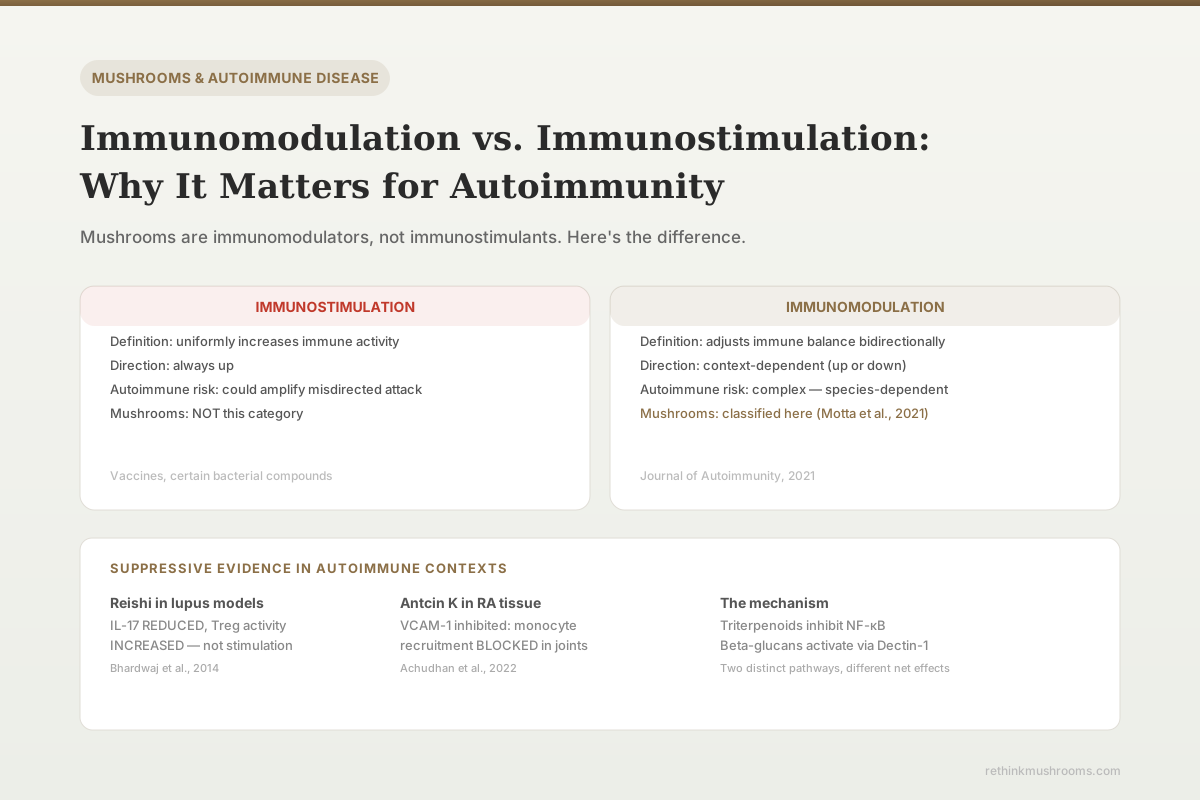
Reishi (Ganoderma lucidum) decreased IL-17 and shifted the Treg/Th17 ratio toward regulatory immune balance in lupus mouse models. This is an immune-suppressing effect in an autoimmune context, not immune stimulation; it's the evidence behind why researchers classify mushrooms as immunomodulators rather than immunostimulants.
Bhardwaj et al., Recent Patents Inflammation & Allergy Drug Discovery, 2014
Immunomodulator
the classification assigned to medicinal mushrooms in a 2021 Journal of Autoimmunity review (the primary autoimmunity science journal) by Motta, Gershwin, and Selmi, based on their context-dependent, bidirectional immune effects
Bidirectional
the property that allows the same mushroom compound to activate an underactive immune response or suppress an overactive one depending on the existing immune state; this is the mechanism underlying the immunomodulator classification
VCAM-1 inhibited
Antcin K, a triterpenoid from Antrodia cinnamomea, blocked monocyte adhesion to RA synovial tissue by inhibiting VCAM-1, a specific immune-suppressing effect in joint inflammation, not a stimulating one (Achudhan et al., 2022)
Bhardwaj et al., Recent Patents Inflammation & Allergy Drug Discovery, 2014
 View as image ↗
The most common concern about medicinal mushrooms and autoimmune disease is straightforward: if mushrooms stimulate the immune system, and autoimmune disease is caused by an overactive immune system, then mushrooms could make autoimmune conditions worse. This reasoning is intuitive and widely repeated.
It rests on a category error.
Medicinal mushrooms are not immunostimulants. The research classifies them as immunomodulators, a functionally distinct category with a different relationship to the immune system. The difference between these two classifications is precisely what determines whether the concern about autoimmunity is justified, overstated, or more nuanced than a yes/no answer can capture.
For the pillar overview of beta-glucan immune research, see mushroom beta-glucans and immunity: the complete research guide.
Key Takeaways
- Immunostimulation pushes immune activity up uniformly; immunomodulation adjusts immune responses bidirectionally toward appropriate balance; these are distinct mechanisms with different implications for autoimmune conditions
- Medicinal mushrooms are classified as immunomodulators, not immunostimulants, in a 2021 review published in Journal of Autoimmunity (the primary scientific journal for autoimmune research) by Motta, Gershwin, and Selmi; their mechanisms include beta-glucan receptor binding, cytokine modulation, and regulatory T cell induction
- The foundational framework for bidirectional fungal immune effects was established by Lull and colleagues in 2005: fungal metabolites produce both anti-inflammatory AND immunomodulatory effects depending on context, not uniformly pro-immune responses (Lull et al., Mediators Inflamm, 2005)
- Reishi (Ganoderma lucidum) decreased IL-17 (the cytokine most associated with autoimmune flares) and shifted the Treg/Th17 ratio toward regulatory balance in lupus mouse models; this is immune suppression in an autoimmune context, not stimulation (Bhardwaj et al., 2014)
- Antcin K (from Antrodia cinnamomea) inhibited VCAM-1-dependent monocyte adhesion in human RA synovial fibroblasts, a specific immune cell recruitment suppression in joint inflammation, not a systemic immune boost (Achudhan et al., Food Nutr Res, 2022)
- The immunomodulator classification does not mean mushrooms are risk-free for autoimmune patients: different species lean different directions (reishi and Antrodia toward immune regulation; some others toward activation), and no human clinical trial has established safety for any mushroom supplement in any autoimmune condition
What Immunostimulation Means, and Why the Concern Is Reasonable
Immunostimulation is a straightforward concept: it means increasing immune system activity. Vaccines are immunostimulants. Some infectious disease treatments are immunostimulants. Certain compounds derived from bacteria reliably push the immune system into a more active state.
The concern about immunostimulation in autoimmune disease is grounded in a real problem. Autoimmune conditions (rheumatoid arthritis, lupus, multiple sclerosis, and others) involve an immune system that has misidentified the body's own tissues as threats and is attacking them. Anything that broadly increases immune activity might, in theory, increase the intensity of that misdirected attack.
This is why people with autoimmune conditions are often advised to be cautious about supplements marketed as "immune-boosting." The concern is logically coherent and not dismissible as excessive caution.
The question is whether medicinal mushrooms, when studied as actual compounds in cell and animal research, behave like immunostimulants. The research says they do not.
What Immunomodulation Means: Bidirectional Adjustment
Immunomodulation is a more complex concept than immunostimulation. An immunomodulator does not simply push the immune system up or down. It adjusts immune responses toward appropriate function, with the direction of adjustment depending on the existing immune state.
In a practical sense: the same compound that activates NK cells and macrophages in a person with an underactive immune response might suppress pro-inflammatory cytokines in a person with an overactive autoimmune response.
This bidirectional capacity is not theoretical. Lull and colleagues documented it in a 2005 review of fungal metabolites and their immune effects, establishing the framework that has organized subsequent research: fungal compounds produce both anti-inflammatory and immune-activating effects depending on the immunological context, not uniform pro-immune stimulation.[1]
The mechanism underlying this bidirectionality involves two distinct molecular pathways that mushroom compounds can activate:
The activation pathway: Beta-glucans bind to Dectin-1 and TLR2 receptors on immune cells, triggering the innate immune cascade. This is the pathway responsible for the immune-activating effects documented in infection and cancer research.
The suppression pathway: Triterpenoids (particularly in reishi and Antrodia species) inhibit NF-κB signaling. NF-κB is a master transcription factor for inflammatory and immune gene expression. Inhibiting NF-κB reduces pro-inflammatory cytokine production, including the cytokines most relevant to autoimmune pathology.
These two pathways coexist in mushrooms that contain both polysaccharides and triterpenoids. Which pathway dominates in a given context depends on the specific compound, the concentration, the tissue type, and the existing immune state.
What the Journal of Autoimmunity Concluded
The most authoritative available source for how the scientific establishment views mushrooms in autoimmune contexts is a 2021 review published in Journal of Autoimmunity by Motta, Gershwin, and Selmi.[2]
Journal of Autoimmunity is the primary peer-reviewed journal for autoimmune disease research. A paper appearing in this journal on the subject of mushrooms and immunity was reviewed by autoimmunity specialists before publication, not by general immunologists.
The review's conclusions: medicinal mushrooms function as immunomodulators with context-dependent, bidirectional immune effects. The mechanisms they documented include beta-glucan receptor activation of dendritic cells and macrophages (activation pathway), cytokine profile modulation (including reductions in pro-inflammatory cytokines relevant to autoimmunity), and induction of regulatory T cells (Tregs, the immune cells that suppress autoimmune activity).
Treg induction is particularly significant. Regulatory T cells are deficient in many autoimmune conditions. A treatment that induces more Tregs is not stimulating the immune system broadly; it is increasing the specific immune cell population whose job is to suppress excessive immune activity.
The Motta 2021 review does not conclude that mushrooms are safe for autoimmune patients or that they should be recommended. It concludes that the immunostimulant categorization is incorrect and that the evidence shows context-dependent regulation rather than uniform activation. This is a scientifically meaningful distinction, even if it does not resolve all clinical questions.
The Evidence for Immune Suppression in Autoimmune Contexts
The most direct evidence that some mushroom compounds suppress rather than stimulate immunity in autoimmune tissue comes from two research lines.
Reishi and the Treg/Th17 axis in lupus. In lupus mouse models, Ganoderma lucidum (reishi) decreased IL-17 production and shifted the balance between Th17 cells (pro-inflammatory, elevated in lupus) and regulatory T cells (Treg, suppressive) toward the regulatory side.[3] IL-17 is one of the primary cytokines driving autoimmune tissue damage, particularly in lupus nephritis (kidney involvement). A compound that reduces IL-17 in a lupus model is acting as an immune suppressant in that context, not an immune activator.
Antcin K and monocyte recruitment in RA. Achudhan and colleagues demonstrated in 2022 that Antcin K (a triterpenoid from Antrodia cinnamomea) inhibited VCAM-1-dependent monocyte adhesion in human rheumatoid arthritis synovial fibroblasts.[4] VCAM-1 (vascular cell adhesion molecule 1) is the surface protein that immune cells attach to before entering inflamed joint tissue. Blocking VCAM-1 reduces immune cell infiltration into joints, a mechanism of immune cell traffic suppression in the tissue most affected by RA.
Both examples show specific immune-suppressing effects in autoimmune-relevant contexts, not the uniform immune amplification that the immunostimulant concern predicts.
For the full condition-specific evidence on RA, lupus, and multiple sclerosis, see mushrooms for lupus, RA, and MS: research across conditions.
The Critical Nuance: Not All Mushrooms Lean the Same Direction
The immunomodulator classification describes medicinal mushrooms as a category. Individual species differ in how they express that bidirectionality.
The ratio of polysaccharides (beta-glucans, which drive the activation pathway) to triterpenoids (which drive the suppression pathway) varies considerably between species. Species with high triterpenoid content (reishi and Antrodia cinnamomea being the clearest examples) lean more toward the immune-regulatory and anti-inflammatory direction. These are the species with the most direct evidence for immune-suppressing effects in autoimmune-relevant contexts.
Species with high polysaccharide content and low triterpenoid content lean more toward immune activation. Turkey tail (Trametes versicolor) and its PSK compound, for example, have extensive evidence for NK cell activation and anti-cancer immune activity. This activating profile may be appropriate in cancer or infection contexts and less appropriate for autoimmune conditions where immune activation is already excessive.
Chaga (Inonotus obliquus) has potent immune-stimulating activity well documented in cell studies and animal models. It has the least direct evidence for immune-balancing effects in autoimmune contexts.
The clinical implication is that "medicinal mushrooms" is not a uniform category for autoimmune purposes, even within the immunomodulator classification. The species matters.
For how different mushrooms affect cytokine profiles across immune conditions, see medicinal mushrooms and cytokine balance. For the T-cell differentiation mechanism behind Treg induction, see mushroom polysaccharides and T-cell differentiation: training adaptive immunity.
What the Immunomodulator Classification Does Not Resolve
Being an immunomodulator rather than an immunostimulant is necessary but not sufficient for safety in autoimmune conditions.
No human clinical trial has tested any mushroom supplement for safety or efficacy in any autoimmune condition. The evidence described in this article and across this cluster is entirely preclinical (cell culture and animal models). The jump from animal model data to human clinical outcomes is substantial and frequently unreliable.
The potential for interaction between mushroom compounds and immunosuppressive medications (methotrexate, hydroxychloroquine, biologic therapies like TNF inhibitors) is unknown. Mushroom compounds that shift the Th17/Treg balance may theoretically interact with medications targeting the same pathways.
The immunomodulator classification is meaningful for understanding why the blanket concern about autoimmunity is not well-supported mechanistically. It is not a clinical safety clearance. For the condition-specific safety considerations, see the safety of mushroom supplements for autoimmune patients and mushrooms and autoimmune disease: can they help without overstimulating?.
For the mechanistic explanation of how the dual activation/suppression capacity operates at the cellular level, see mushrooms for autoimmune disease: when immune stimulation becomes immune balancing.
The Bottom Line
Medicinal mushrooms are immunomodulators, not immunostimulants: they adjust immune responses bidirectionally depending on context rather than uniformly pushing immunity upward. A 2021 Journal of Autoimmunity review classified them in this category based on mechanisms including beta-glucan receptor activation, cytokine modulation, and Treg induction (Motta et al., 2021). The foundational bidirectional framework was established in 2005 (Lull et al., 2005). Reishi decreases IL-17 and shifts Treg/Th17 balance toward regulation in lupus models (Bhardwaj et al., 2014), and Antcin K suppresses VCAM-1-dependent monocyte recruitment in RA synovial tissue (Achudhan et al., 2022). Species with higher triterpenoid content (reishi, Antrodia) lean toward immune regulation; those with predominantly polysaccharide activity lean toward activation. No human clinical trials exist for any mushroom in any autoimmune condition.
Frequently Asked Questions
Sources & References
- 1RTHM-00166·Lull, Cristina et al. (2005). “Antiinflammatory and immunomodulating properties of fungal metabolites..” Mediators of inflammation.Study breakdown →PubMed →↩
- 2RTHM-00709·Motta, Francesca et al. (2021). “Mushrooms and immunity..” Journal of autoimmunity.Study breakdown →PubMed →↩
- 3RTHM-00578·Bhardwaj, Neha et al. (2014). “Suppression of inflammatory and allergic responses by pharmacologically potent fungus Ganoderma lucidum..” Recent patents on inflammation & allergy drug discovery.Study breakdown →PubMed →↩
- 4RTHM-00738·Achudhan, David et al. (2022). “Antcin K inhibits VCAM-1-dependent monocyte adhesion in human rheumatoid arthritis synovial fibroblasts..” Food & nutrition research.Study breakdown →PubMed →↩