Mushrooms & Autoimmune Disease
2 pathways
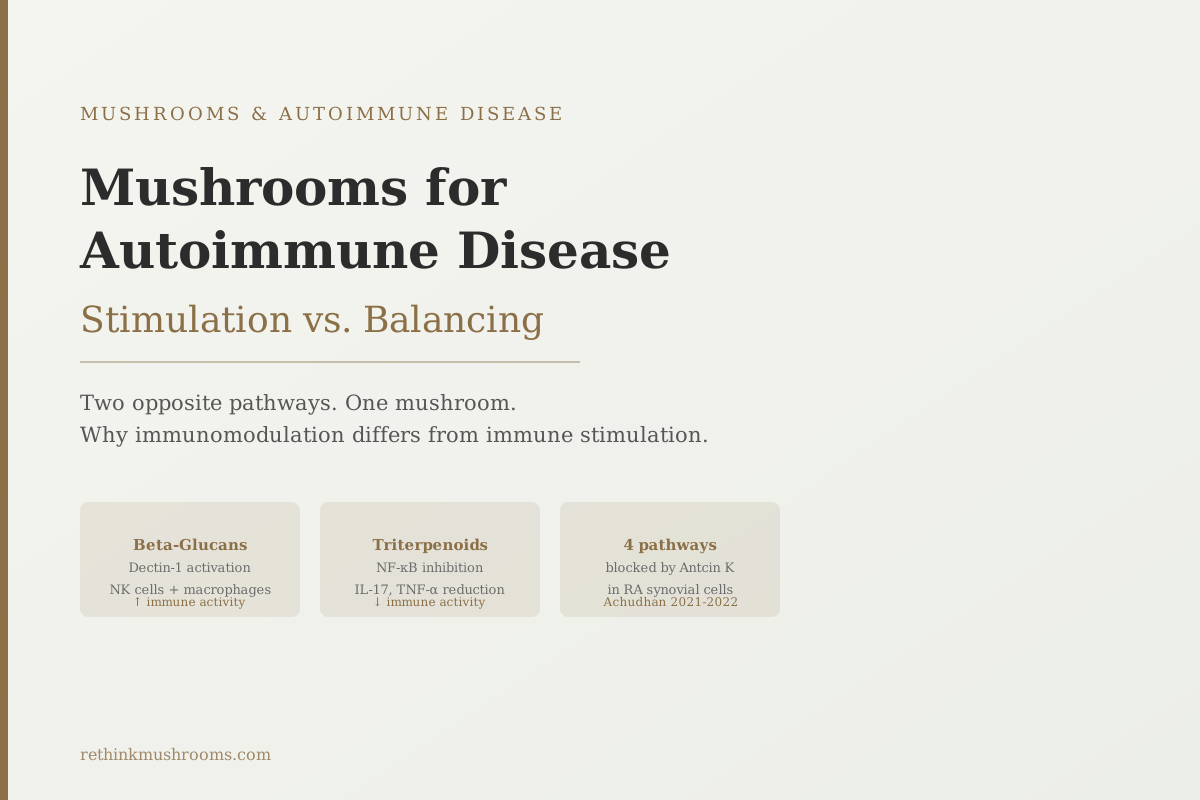
Medicinal mushrooms contain two classes of compounds with opposite immune effects: beta-glucans activate via Dectin-1, while triterpenoids suppress inflammation by blocking NF-κB — the master regulator of inflammatory gene expression.
Motta, Gershwin & Selmi, J Autoimmun, 2021; Lull et al., Mediators Inflamm, 2005
Journal of Autoimmunity
peer-reviewed classification of mushrooms as immunomodulators, not immunostimulants (Motta 2021)
4 pathways
distinct RA inflammation mechanisms blocked by Antcin K from Antrodia cinnamomea in cell studies (Achudhan 2021-2022)
Preclinical only
no human clinical trial has tested any mushroom preparation specifically for autoimmune disease management
Motta, Gershwin & Selmi, J Autoimmun, 2021; Lull et al., Mediators Inflamm, 2005
 View as image ↗
People with autoimmune conditions face a genuine dilemma when considering medicinal mushrooms. Almost everything written about them describes them as "immune boosters." For someone whose immune system is already attacking their own tissue, in rheumatoid arthritis, lupus, or multiple sclerosis, the idea of stimulating immune activity sounds dangerous. But this framing misunderstands how mushrooms and autoimmune immune stimulation balancing actually work in the body. The right question is not whether to boost immunity but whether specific mushroom compounds stimulate or balance it, and the answer depends on which molecular pathway is involved.
A 2021 review published in the Journal of Autoimmunity, the field's primary authority publication, classified medicinal mushrooms as immunomodulators rather than immunostimulants.[1] The distinction is not semantic. Immunostimulants push immune activity uniformly upward. Immunomodulators adjust immune responses in a context-dependent, bidirectional way — meaning the same class of compounds that activates an underactive immune system against infection can also suppress an overactive one in autoimmune disease.
This article covers the two molecular pathways behind that bidirectionality and the specific evidence for immune-suppressing effects in autoimmune contexts. For the complete overview of how mushrooms affect immunity at the molecular level, see the complete research guide to mushroom beta-glucans and immunity. For the conceptual distinction between immunomodulation and immunostimulation in more depth, see immunomodulation vs. immunostimulation: why it matters for autoimmunity.
Key Takeaways
- Motta, Gershwin, and Selmi (2021) in the Journal of Autoimmunity classify medicinal mushrooms as immunomodulators (bidirectional, context-dependent) rather than immunostimulants (uniformly activating) — the most authoritative categorization in autoimmunity research
- Mushrooms work through two opposite pathways: beta-glucans activate immune cells via Dectin-1 receptors, while triterpenoids suppress inflammation by blocking NF-κB, the master switch for inflammatory gene expression — the same mushroom can do both
- Bhardwaj et al. (2014) documented that Ganoderma lucidum (Reishi) decreased IL-18 in RA patients and shifted the Treg/Th17 ratio in lupus mouse models toward regulation, reducing IL-17 while increasing regulatory T cell activity
- Achudhan et al. (2021) in Frontiers in Immunology found that Antcin K, a triterpenoid from Antrodia cinnamomea, inhibited three key RA cytokines simultaneously: TNF-α, IL-1β, and IL-8 in RA synovial fibroblasts
- A 2022 follow-up (Achudhan et al.) found Antcin K also blocked VCAM-1, the adhesion molecule that recruits inflammatory immune cells into joint tissue — a fourth distinct anti-RA mechanism from the same compound
- Species with higher triterpenoid content (reishi, Antrodia) lean toward immunosuppression; species with higher polysaccharide content (turkey tail, lion's mane) lean toward immune activation; no human clinical trial has confirmed either effect in autoimmune patients
Why "Immune Boosting" Is the Wrong Frame for Autoimmune Patients
The phrase "boosts immunity" implies a single dial that mushrooms turn upward. If that were accurate, the concern about mushrooms and autoimmunity would be straightforward: more immune activity in someone whose immune system is attacking their own tissue would mean more damage.
But immunity is not a single dial. It's a network of competing signals. Regulatory T cells, called Tregs, constantly suppress immune overactivation. Th17 cells drive pro-inflammatory responses and are elevated in most autoimmune conditions. NK cells patrol for pathogens. Cytokines like TNF-α and IL-17 push inflammation; cytokines like IL-10 and TGF-β pull it back.
What Lull et al. (2005) established in a foundational review in Mediators of Inflammation is that fungal metabolites — including mushroom polysaccharides and triterpenoids — produce both pro-inflammatory and anti-inflammatory effects depending on context.[2] This isn't a weakness in the evidence. It is the actual biology: the same compounds behave differently in different immune environments.
The concern for autoimmune patients, then, is not about mushrooms uniformly amplifying the immune system. It's about whether specific compounds shift the relevant immune signals — Th17 vs. Treg, TNF-α vs. IL-10, IL-17 vs. regulatory cytokines — in the right or wrong direction for the individual condition. The answer varies by compound and by condition, and the evidence is more specific than most consumer content acknowledges.
Two Pathways: How the Same Mushroom Can Activate and Suppress
Medicinal mushrooms contain two major classes of bioactive compounds, and they work through mechanisms with opposite immune effects.
Beta-glucans via Dectin-1 activation. Beta-glucans are long-chain carbohydrate molecules that make up much of a mushroom's cell wall. They bind to a receptor on immune cells called Dectin-1. When Dectin-1 is triggered, it signals macrophages (cells that engulf pathogens) and NK cells (natural killer cells that patrol for abnormal cells) to become more active. This is the pathway that produces what people call immune stimulation. It's real, it's well-characterized, and it's why beta-glucan supplements are studied for infection resistance and vaccine response enhancement.
Triterpenoids via NF-κB inhibition. Many mushrooms, particularly Ganoderma lucidum (Reishi) and Antrodia species, are rich in triterpenoids: fat-soluble compounds structurally similar to plant steroids. Triterpenoids inhibit NF-κB, which is shorthand for nuclear factor kappa-light-chain-enhancer of activated B cells. NF-κB is a master regulatory protein that controls expression of dozens of inflammatory genes. When NF-κB is blocked, production of pro-inflammatory cytokines — including TNF-α, IL-1β, IL-6, and IL-17 — decreases. This is immune suppression via a specific molecular target, not activation.
Motta, Gershwin, and Selmi (2021) synthesized both pathways in the Journal of Autoimmunity and concluded that the net effect of most medicinal mushrooms is immunomodulatory rather than immunostimulatory: context-dependent, and bidirectional.[1] In someone with an underactive immune state, the Dectin-1 activation pathway dominates. In someone with pathologically overactive inflammation, triterpenoid-rich preparations may shift the balance toward suppression.
This is the mechanistic basis for the claim that mushrooms balance rather than simply boost immunity. For how the Th17 vs. Treg balance shifts with different mushroom preparations, see mushroom polysaccharides and T-cell differentiation. For how beta-glucans reprogram innate immune memory over time, see mushrooms and trained immunity.
Reishi: The Evidence for Immune Balancing, Not Just Immune Boosting
Ganoderma lucidum (Reishi) has more autoimmune-relevant clinical and preclinical data than any other commonly used medicinal mushroom, and the direction of that data is consistently immunosuppressive in autoimmune contexts.
Bhardwaj et al. (2014) reviewed the pharmacological evidence on Ganoderma in inflammatory and autoimmune conditions.[3] Two findings are most directly relevant:
In RA patients: Ganoderma extract decreased IL-18 levels. IL-18 is an interleukin — a type of immune signaling protein — that amplifies existing inflammatory responses by making other inflammatory signals louder. Reducing IL-18 dampens the inflammatory cascade without broadly suppressing immune function. This finding came from clinical studies of RA patients, not animal models.
In lupus mouse models: Reishi shifted the balance between two competing types of immune cells. Th17 cells are the pro-inflammatory drivers that are pathologically elevated in lupus. Regulatory T cells, or Tregs, are the immune cells that suppress excessive immune activity and maintain the body's ability to tolerate its own tissues. Reishi treatment increased Treg activity and decreased Th17 activity, with concurrent reductions in IL-17 (the primary Th17 signaling cytokine) and increases in IL-2 and IL-12. This is immune regulation: shifting the ratio of cells that attack toward cells that restrain.
The mechanism is the triterpenoid content. Reishi is among the most triterpene-dense mushrooms in regular use. Its ganoderic acids are among the best-characterized natural NF-κB inhibitors in the pharmacological literature. Where beta-glucans would activate, ganoderic acids suppress the same inflammatory gene expression programs that drive autoimmune tissue damage.
For how cytokine profiles shift with different mushroom preparations in inflammatory conditions, see medicinal mushrooms and cytokine balance.
Antcin K: A Compound That Blocks Four RA Pathways at Once
Antrodia cinnamomea is a mushroom native to Taiwan with a particularly high triterpenoid concentration. Antcin K is one of its primary active compounds, and between 2021 and 2022, Achudhan and colleagues published three papers documenting how it acts specifically in rheumatoid arthritis tissue.
Cytokine inhibition. Achudhan et al. (2021) in Frontiers in Immunology tested Antcin K in human RA synovial fibroblasts, the cells that line the inner surface of joints and are central to driving the inflammatory destruction in RA.[4] Antcin K inhibited production of three inflammatory cytokines simultaneously:
- TNF-α (tumor necrosis factor alpha): the primary driver of joint inflammation in RA, and the target of biologic drugs like adalimumab and etanercept
- IL-1β (interleukin-1 beta): a signaling protein that activates cartilage-degrading enzymes
- IL-8: recruits additional inflammatory immune cells to the joint tissue
These are three of the most clinically significant cytokines in RA pathology. Inhibiting all three from a single compound suggests action at an upstream regulatory point, consistent with NF-κB inhibition rather than cytokine-specific targeting.
Cell recruitment blockade. Achudhan et al. (2022) in Food and Nutrition Research found that Antcin K also inhibited VCAM-1, or vascular cell adhesion molecule 1.[5] VCAM-1 is a protein that sits on the inner surface of blood vessel walls inside joint tissue. When VCAM-1 is activated, circulating monocytes (inflammatory immune cells) dock onto it, cross the vessel wall, and enter joint tissue, where they become macrophages and amplify inflammation. Blocking VCAM-1 reduces immune cell infiltration into the joint before cytokines even have a chance to amplify.
This is a fourth distinct anti-RA mechanism from the same compound, operating upstream of cytokine production rather than alongside it.
Both the 2021 and 2022 studies are in vitro — isolated human cells in culture, not animal models or clinical trials. The distance between cell culture results and clinical efficacy in RA patients is significant. No Antcin K clinical trial exists for RA or any other autoimmune condition. The mechanistic specificity is striking, but it does not translate directly to confirmed clinical benefit.
Species Profiles: Which Mushrooms Lean Toward Suppression vs. Activation
Based on current mechanistic evidence, medicinal mushrooms can be loosely grouped by which molecular pathway predominates:
Higher immunosuppressive activity (via triterpenoid-NF-κB inhibition, Treg induction):
- Reishi (Ganoderma lucidum): most triterpene-dense common mushroom; direct evidence for Treg induction, IL-17 suppression, and IL-18 reduction in autoimmune-relevant contexts
- Antrodia cinnamomea: highest Antcin K concentration; four distinct RA anti-inflammatory mechanisms in cell studies
Higher immune-activating activity (via polysaccharide-Dectin-1 pathway):
- Lion's Mane (Hericium erinaceus): polysaccharide-dominant profile; strong NK cell and macrophage activation
- Turkey Tail (Trametes versicolor): PSK and PSP compounds are potent Dectin-1 activators; primary clinical use is immune restoration after cancer treatment
This framework describes relative tendencies, not absolute categories. Most mushrooms contain both beta-glucans and triterpenoids. The ratio varies by species, by part of the mushroom used (fruiting body vs. mycelium), by extraction method (water vs. ethanol), and by the standardized concentration of the final preparation.
The honest caveat. No randomized controlled trial has tested any mushroom preparation specifically for the management of any autoimmune condition in humans. The classification of mushrooms as immunomodulators rather than immunostimulants is supported by mechanism and animal data, but the clinical translation is not established. For condition-specific preclinical research on lupus, RA, and MS, see mushrooms for lupus, RA, and MS. For safety considerations relevant to autoimmune patients, see the safety of mushroom supplements for autoimmune patients. For the broader question of whether mushrooms can support autoimmune patients without triggering flares, see mushrooms and autoimmune disease.
The Bottom Line
The concern that mushrooms worsen autoimmunity because they "boost immunity" is based on a categorization error. Mushrooms are immunomodulators, not immunostimulants. Two opposite molecular pathways coexist in most species: beta-glucans activate immune cells via Dectin-1; triterpenoids suppress inflammatory gene expression by blocking NF-κB. Reishi shows direct evidence for Treg induction and IL-17 suppression in autoimmune animal models. Antcin K from Antrodia cinnamomea blocks four distinct RA inflammation mechanisms in cell studies. Species lean differently based on their triterpenoid-to-polysaccharide ratio. No human trial has confirmed any of this in autoimmune patients.
Frequently Asked Questions
Sources & References
- 1RTHM-00709·Motta, Francesca et al. (2021). “Mushrooms and immunity..” Journal of autoimmunity.Study breakdown →PubMed →↩
- 2RTHM-00166·Lull, Cristina et al. (2005). “Antiinflammatory and immunomodulating properties of fungal metabolites..” Mediators of inflammation.Study breakdown →PubMed →↩
- 3RTHM-00578·Bhardwaj, Neha et al. (2014). “Suppression of inflammatory and allergic responses by pharmacologically potent fungus Ganoderma lucidum..” Recent patents on inflammation & allergy drug discovery.Study breakdown →PubMed →↩
- 4RTHM-00670·Achudhan, David et al. (2021). “Antcin K Inhibits TNF-α, IL-1β and IL-8 Expression in Synovial Fibroblasts and Ameliorates Cartilage Degradation: Implications for the Treatment of Rheumatoid Arthritis..” Frontiers in immunology.Study breakdown →PubMed →↩
- 5RTHM-00738·Achudhan, David et al. (2022). “Antcin K inhibits VCAM-1-dependent monocyte adhesion in human rheumatoid arthritis synovial fibroblasts..” Food & nutrition research.Study breakdown →PubMed →↩