Mushrooms & Vaccination
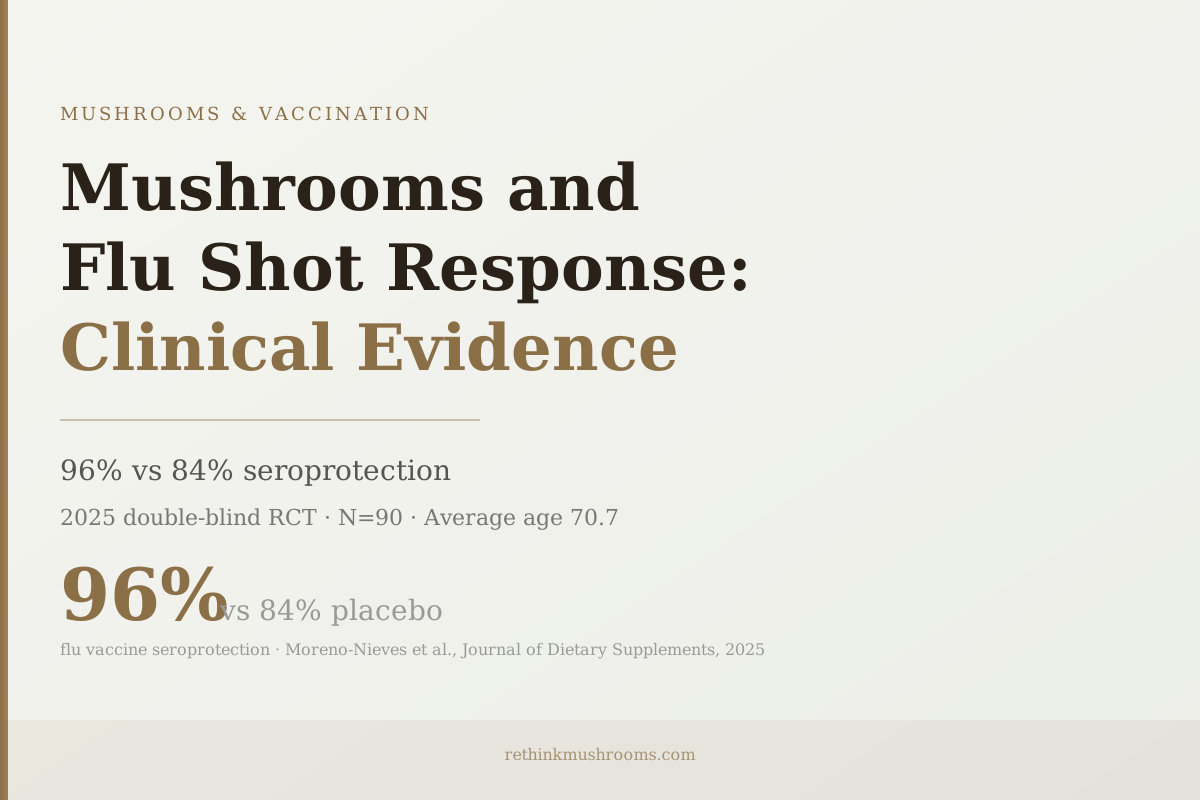
96% seroprotection
A 2025 double-blind pilot RCT found yeast beta-glucan supplementation raised flu vaccine seroprotection to 96% versus 84% in the placebo group, a clinically meaningful gap in older adults where flu vaccines consistently underperform.
Moreno-Nieves et al., Journal of Dietary Supplements, 2025
500mg/day
yeast beta-glucan dose tested in the 2025 RCT
70.7 years
average participant age, exactly the population where flu vaccines underperform
2 seasons
duration across two consecutive flu vaccination seasons
Moreno-Nieves et al., Journal of Dietary Supplements, 2025
 View as image ↗
Flu vaccines work. Except when they don't. In most years, influenza vaccines are 40-60% effective across the general population. In adults over 65, that effectiveness can fall well below 50%. Clinical evidence on whether mushroom supplementation can improve flu shot response has been sparse. The most specific data available comes from a 2025 double-blind pilot RCT published in the Journal of Dietary Supplements, a study that has received almost no coverage outside immunology journals. In 90 adults with an average age of 70.7, yeast beta-glucan at 500mg per day raised flu vaccine seroprotection rates to 96% compared to 84% in the placebo group (Moreno-Nieves et al., Journal of Dietary Supplements, 2025; DOI:10.1080/19390211.2025.2539876). That is a 12-percentage-point gap in the population that needs it most. This article is part of the broader guide to how mushrooms and beta-glucans support immune function.
Key Takeaways
- A 2025 double-blind pilot RCT (N=90, average age 70.7) found yeast beta-glucan 500mg/day raised flu vaccine seroprotection to 96% vs 84% with placebo; antibody titer response was statistically significant (p=0.037) in Season 1 (Moreno-Nieves et al., Journal of Dietary Supplements, 2025)
- Flu vaccines underperform most in adults over 65, where seroprotection rates can sit at 50-70% on standard doses. The 2025 trial recruited exactly this age group, making the findings clinically relevant where they matter most
- The mechanism is trained immunity: beta-glucan exposure causes innate immune cells to undergo lasting DNA-level reprogramming through Dectin-1 receptors, maintaining a heightened response state for months[2]
- A comprehensive 2020 review documented beta-glucan enhancement of antibody responses to influenza, hepatitis B, and multiple other vaccines across animal and human studies (Vetvicka & Vetvickova, Scandinavian Journal of Immunology, 2020; PMID:31544248)
- A 2023 Phase 2 RCT in JAMA Oncology found oral beta-glucan significantly increased the specific antibodies a cancer vaccine was designed to generate. This is the strongest human precedent for beta-glucan enhancing vaccine antibody production (Cheung et al., JAMA Oncology, 2023; PMID:36547975)
- A 2026 double-blind RCT (N=45) confirmed polypore mushroom mycelia are safe and well-tolerated alongside vaccination, significantly reducing vaccine side effects in COVID-naive participants[1]
The 2025 Flu Vaccine Trial: 96% vs. 84% Seroprotection
Moreno-Nieves and colleagues ran a double-blind, placebo-controlled pilot RCT across two consecutive flu vaccination seasons (Fall 2022 and Fall 2023). Ninety adults with an average age of 70.7 were randomized to either 500mg per day of yeast beta-glucan or placebo during flu vaccination. The primary outcome was antibody titer response, the level of flu-fighting antibodies produced after the vaccine.
What seroprotection means: After a flu vaccine, "seroprotection" is measured by a standard antibody test called the hemagglutination inhibition titer. A result of 1:40 or higher means your antibody level is sufficient to provide meaningful protection against flu infection. Fall below that threshold and the vaccine is considered to have not generated adequate immunity for you.
In Season 1, the antibody titer difference between the beta-glucan and placebo groups was statistically significant (p=0.037). Post-vaccination seroprotection reached 96% in the beta-glucan group and 84% in the placebo group.
That is a 12-percentage-point gap. In the older adult population where standard flu vaccines can leave 30-50% of recipients below the protection threshold, moving to 96% is clinically meaningful.
Season 2 trended in the same direction, though the effect was smaller. The authors described this as a pilot study. It was not powered to produce definitive conclusions. But the design was rigorous, the population was precisely the one where the question matters, and the direction of effect held across two consecutive seasons. This study is essentially unknown to the general public. The specific numbers do not appear in any consumer health publication we reviewed. You are reading the most specific consumer-facing coverage of this finding available.
Why Flu Vaccines Struggle in Older Adults, and Why This Trial Was Designed for Them
Influenza kills roughly 30,000-50,000 people in the United States most years. Around 90% of those deaths occur in people 65 and older.
Flu vaccines are the primary public health intervention against this. And they work well in adults under 65, where effectiveness is consistently 50-70%. In older adults, the same vaccine often drops to 25-50%.
The reason is not a flaw in the vaccine. It reflects a fundamental decline in immune system responsiveness that comes with age. Researchers call this immunosenescence, meaning the gradual wearing down of immune function over decades. The adaptive immune cells that vaccines primarily rely on, including B cells that generate antibodies and T cells that provide cellular backup, are fewer in number and slower to respond as people age. The vaccine sends the right signal. The immune system simply cannot amplify it as loudly.
Beta-glucan does not target these adaptive immune cells directly. Its mechanism is earlier in the chain. It works on innate immune cells, the faster-acting first responders like macrophages and monocytes, through a process that leaves those cells in a more alert, reactive state for months. When the vaccine arrives after this priming period, those innate immune cells respond more vigorously and provide faster, stronger support to the adaptive response that generates antibody protection.
This is why the 2025 trial targeted older adults specifically. They face the largest gap between vaccine potential and vaccine reality. Beta-glucan priming of innate immunity addresses precisely the upstream stage that fails first.
The Mechanism: How Beta-Glucan Primes Immune Cells for a Bigger Vaccine Response
Beta-glucan molecules found in mushrooms and yeast are recognized by a receptor on innate immune cells called Dectin-1. When this receptor picks up the beta-glucan signal, it does not just trigger a brief inflammatory response. It initiates changes to how the DNA inside those cells is packaged and read; specifically, it opens up the segments of DNA that control innate immune activation, making those genes much easier to switch on for months afterward. This process of lasting DNA reprogramming is called trained immunity.
A 2020 study in the Journal of Infectious Diseases examined how deep this reprogramming goes.[2] After beta-glucan exposure, the precursor cells in bone marrow that produce future generations of macrophages and monocytes were reprogrammed at the epigenetic level. Months later, when those animals encountered a different infection altogether (Mycobacterium tuberculosis in this study's model), their immune cells responded faster and more forcefully than cells from animals that had not been exposed to beta-glucan. The key signaling molecule coordinating this trained state was IL-1, a messenger protein that mobilizes early immune activation.
What this means for vaccines: if you take beta-glucan 4-6 weeks before a flu shot, the innate immune cells that first encounter the vaccine's signal arrive in a more primed, reactive state. They signal more loudly to the B cells and T cells that ultimately generate antibody protection. The vaccine itself is unchanged. The immune environment it encounters is not.
This is the biological logic behind the 2025 trial's finding. For a deeper look at the epigenetic changes specifically, see how beta-glucans epigenetically reprogram immune cells. For the full trained immunity picture, mushrooms and trained immunity covers the mechanism in detail.
For readers interested in pre-vaccination timing strategies more broadly, mushroom supplements before vaccination: immune priming evidence covers the full case for beta-glucan supplementation before any vaccine, not just flu shots.
Beta-Glucan and Other Vaccines: A Pattern Across Multiple Diseases
The 2025 flu vaccine finding does not exist in isolation. A comprehensive 2020 review by Vetvicka and Vetvickova in the Scandinavian Journal of Immunology (PMID:31544248) catalogued the beta-glucan adjuvant evidence across multiple vaccine types. The conclusion was consistent: beta-glucan enhanced both antibody titer responses and cellular immune responses across hepatitis B vaccination models, influenza vaccination models, aspergillosis vaccine studies, and coccidioidomycosis vaccine models. The enhancement worked alongside, not in competition with, conventional adjuvants already built into standard vaccines.
The clearest human evidence for beta-glucan enhancing the antibodies a vaccine was designed to generate comes from oncology. In a 2023 Phase 2 RCT published in JAMA Oncology, Cheung and colleagues tested oral beta-glucan supplementation in pediatric patients with high-risk neuroblastoma who were receiving an anti-GD2 ganglioside cancer vaccine (PMID:36547975). In cancer vaccine recipients, oral beta-glucan significantly increased the specific antibodies the vaccine was designed to produce (anti-GD2 IgG1 antibodies). In a disease where those antibody levels directly predict survival outcomes, this was a consequential finding. It establishes a clear human precedent: oral beta-glucan taken alongside vaccination can meaningfully increase the antibody response the vaccine generates. How mushrooms influence the full antibody production process is covered in how mushrooms enhance antibody production.
A 2026 double-blind RCT added a safety and tolerability anchor for mushroom-based supplementation specifically.[1] In 45 adults receiving COVID-19 vaccination, polypore mushroom mycelia, a combination of Fomitopsis officinalis and Trametes versicolor (turkey tail), were taken alongside the standard vaccination schedule. The primary finding in COVID-naive participants was a significant reduction in vaccine side effects in the mushroom group compared to placebo. Safety profiles were similar between groups. No unexpected adverse events emerged. This study was designed around feasibility and safety rather than antibody titers, but it demonstrates that polypore mushroom mycelia alongside a real vaccination schedule is safe in a controlled clinical trial.
The pattern across these studies is consistent: beta-glucan from multiple sources, taken alongside or before vaccination, moves immune responses in the same direction across different vaccine types and different pathogens.
Turkey Tail, Shiitake, or Reishi vs. Yeast: Does the Source Matter?
The 2025 pilot trial used yeast-derived beta-glucan, not a mushroom supplement. That distinction matters.
Both yeast and medicinal mushrooms contain beta-glucan with the same core structure, a 1,3/1,6-glucan backbone, that binds Dectin-1 receptors and triggers the trained immunity response. The mechanism is the same regardless of whether the beta-glucan comes from baker's yeast, Saccharomyces cerevisiae extract, or dried turkey tail mushroom powder. Yeast beta-glucan is used more commonly in clinical research because the beta-glucan content can be standardized and verified more precisely. Mushroom powders vary in their beta-glucan concentration depending on growing conditions, harvesting stage, and which part of the mushroom was used.
Among medicinal mushrooms, turkey tail (Trametes versicolor) has the strongest immune research background. It was used in the 2026 COVID vaccination RCT alongside Fomitopsis officinalis. It is the most extensively studied medicinal mushroom in immune-oncology contexts. Shiitake and reishi also contain meaningful beta-glucan concentrations and have established immune-related research, though with less vaccine-specific data for either species.
The practical implication: the specific human RCT evidence for flu vaccine enhancement used yeast beta-glucan at 500mg per day. For consumers choosing mushroom supplements, turkey tail is the strongest-evidenced option for immune priming. The key variable when evaluating any product is the actual beta-glucan content per serving, not the species name on the label, which varies enormously in beta-glucan concentration across products.
When to Start: The Timing Window Trained Immunity Research Suggests
Beta-glucan does not prime the immune system overnight. The process where innate immune cells undergo epigenetic reprogramming and maintain a heightened state develops over weeks.
Based on trained immunity research, the consensus is that 4-6 weeks of consistent beta-glucan supplementation establishes a meaningful primed state in innate immune cells. The 2026 COVID vaccination trial had participants taking mushroom supplements starting before the vaccination schedule began and continuing through it, consistent with the principle that pre-vaccination priming matters.
The 2025 flu shot trial did not test different lead times. Participants supplemented throughout both flu seasons, not specifically in the final weeks before their shot. So there is no randomized evidence comparing 2 weeks versus 4 weeks versus 8 weeks of pre-vaccination supplementation. The 4-6 week figure is an extrapolation from what the trained immunity biology suggests and the timing patterns used in available studies.
In practice: if your typical flu vaccination happens in October, starting beta-glucan supplementation in late August or early September provides approximately 6-8 weeks of priming time before the shot. This is practical guidance derived from the mechanism and available trial designs, not a tested clinical protocol.
What One Pilot Study Can and Cannot Tell You
The 2025 Moreno-Nieves trial is the most specific human evidence available for beta-glucan raising flu vaccine response. It produced a real finding: 96% versus 84% seroprotection, statistically significant antibody titer difference in Season 1. This is rigorous data from a double-blind design.
But a pilot study is not a definitive trial. That term exists for a reason.
A pilot study tests feasibility and generates preliminary evidence. With 90 participants, the 2025 study was underpowered to rule out chance findings or detect smaller effects reliably. The Season 2 effect was smaller than Season 1. No independent research group has replicated the numbers. Single-center pilot studies are frequently not confirmed in larger follow-up trials.
What the evidence supports as of 2026: a consistent biological mechanism for how beta-glucan primes innate immunity before vaccination, an established pattern across multiple vaccine types in animal research and the Vetvicka 2020 review, one strong human precedent in oncology (Cheung 2023, JAMA Oncology), and one pilot RCT specifically in flu vaccination showing a meaningful signal (Moreno-Nieves 2025).
What the evidence does not yet support: a clinical recommendation, a validated dosing protocol for mushroom-derived beta-glucan in this context, or certainty that the effect will hold in larger, more diverse populations.
The honest position: the signal is real, the mechanism is well-understood, and the evidence points in a consistent direction across multiple study types. For older adults, where flu vaccines are the weakest and the clinical stakes are highest, this is worth knowing about. A well-powered confirmatory trial would substantially strengthen the case. Until then, this is promising preliminary data. Not proof, but not noise.
If you want to understand how mushrooms interact with influenza itself, rather than the vaccine response, mushrooms and influenza: can they help fight the flu covers the antiviral evidence separately.
The Bottom Line
A 2025 double-blind pilot RCT found yeast beta-glucan at 500mg per day raised flu vaccine seroprotection to 96% versus 84% in placebo among 90 older adults (average age 70.7). The mechanism is trained immunity: beta-glucan epigenetically reprograms innate immune cells through Dectin-1 receptors, establishing a heightened response state that supports the vaccine-generated antibody response. A 2020 comprehensive review confirms the pattern across multiple vaccine types, and a 2023 JAMA Oncology Phase 2 RCT confirms oral beta-glucan can significantly increase human vaccine antibody production. The evidence is promising and mechanistically grounded; larger confirmatory trials are needed.
Frequently Asked Questions
Sources & References
- 1. Source details for this reference are not yet available.
- 2. Source details for this reference are not yet available.