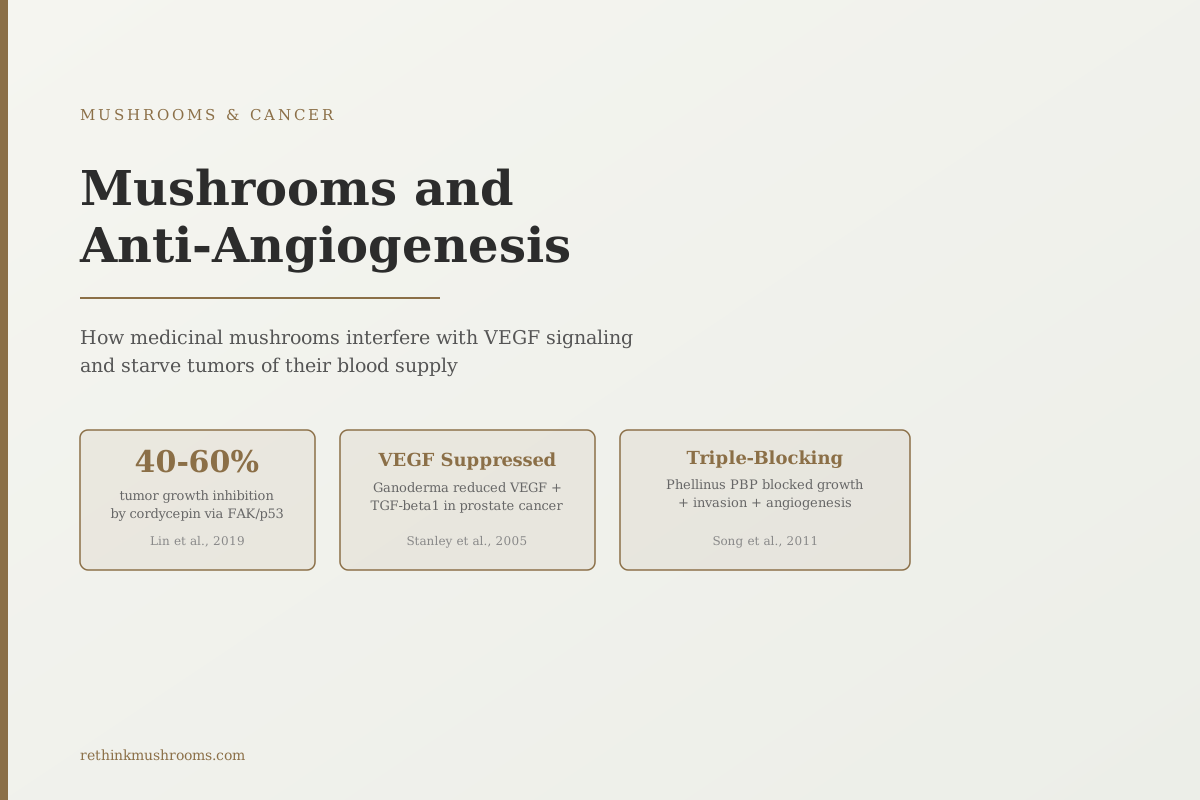
Mushrooms & Cancer
40-60% tumor growth inhibition
Cordycepin from Cordyceps mushrooms inhibited tumor growth 40-60% in xenograft mouse models by dephosphorylating FAK and upregulating p53 in endothelial cells. It is the most mechanistically specific anti-angiogenic mushroom compound identified to date.
Lin et al., Cancers, 2019
VEGF suppressed
Ganoderma lucidum reduced VEGF and TGF-beta1 secretion from prostate cancer cells in both androgen-sensitive and insensitive lines (Stanley et al., 2005)
Triple-blocking
a single Phellinus polysaccharide-protein complex simultaneously inhibited colon cancer growth, invasion, AND angiogenesis (Song et al., 2011)
No clinical trials
all anti-angiogenic mushroom data is preclinical; no head-to-head RCT vs. bevacizumab has been conducted
Lin et al., Cancers, 2019
 View as image ↗
In 2005, Stanley and colleagues reported something that most consumer health content still hasn't caught up to. Ganoderma lucidum extract significantly reduced the secretion of VEGF and TGF-beta1 from two lines of prostate cancer cells tested in a laboratory model.[1] VEGF is the primary signal that tumors send to surrounding tissue to recruit new blood vessels. Without those vessels, solid tumors cannot grow beyond about two millimeters in diameter. The cells at the tumor's interior suffocate from lack of oxygen and nutrients. What the Stanley team demonstrated was that a mushroom compound could interfere with that recruitment signal at its source, at the tumor cell level, before it even reaches the endothelial cells that build new vessels. This article documents the preclinical evidence for mushroom anti-angiogenic activity across species and compound classes, explains the three distinct molecular points of intervention that different mushroom compounds use, and is honest about where the evidence ends. It connects to the full coverage of mushrooms in cancer research at medicinal mushrooms in cancer treatment.
Key Takeaways
- Anti-angiogenesis works by cutting off the blood supply that tumors require for growth; the primary signal tumors use is VEGF (vascular endothelial growth factor), which recruits new blood vessel formation
- Ganoderma lucidum reduced VEGF and TGF-beta1 secretion from prostate cancer cells in vitro, an upstream mechanism acting at the tumor cell before the signal reaches endothelial cells (Stanley et al., 2005)
- Phellinus linteus is the most extensively documented anti-angiogenic mushroom in the research literature, with data from the chorioallantoic membrane assay, breast cancer models, and colon cancer; a single protein-bound polysaccharide complex simultaneously blocked growth, invasion, and angiogenesis (Song et al., 2011)
- Cordycepin (from Cordyceps militaris) is the most mechanistically specific compound: it inhibited endothelial cell tube formation and migration through FAK dephosphorylation and p53 upregulation, and reduced xenograft tumor growth by 40-60% (Lin et al., 2019)
- Antrodia cinnamomea polysaccharides act at the receptor level, inhibiting VEGF binding to VEGFR2 (KDR/flk-1) and reducing receptor phosphorylation in endothelial cells (Cheng et al., 2005)
- A 2020 animal study found multi-mushroom extract formulas reduced VEGF levels and tumor volume in colorectal cancer mice, with additive effects when combined with 5-fluorouracil (Jakopović et al., 2020)
- Golden chanterelle (Cantharellus cibarius), a common kitchen mushroom, demonstrated anti-angiogenic activity in HUVEC assays in 2022, the first documentation that a widely eaten food mushroom has this property (Marathe et al., 2022)
What Anti-Angiogenesis Means and Why Tumors Depend on It
Every solid tumor faces a growth ceiling. The tumor cells at the interior cannot receive oxygen and nutrients through simple diffusion beyond a volume of about 1-2 cubic millimeters. To grow beyond that, the tumor secretes chemical signals that recruit new blood vessel growth from the surrounding tissue. This process, angiogenesis, provides the tumor with the supply lines it needs to expand, invade nearby tissue, and eventually spread to distant organs.
The primary signal is VEGF, which stands for vascular endothelial growth factor. When tumor cells secrete VEGF, it binds to specific receptors on the endothelial cells lining nearby blood vessels. This binding triggers those cells to proliferate, migrate toward the tumor, and form new capillary structures. The result is a dense and disorganized blood vessel network within and around the tumor.
Anti-angiogenic cancer therapy works by disrupting this process. Pharmaceutical anti-angiogenics like bevacizumab (Avastin) trap circulating VEGF so it cannot reach endothelial cells. Drugs like sunitinib and sorafenib block VEGF receptors on endothelial cells directly. These are potent, clinically proven interventions with documented survival benefits in specific cancer types, and they also carry serious toxicities including hypertension, proteinuria, and impaired wound healing.
Multiple mushroom compounds act on the same pathway, through distinct points of intervention and at different levels of potency. None have been tested in clinical anti-angiogenic trials. The existing evidence is preclinical. The mechanistic data explains why this line of research exists, and honesty about what has and has not been tested is the framework for evaluating it.
For a broader look at the epidemiological evidence connecting mushroom intake to cancer risk, see daily mushroom consumption and cancer risk reduction. For how beta-glucans activate anti-tumor immune mechanisms in a complementary pathway, see beta-glucans and anti-tumor immunity.
Three Points on One Pathway
Different Mushroom Compounds Hit VEGF Signaling at Different Points
A tumor recruits blood vessels by sending a VEGF signal from its own cells to the endothelial cells that build capillaries. Mushroom compounds interrupt that relay at three separate points — upstream at the tumor, at the receptor on the vessel cell, and downstream inside it. They are complementary mechanisms, not redundant ones. Every result below is preclinical.
Point 1 · Upstream
At the tumor cell
Cut the VEGF signal at its source
Ganoderma lucidum
Reishi extract reduced VEGF and TGF-beta1 secretion from prostate cancer cells before the signal ever reached endothelial cells.
Stanley et al. 2005
Point 2 · Receptor
At the blood-vessel cell surface
Block VEGF from binding its receptor
Antrodia cinnamomea
A. cinnamomea polysaccharides inhibited VEGF binding to KDR/flk-1 (VEGFR2) and cut VEGFR2 phosphorylation dose-dependently.
Cheng et al. 2005
Point 3 · Downstream
Inside the blood-vessel cell
Disable the response machinery
Cordycepin (Cordyceps)
Cordycepin dephosphorylated FAK and upregulated p53 in endothelial cells, blocking migration and tube formation; tumors shrank 40-60% in mice.
Lin et al. 2019
Sources: Stanley et al., Nutr Cancer 2005 (upstream VEGF suppression); Cheng et al., Life Sci 2005 (VEGF-receptor binding block); Lin et al., Cancers 2019 (endothelial FAK dephosphorylation). All findings are from cell, ex vivo, or animal models. No mushroom compound has been tested as an anti-angiogenic therapy in human cancer patients.
Phellinus linteus: The Most Documented Anti-Angiogenic Mushroom
Of the species examined in this literature, Phellinus linteus has the most published studies and the most consistent mechanistic characterization.
Song and colleagues (2003) were among the first to document anti-angiogenic activity for Phellinus, using the chorioallantoic membrane (CAM) assay in chick embryos. CAM is a standard model for measuring new blood vessel formation: compounds that reduce the density of blood vessels in the CAM assay are flagged as candidate anti-angiogenics. Phellinus linteus extract produced significant reduction in new blood vessel formation.[2]
Sliva and colleagues (2008) took this further into a breast cancer model. Phellinus linteus extract inhibited MDA-MB-231 breast cancer cell growth, reduced VEGF secretion from those cells, blocked endothelial tube formation, and suppressed invasive behavior. All effects were measured in the same experimental system. The mechanism was inhibition of AKT/PKB phosphorylation, which is the intracellular hub that drives both tumor cell survival and VEGF production.[3]
Lee and colleagues (2010) fractionated Phellinus extracts and found that the methanol extract and its ethyl acetate fraction showed the strongest dose-dependent anti-angiogenic activity in HUVEC (human umbilical vein endothelial cell) tube formation assays. The phenolic-rich fraction was responsible for most of the effect.[4]
Sliva's 2010 comprehensive review in Experimental and Therapeutic Medicine synthesized the accumulated Phellinus data, positioning it as the most extensively documented anti-angiogenic mushroom in the research literature at that point, with multi-mechanism activity including VEGF suppression, AKT inhibition, and MMP inhibition for both angiogenesis and invasion.[5]
The structural highlight in the Phellinus data is Song and colleagues (2011) in BMC Cancer. A single compound isolated from Phellinus, a protein-bound polysaccharide (PBP) complex, simultaneously inhibited SW480 colon cancer cell proliferation, reduced VEGF expression, blocked endothelial tube formation, suppressed invasive behavior, and altered Wnt/beta-catenin signaling. All effects were measured in the same experimental setup.[6] Finding one compound that interferes with multiple cancer hallmarks simultaneously is a mechanistically significant result.
Ganoderma lucidum (Reishi): Upstream VEGF Suppression
Ganoderma acts at a different point in the angiogenic cascade from most of the Phellinus data. Rather than blocking endothelial cells after VEGF is secreted, Ganoderma compounds appear to reduce VEGF secretion at the tumor cell level.
Stanley and colleagues (2005) demonstrated this in both androgen-sensitive (LNCaP) and androgen-insensitive (PC-3) prostate cancer cell lines.[1] Ganoderma extract reduced VEGF secretion from both cell types and also reduced TGF-beta1, another pro-angiogenic factor. The fact that this occurred in both androgen-sensitive and insensitive lines is relevant because prostate cancer often evolves into the hormone-insensitive form during treatment.
Cao and colleagues (2004) confirmed anti-angiogenic activity from a different Ganoderma fraction: the polysaccharide peptide (GLPP). In tumor-bearing mice, GLPP reduced both tumor weight and neovascularization (new blood vessel formation within the tumor), demonstrating that the effect observed in cell studies translates to the more complex in vivo environment of a living animal.[7]
For the Ganoderma cancer data in greater depth, see ganoderic acids and cancer: specific anti-tumor research.
Antrodia cinnamomea: Blocking VEGF at the Receptor
Antrodia cinnamomea, a rare medicinal fungus native to Taiwan, occupies the middle point of the pathway. Where Ganoderma reduces VEGF secretion at the tumor cell, and cordycepin acts inside the endothelial cell, Antrodia compounds interfere with the step in between: the moment VEGF binds its receptor on the endothelial cell surface.
Cheng and colleagues (2005) isolated polysaccharides from Antrodia cinnamomea and showed that the crude extract inhibited the binding of VEGF to KDR/flk-1, the VEGFR2 receptor, in a dose-dependent manner. The polysaccharides also reduced VEGFR2 phosphorylation and suppressed the downstream cyclin D1 signaling that VEGF normally switches on in endothelial cells, and they blocked VEGF-induced endothelial migration and capillary-like tube formation.[13]
Yang and colleagues (2009) extended this to the tissue level by fractionating mycelial polysaccharides by molecular weight. Only the largest fraction (greater than 100 kDa) significantly decreased VEGF secretion from human leukemia cells, inhibited endothelial tube formation, and suppressed new blood vessel growth in the chorioallantoic membrane assay. The effect appeared to run through immune modulation rather than direct toxicity to the cells.[14]
This receptor-level mechanism is the specific complement to the other two intervention points. It is neither an upstream cut to VEGF production nor a downstream disruption of endothelial machinery, but a block at the handshake between the tumor's signal and the vessel cell that would respond to it.
Cordycepin: The Most Mechanistically Specific Finding in This Research Area
Cordycepin is an adenosine analog, a molecule structurally similar to adenosine but with a modified ribose sugar. It is produced by Cordyceps militaris (and other Cordyceps species) and interferes with RNA synthesis by blocking chain elongation. This broad mechanism has downstream effects across multiple cellular pathways.
For anti-angiogenesis specifically, Lin and colleagues (2019) published the most mechanistically precise finding in this entire research cluster. Cordycepin dose-dependently inhibited HUVEC proliferation, migration, and tube formation in cell culture. In xenograft mouse models with implanted tumor cells, it inhibited tumor growth by 40-60%. The mechanism was FAK (focal adhesion kinase) dephosphorylation combined with p53 upregulation in endothelial cells.[8]
FAK is a signaling protein that endothelial cells require for migration toward VEGF gradients. When FAK is dephosphorylated (deactivated), endothelial cells lose the ability to move and assemble into new capillaries. p53, the tumor suppressor protein, independently promotes apoptosis in abnormally proliferating cells, including endothelial cells forming abnormal tumor vasculature.
This mechanism is distinct from all other mushroom anti-angiogenic findings. Most mushroom compounds reduce VEGF secretion or interfere with VEGF receptor signaling. Cordycepin acts downstream of VEGF signaling, at the point where endothelial cells act on that signal. Bevacizumab traps VEGF in circulation. Cordycepin does not interfere with VEGF itself but disrupts the machinery the endothelial cell uses to respond to it. These are complementary mechanisms, not redundant ones.
Agaricus blazei: Two Distinct Anti-Angiogenic Compounds
Agaricus blazei Murill (also known as Agaricus brasiliensis) has yielded two separately identified anti-angiogenic compounds through isolation work.
Kimura and colleagues (2004) isolated sodium pyroglutamate as the primary anti-angiogenic compound from Agaricus blazei. In animal models, the isolated compound demonstrated antitumor activity and reduced tumor metastasis by suppressing new blood vessel formation.[9]
Hetland and colleagues (2020), reviewing the accumulated Agaricus blazei evidence in Nutrients, confirmed both ergosterol and sodium pyroglutamate as the anti-angiogenic compounds from this species, alongside the beta-glucan fraction responsible for immunomodulatory effects.[10] The review also examined Hericium erinaceus and Grifola frondosa (maitake) in the same framework, confirming that anti-angiogenic activity is not isolated to the most-studied species.
A Multi-Mushroom Formula in a Colorectal Cancer Animal Model
Most of the studies in this literature test single-species extracts. Jakopović and colleagues (2020) took a different approach: testing commercial multi-mushroom extract formulas in a colorectal cancer animal model.
Two formulas, AGARIKON.1 and AGARIKON PLUS, were tested in CT26.WT colorectal cancer mice. Both significantly reduced tumor volume and VEGF levels compared to untreated controls. When combined with 5-fluorouracil (5-FU), a standard colorectal cancer chemotherapy drug, the mushroom formulas showed additive anti-angiogenic effects.[11] The combination also showed M1 macrophage polarization and MMP-2/9 suppression, suggesting the mushroom formulas may modulate both the immune and angiogenic aspects of tumor biology simultaneously.
This is one of the only animal studies in the mushroom anti-angiogenesis literature to test a combination formula rather than a single extract, and the only one with combination data alongside a standard chemotherapy agent. The results do not translate directly to clinical guidance, but they support the mechanistic hypothesis that mushroom-derived anti-angiogenic compounds can function in a complex biological environment alongside other anti-cancer agents.
The Unexpected Finding: Common Chanterelle Shows Anti-Angiogenic Activity
Marathe and colleagues (2022) published a finding that significantly expands the scope of which mushrooms carry anti-angiogenic activity: golden chanterelle (Cantharellus cibarius), one of the most widely eaten edible mushrooms in European and North American cuisine, demonstrated anti-angiogenic activity in HUVEC-based assays.[12]
The mechanism was correlated with lipoxygenase pathway inhibition, and the primary bioactive compounds identified were ergosterol and cinnabarinate, a yellow pigment specific to chanterelles. This was the first documentation that Cantharellus species carry this type of biological activity.
The chanterelle finding matters because it moves anti-angiogenic mushroom activity from the domain of specialized medicinal species into the everyday food context. If a mushroom that appears at farmers markets and on restaurant menus carries measurable anti-angiogenic compounds, the question of whether regular dietary mushroom consumption might affect cancer biology through this pathway becomes more tractable.
This question remains unanswered in humans. The HUVEC assay result is in vitro. Whether eating chanterelles delivers these compounds to tumor-adjacent endothelial cells in sufficient concentration to produce biological effects in living people is not established by current research.
What the Evidence Can and Cannot Support
The evidence reviewed here is entirely preclinical. Every study discussed involves cell culture systems, animal models, or ex vivo assays. No randomized controlled trial has tested any mushroom extract as an anti-angiogenic intervention in human cancer patients.
The preclinical evidence establishes three things with reasonable consistency: mushroom compounds affect VEGF secretion, VEGF receptor signaling, and downstream endothelial cell behavior in laboratory models. These effects have been demonstrated across multiple species, with different compound classes targeting different points in the pathway, and by independent research groups over more than two decades.
What remains unestablished: the bioavailability of these compounds in humans after oral ingestion; the concentrations that reach tumor-adjacent tissue; whether those concentrations are pharmacologically relevant; and whether the effects observed in cell lines and mouse models predict outcomes in human cancer.
The comparison to pharmaceutical anti-angiogenics is meaningful context. Bevacizumab and sunitinib work through the same general pathway and have proven clinical efficacy. Mushroom compounds have not been tested in the same framework. The honest framing of the relationship between these bodies of evidence is that they share a mechanism, not that they share clinical outcomes.
This article is educational and is not medical advice. Nothing here should be read as a recommendation to use mushrooms or mushroom extracts to treat, prevent, or manage cancer, and none of these compounds is a substitute for anti-angiogenic drugs or any other prescribed oncology treatment. Anyone in cancer care should discuss supplements with their oncologist first, because some compounds can interfere with chemotherapy, radiation, or surgical wound healing.
For the compound-level breakdown of how specific mushroom molecules interact with VEGF pathway components, see how mushroom compounds inhibit VEGF and tumor blood vessel growth. For the comparison between mushroom anti-angiogenics and pharmaceutical approaches, see mushroom anti-angiogenesis vs. pharmaceutical approaches. For the species-by-species comparison of anti-angiogenic potency, see anti-angiogenic mushrooms: which species show the strongest effects.
The Bottom Line
Multiple mushroom species have documented anti-angiogenic activity in preclinical models, acting through three distinct mechanisms: upstream suppression of VEGF secretion at the tumor cell (Ganoderma), VEGF receptor binding interference (Antrodia), and downstream disruption of endothelial FAK signaling (cordycepin). Phellinus linteus has the most published studies in this area, with data from cell assays, breast cancer models, and colon cancer. The 2022 Marathe discovery that common chanterelle also carries anti-angiogenic compounds extends the evidence into widely eaten edible mushrooms. No clinical trial has tested any of these compounds as anti-angiogenic therapy in human cancer patients.
Frequently Asked Questions
Sources & References
- 1RTHM-00087·Stanley, Gwenaelle et al. (2005). “Ganoderma lucidum suppresses angiogenesis through the inhibition of secretion of VEGF and TGF-beta1 from prostate cancer cells..” Biochemical and biophysical research communications.Study breakdown →PubMed →↩
- 2RTHM-00121·Song, Yun Seon et al. (2003). “Anti-angiogenic, antioxidant and xanthine oxidase inhibition activities of the mushroom Phellinus linteus..” Journal of ethnopharmacology.Study breakdown →PubMed →↩
- 3RTHM-00271·Sliva, D et al. (2008). “Phellinus linteus Extract in Breast-Cancer Cell Models: What This 2008 Study Actually Found.” British journal of cancer.Study breakdown →PubMed →↩
- 4RTHM-00349·Lee, Yeon Sil et al. (2010). “Anti-angiogenic activity of methanol extract of Phellinus linteus and its fractions..” Journal of ethnopharmacology.Study breakdown →PubMed →↩
- 5RTHM-00364·Sliva, Daniel (2010). “Medicinal mushroom Phellinus linteus as an alternative cancer therapy..” Experimental and therapeutic medicine.Study breakdown →PubMed →↩
- 6RTHM-00437·Song, Kyoung-Sub et al. (2011). “Protein-bound polysaccharide from Phellinus linteus inhibits tumor growth, invasion, and angiogenesis and alters Wnt/β-catenin in SW480 human colon cancer cells..” BMC cancer.Study breakdown →PubMed →↩
- 7RTHM-00067·Cao, Qi-Zhen et al. (2004). “Antitumor and anti-angiogenic activity of Ganoderma lucidum polysaccharides peptide..” Acta pharmacologica Sinica.Study breakdown →PubMed →↩
- 8RTHM-00573·Lin, Yi-Ting et al. (2019). “Cordycepin Suppresses Endothelial Cell Proliferation, Migration, Angiogenesis, and Tumor Growth by Regulating Focal Adhesion Kinase and p53..” Cancers.Study breakdown →PubMed →↩
- 9RTHM-00073·Kimura, Yoshiyuki et al. (2004). “Isolation of an anti-angiogenic substance from Agaricus blazei Murill: its antitumor and antimetastatic actions..” Cancer science.Study breakdown →PubMed →↩
- 10RTHM-00620·Hetland, Geir et al. (2020). “Antitumor, Anti-Inflammatory and Antiallergic Effects of Agaricus blazei Mushroom Extract and the Related Medicinal Basidiomycetes Mushrooms, Hericium erinaceus and Grifola frondosa: A Review of Preclinical and Clinical Studies..” Nutrients.Study breakdown →PubMed →↩
- 11RTHM-01208·Jakopovic, Boris et al. (2020). “Antitumor, Immunomodulatory and Antiangiogenic Efficacy of Medicinal Mushroom Extract Mixtures in Advanced Colorectal Cancer Animal Model..” Molecules (Basel.Study breakdown →PubMed →↩
- 12RTHM-00786·Marathe, Sandesh J et al. (2022). “Anti-Angiogenic Effect of Cantharellus cibarius Extracts, its Correlation with Lipoxygenase Inhibition, and Role of the Bioactives Therein..” Nutrition and cancer.Study breakdown →PubMed →↩
- 13RTHM-00150·Cheng, Jing-Jy et al. (2005). “Study for anti-angiogenic activities of polysaccharides isolated from Antrodia cinnamomea in endothelial cells..” Life sciences.Study breakdown →PubMed →↩
- 14RTHM-00321·Yang, Chih-Min et al. (2009). “Anti-angiogenic effects and mechanisms of polysaccharides from Antrodia cinnamomea with different molecular weights..” Journal of ethnopharmacology.Study breakdown →PubMed →↩