Mushrooms & Cancer
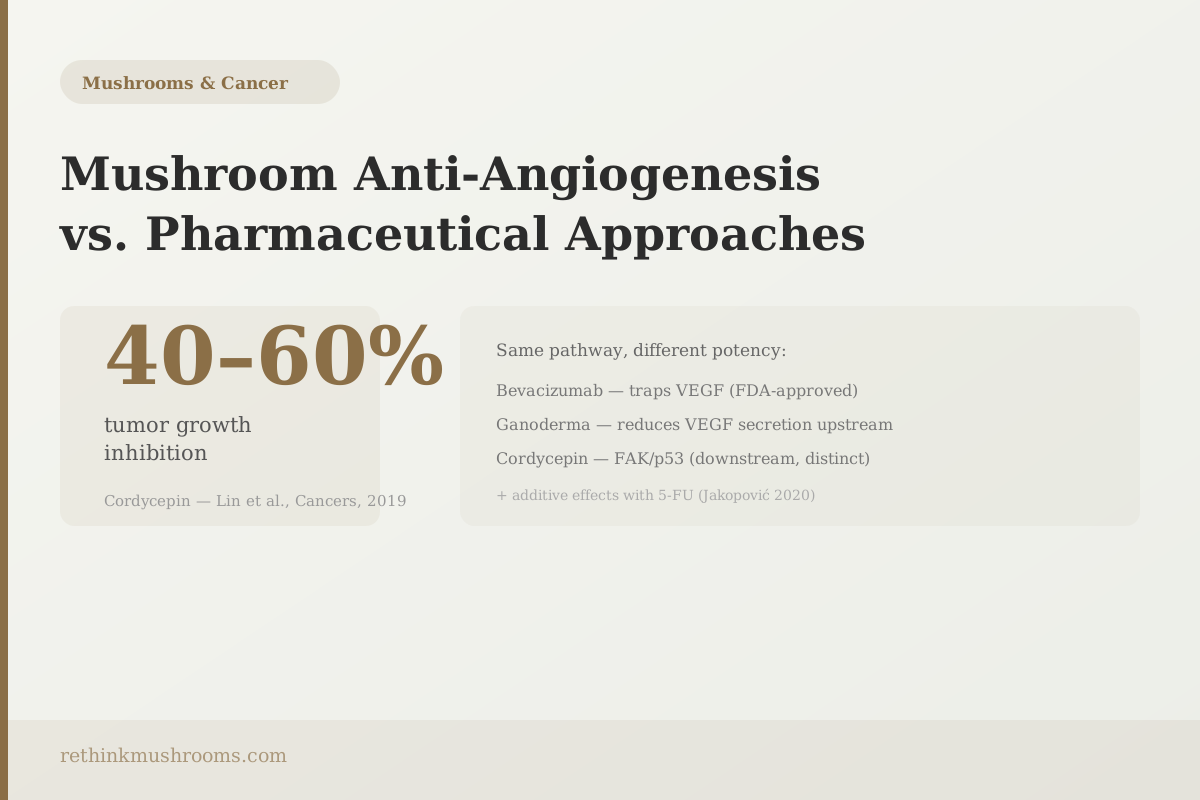
40–60% tumor growth inhibition
Cordycepin, an adenosine analog from Cordyceps mushrooms, suppressed tumor growth by 40–60% in xenograft mouse models by targeting a signaling pathway that pharmaceutical anti-angiogenics don't address — making it a candidate for combination use, not replacement.
Lin et al., Cancers, 2019
6+ species
with documented VEGF-targeting anti-angiogenic activity in research studies reviewed here
+ 5-FU
mushroom formula showed additive anti-angiogenic effects combined with chemotherapy (Jakopović 2020)
0 head-to-head RCTs
no controlled trial has directly compared mushroom compounds to bevacizumab or sunitinib in humans
Lin et al., Cancers, 2019
 View as image ↗
The question that rarely gets asked directly is whether compounds from mushrooms work on the same anti-angiogenic mechanisms as pharmaceutical drugs, and if so, how they compare. The answer is: yes, several do work on the same pathway — and they do so at lower potency, through somewhat different points of intervention, and with a safety profile that differs substantially from approved drugs. None of that makes them equivalent to bevacizumab or sunitinib. Some of it makes them candidates for combination use.
This is the honest comparison no one else has written. It requires explaining what pharmaceutical anti-angiogenics actually do and acknowledging what mushroom compounds can and cannot claim. For the broader overview of anti-angiogenic mushroom research, see Mushrooms and Anti-Angiogenesis: Starving Tumors of Blood Supply. This is a cluster article within the complete guide to medicinal mushrooms in cancer treatment.
Key Takeaways
- Bevacizumab traps circulating VEGF before it reaches blood vessel cells; sunitinib blocks the VEGF receptor and related growth factor receptors directly; both have FDA approval and proven survival benefits, but serious toxicities including hypertension, hemorrhage risk, and cardiac effects
- Ganoderma lucidum extract reduced VEGF and TGF-β1 secretion from both androgen-sensitive and androgen-insensitive prostate cancer cell lines, working upstream of the receptor rather than at it (Stanley et al., 2005)
- Phellinus linteus reduced VEGF secretion, blocked endothelial tube formation, and inhibited AKT signaling in breast cancer cells — a kinase inhibitor mechanism similar in concept to sunitinib but acting through a different signaling protein (Sliva et al., 2008)
- Cordycepin (from Cordyceps mushrooms) inhibited tumor growth by 40–60% in mouse xenograft models by targeting FAK and p53 in endothelial cells — a mechanism distinct from bevacizumab's VEGF trapping, making it a genuine candidate for combination therapy (Lin et al., 2019)
- A multi-mushroom formula combined with 5-fluorouracil showed additive anti-angiogenic effects in advanced colorectal cancer mice, reducing both tumor volume and VEGF levels beyond what 5-FU achieved alone (Jakopović et al., 2020)
- No randomized controlled trial has directly compared mushroom anti-angiogenic compounds to approved pharmaceutical anti-angiogenics in humans; the mushroom data is exclusively preclinical
What Bevacizumab and Sunitinib Actually Do — And What That Costs
To compare anything to approved anti-angiogenic drugs, you first need to understand what those drugs do and what they cost the patient.
Bevacizumab, sold as Avastin, is a lab-engineered protein that binds directly to VEGF — the growth signal that tumors use to recruit new blood vessels — before it can reach blood vessel cells. Once VEGF is trapped by bevacizumab, the cells that would form new vessels never get the instruction to grow. Tumors can't expand their blood supply. The drug has FDA approval for colon cancer, non-small cell lung cancer, cervical cancer, glioblastoma, and several other cancers. Clinical trials confirmed it extends survival in some of these cancers when added to standard chemotherapy.
Sunitinib (Sutent) works differently: it blocks the receptor on blood vessel cells that VEGF attaches to, along with several related growth factor receptors. Think of the receptor as the lock and the growth signal as the key. Sunitinib occupies the lock, so the key can't turn it. It's FDA-approved for kidney cancer and gastrointestinal stromal tumors.
The side effects of these drugs are not trivial. Bevacizumab causes significant hypertension that requires medication in a substantial proportion of patients, protein leakage through the kidneys (a sign of kidney stress), increased risk of bleeding and clotting, and impaired wound healing. Bowel perforation, while rare, is a serious and sometimes fatal complication. Sunitinib causes fatigue, diarrhea, hand-foot syndrome (painful skin changes), hypothyroidism, and cardiac effects including reduced heart function. These are drugs that work — and carry real costs.
That context is the baseline for any honest comparison.
How Mushroom Compounds Fit: A Direct Comparison
The table below summarizes the key differences between pharmaceutical anti-angiogenics and the mushroom compounds reviewed in this article.
| Approach | Primary Mechanism | Evidence Level | Clinical Use | Safety Profile |
|---|---|---|---|---|
| Bevacizumab (Avastin) | Traps VEGF before receptor binding | Phase 3 RCTs in humans | FDA-approved, multiple cancers | Hypertension, hemorrhage, kidney stress, wound complications |
| Sunitinib (Sutent) | Blocks VEGF receptor (VEGFR) and PDGFR | Phase 3 RCTs in humans | FDA-approved, kidney cancer, GIST | Fatigue, cardiac effects, hypothyroidism |
| Ganoderma lucidum | Reduces tumor cell VEGF/TGF-β secretion | In vitro, animal | None (adjunct investigation) | No serious adverse events documented |
| Phellinus linteus | Inhibits AKT kinase; reduces VEGF secretion | In vitro, animal | None (adjunct investigation) | No serious adverse events documented |
| Cordycepin (Cordyceps) | Blocks endothelial FAK and upregulates p53 | In vitro + xenograft mice | None (adjunct investigation) | Minimal toxicity at studied doses |
| Antcin K (Antrodia) | Inhibits VEGFR2 phosphorylation and STAT3 | In vitro | None (adjunct investigation) | Preclinical only |
| Chanterelle extract | Lipoxygenase inhibition, ergosterol activity | In vitro | None | Preclinical only |
The potency gap is real and should not be minimized. Bevacizumab and sunitinib were developed specifically to block VEGF signaling with high selectivity and systemic reach. Mushroom compounds, as studied to date, show anti-angiogenic effects in cell culture and animal models that represent promising pharmacological signals — but they have not been tested against pharmaceutical-grade VEGF inhibition in humans.
What mushroom compounds offer instead is a different pharmacological profile: multiple points of intervention in the angiogenesis pathway, a safety record that preclinical studies characterize as favorable, and early data suggesting they may add to, rather than compete with, conventional treatment.
Phellinus linteus was among the earliest documented mushroom anti-angiogenics. Song and colleagues showed in 2003 that Phellinus extract reduced new blood vessel formation in a standard preclinical test using chick embryo membranes, and simultaneously demonstrated antioxidant activity.[1] Agaricus blazei yielded sodium pyroglutamate, an isolated compound that reduced tumor vasculature and metastasis in animal models.[2] These early studies established that the anti-angiogenic activity in mushrooms was real and reproducible — not unique to a single species or a single experimental system.
Ganoderma and Phellinus: Targeting VEGF at the Source
Stanley and colleagues published a mechanistically significant finding in 2005: Ganoderma lucidum extract reduced the amount of VEGF that prostate cancer cells secreted into their environment.[3] This is a different intervention point from bevacizumab. Bevacizumab intercepts VEGF after the tumor cell has released it. Ganoderma appears to reduce how much the tumor cell produces in the first place.
The study tested two types of prostate cancer cells: cells that respond to androgens (male hormones) and cells that don't. Both types showed reduced VEGF production after Ganoderma exposure, and both showed reduced TGF-β1, a second growth-promoting signal. The finding that androgen-insensitive cells responded is relevant because androgen-resistant prostate cancers are the hardest to treat.
Sliva and colleagues extended the Phellinus linteus picture in 2008, studying breast cancer cells specifically.[4] Phellinus extract reduced VEGF secretion from aggressive breast cancer cells (MDA-MB-231), blocked the ability of blood vessel cells to form tube-like structures (a laboratory model of blood vessel formation), and suppressed the cancer cells' invasive behavior simultaneously. The mechanism was inhibition of AKT, a cellular protein that sits at the hub of survival and growth signaling. Inhibiting AKT is one of the approaches pharmaceutical kinase inhibitors like sunitinib use — Phellinus appears to affect a related node through a different mechanism.
For a detailed look at how reishi's specific compounds compare on the cancer research evidence base, see Ganoderma lucidum as a Cancer Adjunct: Clinical Evidence.
Cordycepin's Unique Target: The Mechanism Pharmaceuticals Don't Block
The most mechanistically interesting anti-angiogenic finding from mushroom research is cordycepin, a compound found in Cordyceps militaris. Lin and colleagues published the study in 2019 in the journal Cancers.[5]
Cordycepin is an analog of adenosine, meaning it has a structure similar enough to a naturally occurring cellular building block to interfere with specific cellular processes. In Lin's experiments, it dose-dependently suppressed the proliferation, migration, and tube-forming ability of blood vessel cells in culture. In mice bearing tumor xenografts (human tumor cells implanted under the skin), cordycepin inhibited tumor growth by 40 to 60% depending on dose.
The mechanism is specific: cordycepin dephosphorylates FAK, a signaling protein that helps endothelial (blood vessel) cells attach to surfaces and move. When FAK is inactivated, blood vessel cells lose their ability to organize into new vessel structures. Simultaneously, cordycepin upregulates p53, a protein that normally suppresses tumor growth but is disabled in many cancers.
This FAK/p53 mechanism is distinct from bevacizumab's approach. Bevacizumab traps VEGF in circulation before it reaches endothelial cells. Cordycepin acts downstream — inside the endothelial cell itself, at the machinery that would respond to the VEGF signal. That distinction matters for combination therapy: a drug that traps VEGF and a compound that targets the endothelial response machinery are blocking the same outcome through non-overlapping mechanisms. The theoretical case for using them together is real, even if no clinical trial has tested it. For the broader context of how mushrooms may work alongside cancer treatments, see Can Mushrooms Make Immunotherapy More Effective?.
The Combination Data: Mushrooms Plus Chemotherapy in the Same Tumor Model
Jakopović and colleagues published one of the most practically relevant studies in the field in 2020: a test of two commercial mushroom extract formulas in an advanced colorectal cancer animal model, including groups receiving the mushroom formula combined with 5-fluorouracil, a standard chemotherapy drug.[6]
The mushroom formulas alone significantly reduced tumor volume and VEGF levels in colorectal cancer mice. When combined with 5-FU, the anti-angiogenic effects were additive — the combination reduced VEGF levels beyond what 5-FU achieved alone. The mechanism included polarization of macrophages toward an anti-tumor state (M1 polarization) and suppression of enzymes (MMP-2 and MMP-9) that tumors use to break down surrounding tissue during invasion.
This combination result is why the clinical framing for mushroom anti-angiogenics is adjunct use rather than replacement. The pharmaceutical drugs block VEGF with high potency. The mushroom compounds may simultaneously reduce VEGF production at the tumor source, block endothelial signaling through complementary mechanisms, and activate immune responses that chemotherapy alone doesn't address. The biology is compatible with a synergistic approach. The clinical evidence for it does not yet exist.
For the broader context of mushroom-based cancer adjuncts, see The Evidence for Mushroom-Based Cancer Adjuncts: A Research Review.
The Rest of the Species Picture: Antrodia, Phellinus, and a Surprising Discovery
Lee and colleagues characterized the specific fractions of Phellinus linteus responsible for anti-angiogenic activity in 2010, finding that a phenolic-rich ethyl acetate fraction showed the strongest dose-dependent inhibition of blood vessel cell tube formation.[7] This fractionation work helps identify which part of the mushroom carries the active compounds — important for any future development work.
Achudhan and colleagues isolated Antcin K, a triterpenoid compound from Antrodia cinnamomea, and found it blocked the phosphorylation of VEGFR2, the receptor on blood vessel cells that VEGF attaches to, along with downstream STAT3 signaling.[8] This receptor-level blockade is conceptually similar to sunitinib's mechanism but from a natural compound class. The potency comparison to pharmaceutical VEGFR inhibitors is not established in a controlled study, but the molecular target is confirmed.
Perhaps the most surprising finding in this cluster is the 2022 Marathe et al. chanterelle study.[9] Golden chanterelles — Cantharellus cibarius, one of the most common wild edible mushrooms found in European and North American markets — showed significant anti-angiogenic activity in blood vessel cell assays, correlated with inhibition of the lipoxygenase pathway (an inflammation-linked route distinct from the VEGF pathway). Ergosterol and a compound called cinnabarinate were identified as the primary bioactive molecules. This was the first documentation that a mushroom routinely eaten as food has measurable anti-angiogenic activity — suggesting the biology may be broader across edible species than previous research implied.
For a broader look at the population evidence on regular mushroom consumption and cancer outcomes, see Daily Mushroom Consumption and Cancer Risk Reduction.
The Honest Bottom Line: Complement, Not Replacement
Pharmaceutical anti-angiogenic drugs work. They extend survival in clinical trials. They do so at a toxicity cost that is real and, for some patients, prohibitive. Mushroom compounds act on the same pathways through different mechanisms, at lower potency, without the documented serious adverse effects — and with combination data suggesting they may add to conventional treatment rather than duplicate it.
None of this constitutes a clinical recommendation. The mushroom research is entirely preclinical: cell culture and animal studies, with no randomized controlled trials in humans comparing mushroom compounds to bevacizumab or sunitinib directly. The fact that cordycepin targets a different mechanism than bevacizumab makes a theoretical case for combination use, but a theory is not a treatment.
What the evidence does support is the conclusion that mushroom anti-angiogenic research deserves clinical investigation alongside established anti-angiogenic therapy, not instead of it. The mechanistic diversity — upstream VEGF suppression, receptor-level blockade, endothelial FAK disruption, lipoxygenase inhibition — combined with the favorable safety profile and the combination data makes this a scientifically credible direction for cancer adjunct research.
The Bottom Line
Pharmaceutical anti-angiogenics like bevacizumab and sunitinib inhibit VEGF signaling with high potency and proven survival benefits, but with serious side effects. Mushroom compounds from Ganoderma, Phellinus, Cordyceps, Antrodia, and chanterelles act on the same pathway at multiple points, with lower potency and better documented safety in preclinical models. The 2019 cordycepin FAK/p53 mechanism is distinct from bevacizumab's approach, and the 2020 combination data showing additive effects with 5-fluorouracil makes the case for adjunct investigation rather than replacement. No human clinical trials comparing mushroom compounds to pharmaceutical anti-angiogenics have been conducted.
Frequently Asked Questions
Sources & References
- 1RTHM-00121·Song, Yun Seon et al. (2003). “Anti-angiogenic, antioxidant and xanthine oxidase inhibition activities of the mushroom Phellinus linteus..” Journal of ethnopharmacology.Study breakdown →PubMed →↩
- 2RTHM-00073·Kimura, Yoshiyuki et al. (2004). “Isolation of an anti-angiogenic substance from Agaricus blazei Murill: its antitumor and antimetastatic actions..” Cancer science.Study breakdown →PubMed →↩
- 3RTHM-00087·Stanley, Gwenaelle et al. (2005). “Ganoderma lucidum suppresses angiogenesis through the inhibition of secretion of VEGF and TGF-beta1 from prostate cancer cells..” Biochemical and biophysical research communications.Study breakdown →PubMed →↩
- 4RTHM-00271·Sliva, D et al. (2008). “Phellinus linteus Extract in Breast-Cancer Cell Models: What This 2008 Study Actually Found.” British journal of cancer.Study breakdown →PubMed →↩
- 5RTHM-00573·Lin, Yi-Ting et al. (2019). “Cordycepin Suppresses Endothelial Cell Proliferation, Migration, Angiogenesis, and Tumor Growth by Regulating Focal Adhesion Kinase and p53..” Cancers.Study breakdown →PubMed →↩
- 6RTHM-01208·Jakopovic, Boris et al. (2020). “Antitumor, Immunomodulatory and Antiangiogenic Efficacy of Medicinal Mushroom Extract Mixtures in Advanced Colorectal Cancer Animal Model..” Molecules (Basel.Study breakdown →PubMed →↩
- 7RTHM-00349·Lee, Yeon Sil et al. (2010). “Anti-angiogenic activity of methanol extract of Phellinus linteus and its fractions..” Journal of ethnopharmacology.Study breakdown →PubMed →↩
- 8RTHM-00739·Achudhan, David et al. (2022). “Antcin K inhibits VEGF-dependent angiogenesis in human rheumatoid arthritis synovial fibroblasts..” Journal of food biochemistry.Study breakdown →PubMed →↩
- 9RTHM-00786·Marathe, Sandesh J et al. (2022). “Anti-Angiogenic Effect of Cantharellus cibarius Extracts, its Correlation with Lipoxygenase Inhibition, and Role of the Bioactives Therein..” Nutrition and cancer.Study breakdown →PubMed →↩